
Do AI Images and Video Help or Hurt a Brand?
AI images and video let a brand produce visuals without a shoot. The gain in speed and cost is real. The question is what the viewer sees in that visual: an idea, or a shortcut? 🎬
This article shows both sides: the adverts that were withdrawn and the uses that work. At the end are five questions to ask before publishing a visual. The scenario file is fiction. It does not describe a real company; it is written to show how the risk works.
Scenario file: why is a campaign film finished in two weeks withdrawn?
BU BÖLÜMÜN ÖZETİ
- The decision
- The launch
- The withdrawal
Picture a clothing brand. There is no shoot budget for the New Year campaign, and the agency suggests producing the film entirely with AI.
The decision
The film is finished in two weeks. The scenes are glossy, the music is familiar and the cost is a small fraction of a shoot. Management watches it on a phone and approves. Nobody watches the film on a large screen, frame by frame. The launch date is close. 📱
The launch
The film goes live. On the first day the views are good. On the second day the comments change: in one scene the hands look odd, in another the faces are blank. Someone pauses a scene and shares it. The discussion is no longer about the product but about how the film was made. The brand has become a side issue in its own advert.
The withdrawal
On the third day the film is taken down. The cost is not only the production fee: the media budget has been spent and the campaign week is lost. The real loss cannot be measured. Viewers concluded that the brand took a shortcut at the most emotional time of the year. 🎄
Has it actually happened?
BU BÖLÜMÜN ÖZETİ
- McDonald’s Netherlands
- Coca-Cola
- The lesson from the two examples
Yes. The last two holiday seasons supplied real examples of this scenario.
McDonald’s Netherlands
On 6 December 2025, McDonald’s Netherlands released a 45-second Christmas advert made entirely with generative AI. After online criticism the advert was taken down three days later. The company said the reaction was an important learning as it explored the effective use of AI. The production team said the work took more effort than a traditional shoot. 🍟
Coca-Cola
In November 2024, Coca-Cola released an AI remake of its famous Christmas advert and was criticised. In 2025 the company again released an AI-made Christmas advert; this time animal figures took the place of people. According to a measurement reported in the press, the second advert was received mostly positively. The same tool produced two different results.
The lesson from the two examples
Both cases show the same thing: the reaction is not to AI but to the result and the context. In an emotional season, in a film that puts human faces forward and promises warmth, flaws are not forgiven. Having put in the effort is not enough either; viewers judge what they see on screen, not the labour. We describe the layers of brand impression in what is a brand signal. 🧭
Why does it draw a reaction?
BU BÖLÜMÜN ÖZETİ
- Uncanny visuals
- Emotion and sincerity
- The sense of a shortcut
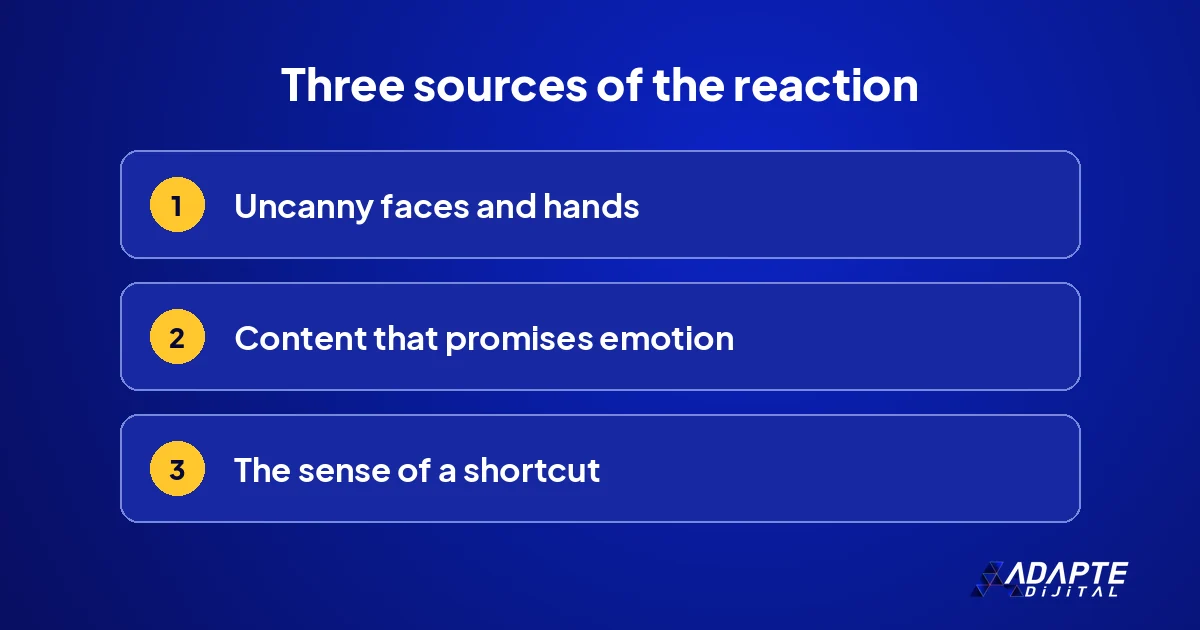
The reaction has three sources. All three are more about expectation than technique.
Uncanny visuals
The human eye catches small errors in faces and hands at once. A face that looks almost real but not quite is more disturbing than one that is plainly a drawing. According to DoubleVerify’s 2026 report, 42 per cent of consumers feel negatively towards a brand that uses AI advertising that looks low-quality or strange. Images of animals, products and landscapes fall into this trap less often. 👁️
Emotion and sincerity
Some content informs; other content promises emotion. A Christmas film, a memorial post and a customer story belong to the second group. Here the viewer expects a real moment. A generated image contradicts that expectation. The reaction is usually not ‘this is bad’ but ‘this is not sincere’.
The sense of a shortcut
In the YouGov survey run in Australia in May 2026, 48 per cent of respondents said they felt uneasy or sceptical about the brand behind an AI-made advert. Viewers can read a large brand’s choice not to shoot, when it could have, as a sign of saving money. The same choice by a small brand is usually met with more understanding. 💭
When does it help?
BU BÖLÜMÜN ÖZETİ
- The idea and draft stage
- Products and variations
- Storytelling that is plainly generated
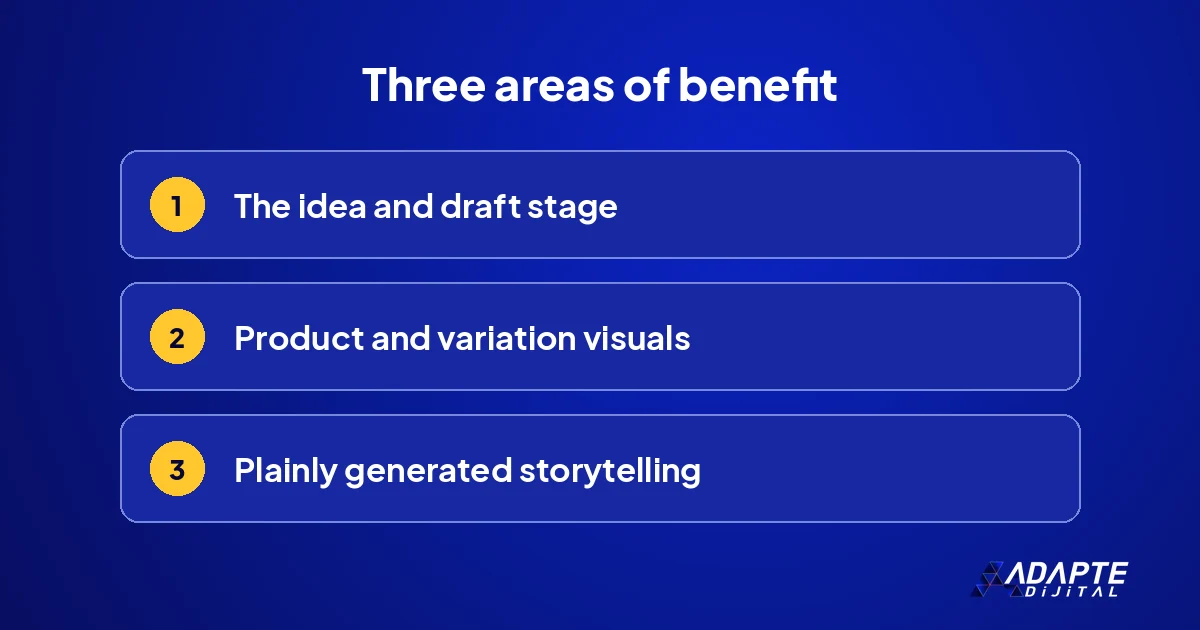
In the right place the same tool is a real advantage. Three uses stand out.
The idea and draft stage
For showing a campaign idea, sketching scenes and offering a client options, AI visuals are fast and cheap. At this stage flaws do not matter, because the visual is not published. Decisions speed up and the shoot budget is spent on the right idea. This is where most teams gain the most at the least risk. ✏️
Products and variations
Showing a product on different backgrounds, adapting sizes and making advert variations suit these tools. There is no human face, no promise of emotion and little chance of error. The one condition is that the product looks right: colour, proportion and detail must match the real thing. A product shown wrongly is a legal problem, not an aesthetic one, and rights questions follow, as copyright risk in AI output explains.
Storytelling that is plainly generated
With drawings, animation and plainly fictional visuals, viewers do not expect reality. In Cint’s research in early 2026, knowing that an advert was made entirely by AI did not noticeably change most respondents’ view of the brand. A visual that is not presented as real is not criticised for being unreal. 🎨
What is asked before publishing?
BU BÖLÜMÜN ÖZETİ
- The risk formula
- Human approval and a rights check
- Five questions asked in an audit
The decision should not be left as a matter of taste. Five questions catch most mistakes before launch.
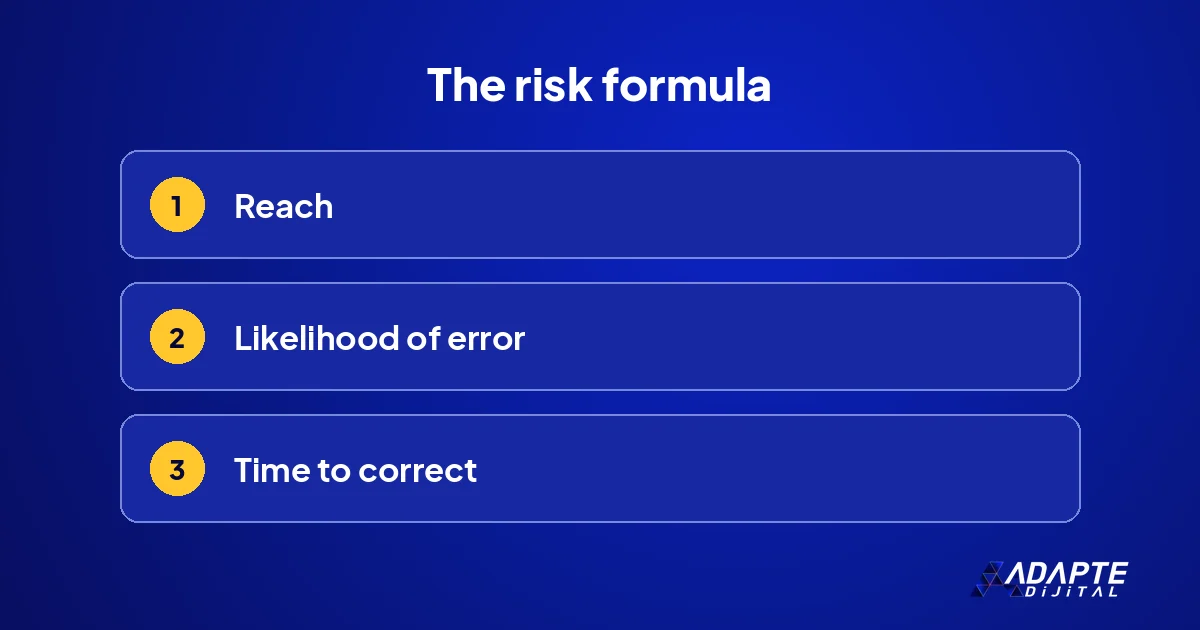
The risk formula
Think of the risk of a visual like this: reach × likelihood of error × time to correct. The media budget sets the reach. The type of content sets the likelihood of error; it is high in work with human faces and emotion. Time to correct depends on who has the authority to take the visual down. A risky visual published with a large budget raises all three multipliers at once.
Human approval and a rights check
Before launch the visual should be watched on a large screen, frame by frame. The person who approves should not be the person who produced the work. If the visual resembles a recognisable person, brand or work, it is examined separately. We cover voice and face imitation in protecting your brand from deepfakes. 🔎
Five questions asked in an audit
One: does the content promise emotion or give information? Two: are there human faces or hands in the visual? Three: does the product look the same as the real one? Four: who watched it before launch, and on which screen? Five: is the use of AI disclosed where needed? Forecast: viewers will get used to AI visuals; the reaction will shift from use itself to careless use. Update log. 18 November 2026: first publication. Forecasts on this page are re-read when they fall due; one that proves wrong is corrected here, not deleted. What happens when a chatbot rather than an image gets it wrong is in chatbot incidents that cost brands.
How does Adapte Digital review the use of visuals?
BU BÖLÜMÜN ÖZETİ
- A single delivery package
- What is delivered
- Where to start
In the brand file we review recent images and videos not one by one but type by type: which was used where, and who approved it?
A single delivery package
Adapte Digital does not charge a monthly management fee. Work starts with a single delivery package whose scope is written down in advance: 36,000 TRY + VAT. If the work grows, the new need is defined as a separate add-on package, priced by what will be delivered rather than by the hours spent. 📦
What is delivered
The output is a risk table by type of content and a checklist to run before publishing, so the same check can be repeated on every campaign.
Where to start
Which packages are open, and at what price, is shown on our campaign pages, item by item. 🧭
Quick Summary
- AI visuals can both help and harm; care and the type of content decide the outcome.
- McDonald’s Netherlands took down its AI-made Christmas advert after three days.
- The sources of reaction: uncanny visuals, the expectation of emotion and the sense of a shortcut.
- The idea stage, product variations and plainly fictional storytelling are safer areas.
- Before launch, the visual should be watched on a large screen by someone other than its maker.
Short Glossary
- Generative AI
- Generative AI is the kind of artificial intelligence used to create new content such as text, images, audio or video.
- Uncanny valley
- The uncanny valley is the unease caused by depictions of people that look almost real but not quite.
- Variation
- A variation is a version of the same visual prepared with a different size, background or text.
Frequently Asked Questions
Next Step
Sort the AI visuals you published in the last six months by type: product, people, emotion. Every visual in the people and emotion columns without an approval record is a finding.
Sources: TechRadar — McDonald’s pulls AI-generated Christmas ad after backlash · eWeek — McDonald’s Pulls AI Christmas Ad After Backlash · Advanced Television — DoubleVerify: AI slop poses growing risk to brand trust · YouGov — AI-generated ads and brand trust (May 2026)
Updated: November 2026
Sık Sorulan Sorular
For product visuals, social media backgrounds and drafts, yes. Where a real customer, a real place or a real team should be shown, a real photograph is safer.
Where the rules require it, yes. Even where they do not, disclosing protects trust if the visual could be taken to show a real event or person.
Decide quickly: take the visual down or stand behind it openly. Closing the comments and waiting only prolongs the argument.