
What Is a Brand Signal? What AI-Made Content Says About Your Brand
A brand signal is the impression a piece of content gives the reader about the brand that produced it. The reader does not know how the text was written, but senses care, consistency and accuracy. Every piece of AI-made content sends a signal too. 📡
This article does not tell you to stop using AI. The question is different: does the content you produce describe your brand correctly? First comes a fictional scenario, then the research, then measurement. The scenario file is fiction. It does not describe a real company; it is written to show how the risk works.
Scenario file: how does a brand voice drift in three months?
BU BÖLÜMÜN ÖZETİ
- Month one: everyone is pleased
- Month two: small drifts
- Month three: customers notice
Picture a furniture brand. Social media, product descriptions and email newsletters have been handed over to AI. The amount of content has tripled.
Month one: everyone is pleased
The content calendar fills up and the team relaxes. The texts are tidy and the images are glossy. Nobody puts old and new content side by side and reads them. Speed becomes the only measure of the first month. 🚀
Month two: small drifts
Product descriptions begin to resemble each other. The brand’s plain language goes, replaced by the ornate sentences seen everywhere. In one image a table has five legs; one newsletter mentions a campaign that does not exist. Each mistake is small. Together they read like a different brand.
Month three: customers notice
One customer shares the image in the comments. Another asks about the campaign in the newsletter. Sales do not fall, but the tone of the comments changes. The team assumes the tool is the problem. What was missing was a pair of eyes before publishing. 👀
What exactly is a brand signal?
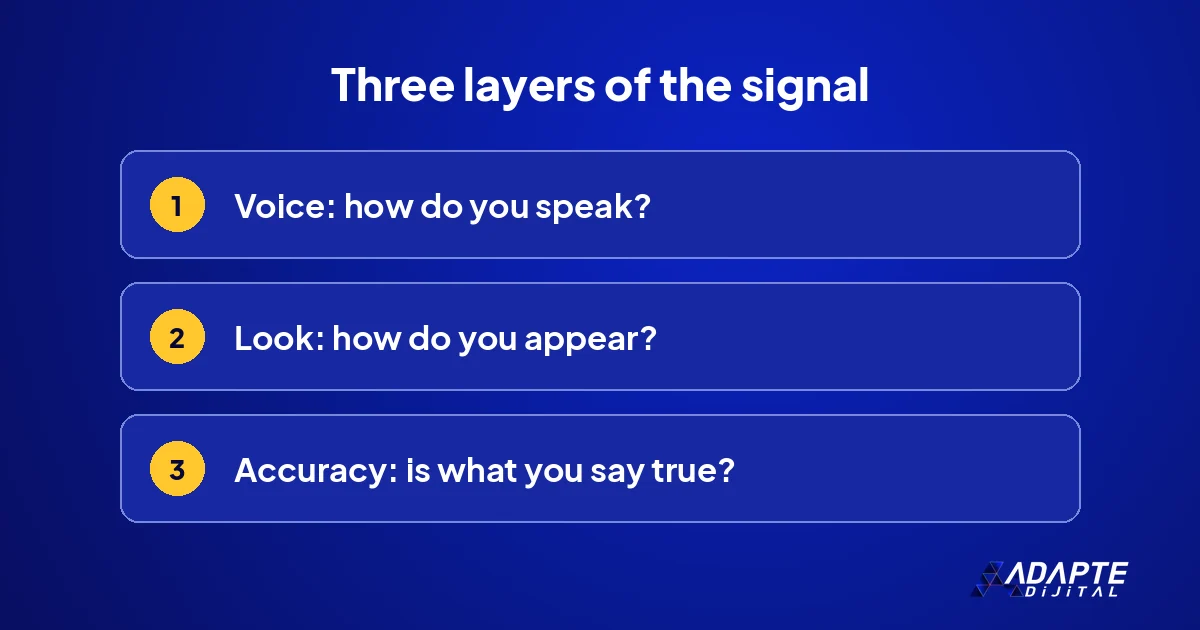
A signal is not what the brand says but what is understood from the way it says it. It has three layers.
What does the research say?
BU BÖLÜMÜN ÖZETİ
- A survey showing loss of trust
- A report showing the quality gap
- A study showing indifference
There is no single result on this subject. Three studies published in 2026 show different sides of the picture.
A survey showing loss of trust
In a YouGov survey of more than a thousand adults in Australia in May 2026, 45 per cent of respondents said they would trust a brand less if its advertising were made mainly with AI. Forty-four per cent said they would be less likely to consider such a brand. Older respondents were more sceptical. This is stated opinion from one country; it measures what people say, not what they do. 📊
A report showing the quality gap
According to the Europe, Middle East and Africa edition of DoubleVerify’s 2026 report, 42 per cent of consumers feel negatively towards a brand that uses AI advertising that looks low-quality or strange. In the United Kingdom the figure is 49 per cent. When the advertising looks polished and professional, the negative reaction falls to 29 per cent. What drives the reaction is quality, not AI.
A study showing indifference
In research Cint carried out in the United Kingdom and the United States in early 2026, knowing that an advertisement was made entirely by AI did not noticeably change most respondents’ view of the brand; the largest group was neutral. Read together, the three studies say this: the risk is real, but it is not fate. Careful work removes most of the reaction. 🧩
Where does the signal break, and what does it cost?
BU BÖLÜMÜN ÖZETİ
- The three places it breaks most
- The effect formula
- The part you cannot measure
The places where the signal breaks are predictable. Working out the cost is not as easy as reading an invoice.
The three places it breaks most
The first is product descriptions produced in bulk; they all look alike. The second is social media images; a mistake spreads quickly. The third is the chatbot that talks to customers; wrong information is read as a direct commitment, as the cases in chatbot incidents that cost brands show. What the three share is volume. As content multiplies, the eyes on it thin out. 📦
The effect formula
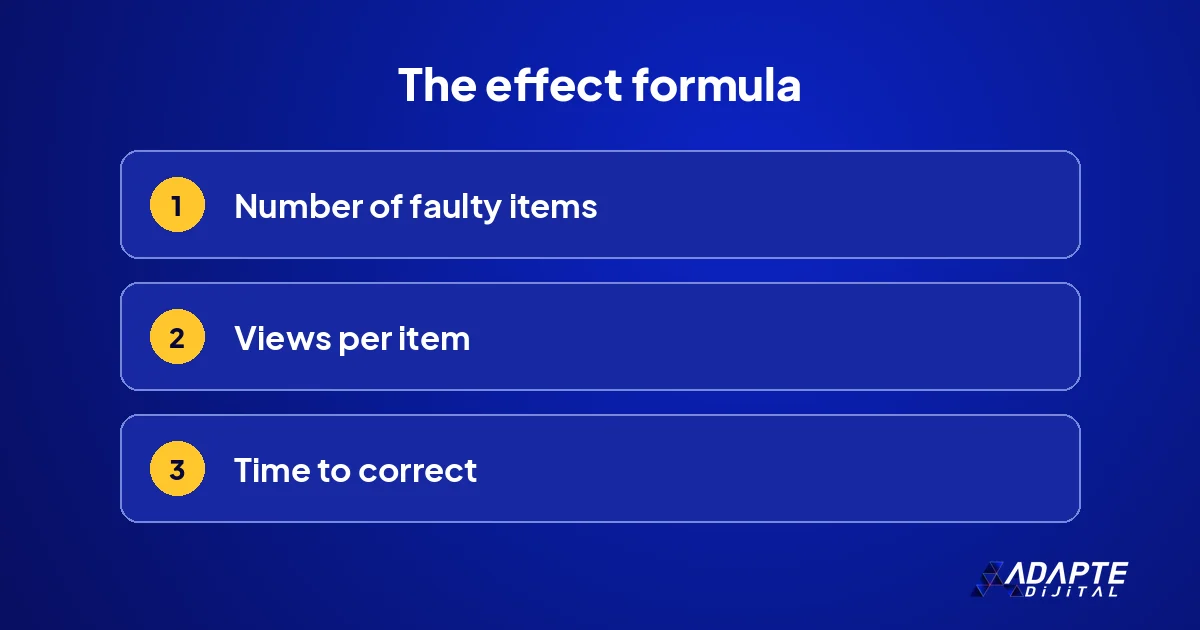
Here the formula measures effect, not money: number of faulty items × views per item × time to correct. Review before publishing lowers the number of faulty items. The channel sets the views. Time to correct is the distance between the person who notices a mistake and the person who can take it down. If that distance is one day, the damage lasts one day.
The part you cannot measure
Loss of trust does not appear on an invoice. It can be watched, though: the tone of comments, the subjects of complaints, the reasons given for returns and searches for the brand name. A drift in these indicators shows before sales do. Forecast: as AI content becomes ordinary, a voice that belongs to one brand will become a point of difference. Update log. 18 November 2026: first publication. Forecasts on this page are re-read when they fall due; one that proves wrong is corrected here, not deleted.
How is the signal audited?
BU BÖLÜMÜN ÖZETİ
- A written voice and visual rule
- Eyes before publishing
- Five questions asked in an audit
An audit is not a debate about taste. It looks at records and samples.
A written voice and visual rule
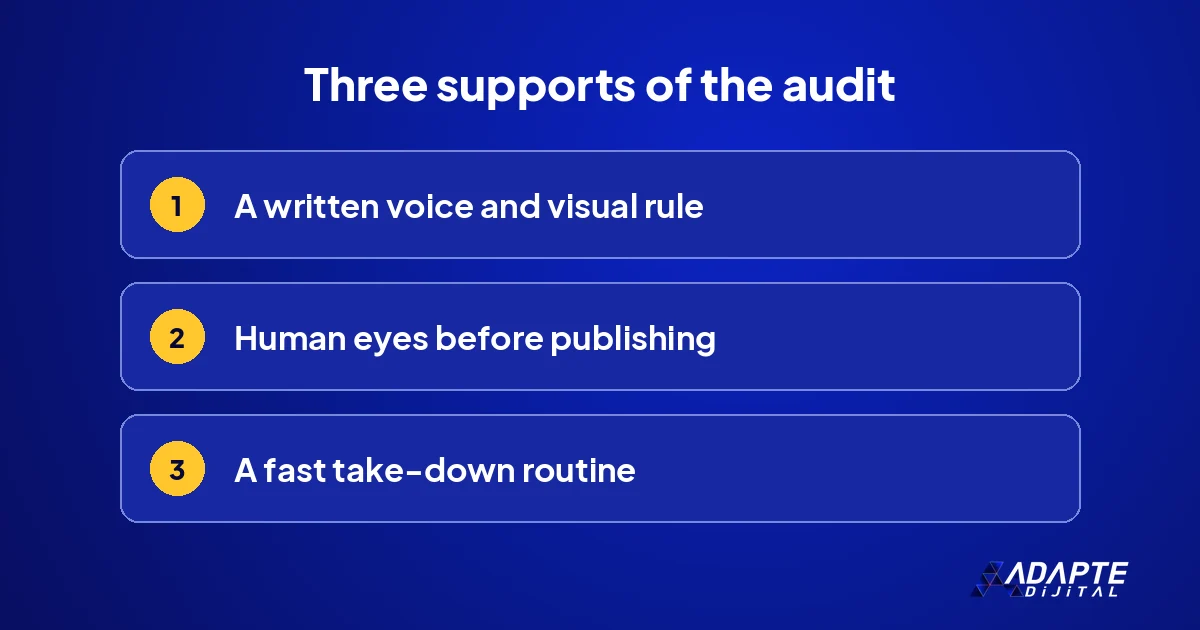
The first question is simple: are the brand’s voice and visual language written down? If they are, are they given to the model on every production run? A one-page rule is more useful than a hundred-page guide. The rule should include banned phrases and sample sentences. A voice that is not written down cannot be audited. ✍️
Eyes before publishing
The second question: does a person look before publishing? Not every item needs a look. It is enough to check every item that contains a price, a campaign, health or legal content, plus a sample of the rest. We cover voice imitation and fake images in protecting your brand from deepfakes, and rights in copyright risk in AI output.
Five questions asked in an audit
One: is the brand voice written down? Two: how many of the last thirty items follow the rule? Three: who gives approval before publishing? Four: within how many hours is faulty content taken down? Five: is the use of AI disclosed to the reader where it should be? We continue the discussion on images and video in do AI visuals help or hurt a brand. 🧪
How does Adapte Digital review a brand signal?
BU BÖLÜMÜN ÖZETİ
- A single delivery package
- What is delivered
- Where to start
In the brand file we work with samples: a slice of recent content is taken, compared with the written rule and the deviations are listed.
A single delivery package
Adapte Digital does not charge a monthly management fee. Work starts with a single delivery package whose scope is written down in advance: 36,000 TRY + VAT. If the work grows, the new need is defined as a separate add-on package, priced by what will be delivered rather than by the hours spent. 📦
What is delivered
The output is a list of deviations, a draft one-page voice rule and the steps for checking before publishing, so the team can keep the same standard after the review.
Where to start
Our current packages and capacity are listed on our campaign pages; scope and price are written there before any work starts. 🧭
Quick Summary
- A brand signal is the impression content gives about the brand.
- The signal has three layers: voice, look and accuracy.
- According to the research, quality rather than AI drives the reaction.
- It breaks most in product descriptions, social media images and chatbots.
- An audit checks the written rule, approval before publishing and time to take down.
Short Glossary
- Brand voice
- Brand voice is the consistent language a brand uses in its written and spoken communication.
- Pre-publication approval
- Pre-publication approval is the step in which an authorised person checks content before it is published.
- Sample audit
- A sample audit is a method of reviewing a selected part of the content, rather than all of it, to see the general state.
Frequently Asked Questions
Next Step
Read the last ten items you published next to ten from a year ago. Is the same brand speaking? Your answer is the first finding of the audit.
Sources: YouGov — AI-generated ads and brand trust (May 2026) · Advanced Television — DoubleVerify: AI slop poses growing risk to brand trust · Cint — AI: friend or foe? The impact of AI on ads
Updated: November 2026
Sık Sorulan Sorular
Every brand has a language: short or long, formal or friendly, bold or measured. Unless it is steered, AI writes in an average language. Average language is free of errors but belongs to nobody. If your brand voice is not written down, a model cannot guess it. A good production set-up gives the model sample sentences from the brand every time. 🗣️
Colour, light, framing and the way people are shown form a whole. AI images can each be impressive; placed side by side they can look as if they belong to different brands. Inconsistency does more harm than a single faulty image. The reader cannot name the difference but feels it.
The third layer is the riskiest. A model can describe a feature that does not exist, a wrong measurement or an expired campaign in a confident tone. A voice or image error costs you approval. An accuracy error costs you trust, and sometimes the price is legal. ⚠️
In some situations the rules require it; in others it is a choice. Even where no rule requires it, disclosing protects trust if the reader could otherwise be misled.
No. Items containing a price, a campaign, health or legal content are checked one by one; the rest by sample. The aim is not to look at everything but to catch the expensive mistake.
From the tone of comments, the subjects of complaints and the reasons given for returns. A drift in these indicators shows before the sales figure does.