
Copyright Risk in AI Output: Where It Arises in Images, Text, Audio and Video
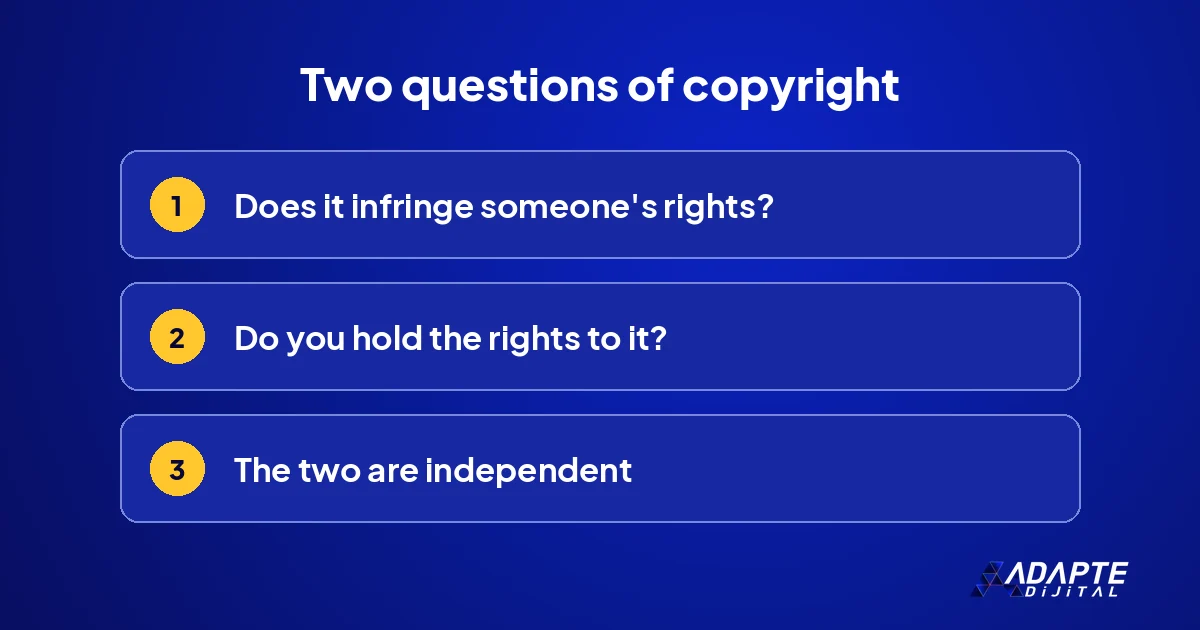
Copyright risk in AI output comes from two separate questions: does the content you produced infringe someone else’s rights, and do you hold the rights to the content you produced? Neither is visible at the moment of production. They surface when an objection arrives or when you want to protect the content. ©️
This article lists where the risk arises by type of content and describes the record to keep. This article is for information only and is not legal advice; consult a lawyer about your own situation. The scenario file is fiction. It does not describe a real company; it is written to show how the risk works.
Scenario file: what happens when someone objects to a campaign visual?
BU BÖLÜMÜN ÖZETİ
- Production
- The objection
- The outcome
Picture a cosmetics brand. For a new product the agency prepares a series of illustrations made with AI. The series is liked and printed on the packaging.
Production
To get the mood right, the designer types the name of a well-known illustrator into the model. The images that come out resemble that illustrator’s work. Nobody sees a problem, because the images are newly made. Which tool was used, with which instructions, is noted nowhere. 🎨
The objection
After the product reaches the shelves, a letter arrives from the illustrator’s representative. It claims that the images on the packaging are too close to the illustrator’s recognised work. The brand turns to the agency and the agency to the designer. The designer does not remember that day’s instructions and never read the terms of the tool.
The outcome
Right or wrong, an objection is a cost. The packaging print run stops, a lawyer is hired and the launch slips. The brand wants to defend itself by showing the production process, but there is no record to show. The case has not been lost; a defence could not be built either. 📦
Which two questions does copyright ask?
The two questions are independent. Coming out clean on one does not mean coming out clean on the other.
The position in Türkiye
Under Turkish law a work is defined as an intellectual and artistic product bearing the individuality of its author, and the author is the person who created it. As far as we know there is no separate, explicit rule for AI output. That uncertainty carries risk in both directions. If you want to protect valuable content, increasing and documenting the human contribution is the safest route. The basics are in what matters in copyright and licensing.
Where does the risk arise for each type of content?
BU BÖLÜMÜN ÖZETİ
- Images
- Text
- Audio and video
Each type of content has a trap of its own. All four are worth knowing separately.
Images
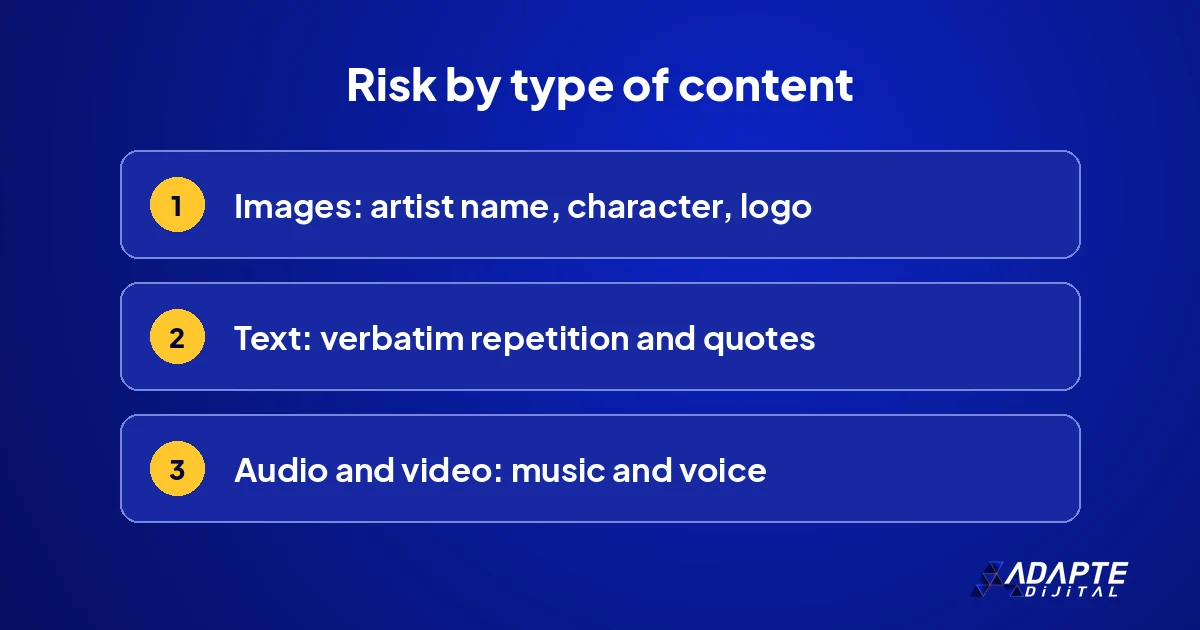
With images the risk comes from three places: producing in the name of an artist, resemblance to a well-known character or product, and traces of logos or signatures that leak into the image. If the uploaded source image belongs to someone else, the risk is there from the start. Typing a living artist’s name into the instructions is the decision that will be hardest to explain later. We look at the brand side of visuals in do AI visuals help or hurt a brand. 🖼️
Text
With text the risk is that the model repeats a source almost word for word. Song lyrics, poems and long quotations are especially sensitive. Translation and rewriting do not remove the rights in the source. Giving a model a competitor’s text and saying ‘write something similar’ puts the similarity on record. A similarity check is a simple and effective precaution here.
Audio and video
With audio the risk has two layers: the music itself and whose voice it sounds like. A voice-over that resembles a well-known person can raise personality rights as well as copyright. In video, image, music and voice come together, so three risks combine. We cover voice and face imitation in protecting your brand from deepfakes. 🎙️
What is checked on the tool and contract side?
BU BÖLÜMÜN ÖZETİ
- The terms of the tool
- Agency and client contracts
- The cost formula
Part of the risk sits in production, and part in documents that are signed and not read.
The terms of the tool
Every tool has different terms of use. Some allow commercial use of the output; some allow it only on a paid plan. Some providers offer an indemnity against copyright claims under certain conditions; others do not. These terms change. Read the current terms of the plan you use once and note the date. 📄
Agency and client contracts
If an agency or freelancer produces the content, the contract should state three things: whether AI is used, which tools are used, and who is responsible if an objection arrives. Without those clauses, everyone looks at everyone else when an objection comes. Adding a clause does not prevent an objection; it decides who answers it.
The cost formula
Think of the cost of copyright risk like this: permanence of the place of use × reach × cost of withdrawal. A social media post can be taken down in minutes. Printed packaging, a shop sign or a logo cannot be taken down; it has to be replaced. That is why the bar rises for permanent, high-reach work. If you use AI for permanent work, records and a lawyer’s opinion come first. 🧮
Which record is kept, and what does an audit ask?
BU BÖLÜMÜN ÖZETİ
- The production record
- A check before publishing
- Five questions asked in an audit
In copyright the best defence is being able to show how the work was produced. A few lines are enough.
The production record
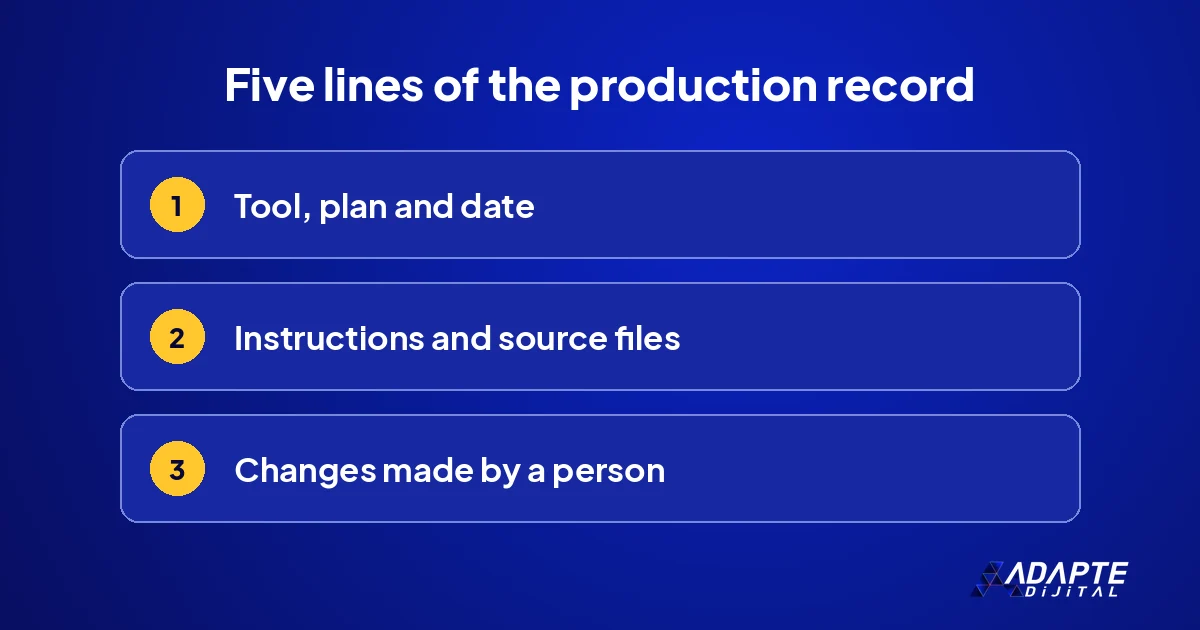
Five facts are kept for each important piece: which tool and plan, the date of production, the instructions used, the source files uploaded and the changes a person made. The record can sit in a table or in the file name. A record of the human contribution does two jobs: it shows the process against a claim of resemblance, and it strengthens your own claim to protection. 🗂️
A check before publishing
For permanent and commercial work three checks are made: resemblance to a known work or brand, traces of logos and lettering inside an image, and long verbatim quotation in text. If there is doubt, the content is produced again or made from scratch by a person. Producing again is cheaper than dealing with an objection.
Five questions asked in an audit
One: which tools are used on which plan, and when were their terms read? Two: do the instructions contain the name of an artist, brand or work? Three: is there a production record for permanent work? Four: does the agency contract have an AI clause? Five: is the human contribution documented? Forecast: large customers will make it routine to ask suppliers for a statement of AI use. Update log. 18 November 2026: first publication. Forecasts on this page are re-read when they fall due; one that proves wrong is corrected here, not deleted. We follow the court cases in AI copyright lawsuits and their lessons.
How does Adapte Digital review the copyright file?
BU BÖLÜMÜN ÖZETİ
- A single delivery package
- What is delivered
- Where to start
In the copyright file we do not give a ruling; we review the record: which content was produced with which tool and with which record?
A single delivery package
Adapte Digital does not charge a monthly management fee. Work starts with a single delivery package whose scope is written down in advance: 36,000 TRY + VAT. If the work grows, the new need is defined as a separate add-on package, priced by what will be delivered rather than by the hours spent. 📦
What is delivered
The output is a list of tools and terms, the permanent work that lacks a record and a production record template. For legal assessment we refer you to your lawyer.
Where to start
Which packages are open, and at what price, is shown on our campaign pages, item by item. 🧭
Quick Summary
- Copyright risk comes from two questions: someone else’s rights and your own.
- According to the US Copyright Office, prompts alone do not make the user the author of the output.
- Artist names and character resemblance in images, verbatim repetition in text and resemblance in audio carry risk.
- The bar rises for permanent, high-reach work.
- A production record and a documented human contribution are the strongest defence.
Short Glossary
- Copyright
- Copyright is the set of rights the person who creates a work holds over that work.
- Indemnity
- An indemnity is a provider’s promise to bear the cost of rights claims made against its customer under certain conditions.
- Production record
- A production record is a note showing which tool, which instructions and which human contribution produced a piece of content.
Frequently Asked Questions
Next Step
Count your permanent work today: logo, packaging, signage, printed material. Gather the production records for anything made with AI; the pieces without one are your first finding.
Sources: U.S. Copyright Office — Copyright and Artificial Intelligence, Part 2: Copyrightability · Mintz — US Copyright Office Publishes Second Part of Report on AI
Updated: November 2026
Sık Sorulan Sorular
A model can carry traces of the content it was trained on. If an output is too close to a protected work, a well-known character or a brand, an objection can follow. When resemblance counts as infringement varies by country and by case, and lawsuits are still running. For a business the practical question is: does this output look like something I know? ⚖️
In a report published in January 2025, the US Copyright Office restated that copyright protection requires human authorship. According to the report, with current technology writing prompts alone is not enough to make the user the author of the output. Protection may be possible where a person’s own work is perceptible in the output, or where the output has been creatively arranged or modified. So if someone copies a wholly generated image, stopping them may be difficult.
The right to use it is usually yours under the tool’s terms. Copyright protection depends on the country and on the human contribution; for a wholly generated image, protection may be limited.
Style as such is not protected everywhere, but resemblance to particular works and use of the artist’s name can draw an objection. For commercial work, avoiding it is safest.
A logo is permanent work and is usually meant to be registered. AI can help at the idea stage; having the final version drawn by hand and running a similarity search is safer.