
Automation Spend Audit: Are Your Flows Spending Money the Right Way?
An automation spend audit is a review that sets out when each automated flow runs, what it spends on each run and what it is allowed to do. An automation does not tire and does not ask. If it was built wrongly, it repeats the mistake without tiring too. ⚙️
This article does not criticise automation. It describes how flows that nobody looks at after set-up spend money and reputation. The scenario file is fiction. It does not describe a real company; it is written to show how the risk works.
Scenario file: what happens when two automations trigger each other?
BU BÖLÜMÜN ÖZETİ
- Friday evening
- The weekend
- What was missing
Picture a wholesaler. Two flows have been set up: one classifies incoming emails and the other writes automatic replies to customers. Both use AI.
Friday evening
A customer’s mailbox fills up and every email sent to it bounces back with an automatic error notice. The classifying flow counts that notice as a new customer message. The reply flow writes a polite answer. The answer bounces again. The loop is in place and nobody is in the office. 🔄
The weekend
The two flows write to each other all weekend. Each round is two model calls. The automation tool charges per run and the model provider charges per token. On Monday morning there are thousands of messages in the inbox and a spike on two separate invoices. Thousands of emails have gone to the customer as well.
What was missing
Both flows worked correctly by themselves. What was missing was a rule limiting how many times a flow may write to the same address in an hour. There was no alarm either; no notification had been set up for an unusual number of runs. An automation error is usually a missing limit. 🚧
Where does an automation spend money?
BU BÖLÜMÜN ÖZETİ
- A fee per run
- Model calls
- Connected services
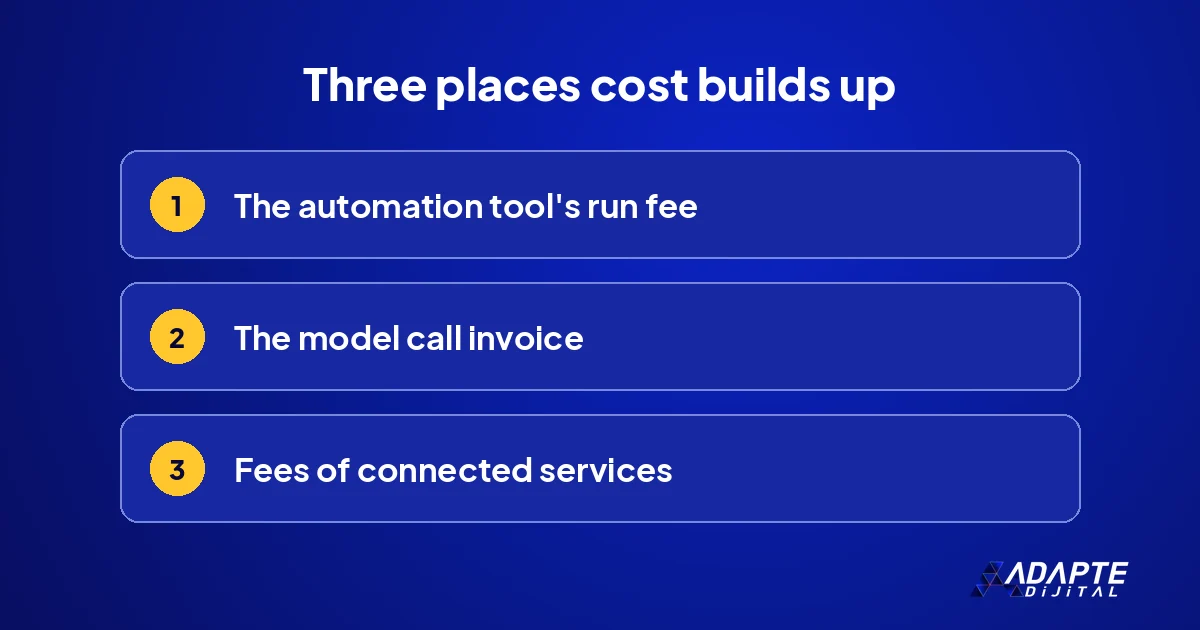
The cost of a flow does not appear on a single invoice. It builds up in at least three places.
A fee per run
Most automation tools count every run or every step of a flow, and your plan is priced on that count. A flow that runs when it need not fills the limit of your plan and pushes you to the next one up. Upgrading the plan before finding the flow that fills the limit only enlarges the leak. 💧
Model calls
If the flow contains an AI step, each run also creates a model bill. That bill may sit in another dashboard, on another card. When the two invoices are not put side by side, the real cost of the flow stays hidden. Often the only person who sees the total is in accounting, and they do not know the cause.
Connected services
If the flow sends messages there is a messaging fee; if it processes documents, a processing fee; if it pulls data, a query fee. These are small lines, but they are multiplied by the number of runs. There is also a cost that no invoice shows: the mark a wrongly sent message leaves on a customer. ✉️
Which errors grow silently?
BU BÖLÜMÜN ÖZETİ
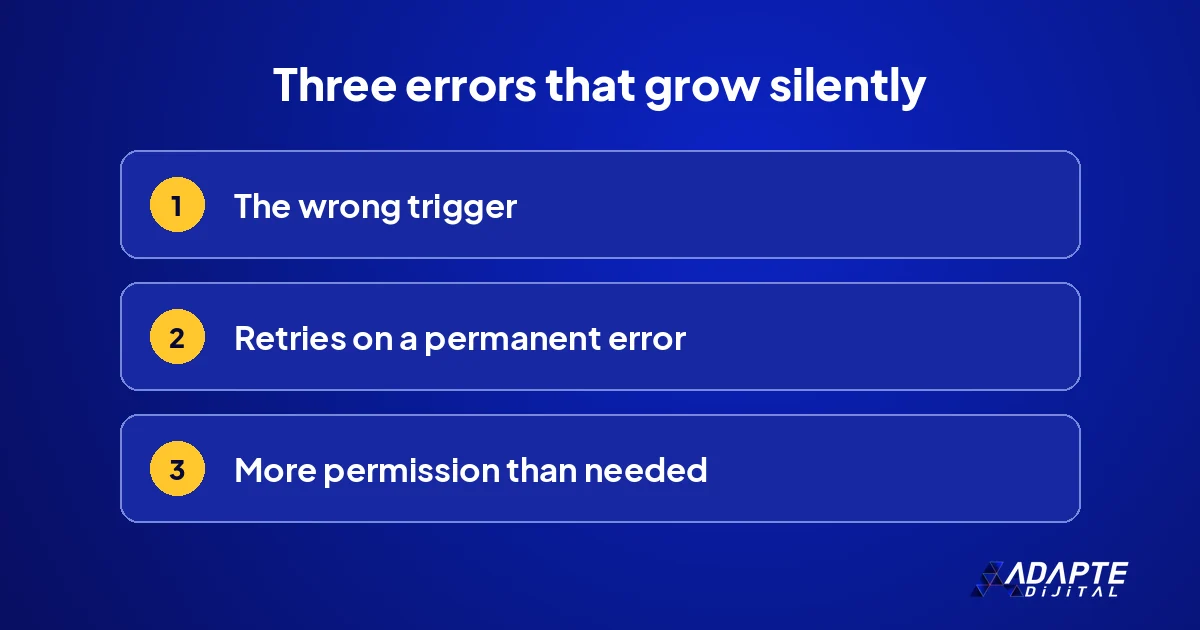
- The wrong trigger
- Retries
- Too much permission
Automation errors make no noise. The flow keeps running; it simply runs wrongly.
The wrong trigger
A flow is built to run ‘when a new record arrives’ but also fires ‘when a record is updated’. Every small correction restarts it. The amount of work stays the same while the number of runs multiplies. Because nobody re-reads the trigger, the error lives on for months. 🎯
Retries
When a step fails, most tools retry the flow by themselves. If the error is temporary, that is good. If it is permanent, the flow runs the same expensive step again and again. When a step after the AI step is broken, the model is called again on every attempt and the result is thrown away each time.
Too much permission
OWASP defines excessive agency in AI systems as a risk of its own and names three root causes: excessive functionality, excessive permissions and excessive autonomy. If a flow that only needs to read can also delete and send, a small error becomes a large action. We cover limits on permission in agent permissions and approval gates. 🔐
How is the cost worked out?
BU BÖLÜMÜN ÖZETİ
- The cost formula
- The wasted-run rate
- Cost per job
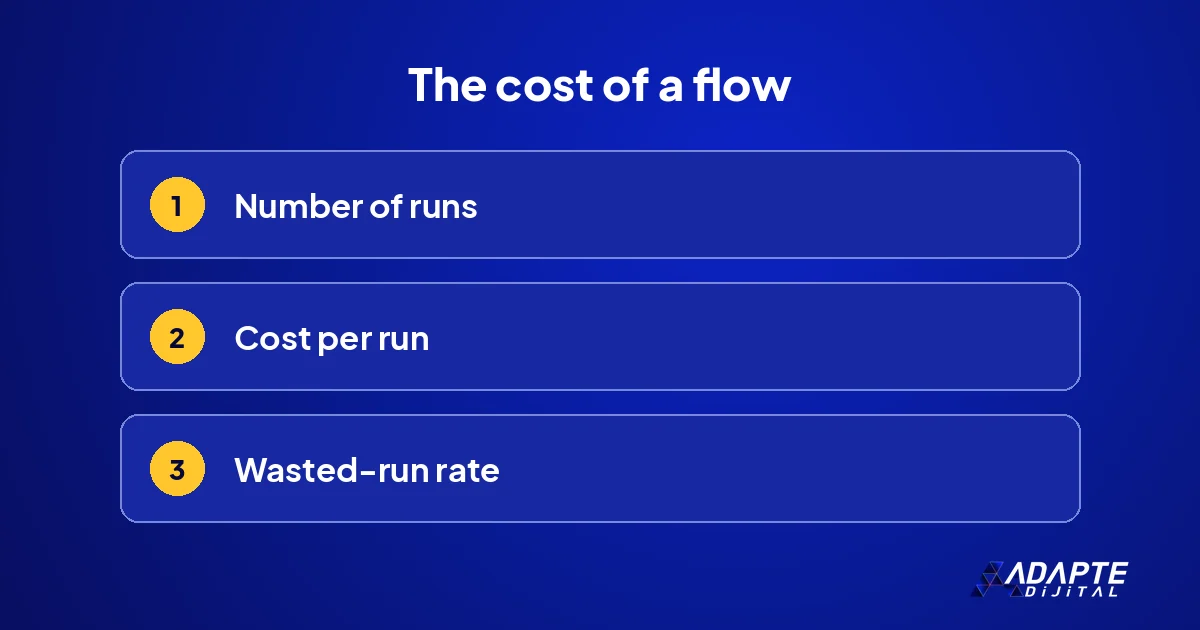
The cost of a flow is found with two questions: how many times did it run, and how many of those runs actually did a job?
The cost formula
The formula is: number of runs × cost per run. Cost per run includes the automation tool’s share, the model call and the fees of connected services. Take the figures from your own dashboards. Then look at the second number: how many of those runs produced a job? 🧮
The wasted-run rate
Every run that ends without producing a job is a wasted run: those that fail and stop, those that repeat, those triggered wrongly. The wasted-run rate shows how much of the total is waste. A business that knows this rate also knows which flow to fix first. Most tools give this information in their run history.
Cost per job
The last step is to divide the flow’s total cost by the number of jobs it produced. You see what processing an invoice, sending a quote or updating a record costs you. Sometimes that figure is higher than human labour. Then the flow is either fixed or closed. We describe measurement for agents in token waste in agent systems, and the budget view in how to audit an AI budget.
How is the audit carried out?
BU BÖLÜMÜN ÖZETİ
- The flow inventory
- Limits and approval
- Five questions asked in an audit
The audit begins with a list of flows. In most companies that list does not exist.
The flow inventory
Five facts are written for each flow: when it is triggered, which steps it runs, which accounts it is connected to, who built it and who owns it today. If the builder has left, the flow has no owner. Ownerless flows are stopped first and examined afterwards. The reverse order means spending while you examine. 📋
Limits and approval
OWASP’s recommendations are plain: give a flow only the functions and permissions it needs, require human approval for high-impact actions, limit the number of actions and log what is done. Every step that sends money, deletes records or writes to a customer should carry an approval or a limit. A limit does not prevent an error; it shortens it. The logging side is in how to keep an agent audit log.
Five questions asked in an audit
One: who owns the flow? Two: how many times did it run last month, and how many runs were wasted? Three: what is the most it can do in an hour? Four: which steps require human approval? Five: who learns about unusual activity, and how? Forecast: automation tools will make a spending cap a required setting for flows that contain an AI step. Update log. 18 November 2026: first publication. Forecasts on this page are re-read when they fall due; one that proves wrong is corrected here, not deleted.
How does Adapte Digital review automations?
BU BÖLÜMÜN ÖZETİ
- A single delivery package
- What is delivered
- Where to start
The second half of the efficiency file is automations: flows are listed, run history is read, and limits and permissions are written down.
A single delivery package
Adapte Digital does not charge a monthly management fee. Work starts with a single delivery package whose scope is written down in advance: 36,000 TRY + VAT. If the work grows, the new need is defined as a separate add-on package, priced by what will be delivered rather than by the hours spent. 📦
What is delivered
The output is a flow inventory, the wasted-run rates and the limits we recommend for each flow, in order of how much each one saves.
Where to start
Our current packages and capacity are listed on our campaign pages; scope and price are written there before any work starts. 🧭
Quick Summary
- Every flow should have an owner, a limit and a log.
- Cost builds up in three places: the automation tool, model calls and connected services.
- Silent errors: the wrong trigger, retries on a permanent error, too much permission.
- Cost: number of runs × cost per run; the wasted-run rate is tracked separately.
- OWASP recommends least privilege, human approval and limits on actions.
Short Glossary
- Trigger
- A trigger is the condition that determines when an automation flow starts to run.
- Wasted-run rate
- The wasted-run rate is an indicator of the share of a flow’s runs that end without producing a job.
- Human approval
- Human approval is the step in which an authorised person confirms a high-impact action before it is carried out.
Frequently Asked Questions
Next Step
Open your automation tool’s run history and find the flow that ran most last month. If its number of runs far exceeds the number of jobs it produced, that is your first finding.
Sources: OWASP Gen AI Security Project — LLM06:2025 Excessive Agency · OWASP Gen AI Security Project — LLM10:2025 Unbounded Consumption · FinOps Foundation — FinOps for AI Overview
Updated: November 2026
Sık Sorulan Sorular
List them all and examine the three that run most. Flows that write to customers or move money are examined even if they run rarely.
Error alerts are enough; spending alerts usually are not. The tool tells you a flow has broken; it does not tell you it is running needlessly.
By limiting the number of actions that can be taken on the same recipient or record in a given time. Automatic replies and error notices should also be kept out of the trigger.