
Small brands toward 2027: how they are taking share from the big names, in 6 signs
Say you make olive oil soap at home in Bursa, and it shows up in the same search results as a supermarket chain’s well-known soap. Small brands are taking share toward 2027 right here: by winning search and delivery, not the shelf. According to the latest data from Turkey’s Ministry of Trade (2025), 75 percent of the 634,000 businesses selling online are sole proprietorships.
The surprise: the digital market is already made of small players. The one that gains share is not the cheapest, but the one with a clear name, identity and story. Read this as the direction the numbers point, not a prophecy.
What do the numbers say about small brands?
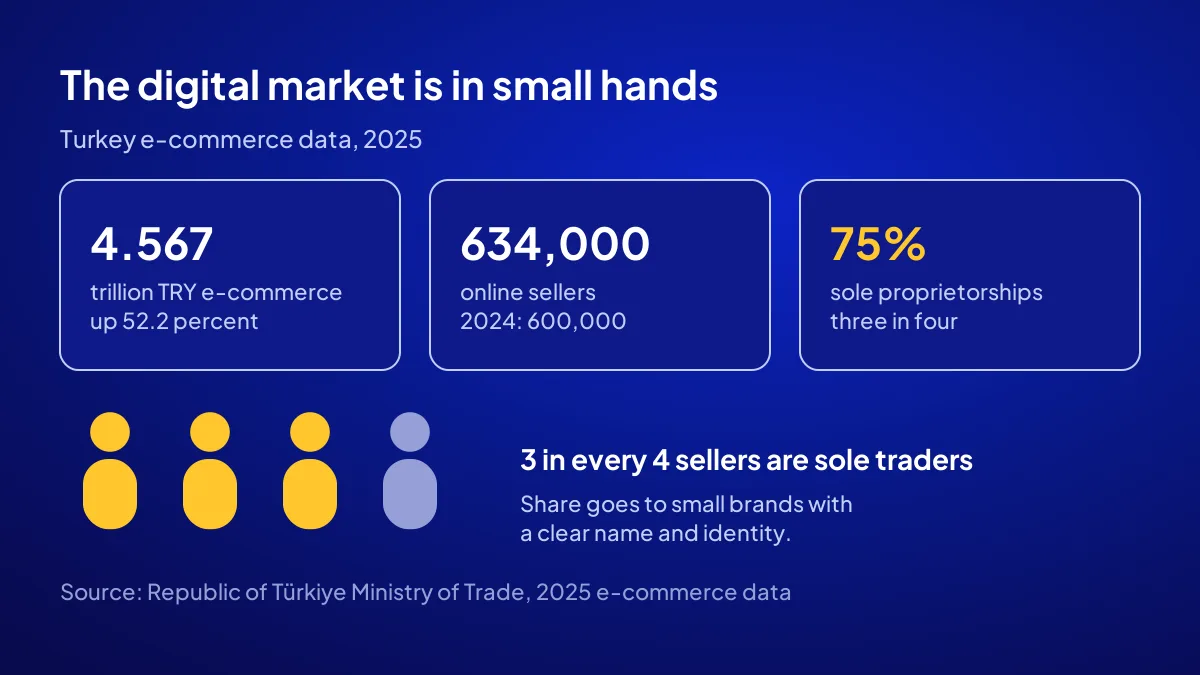
The numbers say small businesses carry the digital market. According to the Ministry of Trade, e-commerce volume in 2025 grows 52.2 percent to TRY 4.567 trillion. The number of businesses selling online rises from 600,000 to 634,000. Of these, 75 percent are sole proprietorships, 21 percent limited companies and 4 percent joint-stock companies; most of the crowd is small, like you.
| Indicator (2025) | Value | What it means for a small brand |
|---|---|---|
| E-commerce volume | TRY 4.567 trillion, up 52.2% | Room opens up |
| Businesses selling online | 634,000 (600,000 in 2024) | Competitors grow too |
| Share of sole proprietorships | 75% | Most of the market is small |
| Online businesses using AI | About 75% | The tool gap is closing |
| Average delivery time | 42.2 hours | Distant producers are fast too |
| Women’s share of spending (value) | 56% | Strong audience for cosmetics, food |
Why is the big brand’s castle wall lower than before?
Because customers now decide in front of a search box and an AI assistant, not a shelf. Shelf space is rented with money; a place in search and assistant answers is earned with content, reviews and consistent identity. Delivery levels the field too: per the Ministry, average delivery is 42.2 hours and 53 percent of orders arrive within 24 to 48 hours.
Which 6 signs favour small brands toward 2027?
Six signs point the same way, all resting on today’s data. The market grows, buyers search, tools get cheaper and delivery gets faster. What favours small brands is not what the big ones lose; it is tools small players hold for the first time. Mark the ones that touch your business.
- The market is growing: e-commerce volume up 52.2 percent in a year.
- The door is open: businesses selling online reach 634,000.
- The audience is ready: women make 56 percent of spending; the top-spending age group is 25 to 34.
- The tool gap is closing: about 75 percent of businesses use AI.
- Distance is shrinking: average delivery takes 42.2 hours.
- The same direction worldwide: small, new manufacturers keep gaining share.
In which sectors is the door wider?
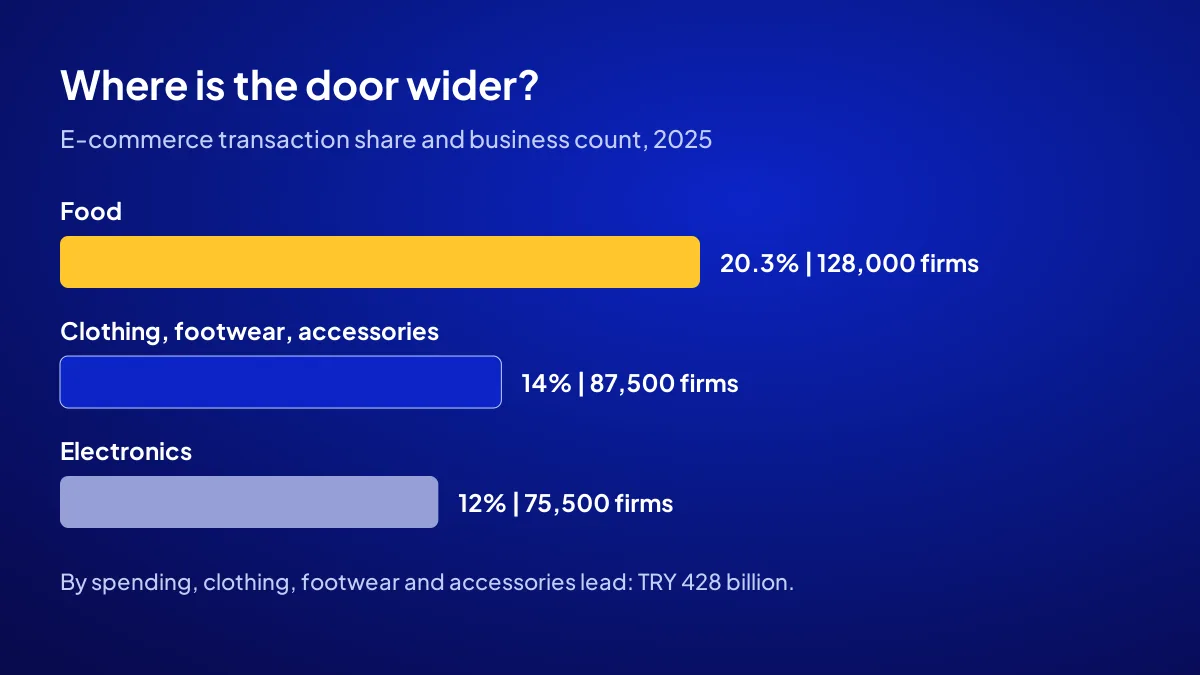
Food and clothing, footwear and accessories stand out in both business count and spending. According to the Ministry, food has a 20.3 percent share of transactions, with 128,000 businesses. Clothing, footwear and accessories have a 14 percent share and 87,500 businesses. By spending value, clothing, footwear and accessories lead with TRY 428 billion.
| Sector | Transaction share | Businesses | Small brand’s edge |
|---|---|---|---|
| Food | 20.3% | 128,000 | Local origin, recipe, production story |
| Clothing, footwear, accessories | 14% | 87,500 | Design language and consistent identity |
| Electronics | 12% | 75,500 | Service and expertise; price comparison is harsh |
What leaves a small brand behind on the way?
Most often it is not a rival but a missing foundation. A business with an unregistered name, a scattered identity, one marketplace and a price-only pitch does not grow in a growing market; it gets lost in the crowd. These traps sit behind most cases of a till that will not turn.
Competing on price
An unbranded product gets compared on price and the margin melts. See why do they only ask price.
Not securing the name
Until you file, your name is open to someone else’s application, and growth makes it more visible.
Say it is you: a kitchen in Beylikdüzü making granola
BU BÖLÜMÜN ÖZETİ
- 1. Name and positioning
- 2. Identity and site
- 3. Being found when searched
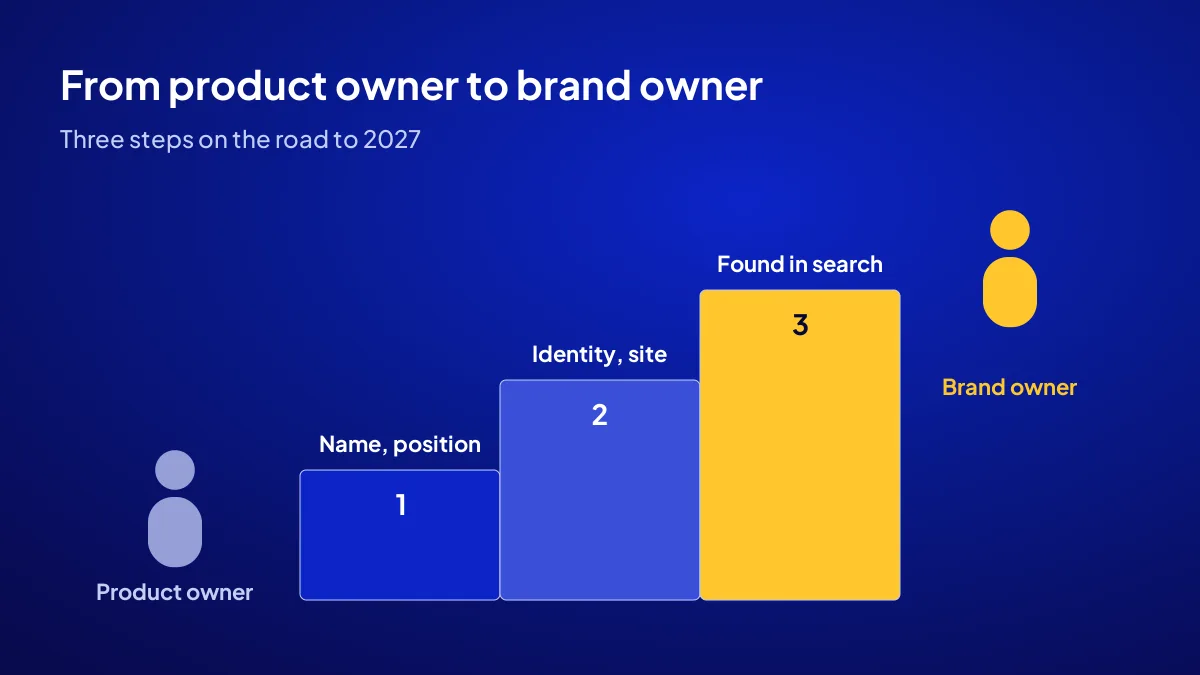
Say you make granola at home in Beylikdüzü and sell jars to neighbours and offices. Customers are happy, but no new customer walks in, because you have no door online. Toward 2027, the shortest path is not a new product; it is a name, identity, site and content found in search. It takes three steps.
1. Name and positioning
“Homemade granola” is a recipe, not a brand. Clarify who buys and why, then find and check a name. Check food sales registrations and permits here too.
2. Identity and site
Logo, colour and typeface match on jar and screen. A site on your own domain is a door no marketplace controls.
3. Being found when searched
Content answering questions like “how to store sugar-free granola” meets people searching. Six fitting profiles are in who should build a digital brand.
What should you prepare before 2027?
Name, identity, site and content, all four together. The Build Your Digital Brand campaign builds them in one package at a fixed, upfront TRY 36,000 + VAT; with 20 percent VAT that is TRY 43,200, but check the current rate on the invoice. There are 12 brand slots and the deadline is 1 November 2026. For the 10 percent coupon, just mention the code when applying or in the meeting.
- Brand consulting: positioning, target audience and brand voice.
- TÜRKPATENT preliminary search and availability check; not a legal opinion.
- Digital identity: 3 directions for logo, colour and typeface, the chosen one finalised.
- Domain, 1 year of hosting and a 6-page brand website.
- 108 AI SEO-ready articles across 6 keyword groups.
- Brand guideline, social media kit, digital business card, structured data and handover video.
One principle
A growing market remembers the one with a name, not just a product.
Quick Summary
- In 2025, e-commerce volume grew 52.2 percent to TRY 4.567 trillion.
- 75 percent of the 634,000 businesses selling online are sole proprietorships.
- Average delivery is 42.2 hours; about 75 percent of businesses use AI.
- Food and clothing lead in transactions and spending.
- Price wars, one-door dependence and unregistered names hold small brands back.
- Share goes to those with a name and identity, not just a product.
Short Glossary
Positioning: Positioning is the decision used to set whom a brand speaks to and how it differs from rivals.
Marketplace: A marketplace is the online sales platform used by many sellers to list their products in one place.
Profit margin: Profit margin is the ratio used to show how much of the sale price stays with the business after costs.
Next Step
Product ready? Give it a name and identity. Apply to the Build Your Digital Brand campaign; the 12 brand slots are open until 1 November 2026.
Frequently Asked Questions
Source: Republic of Türkiye Ministry of Trade — E-commerce volume reached TRY 4.6 trillion in 2025
Sık Sorulan Sorular
NielsenIQ’s report of 8 December 2025 notes that private labels and smaller upstart manufacturers keep gaining share, while only 9 percent of companies grew innovation sales. Launching is easy; sticking is hard.
634,000 businesses means 634,000 rivals. Without a name, a product is chosen on price alone.
When a customer types “natural soap”, the top result need not be the biggest shelf brand. The page that best answers the question can move ahead.
About 75 percent of online businesses use AI, per the Ministry. Visuals and copy that once needed an agency budget are now within a workshop’s reach, so the difference comes down to the brand itself.
The first. A growing market makes room, but those found and remembered by name take it.
The second. An open door does not mean room inside; each newcomer is one more name in your search.
No, but do not enter unprepared. Among 128,000 food businesses, the chosen ones have a name and story. Why branded goods fetch more is covered in why branded products sell higher.
Cosmetics is not a separate line in the Ministry data. But women make 56 percent of spending, so a small cosmetics brand’s audience is already online.
It suits product brands (cosmetics, clothing, food), service brands (salons, consultancies) and anyone turning their work into a brand. In regulated professions such as clinics, check your professional and ministry rules first. See the full route in the building a digital brand guide, and apply via the Build Your Digital Brand campaign page.
Brand consulting, a TÜRKPATENT preliminary search and availability check, a 3-direction digital identity, a 6-page brand site with domain and 1 year of hosting, 108 AI SEO-ready articles across 6 keyword groups, a brand guideline, social media kit, digital business card, structured data and a handover video.
If there is no name, one is proposed during consulting and then checked for availability. Identity, site and articles are built on the chosen name.
The domain is registered in the client’s name. Hosting for the first year is included; second-year hosting renewal is the client’s responsibility.
Updated: October 2026