
Rossmann launches Trends For You with Japanese and Korean makeup, do trend corners sell?
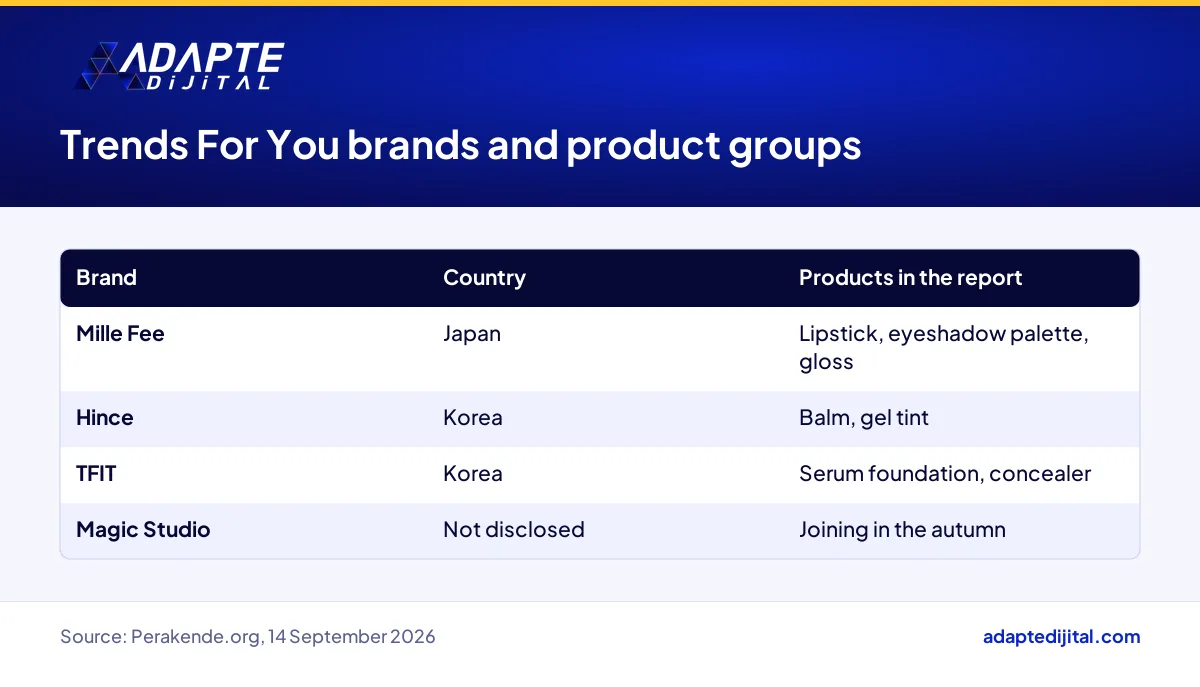
Rossmann has launched “Trends For You”, a makeup concept that gathers global makeup trends in a single area of the store, starting with Mille Fee from Japan and Hince and TFIT from Korea (Perakende.org, 14 September 2026). A fourth brand, Magic Studio, joins in the autumn. Here’s something most people don’t know: four of the seven products announced cost exactly TL 499.
If you run a beauty boutique, here is why it matters. A large chain is grouping trend brands in one corner and keeping prices in a narrow TL 499-999 band. That is a shelf decision a small store can copy, if the corner really grows the basket.
What does Rossmann’s Trends For You concept bring to the makeup shelf?
One area and one story. Trends For You puts makeup brands from Japan and Korea side by side, so the shopper sees what is trending at a glance instead of hunting across three aisles. Rossmann positions the area as a separate concept inside its makeup category.
What price band are Rossmann’s Trends For You products sold in?
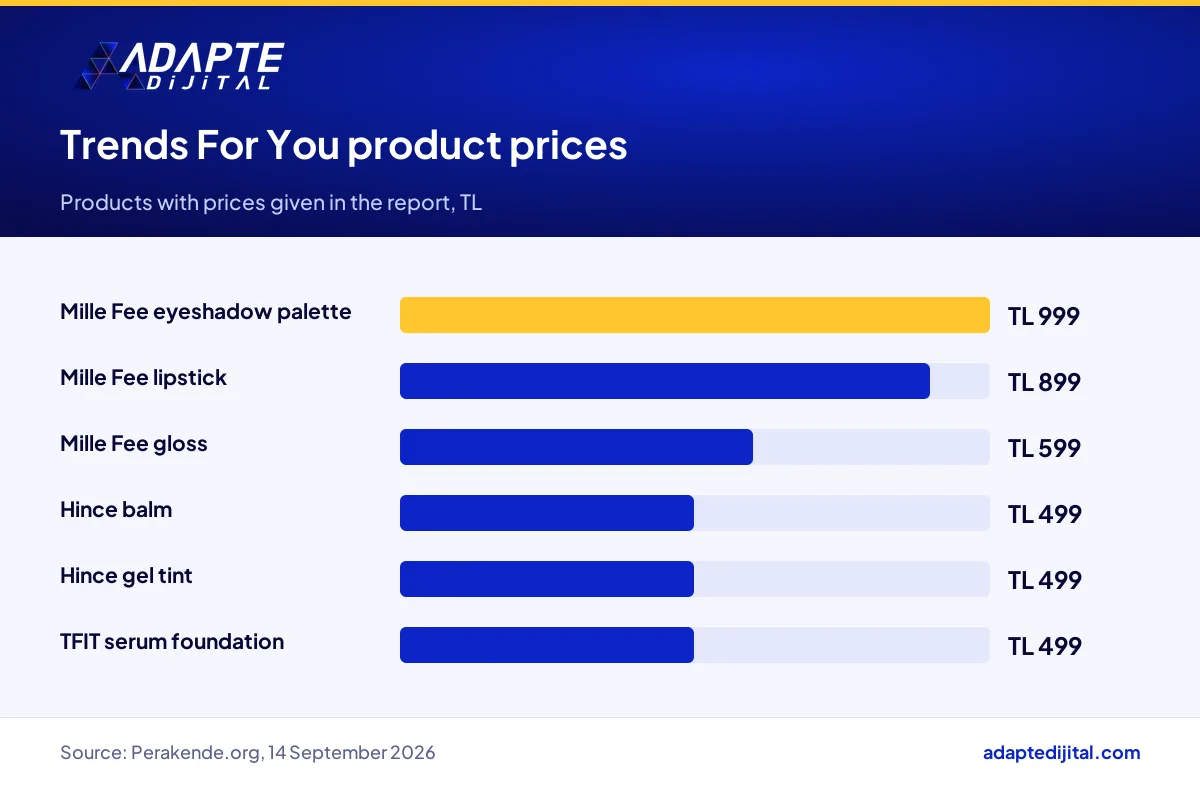
Between TL 499 and TL 999. Hince’s balm and gel tint, and TFIT’s serum foundation and concealer, all cost TL 499. On the Mille Fee side, the gloss is TL 599, the lipstick TL 899 and the eyeshadow palette called The Starry Night TL 999. The most expensive item costs roughly twice as much as the cheapest.
Who feels Rossmann’s Trends For You more, beauty boutiques or social media sellers?
Three groups feel it in different ways. The likely winners are beauty boutiques that can source the same category and sell to younger makeup buyers, because the chain is creating curiosity about these products. The ones under pressure are small sellers who bring in Japanese and Korean products only through social media. The indirect effect lands on shopping mall managers who plan the tenant mix.
Does an in-store trend corner like Rossmann’s grow the average basket?
It can, but there is no guarantee, and Rossmann has shared no figure on sales impact. The logic: while picking up a lipstick, a shopper looks at the gloss too. The average basket, meaning the average amount per receipt, grows with that second item. A badly built corner just takes up space.
How do shoppers search for and find trend makeup like Rossmann’s new brands online?
They search by product name. A trend product is seen on a phone long before it is seen on a shelf. The first page she lands on often decides who makes the sale. Rossmann has not said whether the concept is online, and for a small store that gap is room to be visible.
What should a beauty boutique owner do this week to build a trend corner like Rossmann’s?
Gather enough data to decide. List your trend products, check their recent sales and measure the space you can give the corner. Building a corner is not a furniture job; it is a product selection job. A corner built with the wrong products turns into stock that never moves through the till.
Quick Summary
- Rossmann has launched the “Trends For You” makeup concept (Perakende.org, 14 September 2026).
- The first brands are Mille Fee from Japan and Hince and TFIT from Korea, with Magic Studio joining in the autumn.
- The products announced cost between TL 499 and TL 999, and four of the seven are priced at TL 499 (Perakende.org).
- The number of stores carrying the concept and its online availability have not been disclosed.
- The lesson for a small store is to gather trend products in one corner with a narrow price band.
Short Glossary
- Concept area
- A concept area is the retail term used to describe a section of a store given over to one theme, with its own layout.
- Average basket
- Average basket is the measure used to describe the average purchase value, found by dividing total sales in a period by the number of receipts.
- SKU
- SKU is the stock code used to track each product variant, including colour and size, separately.
Frequently Asked Questions
Next Step
Now you know: a trend corner is not shelf decoration, it is a sales area built on a price band and careful product selection. If you would like to talk through which corner would work in your store, fill in the consult your expert form.
Sources: Perakende.org, 14 September 2026 · Rossmann press release not found · Rossmann Türkiye official website · Sector data: AYD (Borsa Gündem, Ekonomi Gazetesi), Watsons Türkiye (Perakende Türkiye)
Updated: October 2026
Sık Sorulan Sorular
Three brands open the corner: Mille Fee from Japan, and Hince and TFIT from Korea. Magic Studio is added in the autumn; the report gives neither its country of origin nor an exact date. The products named in the report include lipstick, gloss, an eyeshadow palette, a balm, a tint, a serum foundation and a concealer.
A concept area is a small section of a store given over to one theme, with its own layout and its own signage. In everyday words, it is a shop inside the shop.
The report does not give store numbers, cities or online availability, nor whether the brands are new to Türkiye or exclusive to Rossmann. We keep developments like this up to date on our retail page, where we interpret the Turkish retail agenda for you.
Rossmann’s reasoning is not in the report. Still, a single price point speeds up the decision at the shelf. The shopper stops comparing tags and looks at colour and texture instead.
Mille Fee’s products run from TL 599 to TL 999. The palette’s full name is “Painting Shadow Palette – The Starry Night”, a nod to a famous painting. Bought as a treat or a gift, its packaging and story become part of the price.
It sets the bar in the shopper’s head. Far above the band, she starts comparing; far below, she asks whether it is genuine. Pricing inside the band keeps the product from gathering dust on the shelf.
When a chain makes a category visible, curiosity spreads to the neighbourhood. A boutique answers “how do I apply this tint” better than a self-service shelf; its trump card is expertise, not price.
The shopper now sees the same brand on a chain’s shelf with a printed price, so the middleman’s edge shrinks. What this seller still has is speed, and products that have not reached the shelf yet.
Indirectly. A trend corner offers discovery, which a routine aisle rarely does. It competes for the same monthly makeup budget, so any shelf that sells makeup feels the pull.
Here’s a comparison few people have seen. In the April 2026 index of AYD, the Turkish council of shopping centres, cosmetics and personal care is the fastest-growing mall category, up 55.5 percent year on year in nominal terms (AYD data as reported by Borsa Gündem). In the first eight months of 2026, health and beauty turnover in malls rose 35 percent, against 30 percent overall (Ekonomi Gazetesi). These are nominal figures, so read them with Turkish inflation in mind.
Watsons Türkiye is setting up a “Sustainable Living Corner” in 161 of its stores, so it too divides the shelf by theme. We look at how Watsons reports this work in our article on the Watsons Türkiye sustainability report.
A trend corner is a bit like the dessert table at a wedding. Everyone heads there first, but the main course feeds the guests. The corner pulls people in; everyday products make the money.
The shopper types the full name, such as “Hince Raw Glow Gel Tint”. If your website has no dedicated page for that product, with a clear price and stock status, she turns away at your digital door too.
Add photos of the corner and the names of the brands you carry to your business profile on maps. For a search like “Korean makeup near me”, the map result is the shortest road to your door.
Price comparison is harshest on a marketplace, and an inconsistent price there costs trust. First set one consistent price across your store and website.
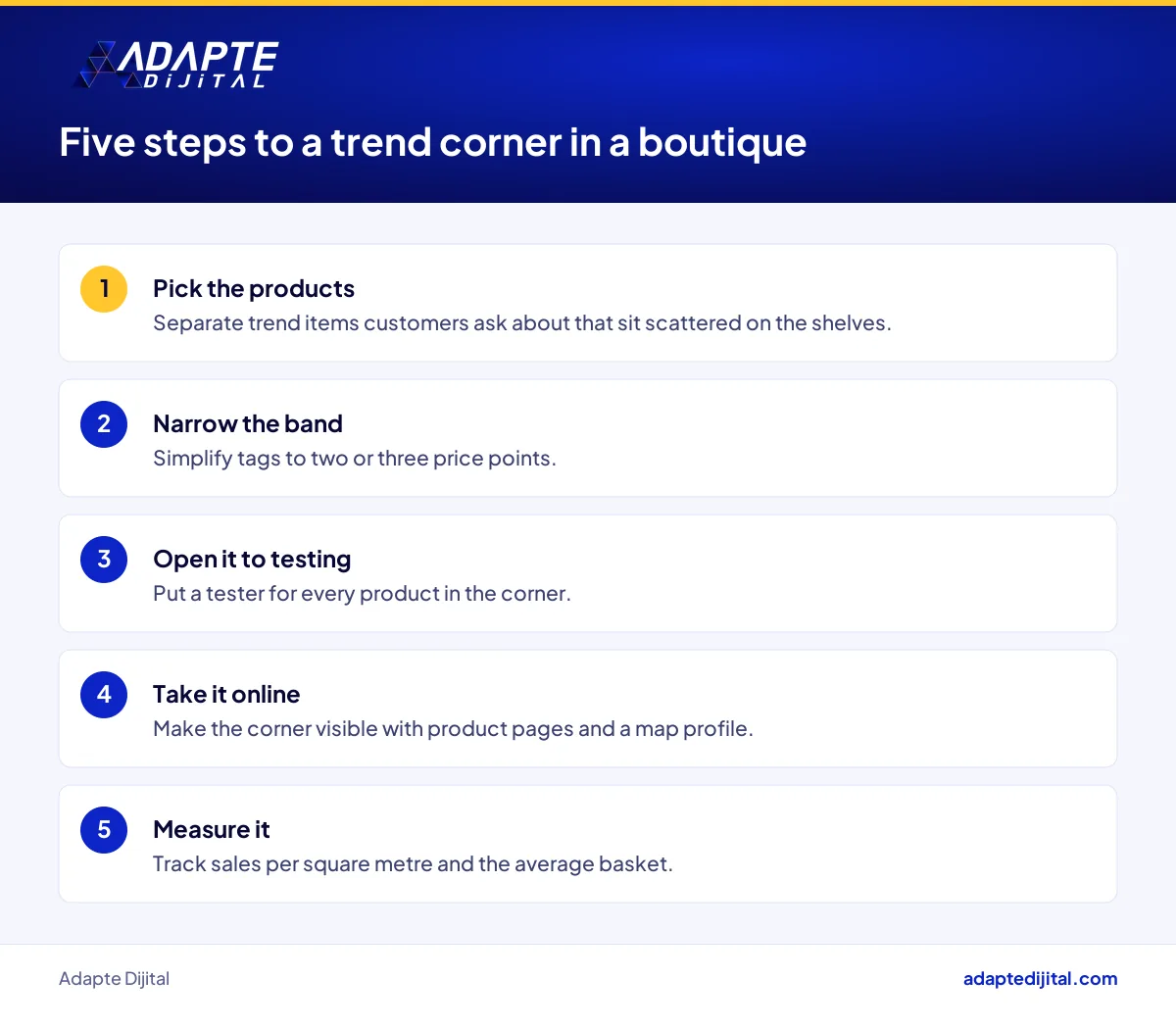
From your SKU list, meaning every product variant you keep in stock, choose the items customers ask about that are scattered across the shelves. Start small and put out a tester for each; a trend product nobody can try does not sell.
Choose a narrow band and simplify the tags. Rossmann’s TL 499-999 band is a reference point, not a rule. Based on your own costs, two or three price points are enough.
Track sales per square metre for the corner products, the average value of receipts that include them, and what people buy alongside them. Hunting for new brands? We explain what a trade fair gives a seller in our article on ZUCHEX. Planning how to announce the corner in-store and online is part of the work we do as a digital marketing agency.
The report does not say how many stores carry the concept. Before you go, it is best to check the nearest store through Rossmann’s official channels.
There is no fixed measure. A single shelf unit, marked with its own sign, where shoppers can pick up and try the products, may be enough to start.
It can help you reach shoppers who search by product name. Keep your store and website prices consistent; different prices damage trust.