
Rossmann Türkiye wins 5 Stevie Awards for 2 days off, how do stores plan flexible shifts?
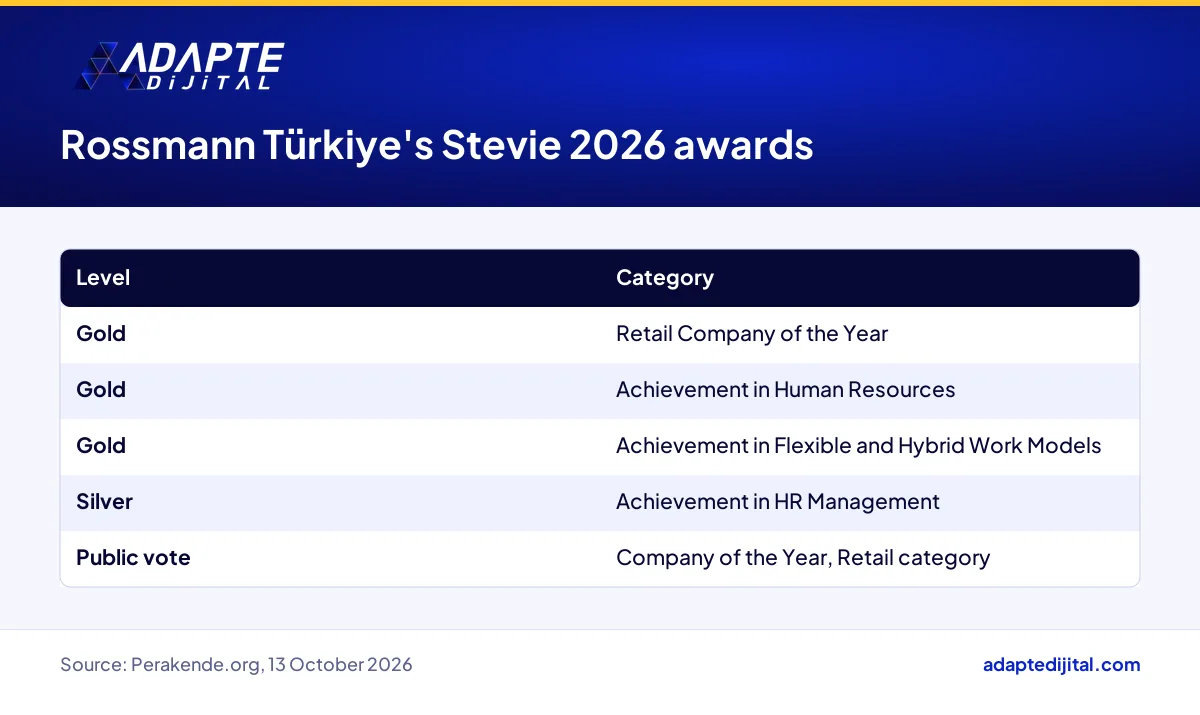
Rossmann Türkiye has won five Stevie Awards 2026 honours for “Two Days Off a Week”, the model it runs for its store staff, according to a trade report (Perakende.org, 13 October 2026). Three are gold, one is silver and one is a title decided by public vote. The practice itself was announced in March 2026: weekly time off went from one day to two, alongside a flexible and predictable shift system (Capital, 27 March 2026).
If you run a store, here is why it matters. When staff leave, you pay again in hiring and training time, and the way time off is planned shapes who stays. Rossmann’s route ran through a year of field analysis in 50 stores, then a pilot, then a rollout to every store. A small retailer can test the same logic in a few stores, or even in one.
Which awards did Rossmann Türkiye win at the Stevie Awards 2026?
According to Perakende.org, three golds, one silver and one public-vote award. The golds are for Retail Company of the Year, Achievement in Human Resources and Achievement in Flexible and Hybrid Work Models. The silver is for Achievement in Human Resources Management. Four of the awards come under the Stevie Awards for Great Employers and The International Business Awards.
What steps did Rossmann follow to build its two-days-off model?
According to Perakende.org, three: preparation, pilot and rollout. Before the model, the company spent a year on field analysis, staff feedback and digital observation in 50 stores. The practice started as a pilot and then spread to all stores. Three development programmes for store managers were added alongside it.
How can a small store set up flexible shifts with two days off like Rossmann?
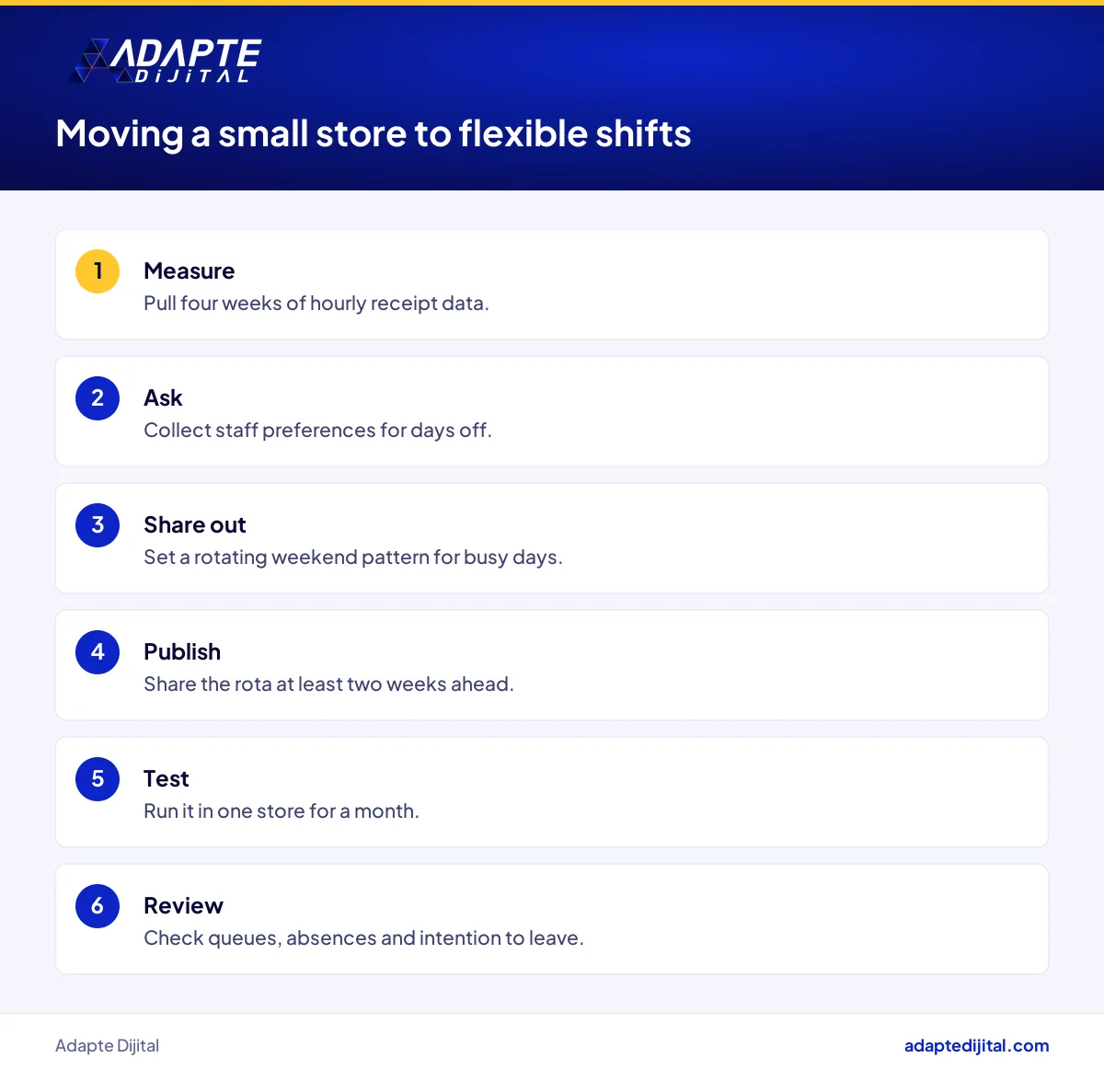
In the same order, at a smaller scale: measure, test, then roll out. A single-store business pulls a few weeks of customer and till data, runs a trial rota for a month and reviews the result with the team. A business with several stores starts the trial in one and spreads it once the results are in.
A rota should not live on paper
A rota written in pencil and rubbed out three times may be the most argued-over document in the store. A shared calendar or a simple shift app lets everyone see changes at the same moment. Once the change history is kept, nobody has to debate who swapped which day.
Which retailers and store staff does a two-days-off model like Rossmann’s affect?
Cosmetics, grocery and fashion chains with high staff turnover may gain, with less hiring and training to carry. Small stores that open long hours with a thin team may struggle, because two days off needs either an extra hire or tighter planning. The indirect effect shows up among employers in the same district competing for the same staff.
In cosmetics retail, reputation does not come from the shelf alone
Workplace and community practices also shape how a brand is seen. For a different example in the same category, see the Yves Rocher Foundation’s award for Hatay silk.
How does Rossmann’s time-off model show up online in its employer brand and store experience?
In two ways: recruitment searches and the in-store experience. A candidate reading a store job ad looks up the employer on review sites and social media, where the awards and the time-off model leave a positive trace. In the store, a rested employee changes the first few seconds a customer spends in front of the shelf.
What should a store owner do this week to try flexible shifts like Rossmann’s?
Make this a week of measuring, not deciding. The desk’s recommendation is to pull the last four weeks of hourly receipt data, hold short conversations with staff about preferred days off and draft a trial rota for one store. Time off and working hours are governed by employment law. Verify with the official source; this is not legal or financial advice.
Run a shelf checklist before the new rota goes live
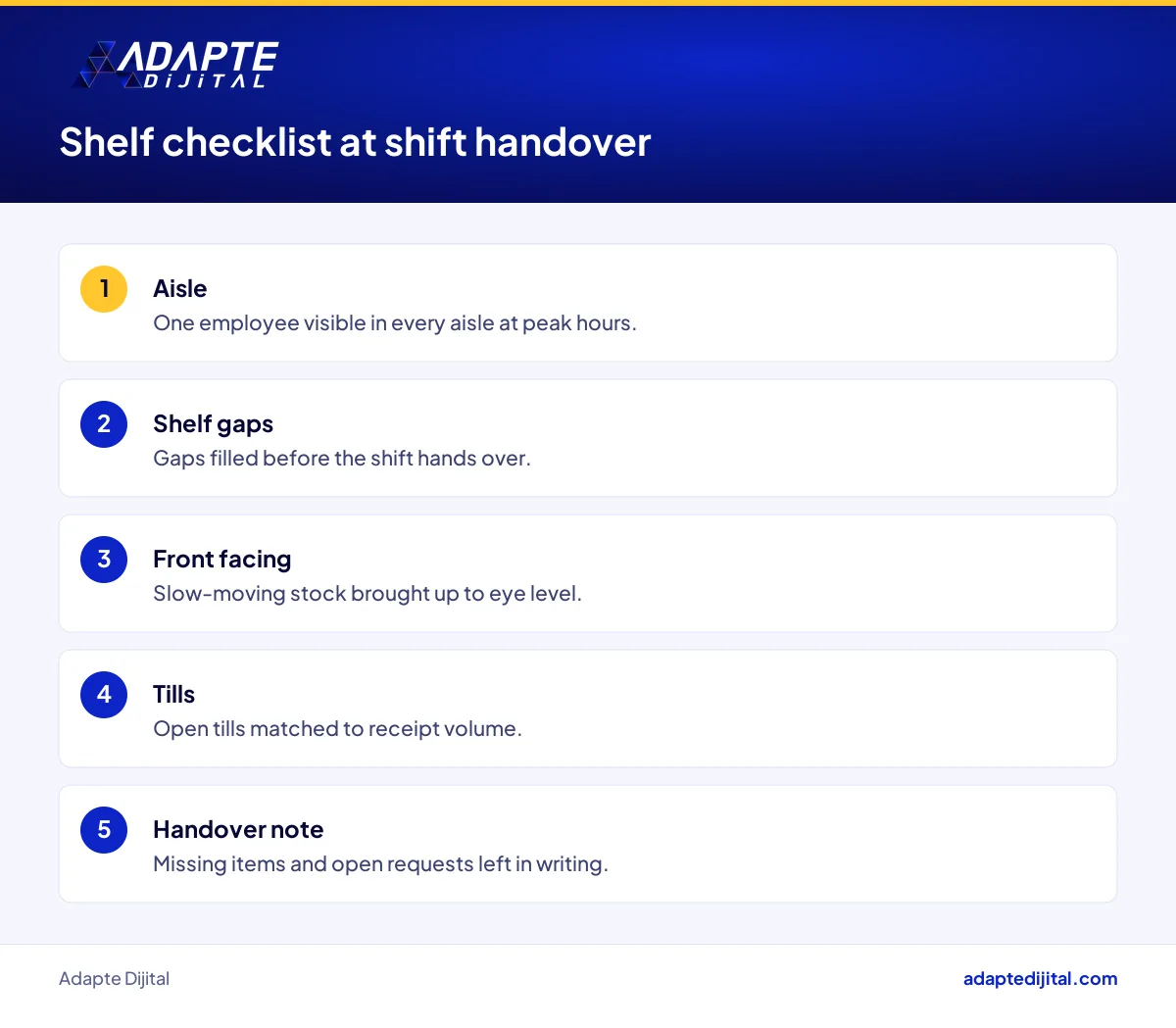
At peak hours, at least one employee should be visible in every aisle. Shelf gaps should be filled before each handover, with slow-moving stock brought forward. Match the number of open tills to receipt volume, and make sure outgoing staff leave a note of missing items.
Keeping shift and hiring data in one place makes the work easier
Bringing till data, the rota and recruitment visibility into a single dashboard is part of our digital consulting work.
Quick Summary
- According to Perakende.org, Rossmann Türkiye won 5 Stevie Awards 2026 honours for its “Two Days Off a Week” model (13 October 2026).
- Weekly time off rose from one day to two, and the practice was announced in March 2026 (Capital).
- Before the model, the company ran a year of field analysis in 50 stores (Perakende.org).
- According to the company, staff turnover improved about fourfold, with no independent check (Perakende.org).
- A small store can apply the same method in the order measure, test, roll out.
Short Glossary
- Staff turnover
- Staff turnover is the HR measure used to express the share of employees who leave and are replaced over a given period.
- Pilot
- A pilot is the method used to test a new practice in a limited number of stores before rolling it out everywhere.
- Employer brand
- Employer brand is the concept used to describe a company’s reputation among its staff and job candidates.
Frequently Asked Questions
Next Step
If you would like to read your store’s shift and till data together, fill in the Consult Your Expert form.
Sources: Perakende.org, Rossmann Türkiye Stevie Awards 2026 report, 13 October 2026 · Capital, 27 March 2026 · Perakende Türkiye, October 2026 · Stevie Awards for Great Employers 2026 winners page (linked in the text)
Updated: October 2026
Sık Sorulan Sorular
The report describes the fifth award as a “Company of the Year” title in the Retail category of a global public vote, and mentions 34,000 votes. It describes the programme behind this award in two different ways, so we leave the programme name open.
Not yet. The Great Employers programme, organised by Stevie Awards Inc, is in its eleventh year in 2026. Its winners page is made up of category links, and the content read did not show Rossmann’s name, so the award details here rest on Perakende.org. The same report says Rossmann Türkiye made Forbes’ list of Türkiye’s Best Employers in 2026.
The report lists only the headings, not the detail. For one store, the translation is clear: how many customers walk in at each hour, when the till queue grows, which day staff want off. A rota is like the back of a shelf. Customers never see it, but they notice the gap at once.
Rossmann launched Store Manager Development, Store Manager Training and Mentor Store Manager programmes (Perakende.org). In any store with two days off, someone has to rebuild the rota every week, and that usually falls to the manager. A flexible rota is only as flexible as the planning skill behind it.
The report does not say whether hours, pay or headcount changed with the move. If you adapt the model for your own store, work out each of those three lines separately.
Take hourly receipt counts from your till system; four weeks is a good start. Put full cover on the busy windows and fewer people on the quiet ones. Hours with a low average basket but a high receipt count call for an extra person at the till.
Collect preferred days off first, then fix the clashes on busy days. Saturday may be the day everyone wants, and a rotating weekend pattern settles that. Predictability is the key, so publish the rota at least two weeks ahead.
Predictability and flexibility are the two ideas at the centre of Rossmann’s March 2026 announcement (Capital). Staff know their days off in advance and can plan their lives around them.
Rossmann Türkiye operates 226 stores with more than 2,000 employees as of October 2026 (Perakende Türkiye). A step like this from a chain of that size can change how staff compare employers across the sector. Our retail page tracks employer moves like this one.
For a candidate, working pattern can matter as much as pay. Clear phrases such as “two days off a week” and “rota set two weeks ahead” help an ad stand out in platform filters and searches. A vague ad sends good candidates to a rival listing.
Set hourly receipt data next to the rota and missing cover at peak time shows up at once. In front of the shelf, a customer looks for the product, the price and someone to help within three seconds. If nobody is there, the customer turns back at the door. We look at experience and sales from another angle through JYSK’s bed experience at SkyView.
Answer criticism on employer review sites briefly, professionally and with specifics. If a practice has changed, say so in the reply.
After four weeks, look at three things: till queues, absences and staff intention to leave. Share the numbers with your team and adjust the pattern together. Rossmann explains its turnover improvement with its own data, and you cannot talk about results without keeping yours.
According to Perakende.org, the model started as a pilot and spread to all stores. At the time of the March 2026 announcement, the company had more than 200 stores (Capital).
It depends on your peak-hour data. If hourly receipts show quiet windows, a rotating pattern may work with your current team; if not, you may need an extra part-time employee.
Divide the number of employees who left in a period by the average number of employees in that same period. Using the same method every quarter lets you see the change.