
Own a digital asset: how does the Asset Value Card show a project’s potential?
In the Own a Digital Asset campaign, every project we build comes with an Asset Value Card. The card is a one-page summary that shows the project’s potential with data, not promises. What people search for in the sector, which of those searches your domain and content plan answer, and which figure to watch in the first months: it all sits on one card.
The card is not an earnings guarantee, and it is not a ranking promise. The START package is TRY 36,000 + VAT, upfront at a fixed price, and the Asset Value Card is one of its deliverables. Below we explain how we build the card, how we read it and how you will use it.
What does the Asset Value Card show, and what does it not?
The card shows the opportunity in the project and the indicators that will measure it. Sector demand, target keyword groups, the reasoning behind the domain and the measurement setup all appear on it. What the card does not show is a certain income or a certain ranking. Nobody can know those.
What it shows: opportunity and indicators
The card sums up the opportunity analysis in plain language: which questions people search and how many pieces answer each group. You track progress with GA4 and Search Console.
What it does not show: a guarantee
There is no “you will earn this much a month” line. Competition, season and your own involvement change the outcome.
Which data do we fill the card with?
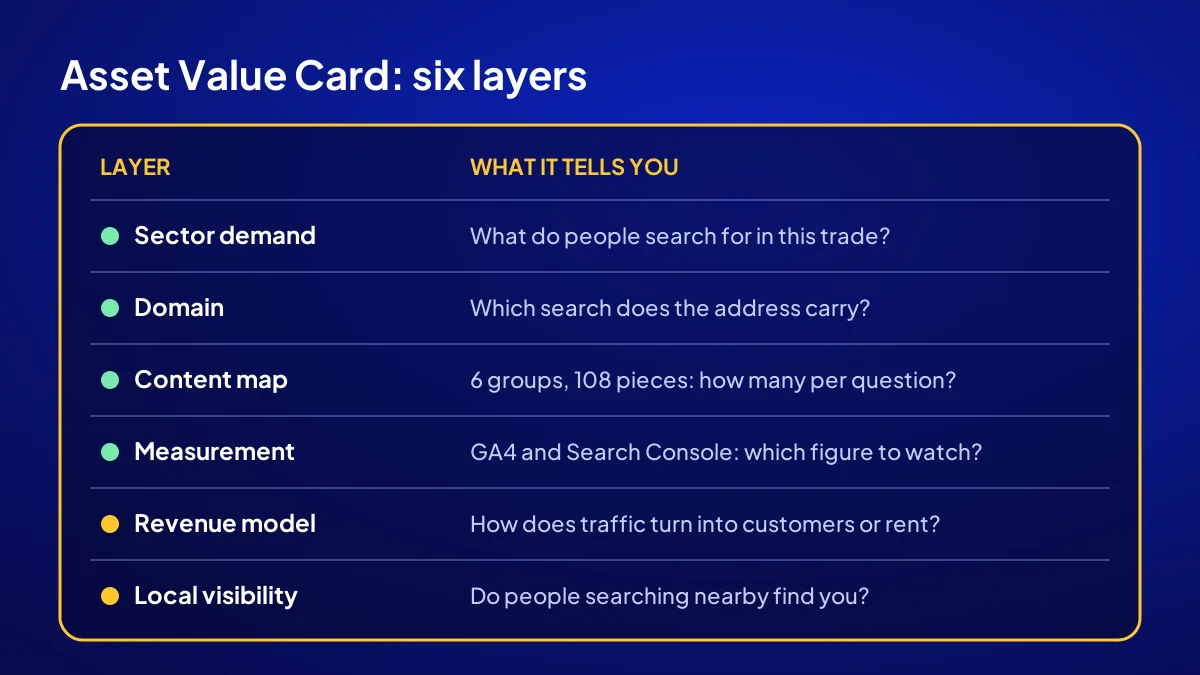
We build the card from a summary of the work inside the package: sector and opportunity analysis, domain choice, 108 pieces of content planned across 6 keyword groups, and the measurement setup. Each layer answers one question. The table shows where each layer comes from and what it tells you.
| Layer | Where it comes from | What it tells you |
|---|---|---|
| Sector demand | Sector and opportunity analysis | What are people searching for in this trade? |
| Domain | Domain choice | Which search does the address carry? |
| Content map | 6 keyword groups, 108 pieces | Which question gets how many articles? |
| Measurement | GA4 and Search Console | Which figure to watch in the first months? |
| Revenue model | Project file and roadmap | How does traffic turn into customers or rent? |
| Local visibility | Google Business Profile (local projects) | Do people searching nearby find you? |
The domain is in your name
The domain on the card’s first line is registered in your name, and 1 year of hosting is included. The owner of the property is clear from day one. We walk through the general logic of website value in how to value a website.
Structured data and measurement from day one
The site is delivered with structured data, GA4 and Search Console connected. With measurement live from day one, the card’s lines never sit empty.
Why are being seen and being clicked read on separate lines?
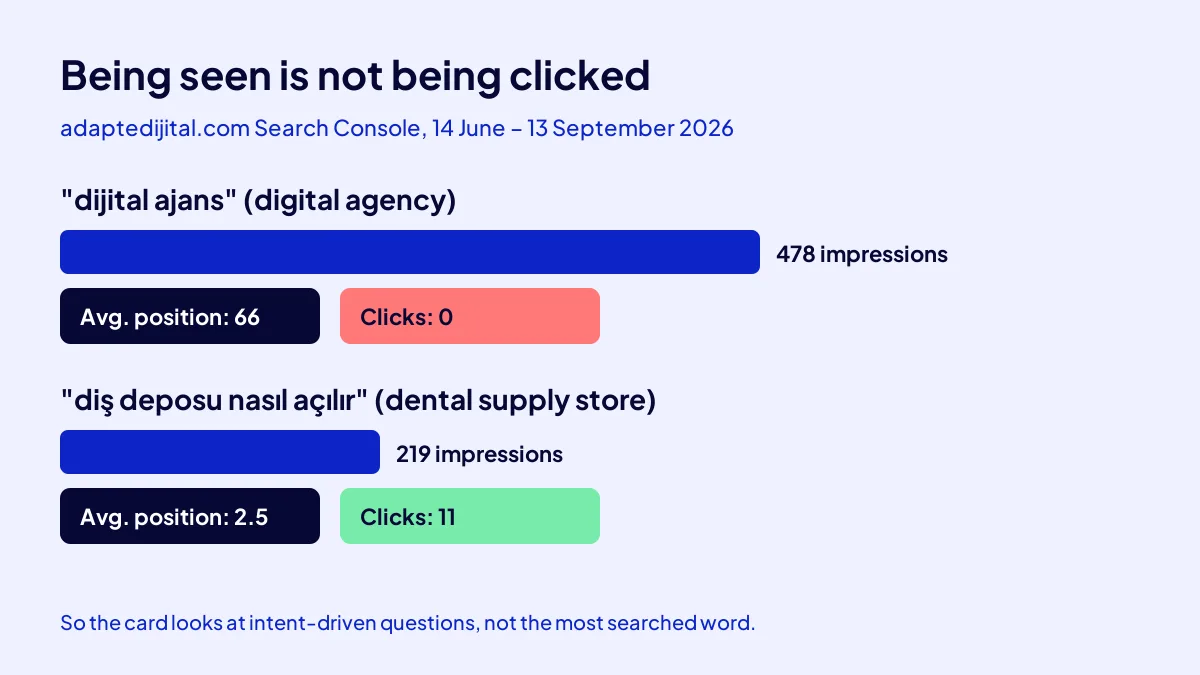
Because showing up on Google does not mean a customer clicks on you. Search Console reports impressions, clicks, click-through rate and average position separately. On the card we read those four figures side by side. We see this gap first on our own site, in adaptedijital.com’s data, and we build our method around it.
An example from our own site
In adaptedijital.com’s data for 14 June to 13 September 2026, the query “dijital ajans” (digital agency) stands at 478 impressions, an average position of 66 and zero clicks. In the same period, “diş deposu nasıl açılır” (how to open a dental supply store) sits at 219 impressions, an average position of 2.5 and 11 clicks. The less visible question brings more visitors.
That is why the card looks at intent
A short, crowded keyword earns many impressions but ranks far down. A long question with clear intent climbs to the top faster. So when choosing the 6 keyword groups, we put the question closest to a purchase ahead of the most searched word.
How is the card used across the project’s three stages?
The campaign process has three stages: choosing the sector, project planning, and setup and launch. The Asset Value Card is the common language of all three. We discuss the opportunity when choosing the sector, the domain and revenue model when planning, and the measurement points at handover, all on the card.
- Choosing the sector: We talk through one of 12 sectors, such as cosmetics, food, real estate or cleaning, or one outside the list. The card’s first line, sector demand, fills in here.
- Project planning: Opportunity, domain and revenue model become clear. The project file and roadmap feed the card’s second and fifth lines.
- Setup and launch: A site with 6 main and 12 sub-pages, 108 pieces of content and measurement go live. In the handover video we read the card with you, line by line.
An extra line for health and law
In fields where advertising is restricted by regulation, such as dentistry, healthcare or law, we check the professional rules first. Ministry regulations or bar association rules go into the content plan as a note. The content stays inside that line.
What does the card do on the day you sell or rent?
The property is yours, and renting it out or selling it later is possible. When that day comes, a buyer or tenant first asks where the traffic comes from and how steady it is. The Asset Value Card and the Search Console history behind it are the ready answer. A property with figures negotiates with records, not with talk.
Keeping records protects value
An up-to-date card documents the property’s history. A site without measurement is left with only its word at the table.
Work out the return yourself
The card gives the figures and leaves the return decision to you. You can find the calculation that puts cost and annual upkeep side by side in digital asset cost and return. For the general return logic of digital investment, see digital transformation ROI.
How do payment, the coupon and the places work?
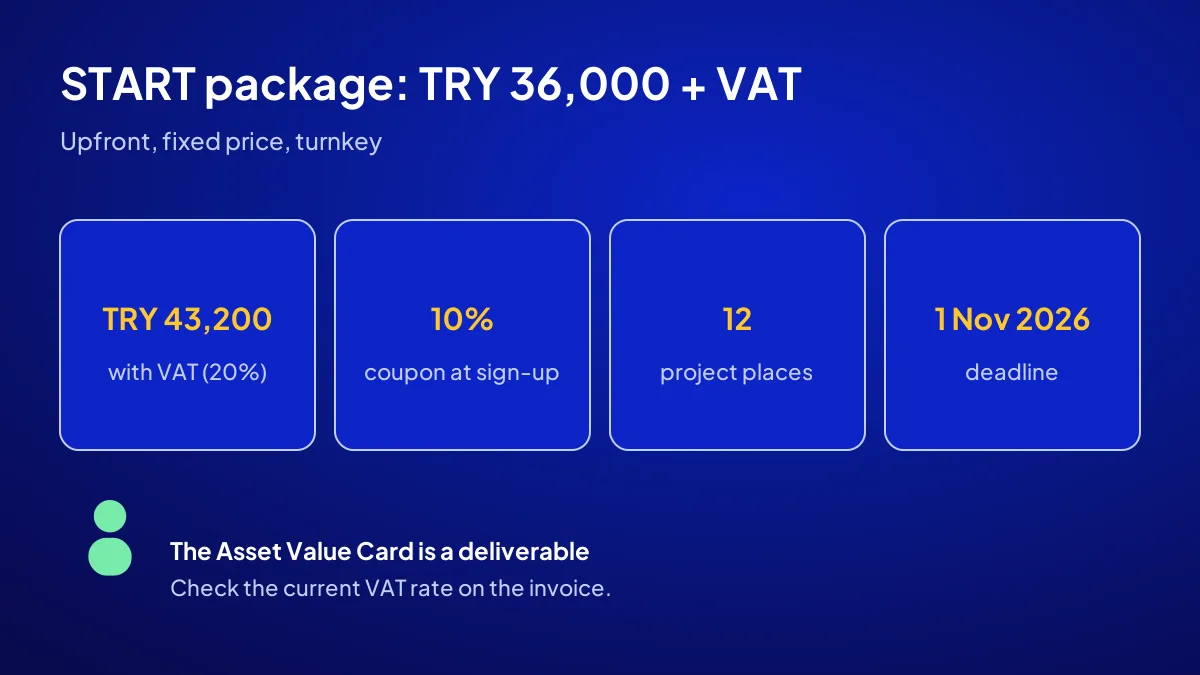
The START package is TRY 36,000 + VAT, upfront at a fixed price. With 20 percent VAT the total is TRY 43,200; the rate may have changed, so check the current rate on the invoice. If you have the 10% coupon code, just mention it when you apply or during the call. The campaign has 12 project places, and the deadline is 1 November 2026.
From application to card
We discuss your sector when you apply, and the card reaches you at handover. For the full picture, start with owning a digital asset. To apply, go to the Own a Digital Asset campaign page.
Quick Summary
- The Asset Value Card is a one-page summary that shows a project’s potential with data.
- The card gives no guarantee; it shows sector demand, domain, content map and measurement.
- Being seen and being clicked are read separately; intent-driven questions come first.
- The card is the shared language of sector choice, planning and setup.
- On the day you sell or rent, the card and Search Console history become your record.
- TRY 36,000 + VAT upfront, 10% coupon, 12 places, deadline 1 November 2026.
Short Glossary
Impressions: Impressions is the Search Console metric used to count how many times your site appears in Google search results.
Click-through rate: Click-through rate is the ratio used to measure interest in search, found by dividing clicks by impressions.
Asset Value Card: The Asset Value Card is the method Adapte uses to show a digital asset project’s opportunity and measurement points on one page.
Next Step
If you want to see how the card would fill in for your own sector, the next step is to apply. Apply to the Own a Digital Asset campaign and let us plan your project before 1 November 2026.
Frequently Asked Questions
Source: Search Console Help — Performance report (Search results)
Sık Sorulan Sorular
Shopkeepers are short on time. One page reads at a glance, like checking the till; detail lives in the project file and roadmap.
In the first months, watch impressions grow before you watch clicks. Impressions tell you Google is starting to recognise your site for those questions. Clicks and enquiries follow; that order holds.
+180 pieces of content, brand identity, e-commerce or a lead collection system can be added as options. Each option shows on the card as its own line.
In every project, sector analysis, domain choice and 108 pieces of content go through the same team. To build each card with care, we limit how many projects we run at once. The way to get a place before the shutters come down is to apply early.
The START package is TRY 36,000 + VAT, upfront at a fixed price. With 20 percent VAT the total is TRY 43,200; check the current rate on the invoice.
Simply mention your 10% coupon code when you apply or during the call.
No. The card guarantees neither earnings nor rankings. It shows the project’s opportunity, the domain and content plan, and the figures to track, using data.
Updated: October 2026