
Future of content sites: where value is shifting in the AI era by 2027
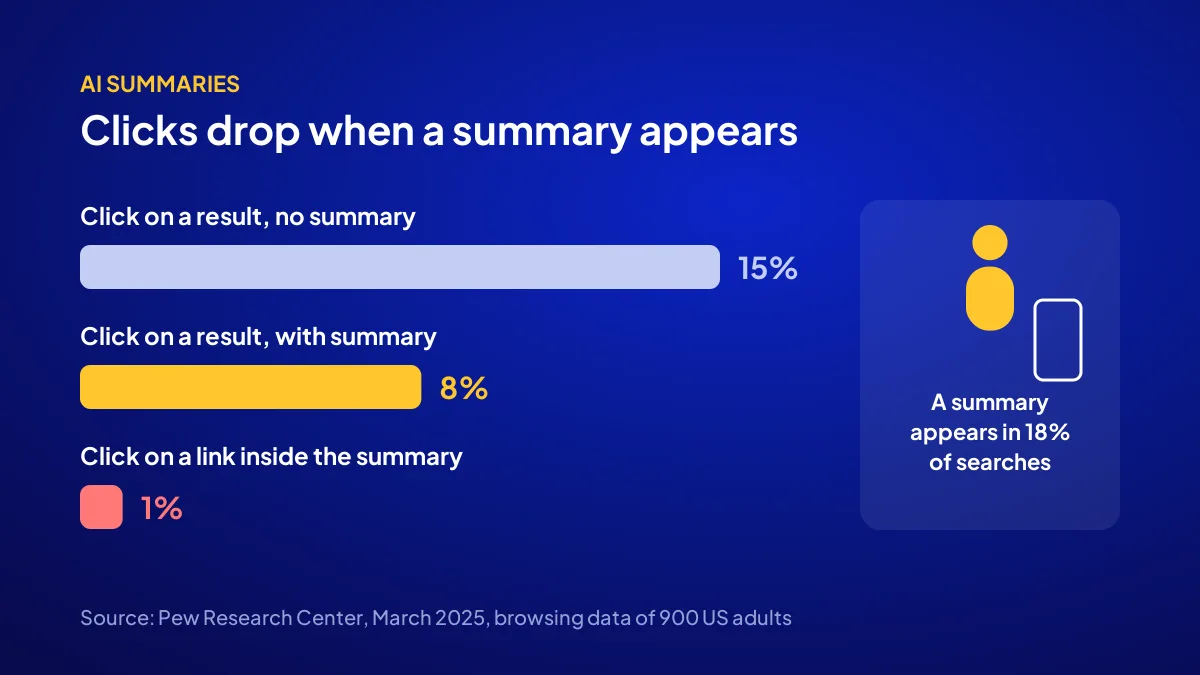
Say you own a content site and AI summaries have you thinking “nobody will click any more”. The future of content sites toward 2027 is more nuanced than that: value is shifting from click counts to being the source, and to ownership. According to Pew Research Center data from March 2025, Google users click a result in 8 percent of visits when an AI summary appears; without a summary, the figure is 15 percent.
But that same summary needs a source. Google states on its own help page that there are no extra requirements to appear in AI features, and that core SEO practices still apply. So the site that repeats general information weakens, while the site that gives original answers to a specific sector’s questions, with a clear owner, moves forward.
Do AI summaries make content sites worthless?
No, but they change the shape of traffic. The summary answers the user’s first question on the results page, so clicks drop for simple questions. For detailed questions where a decision gets made, users still go to a source. What loses value is not the content site but the generic copy nobody specifically looks for.
The unexpected finding
The summary does not erase the source; it sorts sources. Copy-paste sites get filtered out, while the page with the best answer to a specific question becomes what the summary rests on.
Say you run a site that answers 108 questions: what changes by 2027?
BU BÖLÜMÜN ÖZETİ
- The customer asks in one sentence
- Clicks may fall, the phone does not
- Your site becomes a data store
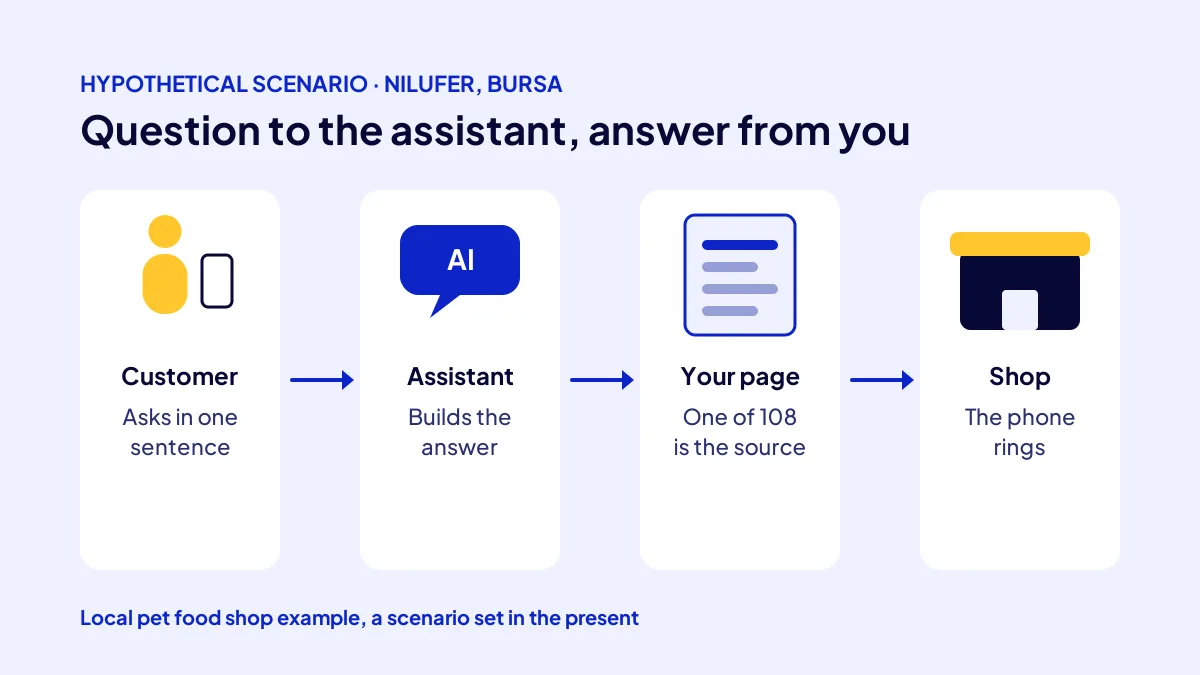
Picture a pet food shop in Nilüfer, Bursa. Your site holds 108 posts across six topic groups: which food suits which age, how to choose cat litter, which day you deliver in the neighbourhood. Heading into 2027, your customers ask these questions more and more to an assistant. The assistant builds its answer from the page that answers the question most clearly.
The customer asks in one sentence
A long question like “a shop in Nilüfer that sells grain-free cat food and delivers in the evening” gets asked in one go. The shop that writes these details on its pages has a chance to make it into the answer. The one that does not stays invisible, even with its shutters up.
Clicks may fall, the phone does not
Maybe the customer does not browse your site at length. But they see your name, address and number in the answer and call you directly. This scenario is hypothetical; the logic holds in every local sector.
Your site becomes a data store
The 108 posts also record what customers ask. With GA4 and Search Console, you see which question earns impressions. That information can even change what goes on the shelf.
Which content sites lose value, and which gain it?
The split rests on one question: does this page say something that exists nowhere else? A site repeating what everyone writes melts into the summary. A site that gives original, current, clearly owned answers to the questions of a specific sector, city and customer stays a source. The table below sums up that split as a 2027 expectation.
| Criterion | Site losing value | Site gaining value |
|---|---|---|
| Topic | A bit of everything, general information | One sector, clear questions |
| Information | Repeats other sites | Local and sector detail |
| Ownership | Unclear who owns it | Domain and brand in the owner’s name |
| Measurement | No tracking, run on gut feeling | GA4 and Search Console connected |
| Voice | No author, no voice | A consistent, recognisable author voice |
| Technical | No structured data | Readable with structured data |
Why is the gap between being seen and being clicked growing?
Because a summary can give its answer without showing your page. We see this in Adapte’s own data. Between 14 June and 13 September 2026, adaptedijital.com gets 142,296 impressions and 1,699 clicks, an average click-through rate of about 1.2 percent. Being seen and being clicked are not the same thing, and the gap matters even more in 2027.
Mobile versus desktop
In the same period, 1,267 of the clicks come from mobile. The mobile click-through rate is 1.86 percent, desktop 0.57 percent. Customers ask from their pocket and call from their pocket.
What is owning a site worth in 2027?
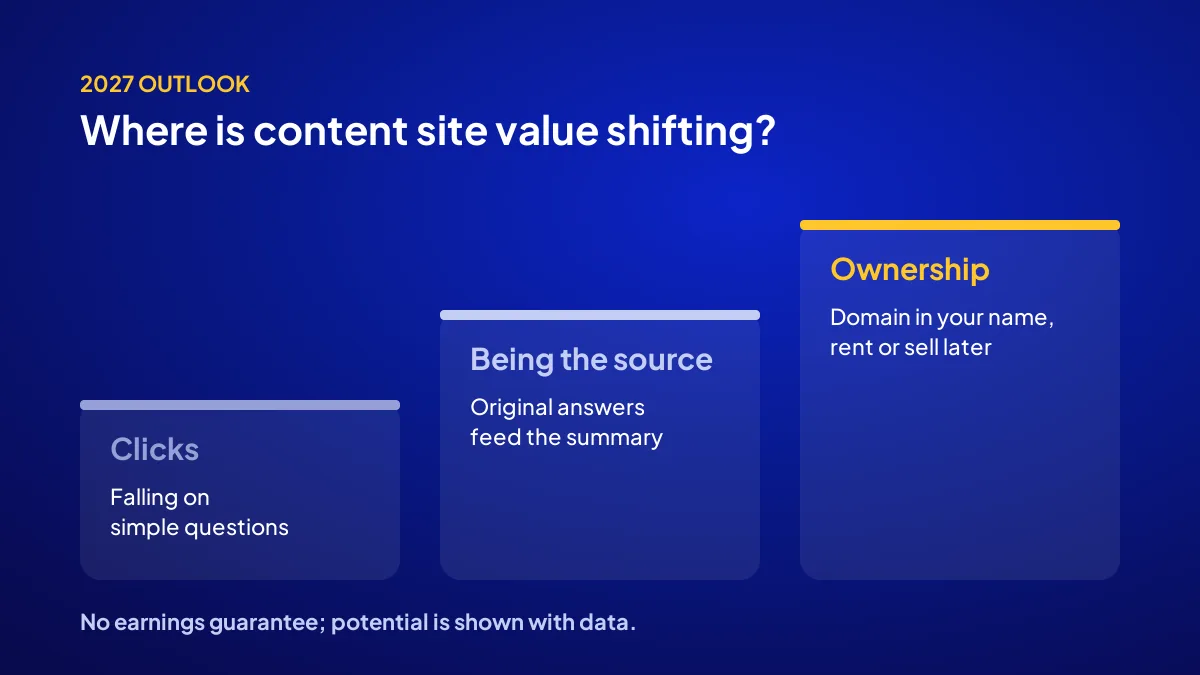
Ownership is like the difference between a rented shop and one you hold the deed to. If the domain, site and content are in your name, the traffic and trust they build stay with you. The asset can later be rented out or sold. But nobody can promise you certain earnings, and in the AI era that uncertainty is even plainer.
The rent and sale option
A site that gathers traffic can bring customers to another business even if you do not do the work yourself. We cover the logic of the rental model in why traffic sites can be rented.
No guarantee, but data
The campaign carries no earnings guarantee; potential is shown with data. You can find how to read the return on a digital investment in digital transformation ROI.
Which 3 decisions prepare you for 2027 starting today?
Preparation starts with three decisions: stay in one sector, build the asset in your own name, and switch on measurement from day one. These three decisions work regardless of how AI summaries change. You can read why domain, site and content gain value together in owning a digital asset.
- Choose one sector and one city, and answer the questions people ask there.
- Build the domain, site and content in your own name.
- Connect GA4 and Search Console from day one.
One principle holds: the page that gives an answer found nowhere else stays a source, however search changes.
Calendar
There are 12 project slots and the last day is 1 November 2026. See the Own a Digital Asset campaign page for details.
Quick Summary
- Searches with an AI summary see an 8 percent click rate versus 15 percent without (Pew, March 2025).
- According to Google, there are no extra requirements to appear in AI features.
- Generic copies lose value; sites with sector-specific answers become sources.
- Being seen and being clicked differ; measure impressions too.
- Ownership keeps the rent and sale options open; there is no earnings guarantee.
- Preparation takes three decisions: one sector, an asset in your name, measurement from day one.
Short Glossary
AI summary: An AI summary is the feature used to give a short answer with source links above the search results.
Click-through rate: Click-through rate is the ratio used to measure what share of a page’s impressions turn into clicks.
Structured data: Structured data is the code used to label page information in a form search engines understand.
Next Step
If you want to be the source in a sector, build the asset in your own name starting today. Apply to the Own a Digital Asset campaign and see your sector’s potential with data.
Frequently Asked Questions
Source: Google Search Central — AI features and your website
Sık Sorulan Sorular
The study draws on the March 2025 browsing data of 900 US adults. An AI summary appears in 18 percent of searches. Clicks on a link inside the summary come to just 1 percent of visits.
Google says clicks from results pages with AI Overviews are higher quality. Fewer visitors arrive, but with more intent.
An assistant trusts a source that answers consistently within one sector. A site focused on one sector is recognised more easily than one spread across ten topics. We explain this focus logic of a digital asset in more detail in what is a digital asset.
Structured data means labelling what a page says in a way machines understand. Details like address, product and Q&A become easier to read with these labels.
Not just clicks: impressions, the variety of queries and incoming calls too. Whoever knows which questions they appear for can arrange the shelf to match. Deciding without seeing that is fighting in the dark.
The START package of the Own a Digital Asset campaign includes sector and opportunity analysis, a domain in your name, a site with 6 main and 12 sub pages, 108 AI SEO-ready pieces of content, GA4, Search Console and structured data. The price is TRY 36,000 + VAT, or TRY 43,200 with 20 percent VAT; check the current VAT rate on your invoice.
Current data does not show that. Clicks fall on searches with a summary, but summaries still rely on source pages. Google states there are no extra requirements to appear in AI features.
No. There is no earnings guarantee. The asset’s potential is shown with data through the sector and opportunity analysis and the Asset Value Card.
An optional 180 more pieces can be added to the 108 in the START package. The need is set during project planning, based on how many questions the sector has.
Updated: October 2026