
What is a digital asset business? Not crypto, a site you own that pulls traffic
What is a digital asset business? From a business owner’s side the answer is short: a domain, a site and content that belong to you, pull search traffic and grow in value over time. It is not cryptocurrency, it is not a digital collectible and it is not traded on an exchange.
Most people do not know this: when you say “digital asset”, the finance world hears crypto and the shopkeeper hears nothing at all. Yet the term is also used for a site whose title deed is in your hands. Adapte’s Own a Digital Asset campaign sells this second meaning: an asset that starts with a domain, a site and 108 posts for TRY 36,000 + VAT.
Why does everyone hear “crypto” when you say digital asset?
Because in recent years the term has appeared most often in crypto news. In English, an asset is anything you own that carries value: a house, a car, a share or a website. Crypto is only one branch of that wide family. In business language, a digital asset is digital property that can bring you income or customers.
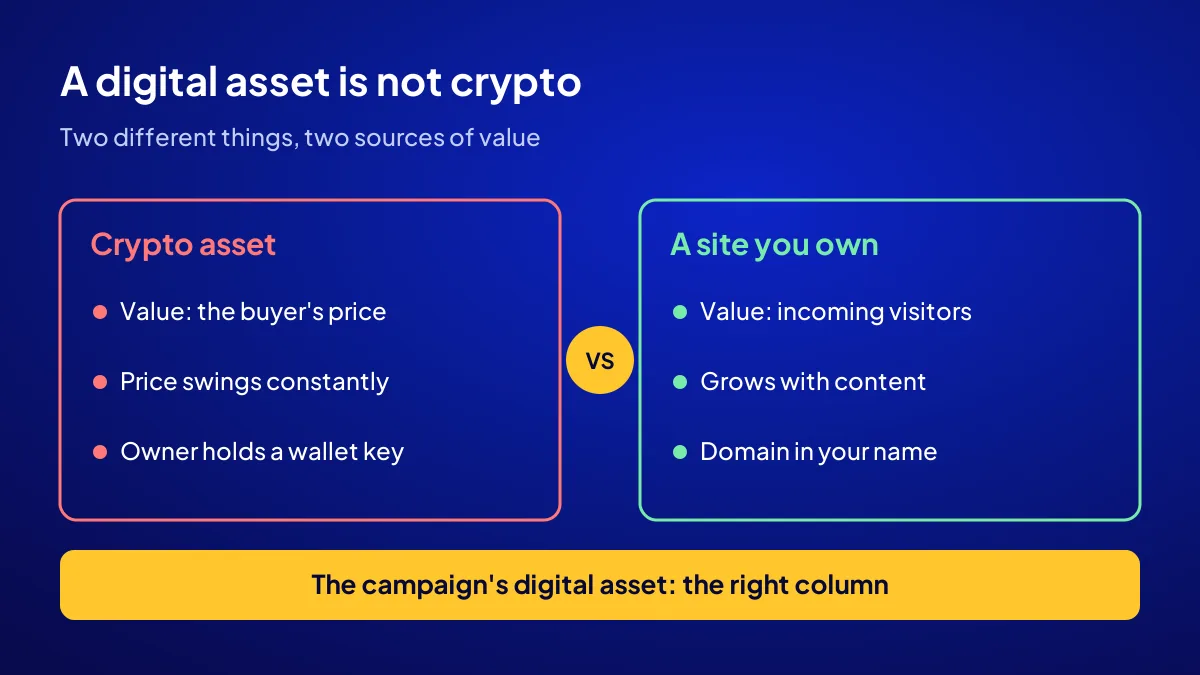
The difference from crypto in one sentence
Crypto gets its value from the price buyers put on it. A site gets its value from the visitors who walk through its door every day and the business they leave behind.
What is the difference between your own site and a social media account?
The difference lies in ownership and rules. You use a social media account, but the platform owns it. The platform changes the algorithm, reach drops and the account can be closed. On your own site, the domain is registered in your name, the content is yours and any transfer is your decision.
| Criterion | Your own site | Social media account |
|---|---|---|
| Ownership | Domain in your name | Subject to the platform’s terms of use |
| Rules | You set them | The platform sets and changes them |
| Traffic source | Search engines and AI assistants | The feed algorithm |
| Transfer and sale | Possible, ownership is clear | Restricted on most platforms |
You have an account, not a shop
You may have 5,000 followers on Instagram. But when the algorithm changes, you do not decide what share of them sees your post. When customers stop walking in, the reason is often the feed itself, not you.
A site has a long life
A well-built site works for years. We explain how long a site lasts in how long will my website last.
What 3 conditions make a site an asset?
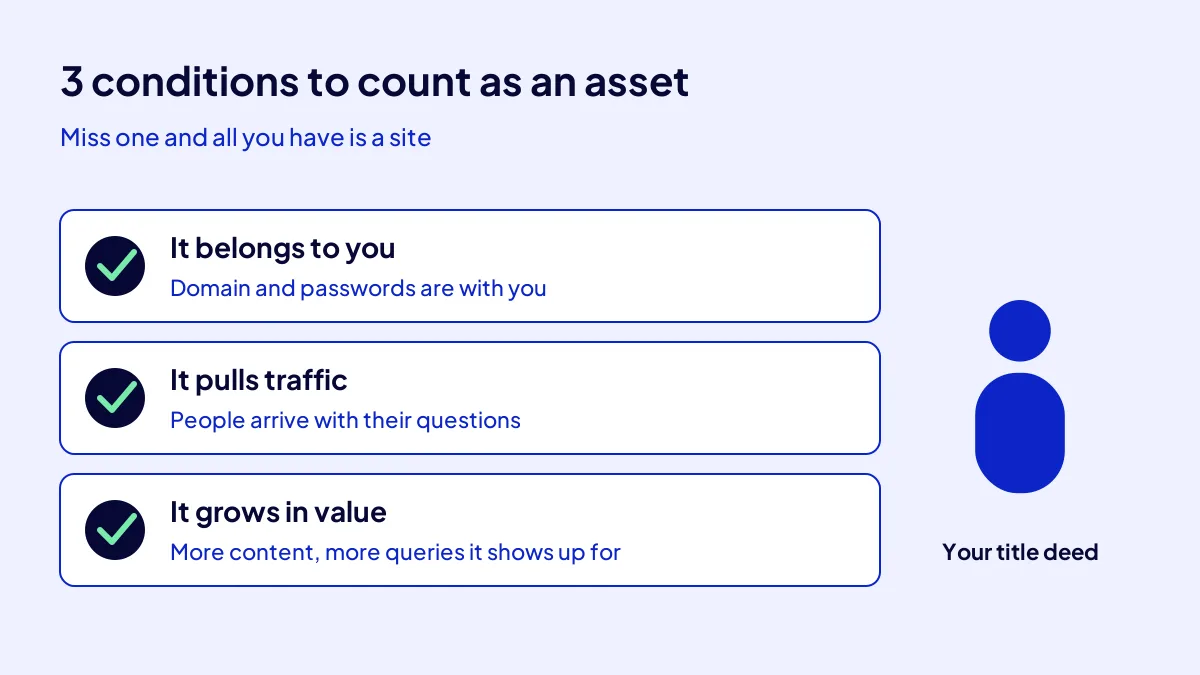
There are three conditions: it belongs to you, it pulls traffic and it grows in value. If one of the three is missing, you have a site but not an asset. A site registered to an agency does not belong to you. A site with no visitors pulls no traffic. A site whose content never grows does not gain value; it only produces a yearly hosting bill.
- It belongs to you: the domain is in your name and the admin passwords are with you.
- It pulls traffic: people reach your site with the question they ask Google or an assistant.
- It grows in value: as content builds up, it appears in more queries and the visitor count grows.
Why a business card site is not an asset
A single page saying “about us and contact” is a business card. Nobody searches for it, because it answers no question. Organic traffic, meaning visitors who arrive without ads, only goes to pages that answer something.
An everyday comparison: stock on the counter
Nobody walks into a shop with empty shelves, and anyone who does leaves empty-handed. On a site, the shelves are the content. A site that opens with 108 posts is like a shop that opens fully stocked. The old rule holds: you need goods before you can sell goods.
With 401.6 million domains out there, why would yours carry value?
Because the value does not come from the address itself but from the traffic behind it. According to Verisign’s report for the second quarter of 2026, there are 401.6 million registered domain names worldwide. Of these, 166.6 million are .com. Among so many addresses, a domain stands out only if it answers specific questions in a specific sector.
Millions of new addresses every quarter
According to the same report, the number of domains grows by 9.1 million in a quarter; the yearly growth is 8.1 percent. So finding an empty address is not hard. The hard part is bringing people to it.
What will a digital asset bring you, and what won’t it?
It brings you a lasting door for customers and an asset you can transfer. It does not bring a guarantee. Traffic and income depend on the sector, the competition and the quality of the content. Adapte does not guarantee earnings; it shows the potential with data. This is not investment advice either. Decide according to your own cash position and your business.
Three things it can bring
Customers for your own business, the option of renting it to another business and the option of selling it later. You will find the logic of the rental model in why traffic sites can be rented.
The thing it will not bring
A magic button that fills the till in a month. If the till is not ringing and you need cash this month, an asset investment may not be your first step.
Which parts make up a digital asset in the START package?
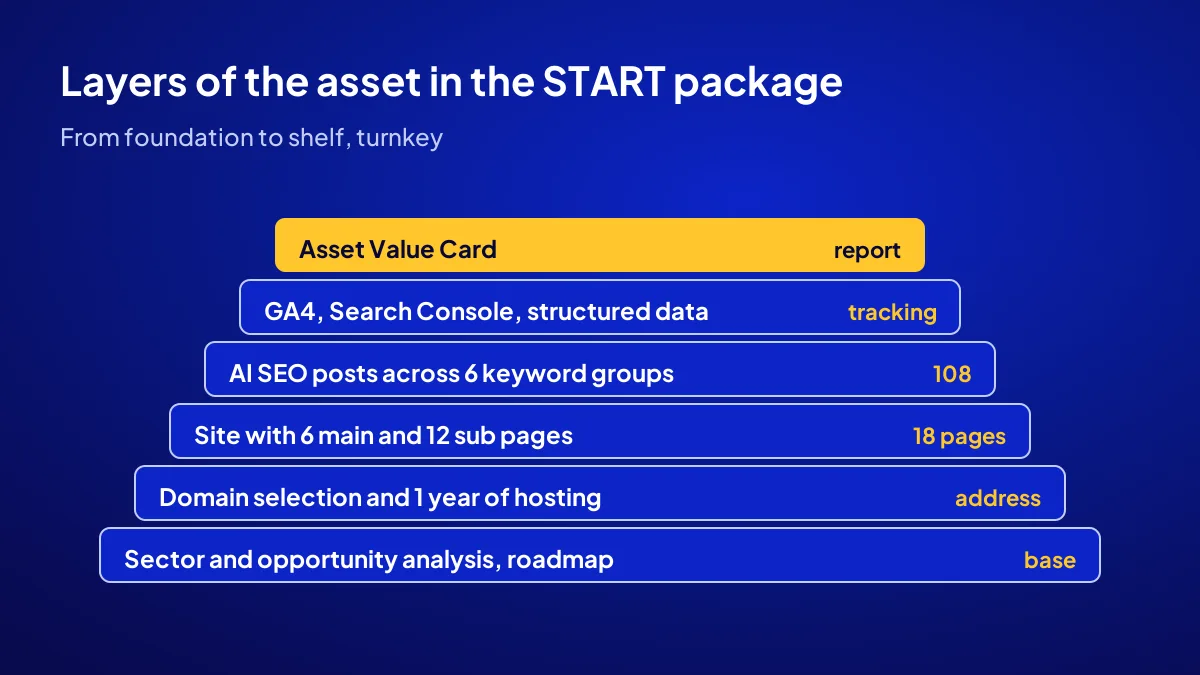
The START package is TRY 36,000 + VAT, paid upfront at a fixed price. With 20 percent VAT it comes to TRY 43,200; check the current rate on the invoice. The package is delivered turnkey, from the sector analysis to the handover video. The domain is bought in your name and 1 year of hosting is included. For the full picture of the asset, see owning a digital asset.
- Sector and opportunity analysis, project file and roadmap
- Domain selection and 1 year of hosting
- A site with 6 main and 12 sub pages
- 108 AI SEO ready posts across 6 keyword groups
- GA4, Search Console, structured data; a Google Business Profile for local projects
- Asset Value Card and a handover video
Slots and coupon
The campaign has 12 project slots, and the last day is 1 November 2026. If you have a 10 percent coupon, just mention the code when you apply or during the call. If you have picked your sector, you can apply on the Own a Digital Asset campaign page.
Now you know
A digital asset is not crypto; it is a site whose title deed is yours. It must belong to you, pull traffic and grow. Its value comes not from the address but from the people who arrive at it.
Quick Summary
- A digital asset is a domain, site and content package you own that pulls traffic and grows in value.
- It is not cryptocurrency or a digital collectible.
- Three conditions: it belongs to you, it pulls traffic, it grows in value.
- There are 401.6 million domains worldwide; traffic sets the value.
- The START package is TRY 36,000 + VAT, with 108 posts and the domain in your name.
- There is no earnings guarantee; the potential is shown with data.
Short Glossary
Asset: An asset is the accounting term used for anything a person or business owns whose value can be measured.
Organic traffic: Organic traffic is the measure used for visitors who reach a site from search results without paid ads.
Domain extension: A domain extension is the term used for the ending of an address, such as .com or .com.tr.
Next Step
Let’s see together which sector could hold an asset that belongs to you. Apply for the Own a Digital Asset campaign and start with your sector and opportunity analysis.
Frequently Asked Questions
Source: Verisign — Domain Name Industry Brief, Q2 2026
Sık Sorulan Sorular
In accounting, an asset sits on the left side of the balance sheet. It belongs to the business and its value can be measured. The title deed to a shop is an asset; the monthly rent invoice is not.
A domain that carries the word the sector searches for, is easy to remember and has a full site behind it stands out. We list the sources of a domain’s value one by one in what makes a domain valuable.
A digital asset is something you own that pulls traffic and grows in value: a domain, a site and content together. In Adapte’s campaign, the domain is registered in your name.
No. What is meant here is a domain and a site that you own. Its value comes not from price swings but from the visitors and the content on the site.
Not quite. You use the account, but the platform sets the rules and transfer is often restricted. A site on your own domain belongs to you.
Updated: October 2026