
Local domain SEO: how a city plus sector domain works as a digital asset
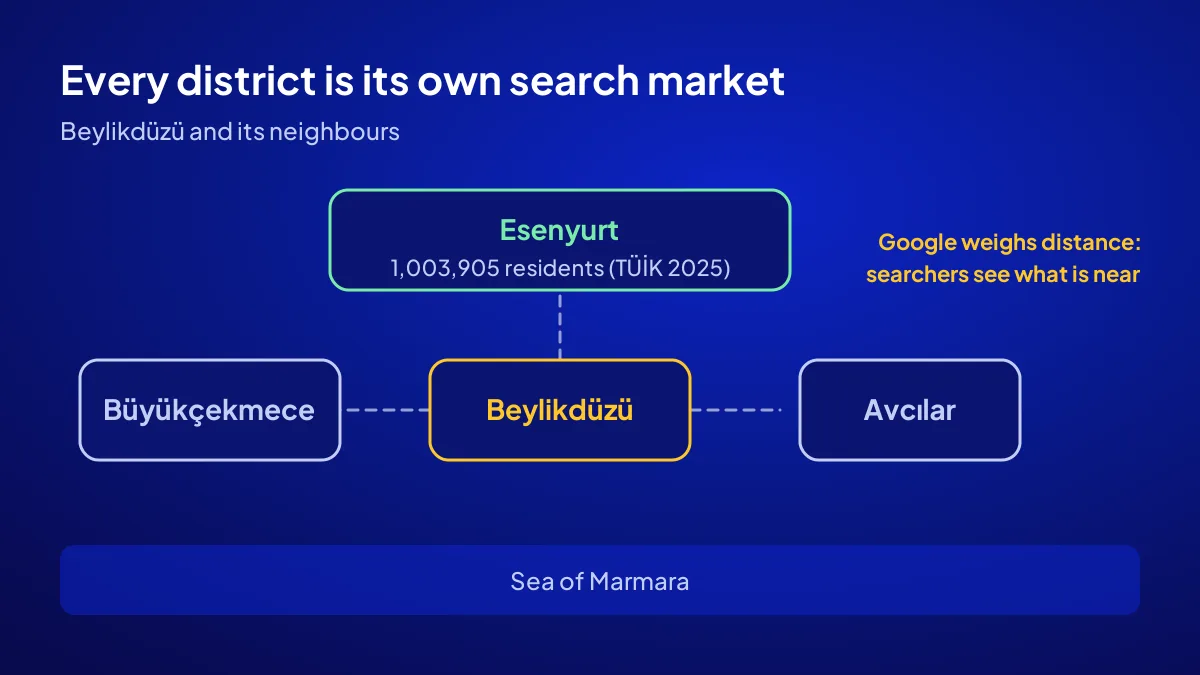
Local domain SEO means a site built on a domain that joins a district or city name with a sector, gathering traffic from searches in that area. From Beylikdüzü the picture is clear: next door, Esenyurt has 1,003,905 residents according to TÜİK’s 2025 data, the first district in Türkiye to pass one million. That is a market where people search “near me” every day.
The short answer: a district name in the domain will not lift you up the rankings by itself. Google says so plainly. What makes a local asset work is content about that district, real business details and recognition earned over time. The domain is the signboard: memorable, clickable and, later, rentable.
What does a city plus sector domain actually do?
A city plus sector domain tells the visitor “this is my district and the trade I need” before they even click. Its direct ranking effect is small; Google’s SEO Starter Guide says keywords in a domain name have hardly any effect beyond appearing in breadcrumbs. Its value lies in trust, recall and the asset’s ability to be handed over later.
A domain is a signboard
Like the corner shop’s sign, a district domain catches the eye in search results. But the right sign makes walking in easier.
The real work happens in content
Google looks at how well a page matches the search. Pages covering the district and the service together do far more work than the domain does.
How does local search work, seen from Beylikdüzü?
Beylikdüzü borders Esenyurt, Avcılar and Büyükçekmece, and each is a search market of its own. Someone looking for air conditioning repair in Esenyurt wants the nearest service, not one across the line. So a local asset targets one district or two neighbouring ones, not the whole of Istanbul.
A neighbouring district is a separate market
Istanbul’s population is 15,754,053 according to TÜİK. In a city that size, “Istanbul hairdresser” is too wide, while “Beylikdüzü hairdresser” is a manageable target. A narrow district narrows the competition too.
A district name carries identity
Local readers feel ownership of their district. Someone searching “in our area” feels at home on a site carrying its name.
Which three things does Google look at in local ranking?
According to Google Business Profile Help, local results rest on three factors: relevance, distance and prominence. Relevance is how well a profile matches the search; distance is how far the business is from the searcher; prominence is how well known the business is. Google also states that you cannot request or pay for a better local ranking.
| Factor | What the domain adds | What the local asset adds |
|---|---|---|
| Relevance | Small, a hint only | District and service pages, 108 pieces of content |
| Distance | Nothing | Real address and service area details |
| Prominence | Easier recall | Reviews, links, recognition over time |
You cannot change distance
Where the searcher stands is not in your hands. What you can do is state clearly which districts you serve, using district pages.
Prominence takes time
Reviews, links and mentions do not arrive at once. A site built early starts that build-up early, and the local asset’s value grows with it.
Which parts make up a local digital asset?
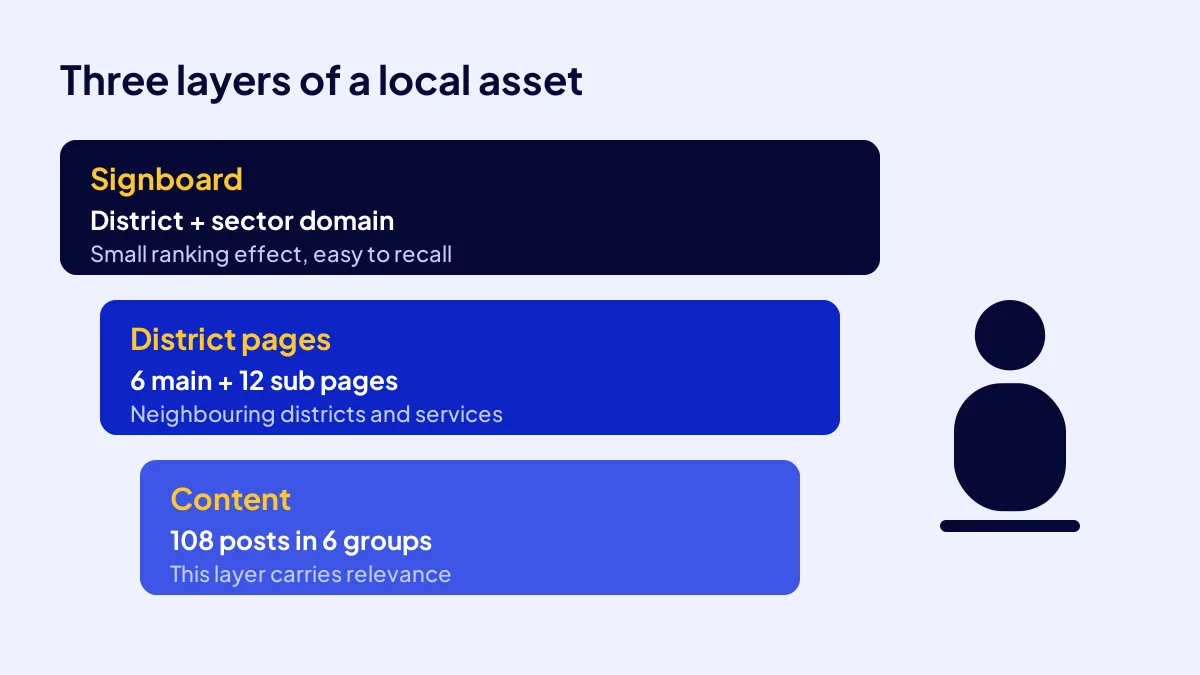
In Adapte’s START package, a local asset is built from a domain joining district and sector, a website with 6 main and 12 sub pages, and 108 pieces of content in 6 keyword groups. The 12 sub pages can be split across nearby districts and service types. The package is TRY 36,000 + VAT at a fixed price, and the domain is registered in your name.
How do six keyword groups spread locally?
- District plus service: “Beylikdüzü air conditioning repair”
- District plus price: “Beylikdüzü AC service price”
- Urgent and nearby: “AC repair near me”
- Neighbouring districts: Esenyurt, Avcılar, Büyükçekmece
- How and when questions
- Comparison and choice questions
A Business Profile is for real businesses only
Under Google’s guidelines, the business name must be the real name on the signage, with no district or service added. A profile is for a real business that meets customers in person. That is why the campaign sets up a Google Business Profile only in local projects. The full scope is on the Own a Digital Asset campaign page.
Which mistakes do people make when choosing a local domain?
The most common mistake is treating the domain as a ranking tool and neglecting content. The second is spelling the district in a way readers never type. The third is aiming too wide and squeezing the whole city into one site. All three end in the same place: the site is live, but no customer walks in.
Transliterate Turkish characters properly
Replace “ü”, “ı” and “ş” with what readers actually type, such as “beylikduzu” for Beylikdüzü.
Pick the extension for your goal
For readers in Türkiye, .com.tr signals trust; there are also .istanbul and .ist, run by Istanbul Metropolitan Municipality. The steps to find a valuable free name are in how to find a keyword domain.
Common mistake: Buying a district domain and building a three-page site. Relevance stays empty, Google cannot match the page to searches, and the shop sits idle online too.
Who can a local asset earn for, and how?
BU BÖLÜMÜN ÖZETİ
- The shopkeeper with their own shutters
- The investor without a business yet
- Health and law: rules first
A local asset works in two ways. If you run a business, it brings your district’s searches to you. If you do not, a local site with established traffic may be rented or sold to a business in that district. Neither comes with an income guarantee.
The shopkeeper with their own shutters
For district trades such as hairdressers, AC services and estate agents, a local asset brings customers directly. Unlike a marketplace, your own site belongs to you; see why build my own store.
The investor without a business yet
A district plus sector site gains value for local businesses as it gathers traffic. All the profiles it fits are in who digital assets are for.
Health and law: rules first
For a dental clinic, health facility or law firm, check your professional rules, ministry regulation or bar association rules first.
Which 6 local checks should you run before starting?
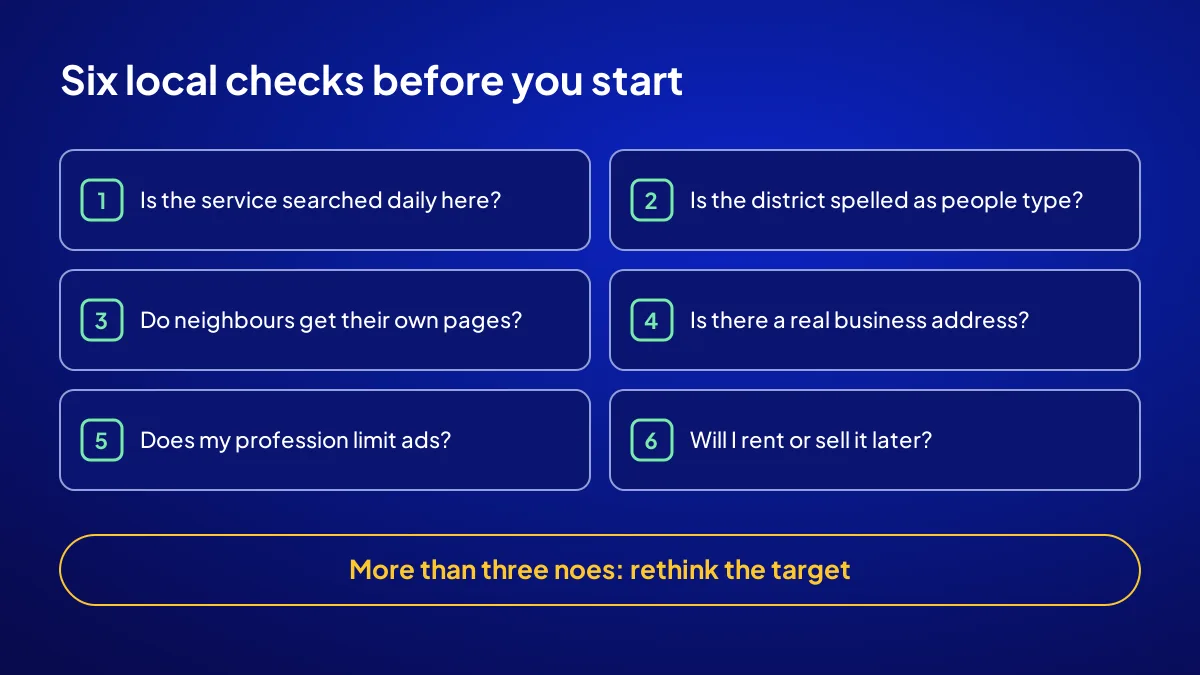
Before building a local asset, take the pulse of the area. These six checks show which district and sector fit you. Answer yes or no; more than three noes means rethinking the target. The bigger picture is in owning a digital asset.
- Is this service searched for in the target district every day?
- Can I put the district name in the domain the way readers type it?
- Can I cover neighbouring districts with separate pages?
- Is there a real business address, or will the site gather content only?
- Does my profession restrict advertising?
- Do I want to rent or sell the site later?
Check on the street too
Walk the district for half an hour and count competitors’ open shutters. If the screen and the street agree, the target is solid.
Quick Summary
- A district name in the domain does not bring rankings by itself.
- Google ranks locally by relevance, distance and prominence; no paying for position.
- A local asset targets one or two neighbouring districts, not a whole city.
- START builds district pages and 108 pieces of content for TRY 36,000 + VAT.
- A Business Profile is for real businesses, with no district in the name.
- In health and law, check professional rules first.
Short Glossary
Local ranking: Local ranking is the order Google uses to rank businesses in map and local results.
Prominence: Prominence is the local ranking factor Google uses to measure how well known a business is.
Service area: Service area is the profile field used to show which districts a business that travels to customers serves.
Next Step
There are 12 project slots, and the last day is 1 November 2026. Apply to the Own a Digital Asset campaign and get the first analysis for your local project.
Frequently Asked Questions
Source: Google Business Profile Help — Tips to improve your local ranking on Google
Sık Sorulan Sorular
A no on the first question means the district or sector is wrong. A no on the fourth means you gather traffic with content instead of a Business Profile.
Yes. The campaign names local businesses among its audience, and local projects include Google Business Profile setup.
Yours. The first year of hosting is included. Renting or selling it later is possible.
Barely, on its own. Google says keywords in a domain name have very little effect. District content, real business details and recognition decide rankings.
No. A profile is for a real business that meets customers in person. A local asset without a business gathers traffic through content and organic search.
No. Potential is shown with sector and opportunity analysis, and the decision is yours.
START is TRY 36,000 + VAT, upfront at a fixed price; with 20 percent VAT it is TRY 43,200, but check the current rate on your invoice. For the 10 percent coupon, mention the code when you apply or during the call.
Updated: October 2026