
MetropolCard builds a joint benefits model with Bilet.com, what do member merchants gain?

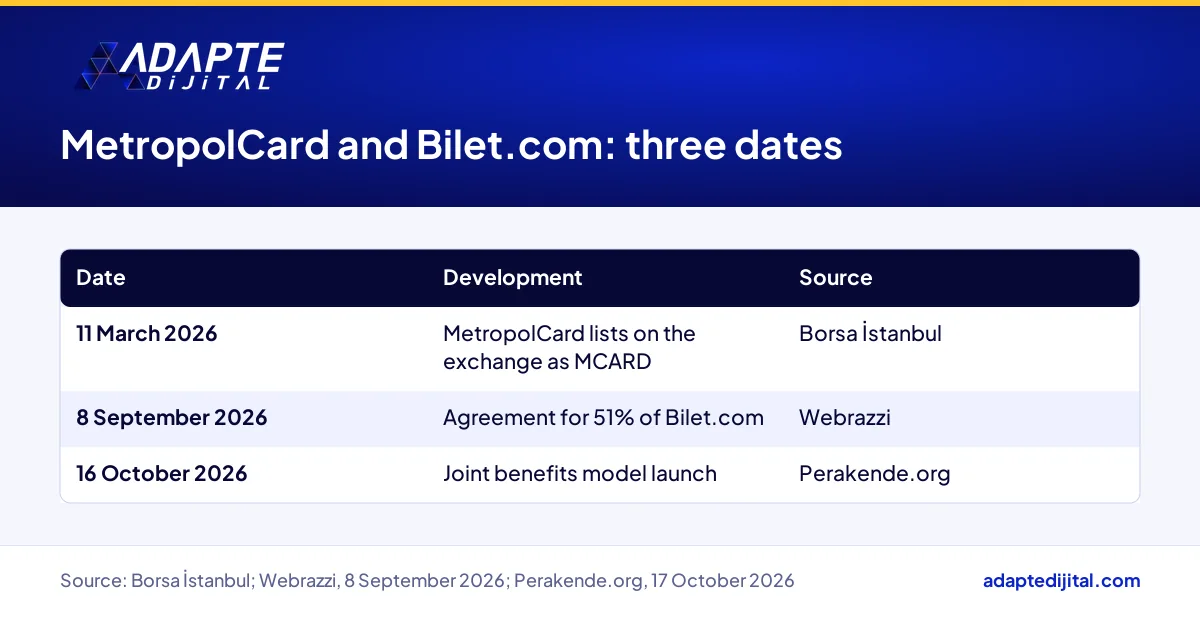
Meal card company MetropolCard and travel technology brand Bilet.com announced plans for a joint benefits ecosystem at a launch in Altunizade, İstanbul, on 16 October (Perakende.org, 17 October 2026). The model is still a plan: no start date or first concrete feature has been announced.
What it means for you: restaurants, cafes and grocers that accept the card are entering a period in which the same card reaches spending beyond food. If cardholders could one day move part of their balance to travel and experiences, deciding which cards you accept stops being a simple till decision.
What does the MetropolCard and Bilet.com joint benefits model cover?
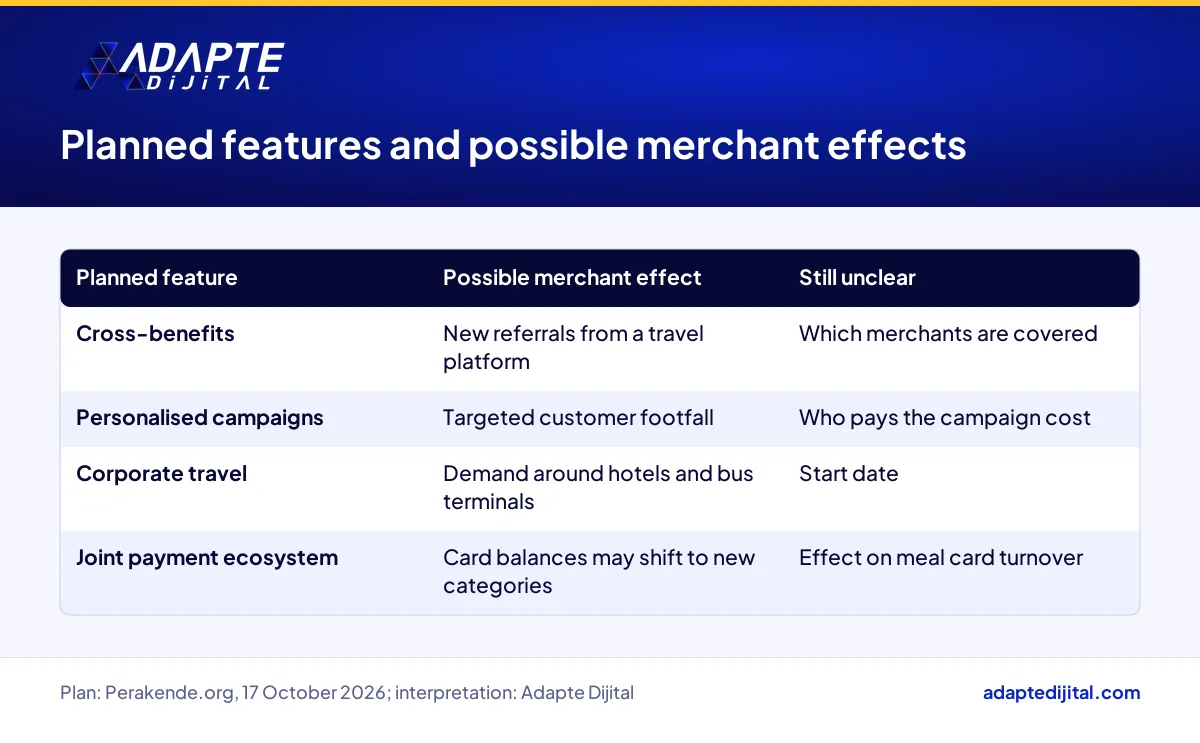
For now it is a plan with four headings: cross-benefits, campaigns, corporate travel and user experience models. According to Perakende.org, the companies plan personalised campaigns based on user data and investment in artificial intelligence. MetropolCard users are to get Bilet.com services, and Bilet.com users are to get MetropolCard’s benefits and payment ecosystem.
Why is a meal card company like MetropolCard moving into travel?
The sources do not state a reason in a single sentence, but the direction is clear. MetropolCard began trading on Borsa İstanbul under the ticker MCARD on 11 March 2026. According to the Borsa İstanbul announcement, the company plans to put its IPO proceeds into financial technology and R&D, and to expand into areas such as fuel, fleet, motorway tolls and electric vehicle charging.
How could the MetropolCard and Bilet.com partnership affect restaurants, cafes and grocers?
Lunchtime restaurants, cafes and neighbourhood grocers with a high share of meal card sales feel it most directly. If part of a card balance moved to travel, card sales at these businesses could fall; if campaigns steered cardholders to them, sales could rise. Bus companies, hotels and car rental firms feel it indirectly, because they could reach a new paying audience.
How could the payment flow change at a merchant that accepts MetropolCard?
Nothing announced so far changes the transaction at the till; what could change is how the cardholder arrives. Today the flow is simple: the cardholder comes in, pays on the POS terminal (the card machine at the counter), and the merchant receives its settlement. If the joint model adds a campaign and data layer, a customer could arrive through an offer, and that visit could become measurable.
How do meal card users find a restaurant online?
Through map searches, merchant listings and review sites. At lunchtime, a cardholder searches for nearby restaurants that take meal cards and picks one of the first profiles. If your profile does not list the cards you accept, you drop off that list.
What should a restaurant or cafe owner do this week about meal card acceptance?
BU BÖLÜMÜN ÖZETİ
- Treat card acceptance as a channel decision
- Be ready for campaign offers
- Connect payment data with digital visibility
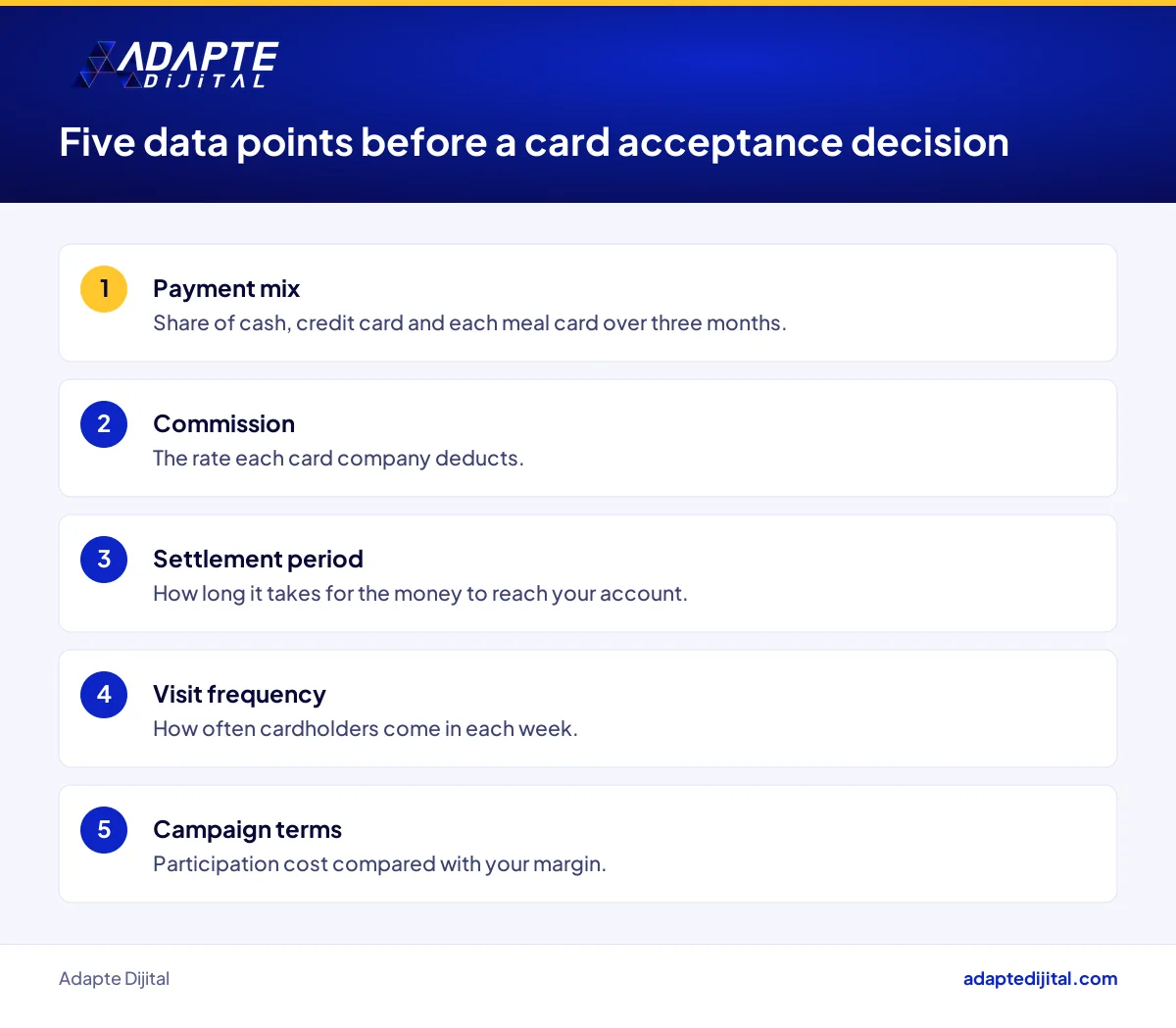
Pull the last three months of payment mix from the till: cash, credit card and each meal card brand separately. Our desk recommends seeing each card’s commission, settlement period and turnover share in one table. Do not decide which cards to accept without that table.
Treat card acceptance as a channel decision
Every meal card is a customer channel. Dropping a card with a high turnover share but a heavy commission can send customers out the door. Weigh turnover, commission and visit frequency together, and confirm contract terms with the card company. This is not legal or financial advice.
Be ready for campaign offers
If the joint model brings campaigns, compare the participation terms with your margin. Do not join until you can measure whether a discounted sale lifts average basket value and repeat visits. We look at how instalment and pay-later options affect the basket in our piece on M&S and Klarna.
Connect payment data with digital visibility
Knowing which card’s customers come at which hour also feeds your campaign and opening-hours choices on your map profile. We look at how a physical store links to digital channels through MediaMarkt’s Ankara Podium store. Tying payment data to measurement and visibility plans is one of the jobs we handle in digital consulting.
Quick Summary
- MetropolCard and Bilet.com announced plans for a joint benefits ecosystem on 16 October (Perakende.org, 17 October 2026).
- The model is a plan; no start date or first concrete feature has been announced.
- MetropolCard signed an agreement on 8 September 2026 to buy 51% of Bilet.com’s operator (Webrazzi).
- According to the company, MetropolCard works with more than 50,000 member merchants (Perakende.org).
- TL 127,500 is the nominal value of the shares acquired; the purchase price was not disclosed (CNBC-e, 11 September 2026).
Short Glossary
- Member merchant
- Member merchant is the payments term used to describe a business that has a contract with a card company and accepts its card.
- Settlement
- Settlement is the payments term used to describe paying a card sale to the merchant after the commission is deducted.
- Nominal value
- Nominal value is the accounting value used to record a share’s face amount in company capital, separate from its market price.
Frequently Asked Questions
Next Step
If you want to weigh your payment and card acceptance decisions with your own data, fill in our consult your expert form.
Sources: Borsa İstanbul announcement, March 2026 · Perakende.org, 17 October 2026 · Webrazzi, 8 September 2026 · CNBC-e, 11 September 2026
Updated: October 2026
Sık Sorulan Sorular
Metropal Kurumsal Hizmetler, the company behind MetropolCard, signed a share transfer agreement on 8 September 2026 to buy 51% of the company that runs Bilet.com (Webrazzi, 8 September 2026). No financial details were disclosed. According to CNBC-e (11 September 2026), the transfer was completed and paid in cash.
No. The TL 127,500 reported by CNBC-e is the nominal value of the shares acquired, out of a share capital of TL 250,000. The purchase price has not been made public, so the two figures should never be mixed up.
According to the company, MetropolCard works with more than 50,000 member merchants across 81 provinces and 922 districts. Bilet.com, by its own account, lists more than 450 bus companies, more than 1.5 million hotel options and more than 200 car rental firms. No date is given for these figures.
Travel and event spending. According to the company, Bilet.com sells flights, bus and ferry tickets, hotels, car rental, transfers, İstanbulkart top-ups and event tickets. That gives an employee benefits card a possible channel from the till to the booking screen.
That benefits should follow the cardholder’s daily life. In the words of MetropolCard CEO Uğur Yıldırım: “Wherever life goes, we will carry the benefit there.” Akif Enes Kütük, General Manager of Bilet.com, spoke for the travel side.
The start date, the first concrete feature and the effect on member merchants. Whether a meal card balance can be used directly to buy a ticket has not been announced either. So the scenarios below describe what could happen, not confirmed features.
The cardholder who decides to save a little this month and spend it on a ticket. That shift is not certain, but if it happens, the lunchtime till does not turn over as before. A business whose lunch trade runs on meal cards should already know the card share of its total turnover.
Member merchants included in the personalised campaign model. If a travelling cardholder is shown a restaurant on the route or a cafe in the destination city, new footfall could follow. No source mentions any commission or campaign cost for member merchants under the model.
Partly. Food shopping is a necessity, so the card balance is still likely to reach the grocer. Even so, the average basket value follows whatever balance the cardholder has left.
A user on one platform earns an advantage on the other. For a merchant, that could mean a new referral source from a travel platform. Which merchants such referrals would cover has not been announced.
The cardholder sees an offer based on spending data. In everyday terms, someone who buys coffee often gets an offer from a nearby cafe. Here’s something most people don’t know: the merchant’s key question is not the offer itself, but who pays for it.
Companies that give employees benefits, and the places where people eat on business trips. Restaurants around airports, bus terminals and hotels are this model’s nearest neighbours.
For a cardholder, the first question is not the menu; it is whether the card works. A profile with current payment options, opening hours and menu photos prevents disappointment at the door, when a customer would otherwise turn around and leave.
If personalised campaigns rely on merchant records, accuracy decides visibility. A merchant with a missing address, category or photo stays invisible during campaign periods too.
The joint model is still a plan, and no concrete feature such as buying tickets with a meal card has been announced. No start date has been announced either.
The effect is not known. It could fall if part of card balances moves to travel, or rise if campaigns send customers your way; tracking your own payment mix is the most reliable measure.
Compare each card’s turnover share, commission and settlement period in one table. Then decide based on those three figures and how often cardholders visit.