
Why Did Elon Musk Build a Flying Car? From Peter Thiel’s Line to the Roadster Demo
“We were promised flying cars.” That line belongs to Peter Thiel, and according to Axios, Elon Musk cited it while describing the Roadster on the Joe Rogan podcast in autumn 2025. The link between Elon Musk and the flying car begins with his 2018 post, “SpaceX option package, about 10 small rocket thrusters, maybe even allow it to fly”, and became real at the demo in Waco, Texas on October 15, 2026.
According to the sources, the reason has three layers. First, an answer to Thiel’s complaint about technological disappointment; second, the availability of SpaceX’s cold-gas thruster technology. Third, in Musk’s own words, a halo car that “won’t move the needle much on revenue” but will be “the last and best human-driven car”. Musk’s earlier objections, noise and “a hubcap flying over your head”, remain on the record.
Where does the Peter Thiel line come from?
According to Axios’s report dated November 5, 2025, Musk cited Peter Thiel’s “we were promised flying cars” line while describing the Roadster demo on the Rogan podcast. The line is a complaint that the promised future never arrived. Musk turned that complaint into a product goal. On the same show he said “a demo by the end of 2025”; the demo took place on October 15, 2026.
Rogan’s question and the answer
According to Axios, Rogan asked, “an electric flying car?” Musk’s answer was “we’ll see at the demo”. A week later, at the shareholder meeting, he pushed the demo to April 1, 2026 and added that the date gave him “plausible deniability”. The chain of delays did not stop there; the demo was first announced for October 1 and slipped to October 15 because of weather.
The gap between the line and the product
The podcast was recorded in autumn 2025 and the demo came in October 2026, close to a year apart. In that same window, on another podcast, Musk said, “if safety is your number one goal, don’t buy the Roadster”; TechCrunch reports the quote. The flying car goal and the safety warning were voiced in the same period.
Why was Musk against flying cars before?
According to Axios, Musk had earlier said flying cars would be noisy and would raise the worry of “a hubcap flying over your head”. Both objections are practical: sound and falling parts. The October 15 demo does not answer either one; no source in the fact sheet gives a measured noise level for the cold-gas thrusters. The objections still stand, and the product was built anyway.
The noise objection
Cold-gas thrusters work without combustion; according to Moravy, they use 600 liters of compressed air. That means a different sound profile from a combustion rocket. But no source gives a decibel figure. The noise objection has not been answered today; only the technology has changed.
The hubcap objection
The falling-parts worry depends on how long the car stays in the air. In the demo the car launched off a ramp into a backflip and jumped the Semi, which stands 13.5 feet, about 4.1 meters. That is a short hop, not sustained flight. The limit narrows Musk’s old objection through his own design.
Why is the flying car a “halo car” for Elon Musk?
According to TechCrunch, Musk says the Roadster “won’t move the needle much on revenue”. That sentence explains the commercial logic: the car exists to show the brand’s technical limit, not to sell in volume. In the same source Musk calls it “the last and best human-driven car”. So the halo car is a closing act before driverless products such as the Cybercab.
A halo car is a brand’s most expensive and most showy model; it is measured by the prestige it lends to other models, not by its sales count. Tesla’s X account names the SR-71 reconnaissance aircraft and the F-35 as design inspiration and says “our design language evolved from S3XY to Cybertruck, Cybercab and Optimus”. The Roadster is the showcase of that evolution.
The “am I crazy?” question
According to TechCrunch, Musk said he wondered “am I crazy?” when he pitched the idea to his team. Before the demo he said “success is not guaranteed”; afterward he added, “this will be the real car on the roads”. He called it “better than the James Bond car”, and his own Lotus Esprit was on display at the event.
How did the SpaceX collaboration come in?
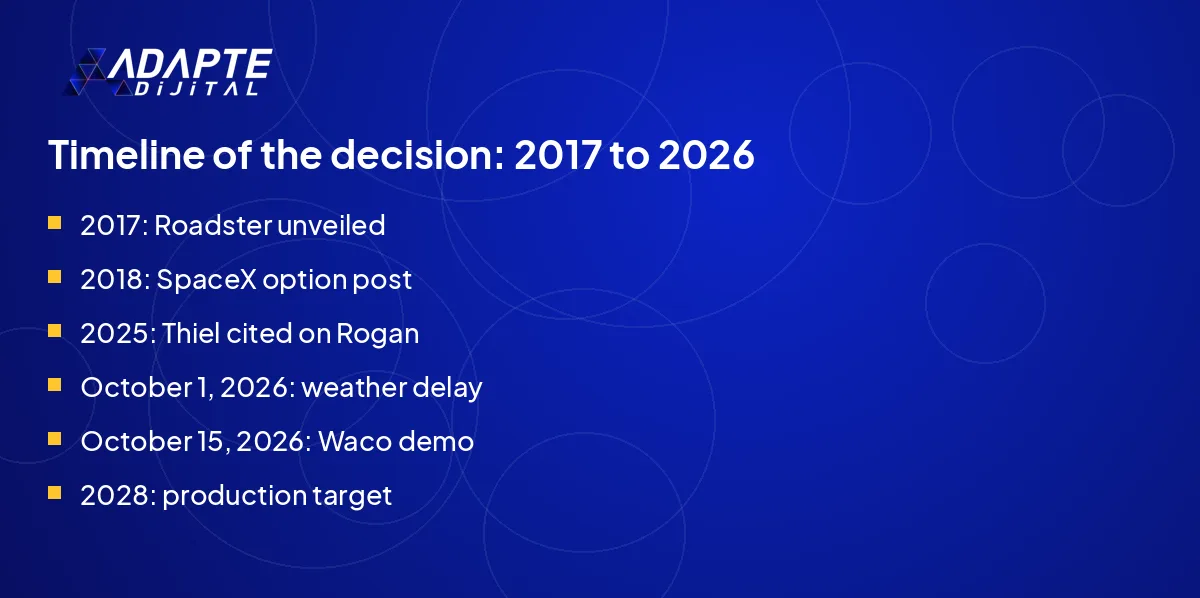
The launch took place at SpaceX’s Rocket Development and Test Facility in Waco/McGregor, and the thrusters use SpaceX-derived cold-gas technology. According to Tesla’s post on X, every usable space in the car is filled with carbon-fiber-wrapped pressure vessels (COPVs). The “SpaceX option package” of the 2018 post was named the Rocket version in 2026. The collaboration is at the hardware level, not just the idea level.
Timeline of the decision: 2017 to 2026
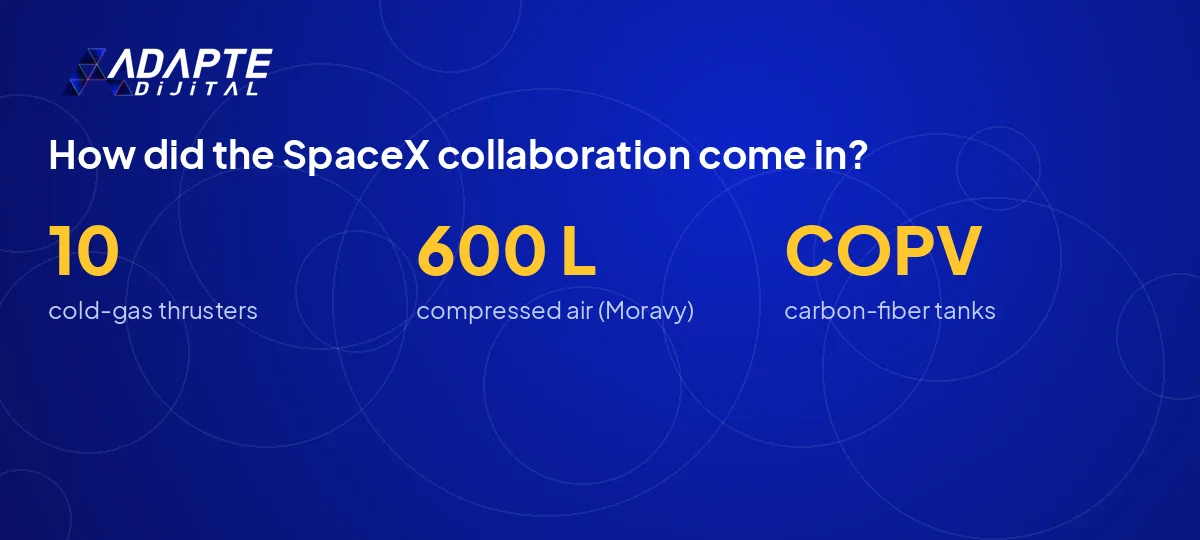
The table below orders the sourced dates. Every row rests on TechCrunch, Axios or Tesla’s official channel. What this means: the flying car decision took shape across nine years of delays, not in a single moment.
| Date | Event | Source |
|---|---|---|
| November 16, 2017 | Roadster unveiled at the end of the Semi launch; 2020 delivery promised; $50,000 deposit | TechCrunch |
| 2018 | “SpaceX option package, about 10 small rocket thrusters, maybe even allow it to fly” post | TechCrunch, Carscoops |
| 2020–2024 | Four delays; Model Y and Cybertruck moved ahead | TechCrunch |
| October/November 2025 | Rogan podcast: Thiel citation, “demo by end of 2025”; a week later pushed to April 1, 2026 | Axios |
| October 1, 2026 | Announced launch postponed because of weather | TechCrunch |
| October 15, 2026 | Waco demo: upside-down driving, backflip, jump over the Semi; production 2028 | TechCrunch, Tesla on X |
Three sourced numbers and what they mean
- 9 years: the span from the 2017 unveiling to the 2026 demo (TechCrunch). What this means: the decision is the product of an era, not a year.
- 10 thrusters: the “about 10” in the 2018 post matched the 2026 Rocket version exactly (TechCrunch, Moravy). What this means: the idea did not change in eight years.
- 2028: the production year Musk gave with the note “for real this time” (TechCrunch, Edmunds). What this means: the demo is done, the sale is still two years away.
Was the decision right? The skeptical voices
According to Thomas Hundal of The Autopian, skepticism about legal approval, the technology’s usefulness and reaching the targets is “absolutely warranted”. Deposit holder Marques Brownlee asked, “they said a 4,000+ pound car will do a backflip, hit half the speed of sound and arrive in 2028. This is a prank, right?” Musk’s reasons are on record; the outcome is not yet.
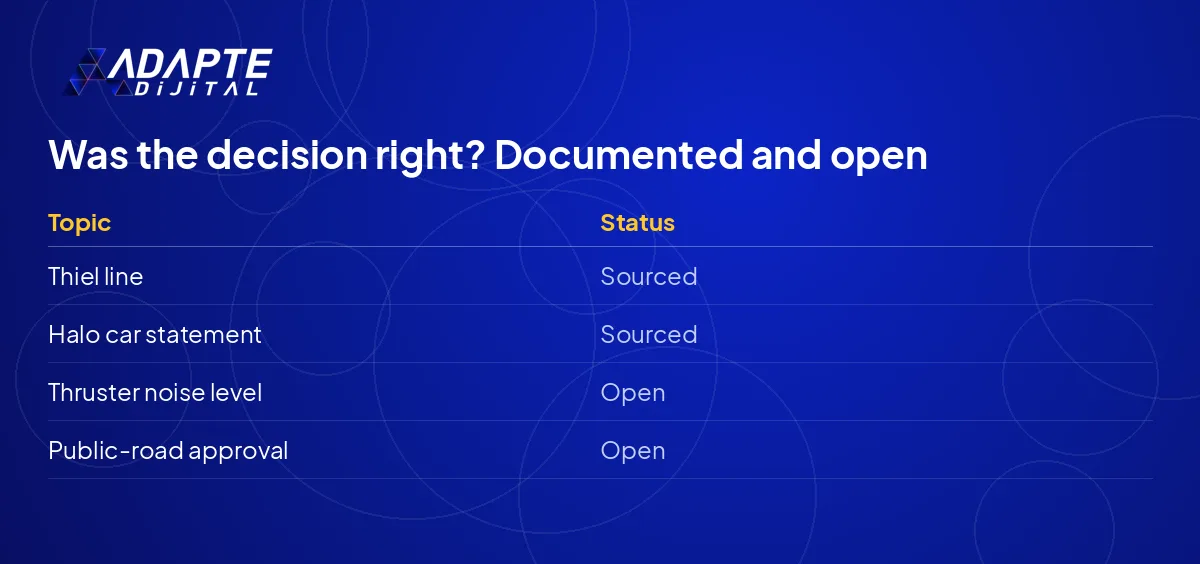
In the sources: the Thiel line, the 2018 post, the halo car statement, the SpaceX facility. Not in the sources: the thrusters’ noise level, public-road approval, the final sale price. What this means: the reasons are documented, the results are pending.
What this means for readers in Turkey
The flying car decision is as much a positioning lesson as a product story. Musk chose the showcase over volume and said so openly, while Tesla sells the Model Y in Turkey with no Roadster reservations open there. Still, the answer to “why” shows how brands justify an expensive product that sells in small numbers. Why the flying car never arrived before now is covered separately in the eVTOL and McMurtry comparison.
The car’s basic definition and delay timeline are in the What is the Tesla Roadster article, and the full picture of the flying car era is in the pillar article. The set is gathered in the flying cars archive.
Frequently Asked Questions
Quick Summary
- On the Rogan podcast in autumn 2025, Musk cited Peter Thiel’s “we were promised flying cars” line.
- The idea goes back to the 2018 post: “SpaceX option package, about 10 thrusters”; the 2026 Rocket version has 10 thrusters.
- Musk’s earlier objections, noise and falling parts, remain unanswered in the sources.
- The Roadster is a halo car that “won’t move the needle on revenue”; “the last and best human-driven car”.
- Launch at a SpaceX facility, production at Gigafactory Texas, target 2028.
Short Glossary
A halo car is a brand’s top model, built for prestige rather than sales volume.
A cold-gas thruster is a rocket component that produces thrust by releasing compressed gas without combustion.
eVTOL is the class of electric aircraft that take off and land vertically.
Sources
- Axios – Tesla Roadster flying car: Elon Musk on Joe Rogan
- TechCrunch – Tesla reveals SpaceX-powered Roadster that flies and falls with style
- The Autopian – The Tesla Roadster is more insane than you could possibly have imagined
- Tesla on X – COPV statement
- Tesla – Roadster reservation page
Updated: October 2026
Sık Sorulan Sorular
According to GadgetPilipinas, Lars Moravy and Franz von Holzhausen confirmed Gigafactory Texas as the production site. The launch site belongs to SpaceX; the factory belongs to Tesla. The thruster details are covered in the Musk’s new promises article and in the cold-gas thruster definition.
According to TechCrunch, in 2018, with the post “SpaceX option package, about 10 small rocket thrusters, maybe even allow it to fly”. The Roadster itself was unveiled on November 16, 2017.
According to Axios, the line is “we were promised flying cars”. Musk cited it while describing the Roadster on the Joe Rogan podcast in autumn 2025.
According to TechCrunch, Musk says the car “won’t move the needle much on revenue”. He positions the Roadster as “the last and best human-driven car”, in other words a halo car.