
How Does the Tesla Roadster Drive Upside Down? The 2G Suction Fan System Step by Step
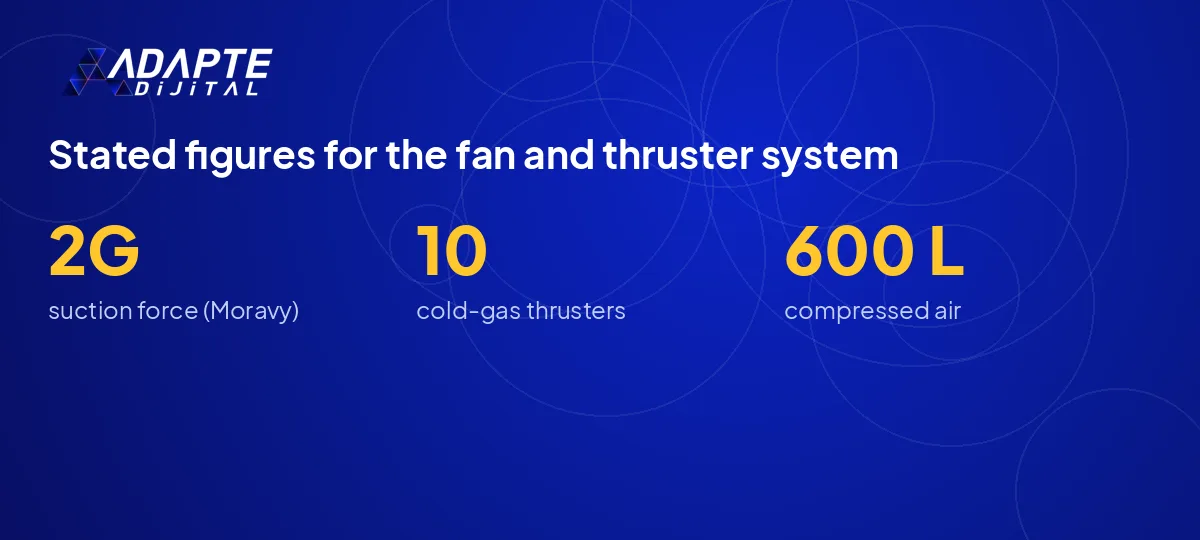
Waco/McGregor, Texas, the evening of October 15, 2026. The Tesla Roadster is driving across the roof of a half-pipe ramp, upside down: wheels up, roof down. What holds it there is a suction fan at the rear. According to Lars Moravy, Tesla’s Vice President of Engineering, the fan pulls up to 2G, which means it presses the car into the surface with twice the car’s own weight. There is no independent verification of that figure.
The Tesla Roadster can drive upside down because the fan pulls the air out from under the car and pins it to the surface. Even when that surface is above the car, the force pushes the car against it. The system works together with an active rear wing, and it holds the car to the ground even at a standstill. Below, step by step: how the fan works, how the demo ran, the McMurtry comparison and which versions carry the system.
How does the suction fan pin the car to a surface?
The fan draws air out of the space under the car and pushes it outside. When the pressure under the car drops, the atmospheric pressure above presses the car toward the surface. For an inverted car, that surface is the ceiling, but the force still forms between car and surface, so the car does not fall. The difference from wing-based downforce is that it does not depend on speed: according to Moravy, the system holds the car to the ground even when it is standing still.
What does the 2G figure mean?
According to Moravy, the fan produces suction of up to twice the car’s weight. So an inverted car would stay on the ceiling even with an extra load of half its own weight. There is no official weight figure: Musk and Marques Brownlee put it at “over 4,000 pounds” (about 1,800 kilograms). With those two unknowns stacked, the absolute force behind 2G cannot be calculated.
2G means twice the car’s weight. 1G is enough to hold the car in place; the second G adds a safety margin in corners and ramp transitions. The figure is Tesla’s statement, and no independent measurement has been published. For the other stated figures, see the Tesla Roadster by the numbers.
How did the Tesla Roadster upside-down demo run, step by step?
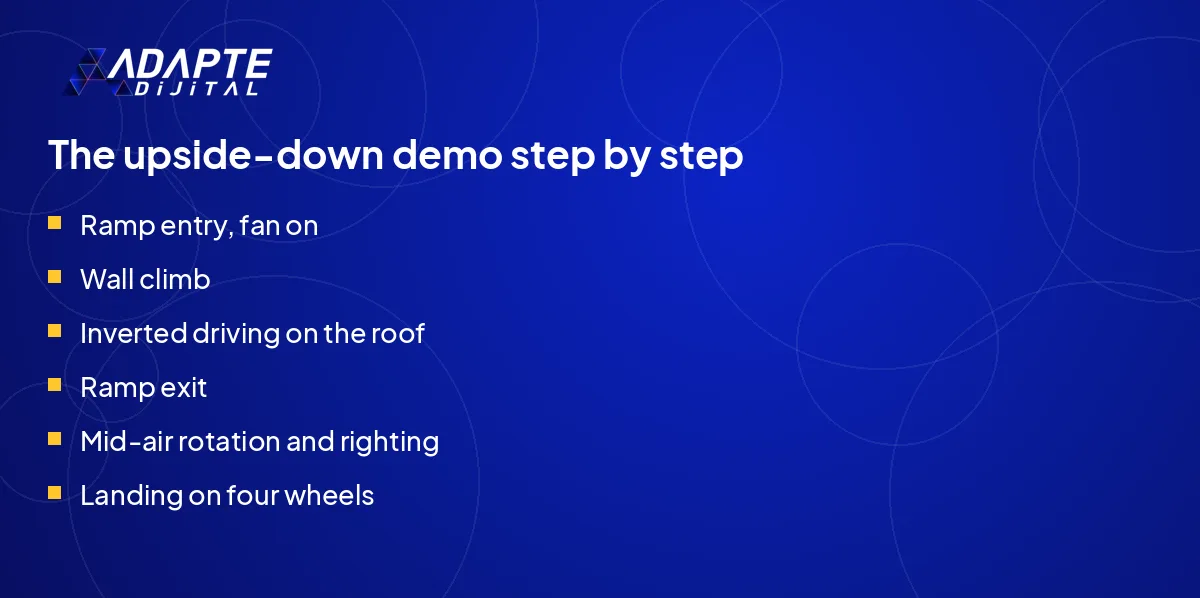
The October 15, 2026 demo took place at SpaceX’s Rocket Development and Test Facility. The car entered the ramp, drove inverted across the roof, left the ramp into the air, flipped and landed on its wheels. The six steps below follow Tesla’s X post and the reporting of TechCrunch, InsideEVs and Yahoo Finance, with the active system named at each step.
- Ramp entry: the car enters the lower end of the half-pipe. The fan is on and the wing is in high-downforce mode.
- Wall climb: as the surface steepens, fan suction keeps the car attached. According to Moravy, suction reaches up to 2G.
- Upside-down driving: the car moves across the roof inverted. Ground sealing is critical here; if air leaks in at the edge, the car drops.
- Ramp exit: the car leaves the far end of the ramp and goes airborne. The fan has no surface left to hold.
- Rotation and righting: the car flips. The rear cold-gas thrusters change direction within a fraction of a second and right the car.
- Landing: the car comes down on all four wheels. After the demo, Musk said “this will be the real car on the roads”.
Common mistake: confusing upside-down driving with flight
On social media the demo circulates as “the Roadster flew”. But upside-down driving and mid-air rotation are the work of two separate systems: the fan handles the inverted driving, the thrusters handle the rotation. The fan alone cannot lift the car, and the thrusters alone cannot hold it to a ceiling. The box below corrects the three most common mix-ups.
Mistake 1: “The fan makes the car fly.” Reality: the fan presses the car onto a surface; it does not lift it. Mistake 2: “2G means the car accelerates at 2G.” Reality: 2G here is suction force; the acceleration figure is separate (0-60 mph in 0.81 seconds according to Tesla, no independent verification). Mistake 3: “Every Roadster can drive upside down.” Reality: all three versions have the fan, but Tesla has not said which versions can drive inverted.
How close is the Roadster’s fan to the McMurtry Spéirling?
InsideEVs, The Autopian and Autoblog all compare the Roadster’s fan system to the McMurtry Spéirling, a British electric track car. The Spéirling can hold itself upside down with fan-based suction, so the idea is not new. The difference: the Spéirling is a track car only, while the Roadster carries the fan even in its road-ready Performance version and pairs it with cold-gas thrusters.
| Feature | McMurtry Spéirling | Tesla Roadster |
|---|---|---|
| Suction method | Fan-based | Fan-based (Moravy: up to 2G) |
| Can drive inverted | Yes | Yes (October 15, 2026 demo) |
| Thruster system | None | Rear cold-gas thrusters (Thrust, Rocket) |
| Use | Track | Road (Performance), track (Thrust), flight (Rocket) |
Which Tesla Roadster versions have the suction fan?
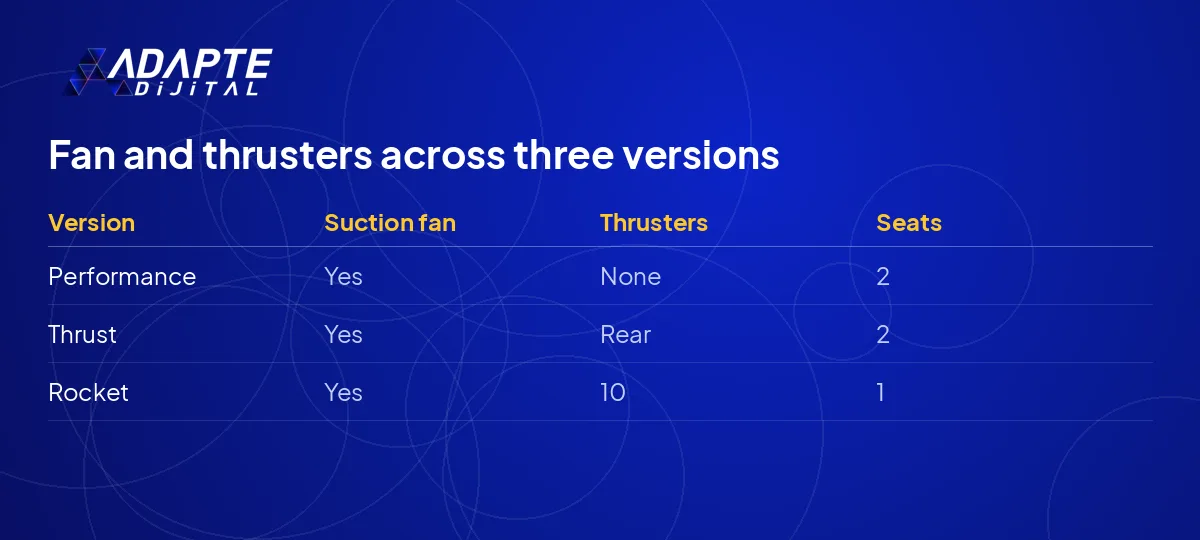
All three. According to Tesla’s reservation page, Performance comes with “active aero and multi-mode suction” and no thrusters. In Thrust and Rocket, the fan works alongside rear thrusters. So even the entry version with a $50,000 deposit has the fan system. Tesla has not said to what extent upside-down driving is possible in each version.
- Performance: fan, no thrusters, 2 seats, “road ready”, total deposit $50,000.
- Thrust: fan, rear thrusters, 2 seats, “race ready”, total deposit $250,000, “subject to regional regulations”.
- Rocket: fan, 10 thrusters and full flight system, 1 seat, “air ready”, invitation only.
Where to read more
The technical statements are on Tesla’s official Roadster page and in its launch-night X posts. The car’s nine-year history is in what the Tesla Roadster is, and the whole set is in the flying cars archive.
Frequently Asked Questions
Quick Summary
- The suction fan pulls air out from under the car and presses it onto the surface; that is what makes upside-down driving possible.
- According to Moravy, suction reaches up to 2G; no independent verification.
- The fan works at a standstill, and the active rear wing adds support at high speed.
- The demo ran in six steps: entry, climb, inverted driving, exit, rotation and righting, landing.
- The system resembles the McMurtry Spéirling; the difference is the pairing with thrusters.
- All three versions have the fan; use on public roads is unclear.
Short Glossary
A suction fan is a motor-driven system that pulls air out from under the car to create a pressure difference that presses the car onto the surface.
Ground sealing is the arrangement that blocks air from entering the gap between the underbody and the surface, preserving the suction force.
An active rear wing is a movable wing whose angle changes with speed and mode, producing downforce from airflow.
Sources
- [Tesla] – Official Roadster page and reservations
- [InsideEVs] – Roadster backflip and 2G suction demo
- [The Autopian] – Roadster fan system and McMurtry comparison
- [Edmunds] – Roadster first look and legal status
Updated: October 2026
Sık Sorulan Sorular
An active rear wing only works when air flows over it, which means when the car is moving fast. A car entering a ramp at low speed gets too little downforce from a wing. A fan runs on motor power, so it produces force even at zero speed. Tesla uses both: the wing switches between “low drag” and “high downforce” modes.
No matter how much air the fan moves, the pressure difference disappears if air leaks in from the sides. So the gap between the underbody and the surface has to stay as closed as possible. Tesla has not described its sealing solution. The only known facts are that the system is “multi-mode” and that even the Performance version carries it.
No. The fan sucks air out to press the car onto a surface, while a cold-gas thruster blows compressed air out to push the car. The fan works during upside-down driving; the thrusters work at ramp exit and during mid-air righting. Both systems sit side by side at the rear. The thruster logic is covered in how the flying car flies.
The launch was first announced for April 1, 2026, then for October 1, 2026. The October date slipped to October 15 because of severe weather. Before the demo, Musk said “success is not guaranteed”.
Because fan suction has already worked in a car, the Roadster’s upside-down driving is no surprise from a physics standpoint. What is new is pairing the fan with thrusters and putting both into a road-ready car. Mate Rimac said in 2024 that it was “possible with thrusters”; Tesla combined that with a fan and showed it. The wider comparison is in Performance vs Thrust vs Rocket.
Unclear. According to Edmunds, Reuters and InsideEVs, the legality of the thruster and fan systems on public roads is not settled. The Thrust version is sold with a “subject to regional regulations” note. Production is planned for 2028 at Gigafactory Texas.
The rear suction fan pulls the air out from under the car and presses it against the surface. According to Moravy, suction reaches up to 2G; the figure has not been independently verified.
No, all three versions have it. Performance has the fan and active aero but no thrusters. In Thrust and Rocket the fan works together with thrusters.
The principle is the same: fan-based suction that allows inverted driving. The difference is that the Roadster pairs the fan with cold-gas thrusters and offers it in the road-ready Performance version.