
How Does a Flying Car Fly? The Tesla Roadster’s 10 Cold-Gas Thrusters and 600 Liters of Air
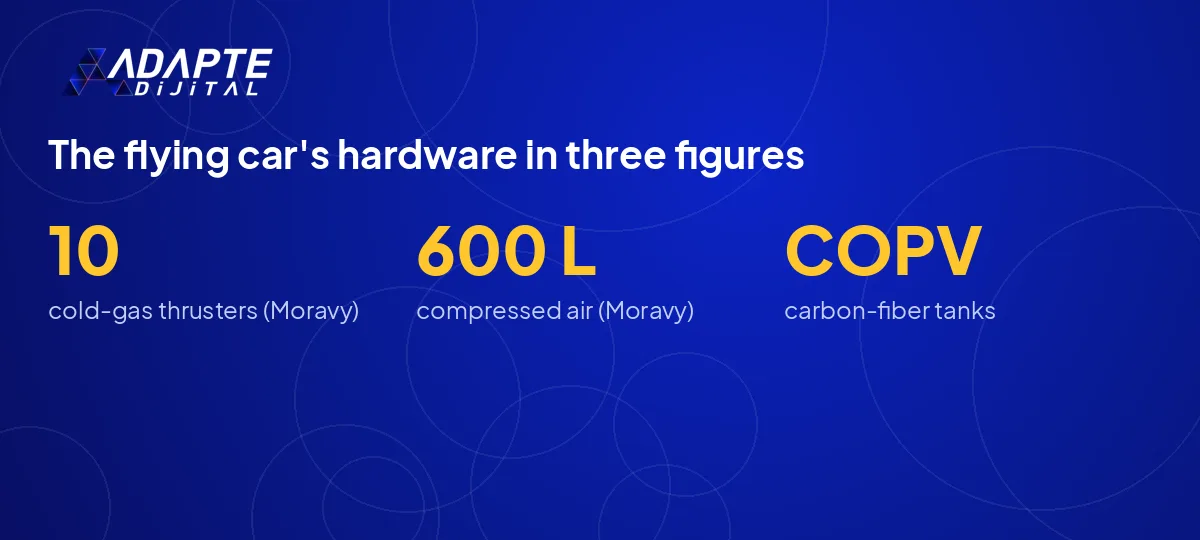
Ten thrusters, 600 liters of compressed air and carbon-fiber tanks packed into every empty space in the car. The “flight” the Tesla Roadster showed in Texas on October 15, 2026 rests on those three parts. This flying car does not lift off with wings or propellers: cold-gas thrusters at the rear push pressurized air out, and the car is pushed the other way. According to Lars Moravy, Tesla’s Vice President of Engineering, the system holds 10 thrusters and 600 liters of air. There is no independent verification of those numbers.
The short answer: the Roadster does not stay in the air like an aircraft. It makes a brief jump and turns in mid-air. At SpaceX’s test site in Waco/McGregor, Texas, the car left a ramp, flipped, righted itself with the thrusters and landed on its wheels. In a second demo it jumped over a row of Tesla models, including the 13.5-foot (about 4.1-meter) Semi. Below: the physics, the hardware and the six-step sequence.
Where does the force that lifts a flying car come from?
It comes from action and reaction. A thruster pushes high-pressure air out in one direction at speed, and the car is pushed the opposite way with a force of the same size. A rocket works the same way; the difference is that the Roadster burns no fuel. Hence the name cold-gas thruster: no combustion, only stored pressure.
Where do the 10 cold-gas thrusters sit on the car?
The thrusters sit at the rear of the car. According to Autoblog and The Autopian, the first versions carry rear thrusters only; other axes come later. Moravy puts the total at 10. The thrusters change direction within a fraction of a second using fully electric actuators, which is how the car can raise or lower its nose while airborne.
Where do 600 liters of air fit: the COPV tanks
According to a post on Tesla’s X account, “every usable void in the car is filled with carbon-fiber overwrapped pressure vessels (COPVs)”. Moravy says those vessels carry 600 liters of compressed air in total. The tank can be refilled while driving, so no service visit is needed after a jump. There is no independent verification of the volume or pressure.
Takeoff, flip and landing: the demo in 6 steps
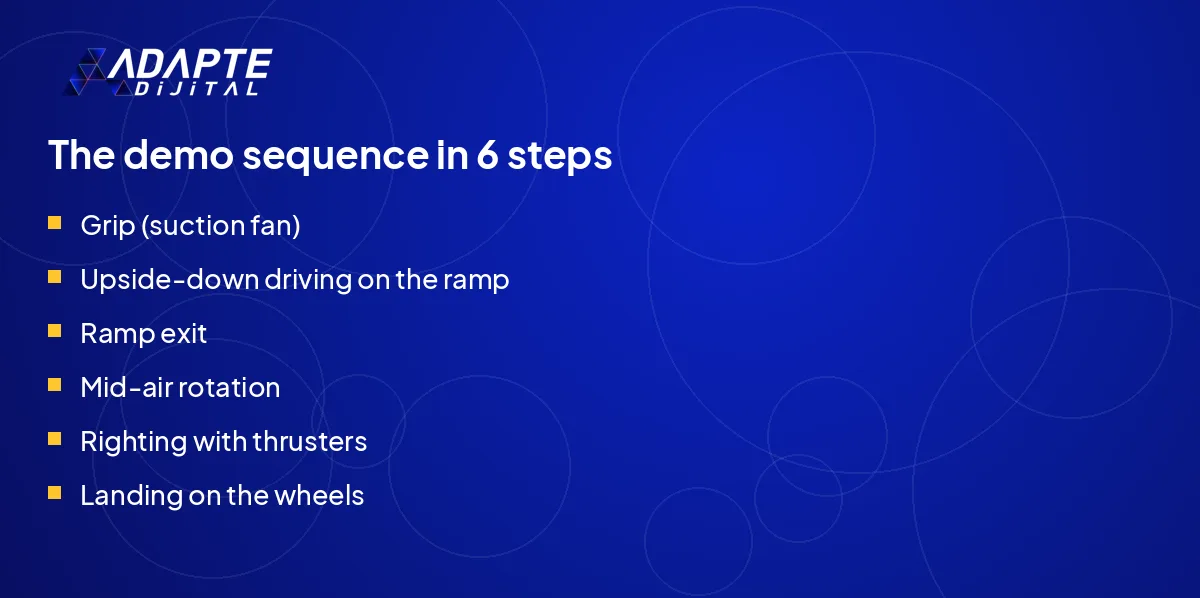
The first demo on October 15, 2026 had six distinct phases, and a different system took over at each one. The steps below follow the video Tesla shared and the reporting of TechCrunch, InsideEVs and Yahoo Finance.
- Grip. As the car enters the ramp, the suction fan runs. According to Moravy, the fan pulls up to 2G, twice the car’s weight.
- Upside-down driving. The car drives inverted across the roof of the half-pipe ramp. The fan and the active rear wing work together.
- Ramp exit. The car leaves the end of the ramp. At that point the fan has no surface left to hold.
- Mid-air rotation. The car flips. Tesla’s X post called it a “kickflip”.
- Righting. The rear thrusters fire. The actuators set the direction within a fraction of a second, and the car turns its wheels downward.
- Landing. The car comes down on all four wheels. Musk said “success is not guaranteed” before the demo and “this will be the real car on the roads” after it.
The second demo is simpler: the car fires its thrusters while moving and jumps over a row of Cybercab, Cybertruck, Semi, Model Y and Model 3. The Semi stands 13.5 feet tall. The full launch-night story of both demos is in the flying car era.
Common mistake: treating the flying car as an eVTOL
The Roadster is not a vehicle that hovers or cruises at altitude. As Axios notes, today’s equivalent of the flying-car market is the eVTOL, the electric vertical takeoff and landing aircraft. The Roadster does not belong to that class; what it does is a short jump with attitude control in the air.
Common mistake: “The Roadster flies, so it can travel above traffic.” The reality: the car makes a jump that lasts seconds, driven by thrusters, with no wings or propellers for sustained flight. When the 600-liter air supply (Moravy’s figure) runs out, the thrust stops. The legality of the thruster and fan systems on public roads is also unclear; the Thrust version is sold with a “subject to regional regulations” note.
Which Tesla Roadster version actually flies?
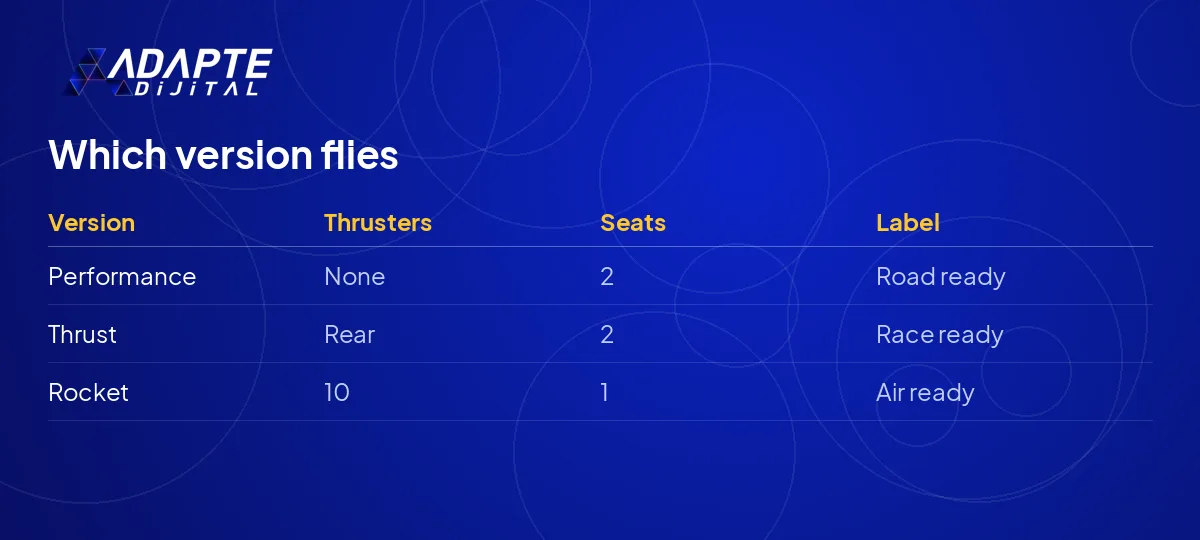
Only one of the three versions has the full flight system. According to Tesla’s reservation page, Performance has no thrusters, Thrust has rear cold-gas thrusters, and Rocket has 10 thrusters with the complete flight system. The car that can do the moves shown in the demo is the Rocket. It is sold by invitation only and has one seat.
Performance: no thrusters, active aero and multi-mode suction fan; “road ready”. Thrust: rear thrusters, 0-60 mph under one second according to Tesla; “race ready”. Rocket: 10 thrusters, full flight; “air ready”. All three have a 300-mile range, according to Tesla.
Checklist for reading any flying-car claim
After a launch, numbers grow fast on social media. The six items below show what to check when you read a flying-car story, with the Roadster’s current standing next to each.
- Who is the source? The 10 thrusters and 600 liters come from Moravy; there is no independent measurement.
- Flight or jump? The Roadster jumps; there is no sustained-flight claim.
- Which version? Only the Rocket carries the full system.
- What is the legal status? Use of the thruster and fan systems on public roads is unclear.
- Is there a weight figure? Not on the official spec page; “over 4,000 pounds” is Musk’s statement.
- What is the date? Production is targeted for 2028, after six delays since 2017.
The technical statements appear on Tesla’s official Roadster page and its launch-night X posts. For the rest of the set, browse the flying cars archive.
Frequently Asked Questions
Quick Summary
- The Roadster jumps using rear cold-gas thrusters and the action-reaction principle; there are no wings or propellers.
- According to Moravy there are 10 thrusters and 600 liters of air; no independent verification.
- The air sits in carbon-fiber COPV tanks packed into the car’s voids.
- The demo runs in six steps: grip, upside-down driving, exit, rotation, righting, landing.
- The full flight system belongs only to the invitation-only Rocket version.
Short Glossary
A cold-gas thruster is a propulsion unit that produces reaction force by releasing stored pressurized gas without combustion.
A COPV is a lined pressure vessel wrapped in carbon fiber, light and able to hold very high pressure.
The action-reaction principle is the physics rule that every force on a body produces an equal and opposite force.
Next Step
Read the full story of the flying car era in one article
Sources
- [Tesla] – Official Roadster page and reservations
- [Tesla X] – COPV tank statement
- [TechCrunch] – Tesla reveals SpaceX-powered Roadster that flies and falls with style
- [Yahoo Finance] – Tesla unveils Roadster featuring compressed air thrusters for limited flight
- [The Autopian] – Roadster technical details and open questions
Updated: October 2026
Sık Sorulan Sorular
Compressed air waits in a tank at high pressure. When the valve opens, it leaves through a narrow opening and gains speed. The faster the ejected mass, the larger the reaction on the car. SpaceX uses this kind of thruster for small attitude corrections in space; Tesla brought the same logic down to the ground.
The demo video shows the car leaving the ramp, turning and righting itself with the thrusters. Tesla did not state the size of the lifting force. The only weight figure comes from Musk and Marques Brownlee: “over 4,000 pounds” (about 1,800 kilograms), and the official spec page lists no weight. So the question “how high and for how long” has no answer today. For the technical background, read what a cold-gas thruster is.
In the air, the car rotates around its center of gravity. During the flip, the thrusters have to push the other way, or the car lands on its roof. According to Tesla’s X account, the thrusters fired at the moment of righting and the car came down on its wheels.
The thrusters handle takeoff and mid-air rotation; the suction fan handles grip. The fan holds the car to the ramp, and the thrusters take over at exit and landing. The fan system is explained step by step in how the Tesla Roadster drives upside down.
A COPV is a pressure vessel with a metal or plastic liner inside and a carbon-fiber wrap outside. The rocket industry prefers it because carbon fiber matches steel’s strength at a fraction of the mass. In the Roadster, Tesla says these vessels fill “every usable void”; the company has not published a layout.
Yahoo Finance reported the same system as “250 kilograms of compressed air”. The two sources use different units, and they cannot be converted because the pressure was never published. The reliable statement is Moravy’s 600 liters.
The Thrust version’s thrusters sit only at the rear and serve acceleration. Tesla makes no flight or jump claim for it. Rotation and righting in the air need thrusters on the other axes, and those belong to the Rocket.
Musk pointed to 2028 and added “really, this time”. The site is Gigafactory Texas, confirmed by Moravy and Franz von Holzhausen. The car’s history and delays sit in the hub article what the Tesla Roadster is.
It makes a brief jump and rotates in the air; there are no wings or propellers for sustained flight. In the October 15, 2026 demo, the car left a ramp, flipped and righted itself with the thrusters.
According to Lars Moravy, 600 liters of compressed air in total, stored in COPV tanks. The tank can be refilled while driving. The pressure value and any independent measurement were not published.
Only the Rocket. Thrust has rear thrusters, and Performance has none. The Rocket has one seat and is sold by invitation only.