
Producing Food at Home and Selling It: Documents and the Thresholds
The number of people wanting to produce food at home and sell it is rising, and the direction is clear: this field is moving towards registration. Small sales that once ran among neighbours now reach a wide audience through social media and marketplaces, and as visibility rises the expectation of registration rises with it.
We give no definite ruling here, because there is no single answer: the conditions change with the product group, the scale of production and the sales channel. Instead we set out the three thresholds, the right question and where to get confirmation.
The direction is clear: visibility brings registration
What decides in home production is not the size of the output but the sale becoming public. The moment you promote a product and take orders, you have entered commercial activity.
What to expect in the medium term: online channels will ask about the seller’s registration status more often. Platforms tend to request documents to reduce their own exposure, and on the food side that tendency is settling in quickly.
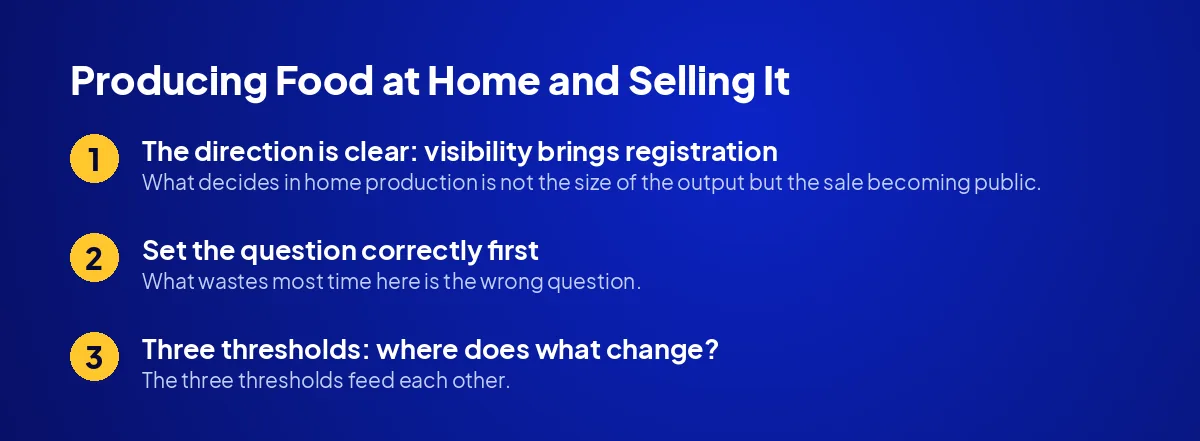
Set the question correctly first
What wastes most time here is the wrong question. “Can I produce at home and sell it” has no single answer. The right question has three parts.
- Which product will I make? Jam and pickles are not assessed in the same framework as a dairy or meat product
- At what scale and how continuously? Seasonal small production differs from regular, continuous production
- Through which channel will I sell? A local market, my own site, a marketplace and corporate supply carry different obligations
Write those three answers down, take them to the provincial directorate of agriculture and forestry, and you get clear guidance. Ask without settling all three and the answer stays general.
Three thresholds: where does what change?
| Threshold | Deciding question | What changes |
|---|---|---|
| Product group threshold | Is it a high-risk food? | Expectations on registration and premises |
| Scale threshold | What level of continuity and quantity? | Business registration comes into play |
| Channel threshold | Where and to whom is it sold? | Labelling, invoicing, platform conditions |
The three thresholds feed each other. Cross one and the others usually come into play too, so plan the transition as a whole rather than piece by piece.
First threshold: the product group
Foods do not carry the same risk. A high-acid product with a long shelf life raises different expectations from one needing the cold chain.
Dairy products, meat products, cream-based desserts and the ready-meal group needing cold storage are the most sensitive areas. In those groups home kitchen conditions may well not be counted as sufficient.
What to do
Notify the name and contents of your product in writing and ask the provincial directorate of agriculture and forestry for an assessment. An answer against a named product is far more useful than general information.
Second threshold: scale and continuity
A small batch a few times a year and regular weekly orders are not the same thing. The second is a business activity, and the expectation of registration becomes clear there.
As the scale grows these items arise in turn: tax liability, the food business registration certificate (issued by the provincial directorate of agriculture and forestry), the suitability of the place of production, and the hygiene training certificate. That order can vary from province to province; have your own position confirmed.
Third threshold: the sales channel
The channel is the most visible threshold. Even with the same product in the same quantity, where you sell it changes your file.
- Local markets and producer stalls: the municipality’s and the market management’s own conditions apply
- Your own site: distance selling, invoicing and duties to inform come into play
- A marketplace: the platform’s seller documents and category conditions are added
- Corporate supply: the other side expects you to be a registered business and to issue invoices
The fourth item speeds up the transition most often. When a cafe or a shop wants your product, that relationship cannot be built without a registered business.
What does online selling bring?
Selling over the internet means sending a product to a buyer who has not seen it. Two headings come to the fore: information and transport.
The information side
The buyer buys without seeing the product. Contents, production and use-by dates, storage conditions and producer details are expected in writing. A statement that the product treats or prevents an illness cannot be used under any circumstances.
The transport side
Sending a cold chain product by courier is a serious matter of packaging and delivery time. For that group, do not decide the channel before the transport solution is built.
What changes in moving from a home kitchen to a business?
Once the decision is taken, four things change together, and doing them separately stretches the process out.
- The place of production: the kitchen is expected to be separated in flow from the living space
- The record system: keeping raw material intake, production and dispatch records
- The tax and invoicing side: opening a liability and documenting sales
- The staffing side: a hygiene training certificate for everyone taking part in production
The first item makes most people put the decision off. With no separable area at home, moving into a small production unit is less risky than forcing it indoors.
Three suggestions for the period ahead
- Narrow the product group. Mastering one low-risk group with a long shelf life is more productive than spreading across a wide menu
- Build the record habit today. Writing down which raw material you took from whom leaves a ready file when the scale grows
- Get your confirmation in writing. Proceeding on verbal guidance means having to turn back later
Who will you ask for confirmation, and what?
There are two right addresses here, and you need both.
Notify the provincial directorate of agriculture and forestry in writing of your product, the estimated quantity and your sales channel, and ask whether business registration is required. Notify your district municipality of your production address and ask whether you fall within the scope of the workplace opening and operating licence.
Ask for both answers in writing. Those two documents strengthen your hand later with platforms and corporate buyers alike.
For the general order authority by authority see the business licence roadmap, and for capital and profit margin bands our herbalist and food sector page. If you will move to the ready-product side see our meze deli article, and for the dessert and baked goods side our patisserie and dessert shop article.
In Short
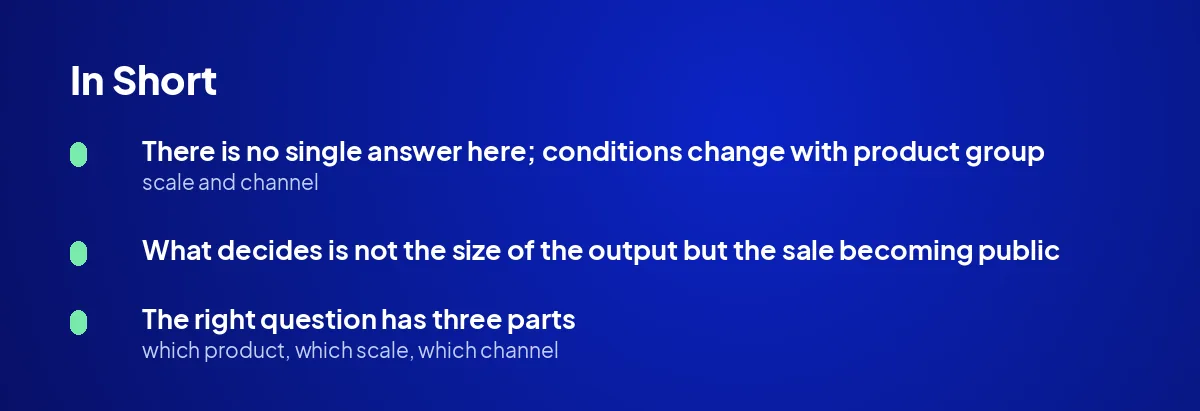
- There is no single answer here; conditions change with product group, scale and channel
- What decides is not the size of the output but the sale becoming public
- The right question has three parts: which product, which scale, which channel
- The three thresholds feed each other; plan the transition as a whole
- In dairy, meat and cold chain groups home conditions may not count as sufficient
- Regular, continuous production makes the expectation of registration clear
- Corporate buyer demand is the most common reason for speeding up the transition
- In online selling, information and transport are two separate headings
- Statements amounting to a health claim cannot be used under any circumstances
- In the transition, premises, records, tax and staffing change together
- Get written confirmation from the provincial directorate and the district municipality
Quick Glossary
Food business registration certificate: the document showing that a food business has been recorded through the provincial directorate of agriculture and forestry. Product group: the class of foods carrying similar risk and storage characteristics. Sales channel: the route by which a product reaches the buyer; a market, your own site, a marketplace or corporate supply. Health claim: a statement that a product prevents or treats an illness.
Next Step
Let’s settle your product group, your scale and your channel decision together: consultation request form.
Frequently Asked Questions
Updated: September 2026
Sık Sorulan Sorular
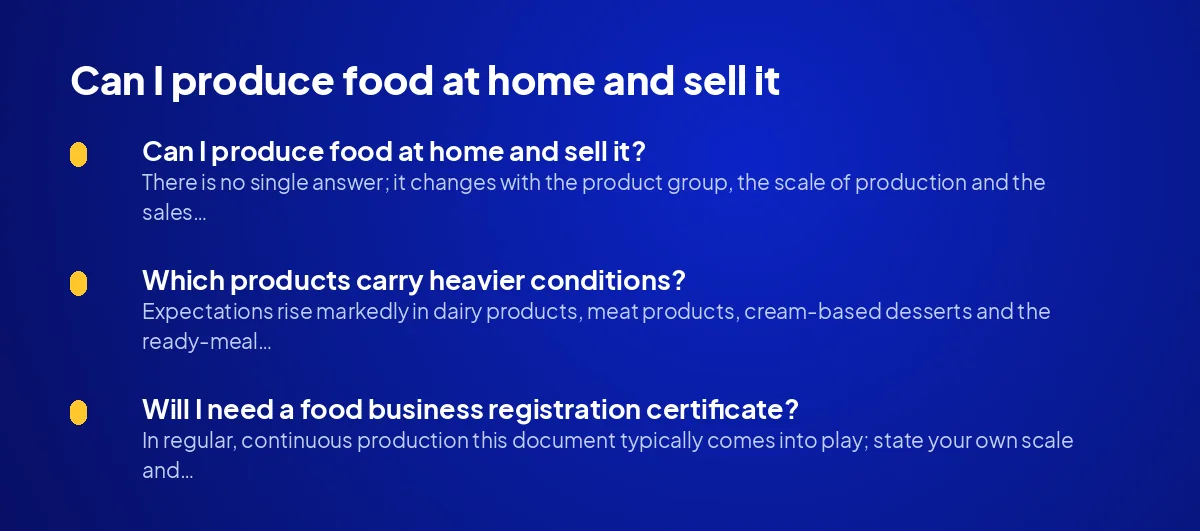
There is no single answer; it changes with the product group, the scale of production and the sales channel. Write the three down and get written confirmation from the provincial directorate of agriculture and forestry.
Expectations rise markedly in dairy products, meat products, cream-based desserts and the ready-meal group needing the cold chain.
In regular, continuous production this document typically comes into play; state your own scale and have it confirmed.
If your selling is commercial in nature and continuous, liability comes into play; assess your own position with your accountant.
Platforms have seller document and category conditions; on the food side registration status is being asked about more and more often.
Contents, production and use-by dates, storage conditions and producer details must be written out; no statement amounting to a health claim may be used.
Do not enter that channel before packaging and delivery time are solved; a channel decision taken without a transport solution carries risk.
The production flow is expected to be separated from the living space; with no separable area, moving into a small production unit is the healthier path.
Give the provincial directorate of agriculture and forestry your product, quantity and channel; give your district municipality your production address and ask about the licence scope. Ask for both answers in writing.
Source: Ministry of Agriculture and Forestry — Food and Control