
What is online visibility? The 3 layers that make a business found, searched and reached
What is online visibility? In short, it means your business shows up when customers look for it online, gets chosen and can be reached with one tap. It has three layers. Being found: an accurate listing on Google and the map. Being searched: a name and reviews that inspire trust. Being reached: one tap to call, message or get directions on a phone.
Most people do not know this: you cannot buy your local ranking on Google. The Google Business Profile help page says so plainly. Visibility is not an ad you pay for once and forget; it is a setup where three layers work together. The good news for a small business in Türkiye in 2026 is that all three can be built properly from the start.
Most people do not know this: map rankings are not for sale
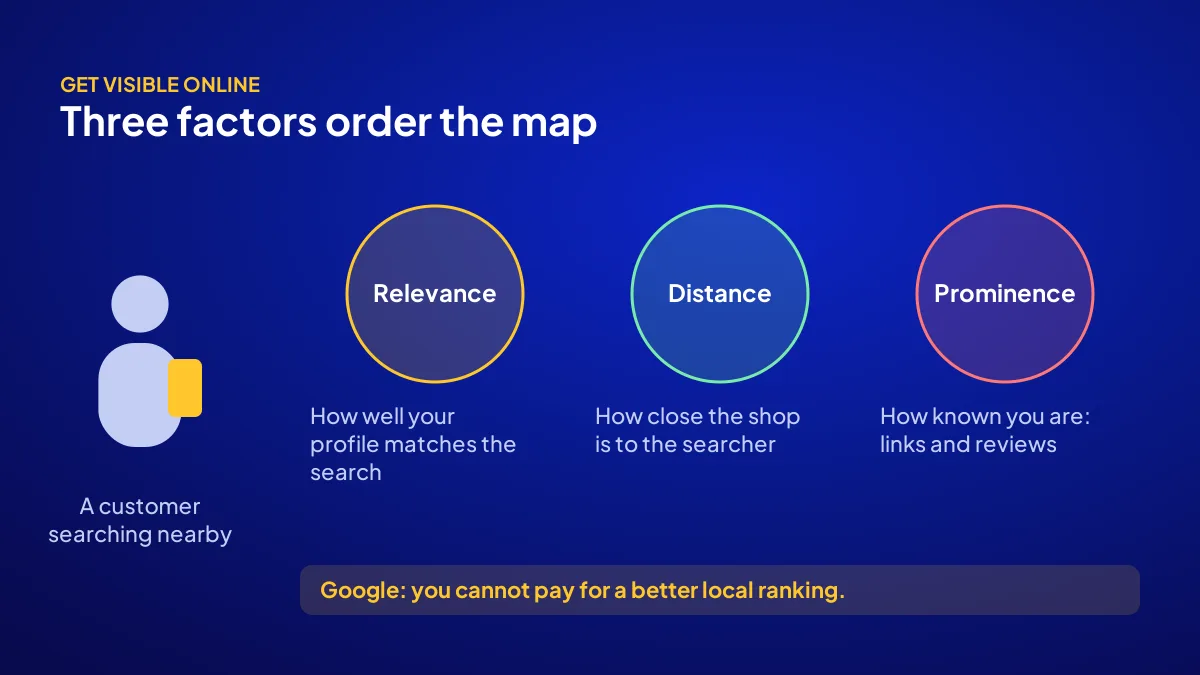
Map rankings are not for sale; Google orders local results by three factors. Relevance, distance and prominence. The help page is clear: you cannot request or pay for a better local ranking. Ads are a separate shop window. The organic order on the map is earned through these three factors alone.
The first layer is being found
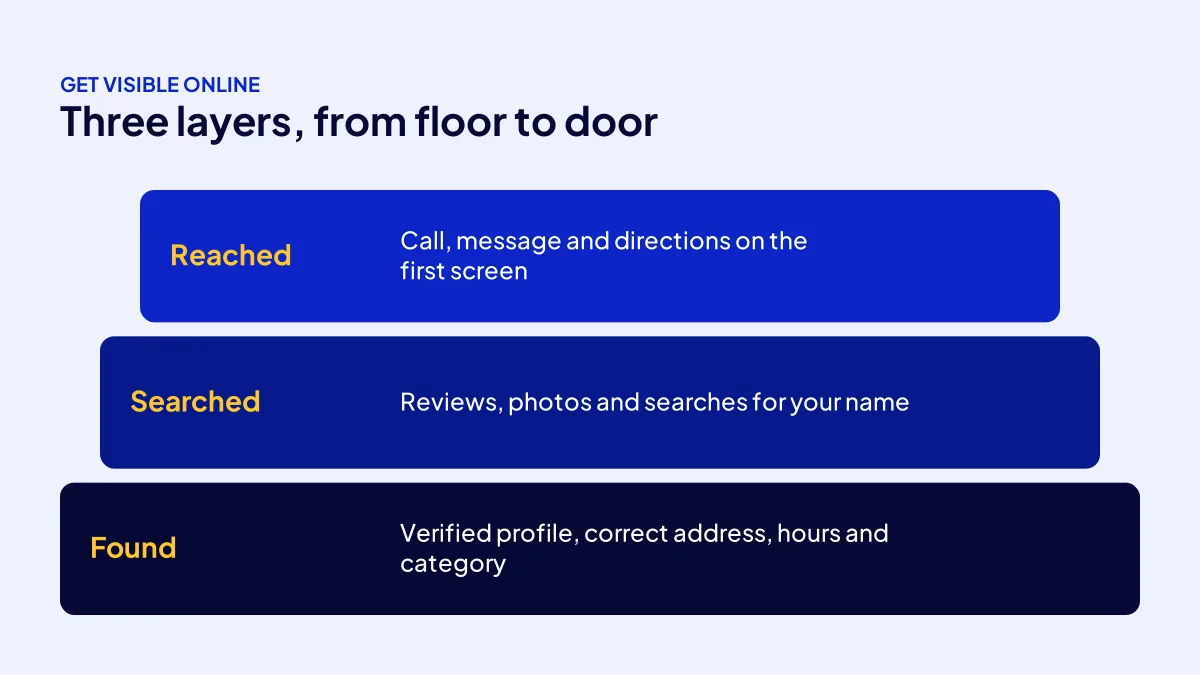
Being found means your business has an accurate, verified listing on Google and the map. No listing, and in the customer’s eyes there is no shop. Address, phone, opening hours and category each matter here. This layer is the floor the other two stand on.
A shop without a listing does not exist
A customer opens their phone and types “tailor near me”. Without a listing, your shutters may be up but you are not on the list. The customer walking past your door walks into another shop on the screen.
Why verification matters
According to Google, verification shows you are authorised to represent the business and makes it more likely to appear in results. Opening a profile without verifying it is like hanging a sign and never fitting the bulb. The step-by-step setup is in how to set up Google Business Profile.
The second layer is being searched
Being searched means customers choose you once they find you, and even look you up by name. Reviews, photos and pages about you feed this layer. It is largely what Google calls prominence. When two shops appear side by side, customers pick the one people talk about more.
Reviews are the neighbourhood’s word of mouth
“Go to that guy” travels across the tea house; today the same word travels in stars too. Google says reviews and helpful replies can help a business stand out. Why they carry so much weight is covered in why Google reviews matter.
The third layer is being reached
Being reached means a customer who has found and chosen you can contact you with one tap. A call button, a message button and directions are the three parts of this layer. A business that is seen but cannot be reached is like a shop with its window lit and its door locked. Customers look, cannot try, and leave.
Customers arrive on their phones
In Adapte’s own Search Console data for 14 June to 13 September 2026, roughly three quarters of clicks come from mobile. The mobile click-through rate is 1.86%, desktop is 0.57%. Your customer is most likely looking for you on the screen in their hand.
The three-button rule
The first screen of your mobile page should show call, message and location buttons. If customers have to scroll, they put off the decision. And a customer who puts it off often ends up next door.
Which signals tell you how visible you are?
Each layer has its own signal. For being found, watch profile impressions. For being searched, watch searches for your name and your review count. For being reached, watch call, message and direction clicks. When all three rise together, the setup is working.
| Layer | The customer’s question | Signal to watch |
|---|---|---|
| Found | Is there a place like this near me? | Profile and map impressions |
| Searched | Can I trust this place? | Review count, searches for your name |
| Reached | How do I contact them right now? | Call, message and direction clicks |
Say you run a bakery in Esenyurt
You have a profile, but your hours are missing, there are no photos and the phone number is old. You show up on the map, yet when customers call, the line is dead. The found layer is half built and the reached layer is broken. The problem is a missing listing detail, not a missing ad.
Lots of impressions, no calls
If impressions climb but calls do not, the problem usually sits in the second or third layer. Reviews may be thin, or the page may load poorly on a phone. Fix the broken layer first, then set money aside for ads.
How does the package cover the three layers?
In Adapte’s Get Visible Online campaign, the Website Recipe touches all three layers at once. It includes a mobile-friendly sales page, contact buttons, Google Business Profile, basic SEO and visitor tracking. The package is TRY 36,000 + VAT, paid upfront at a fixed price, for a 3-month term.
Now you know this
Visibility is not a single ad but three layers: being found, being chosen, being reached. Map rankings are not bought; they are built. To see which of your layers is missing, fill in the needs form on the Get Visible Online campaign page.
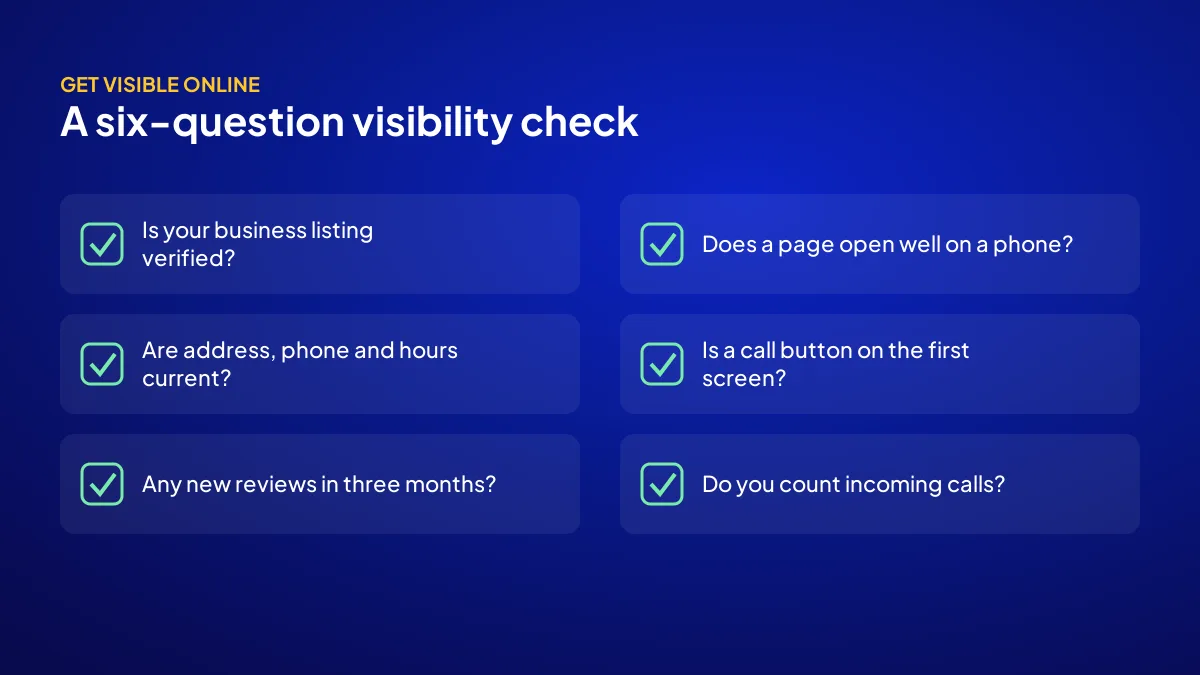
- Do you have a verified business listing on Google?
- Are your address, phone and hours up to date?
- Have you received new reviews in the last three months?
- Do you have a page that opens well on a phone?
- Are call and message buttons on the first screen?
- Do you count incoming calls and messages?
Quick Summary
- Online visibility has three layers: being found, searched and reached.
- You cannot pay for local ranking on Google; relevance, distance and prominence decide it.
- Most customers search on their phones, so contact buttons belong on the first screen.
Short Glossary
Prominence: Prominence is the local ranking factor Google uses to judge how well known a business is online.
Profile verification: Profile verification is the confirmation step used to prove to Google that you may manage the business profile.
Impression: An impression is the measure used to count how many times your business appears in search or map results.
Next Step
Find your missing layer with numbers, not guesses. Apply for the Get Visible Online campaign and get the right recipe recommended to you.
Frequently Asked Questions
Source: Google Business Profile Help — Tips to improve your local ranking on Google
Sık Sorulan Sorular
Relevance describes how well your profile matches what the customer searched for. Your category, service list and description do the talking here. Someone searching “hairdresser” will struggle to find a shop whose profile only says “beauty”.
Distance is how far the business is from the person searching. You cannot change it, unless your shop has wheels. But an accurate address and service area make distance work for you rather than against you.
Prominence is how well known the business is. Google ties it to signals such as the number of websites linking to you and the number of reviews you have. In plain words, being the shop other traders mention, online.
If your address reads one way on your site, another on the map and a third on social media, customers and Google both get confused. Name, address and phone should match letter for letter. It takes an afternoon and costs nothing.
Yes. A map listing is a short business card; a website is the long conversation. Price ranges, services and common questions live there. What a site does for a business is explained in what does my website do.
The Google Ads and Meta Ads recipes shorten the road to being searched by putting you in front of people who do not know you yet. The ad budget is not included and is paid separately to Google or Meta. Adapte recommends the right recipe after the needs form. How to choose a package for the first 3 months is covered in digital marketing packages.
One of three recipes is included: the Website, Google Ads or Meta Ads Recipe. The Website Recipe covers a sales page, contact buttons, Google Business Profile, basic SEO and visitor tracking.
No. According to Google’s help page, you cannot pay for a better local ranking. The order is decided by relevance, distance and prominence.
No. The found and reached layers can be built without ads. Ads speed up reaching customers who do not know you yet, and their budget is paid separately.
Updated: October 2026