
MR.DIY opens its 200th store in Türkiye, how do scanners and handhelds speed up a store?
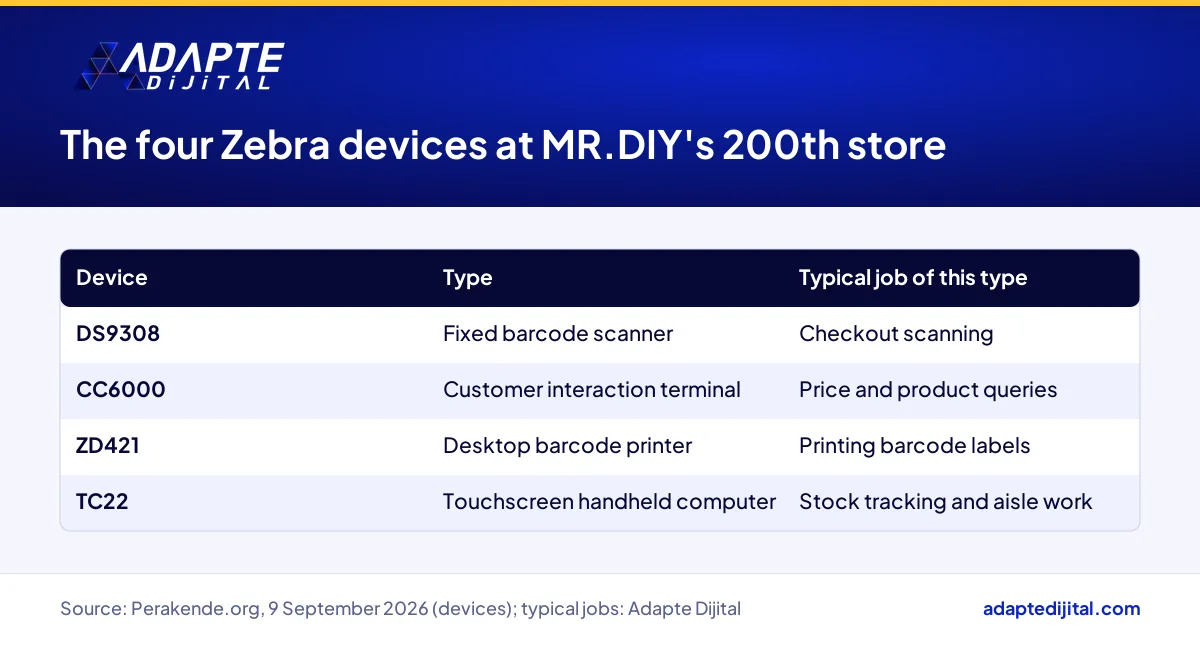
MR.DIY has opened its 200th store in Türkiye at Koru Florya AVM, a shopping mall in Istanbul, and runs store operations on Zebra Technologies devices (Perakende.org, report published 9 September 2026). Four devices are named: a fixed barcode scanner, a customer interaction terminal, a desktop barcode printer and a touchscreen handheld computer.
For a retailer planning more branches, the message is simple: as store numbers grow, checkout, price checks and stock counts have to depend on a system rather than on individual people. The report gives no speed or efficiency figures, so the steps below are a setup order, not a promise of results. You can find other operations stories on our retail page, where we interpret the Turkish retail agenda.
Which Zebra devices does MR.DIY’s 200th store use, and for what?
Four devices cover a set of everyday store jobs. The report names the Zebra DS9308 fixed barcode scanner, the CC6000 customer interaction terminal, the ZD421 desktop barcode printer and the TC22 touchscreen handheld. The stated uses are checkout transactions, aisle management, price checks, in-store stock tracking, self-service and customer queries. The report lists these uses together and does not tie each one to a specific device.
How can a small store standardise checkout, pricing and stock the way MR.DIY does?
BU BÖLÜMÜN ÖZETİ
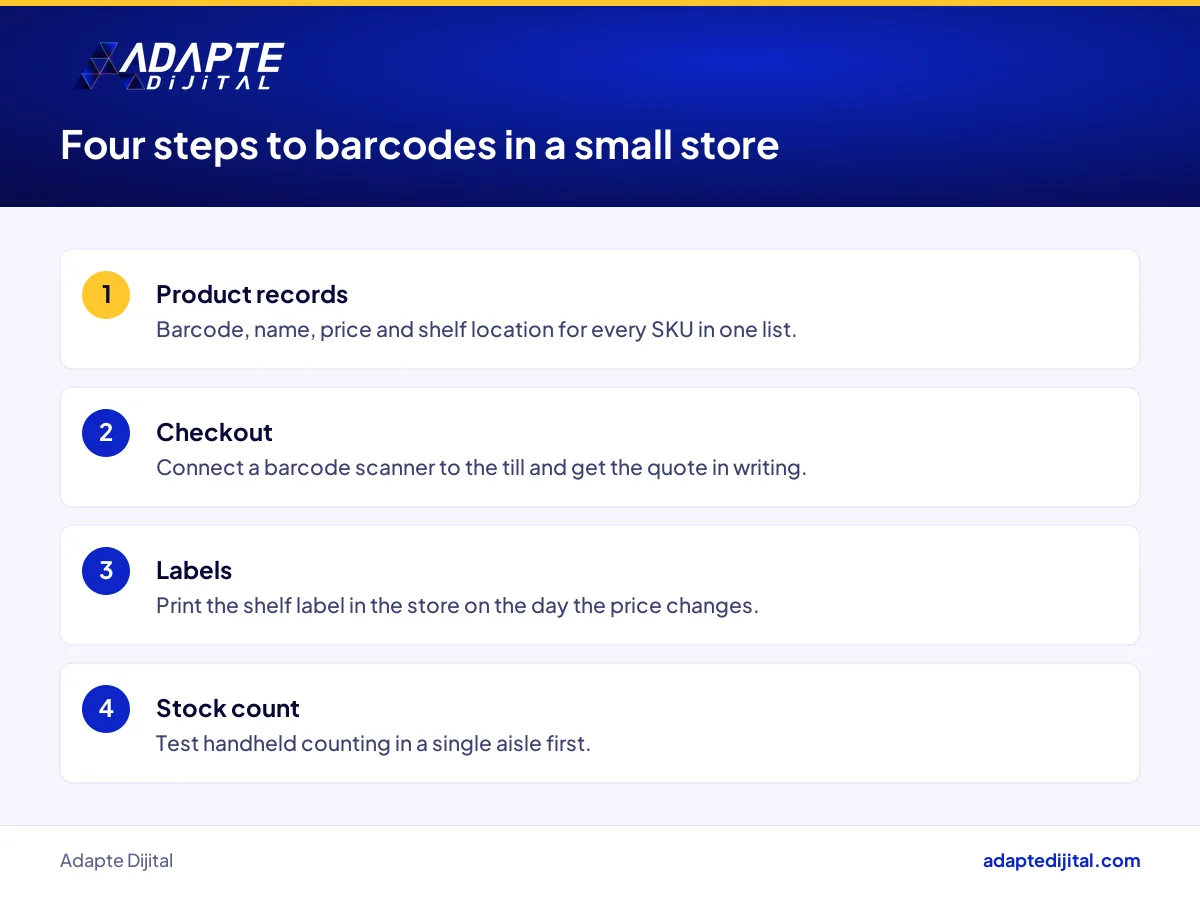
- Step 1: Put every product record in one list
- Step 2: Connect a barcode scanner to the till
- Step 3: Print shelf labels in the store
- Step 4: Move stock counts to a handheld
In four steps, starting with the job that causes the most errors. Time and cost vary by business, and the report gives neither, so at each step you need to get your own quote. The order is product records, checkout, labels, stock count.
Step 1: Put every product record in one list
Every SKU needs its barcode, name, price and shelf location in one table. If that list is messy, a new device only makes mistakes faster. Time depends on your product count, so run a one-week trial to estimate it.
Step 2: Connect a barcode scanner to the till
Ask your supplier which scanners work with your point-of-sale software. For cost, get your own quote from at least two suppliers. Ask for installation, training and service response times in writing.
Step 3: Print shelf labels in the store
A gap between a price change and the shelf label means an argument at the till. A desktop barcode printer lets you change the label the same day. Write down which staff member prints labels and on which day.
Step 4: Move stock counts to a handheld
With paper counts, the shelf, the count sheet and the system live in three separate places. A handheld writes the count straight into your stock record. Start with one aisle, note the differences, then roll it out to the whole store.
What is the most common mistake when moving to barcodes and handhelds like MR.DIY’s?
The most common mistake is buying devices before cleaning the data. If product records are messy, the scanner reads the wrong price faster and the handheld counts the wrong stock faster. The argument with the customer at the till does not end; it just moves. List first, devices second.
Second common mistake: going live without training staff
The device arrives, the box is opened and it goes on the till the next day. Staff fall back on old habits and type prices by hand, so the system keeps two records. Put a short training session between installation day and go-live day.
Who does MR.DIY’s device-driven store model affect, and how?
The winners are fast-expanding chains and stores with wide ranges, such as hardware, homeware and stationery retailers. Under pressure are neighbourhood hardware shops that keep stock in a notebook; when a customer asks a price and has to wait, the customer walks out. Point-of-sale software firms and device suppliers feel the effect indirectly.
What does barcode and stock data turn into on MR.DIY’s digital side and yours?
Accurate stock data means accurate information on your website, on marketplaces and in local search. If an item counted in the store shows as “in stock” online, the customer is sure before setting off. If the count is wrong, online orders go wrong too and complaints land back at the store.
What should a retailer planning new branches do this week after MR.DIY’s milestone?
BU BÖLÜMÜN ÖZETİ
- Checklist: checkout, labels, stock count
- Prepare a quote checklist
- Put the whole process in one document
This week, write down how your current store runs and work out what devices you need. A new branch will be a copy of your current store. If the process to copy is not written down, every branch invents its own rules.
Checklist: checkout, labels, stock count
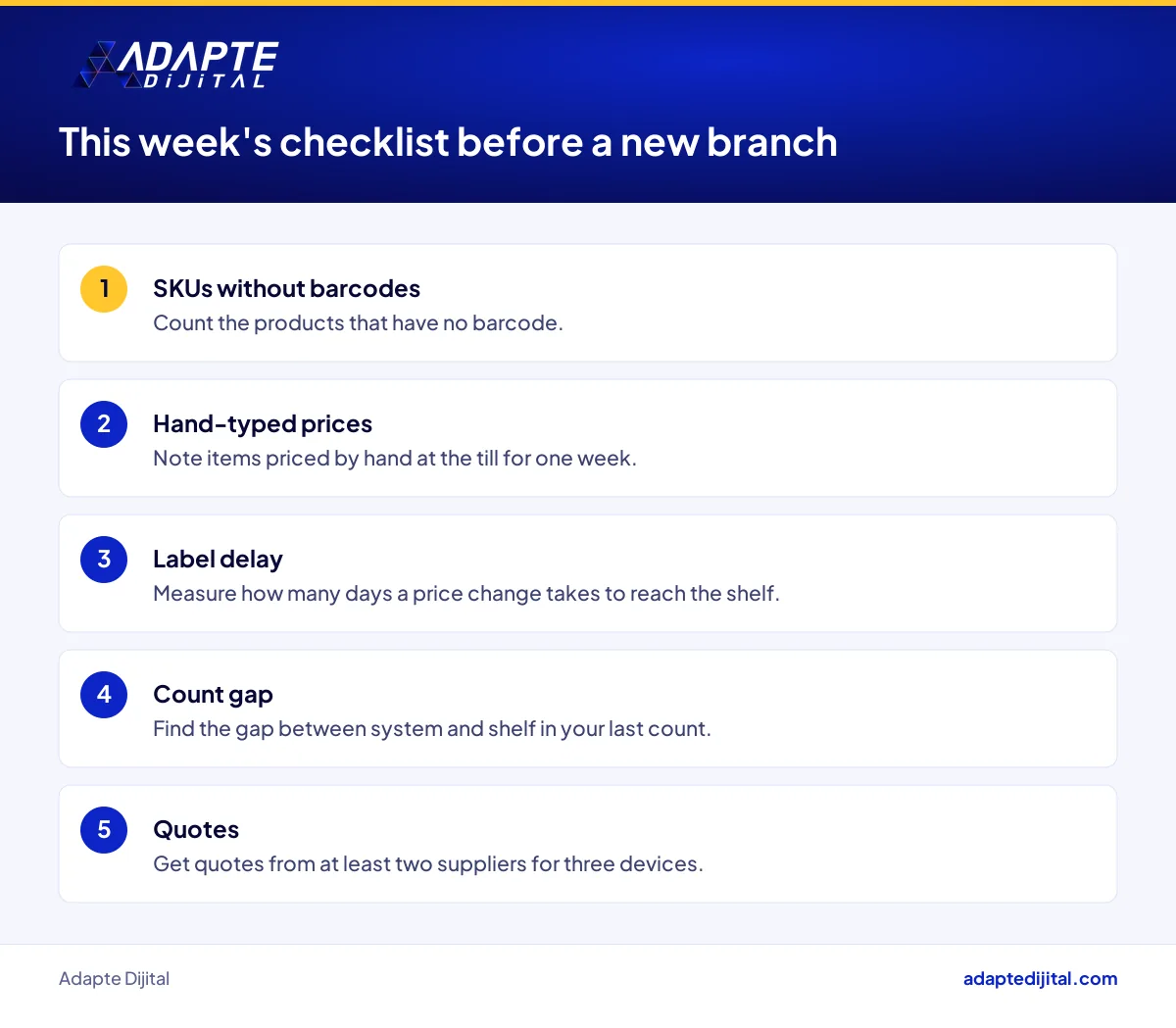
Count the SKUs in your product records that have no barcode. For one week, note every item whose price is typed in by hand at the till. Check how many days the last price change took to reach the shelf label, and find the gap in your last stock count.
Prepare a quote checklist
Get your own quote from at least two suppliers, with the scanner, printer and handheld as separate lines. Ask in writing for compatibility with your point-of-sale software and for service response times.
Put the whole process in one document
From opening the till to the end-of-day count, write on one page who does each job, with which device and when. To build your business model and digital transformation plan alongside branch growth, this is work we do in digital transformation management.
Quick Summary
- MR.DIY opened its 200th store in Türkiye at Koru Florya AVM in Istanbul (Perakende.org, 9 September 2026).
- The report names four Zebra devices: DS9308, CC6000, ZD421 and TC22 (Perakende.org).
- Whether the devices are in every store, and any measured speed gain, have not been disclosed.
- For a small store, the right order is product records, checkout, labels and stock count.
- The most common mistake is buying devices before cleaning product data.
Short Glossary
- SKU
- SKU is the stock keeping unit used to track each product variant separately in inventory.
- Handheld computer
- A handheld computer is the portable device used to scan barcodes in the store and process stock and price data on the spot.
- Aisle management
- Aisle management is the in-store planning work used to decide where products sit, how they are arranged and how full the shelves are.
Frequently Asked Questions
Next Step
If you want to get your checkout, labelling and stock count routines ready for branch growth, fill in our consult your expert form.
Sources: Perakende.org, 9 September 2026 · Primary source: no MR.DIY Türkiye or Zebra press release found · Authority: MR.DIY group corporate information page · Context: Investment Office of the Presidency of Türkiye, 26 November 2021; Borsa Gündem, August 2026 mall data
Updated: October 2026
Sık Sorulan Sorular
A fixed scanner like the DS9308 is a device type built to stay in one place, usually at the till. The cashier passes items in front of it instead of holding a scanner gun. Hands stay free for products and bags, and in a busy queue that small difference touches every minute at the till.
A customer interaction terminal lets shoppers check a price or product detail on their own, which saves staff from the constant “how much is this” question. A desktop barcode printer prints barcode labels on site. In a store that prints its own labels, a price change can reach the shelf the same day.
The Zebra Technologies Türkiye team says it is happy “to be part of the pride of the 200th store”. The report names no individual speaker or title. It includes no statement from MR.DIY.
No. The report does not make clear whether the Zebra devices are used only at Koru Florya or across all 200 stores. In your own plan, too, testing in one branch before rolling out carries less risk than switching every branch at once.
Thousands of small items, frequent price changes and thin margins are the daily reality of this category. When MR.DIY announced its first store in Türkiye in November 2021, the group was described as having more than 1,600 locations worldwide and about 18,000 product lines (Investment Office of the Presidency of Türkiye, 26 November 2021). At that scale, products cannot be managed by hand. You can check the group’s current details on the MR.DIY corporate information page.
A chain whose stores run on barcodes expects suppliers to deliver correctly barcoded, properly labelled goods. We look at stock and supply chain questions from a manufacturer’s view in Form Grup’s second-half plans.
It can, because home improvement shoppers are often looking for an urgent part. If your website or business profile answers “is this item at the nearest store”, the customer gets in the car. That depends on the accuracy of the count on your handheld.
The items most often checked on a customer terminal can read like a list of products that are hard to find or unclearly priced. You can use that list to improve aisle layout and online product pages. We discuss AI-assisted shopping in the Migros MAYA AI case.
Barcode data from the till shows what each aisle sells, day by day. In August 2026, sales per square metre in Istanbul shopping malls stood at TL 23,983, while mall turnover shrank 6.5% in real terms (Borsa Gündem, August 2026 mall data). In that climate, seeing in the data which product is just sitting on the shelf is the first condition for giving space to the right one.
If your range is small, connecting a barcode scanner to the till may be enough at first. As your product count and counting frequency grow, a handheld becomes the way to cut counting errors.
It depends on your product count and how tidy your product records are; the report gives no information on this. The most reliable answer is a written quote from your supplier.
The report does not make this clear. It describes the devices at the 200th store and says nothing about the other stores.