
Migros brings MAYA AI into ChatGPT, what does a 60% add-to-cart rate mean for retailers?
Turkish food retailer Migros has moved its AI shopping assistant MAYA AI inside ChatGPT: users pick Migros from the apps tab, search for products in the chat and add them straight to the basket (Perakende Türkiye, 1 September 2026). It was first announced in July 2026. Early company results show 60% of users who search through MAYA AI add the suggested items to their basket.
What it means for you: product discovery now also happens inside a chat assistant, not only in search engines and store apps. If you run a grocery store, a deli or an online food shop in Türkiye in autumn 2026, the real question is whether an AI system can read your product data. The 60% figure is an add-to-cart rate, not a sales rate, but it shows where the channel is heading.
How does Migros MAYA AI work inside ChatGPT, step by step?
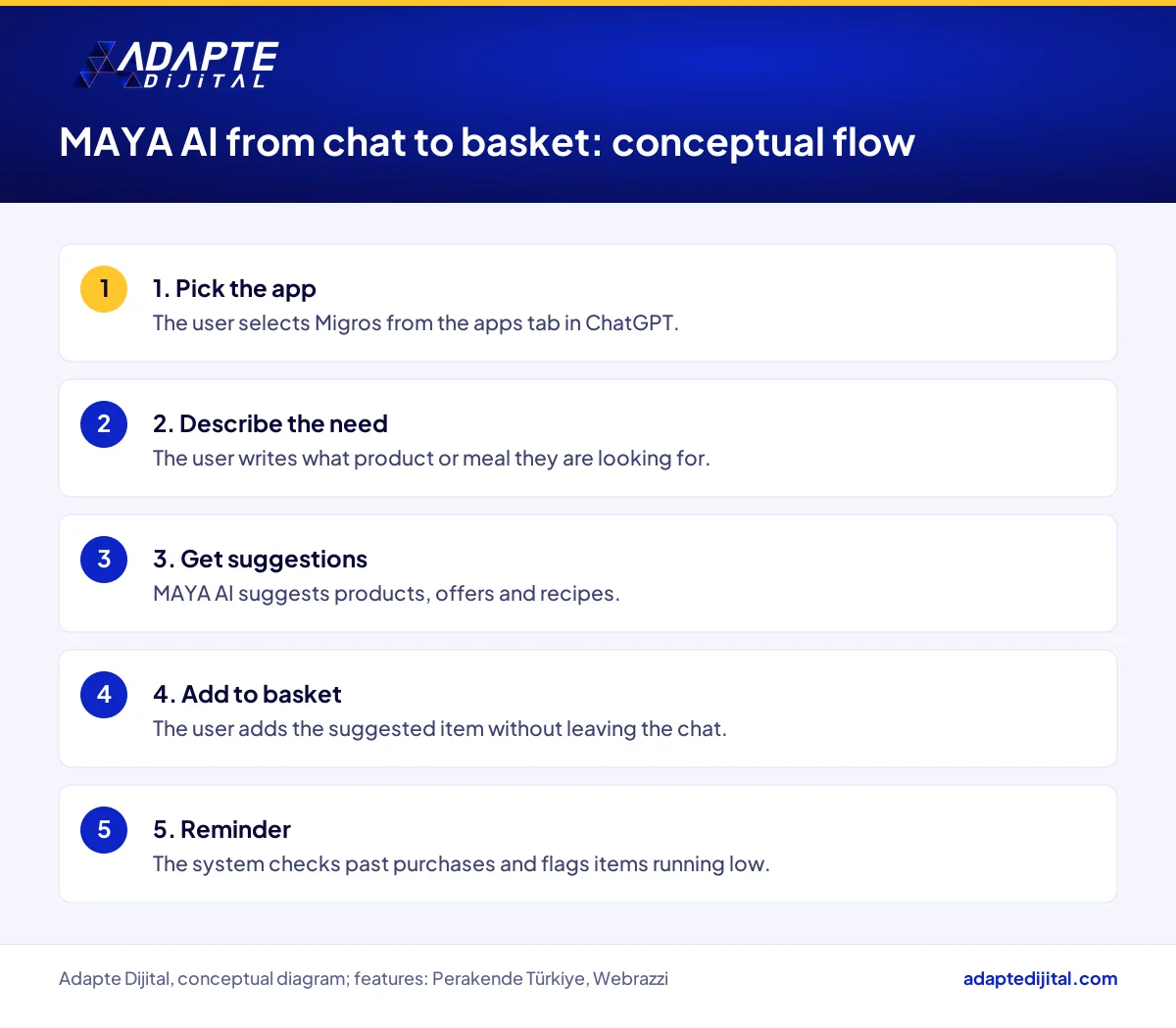
The flow reads in four steps: the user selects the Migros app in ChatGPT, describes what they need, MAYA AI suggests products and offers, and the user adds the item directly to the basket. The coverage does not describe the technical setup, so the diagram below is conceptual: its steps come from the announced features, not from Migros’s architecture.
What exactly does MAYA AI’s 60% add-to-cart rate measure?
Only this: 60% of users who search through MAYA AI add the suggested items to their basket, which is not a sales or order rate. The coverage gives no measurement period and no user or session count. User numbers, orders and revenue effect are not disclosed either.
Which businesses do AI shopping assistants like MAYA AI affect, and how?
Winners are businesses with tidy product data that already take online orders. Under pressure are neighbourhood grocers whose product list lives only in the till software, and small online shops with one template description for every product. Indirectly affected are local producers and suppliers: thin product information keeps them out of suggestions too.
How should product data be prepared to show up in assistants like ChatGPT?
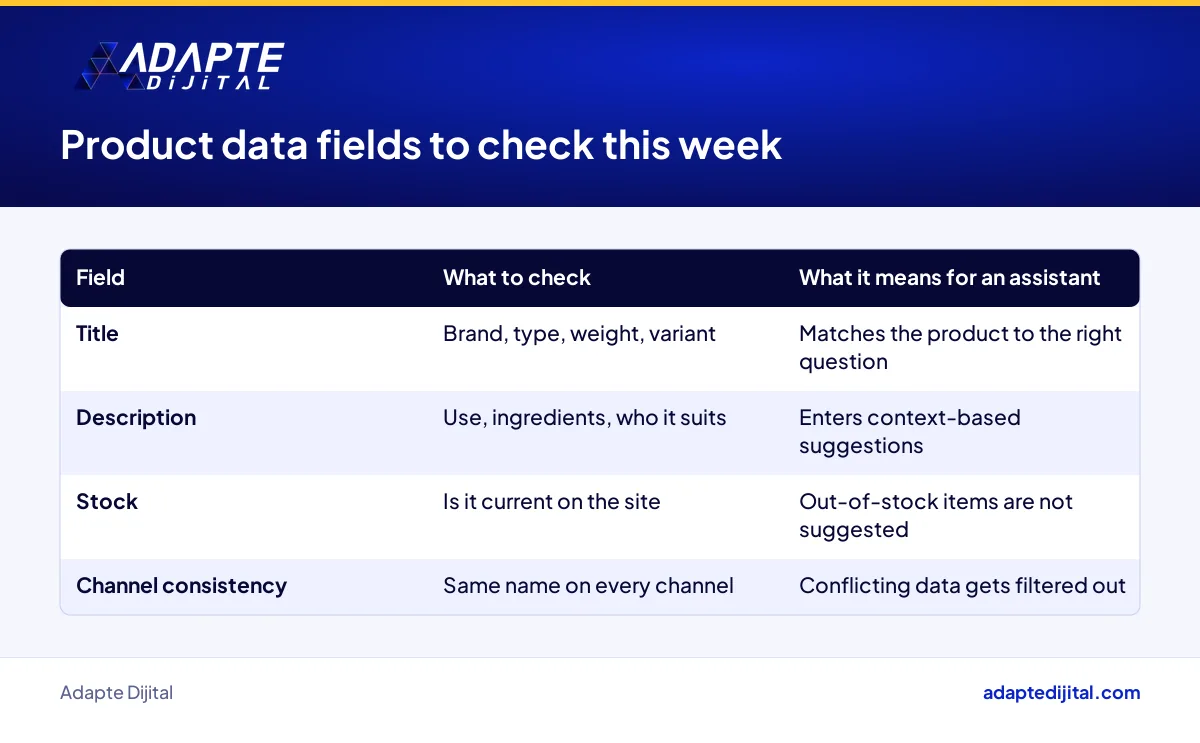
Three fields decide it: title, description and stock. An assistant recognises a product from these, and missing or conflicting data means no suggestion. So your website, marketplace store and Google Business Profile should carry each product under the same name and details.
Should a small grocer build its own MAYA AI-style assistant?
For most small businesses, that is not the first step. Migros’s setup is an integration built in partnership with OpenAI. For a small grocer, the realistic order is clean data first, then existing channels fed with it, and an assistant last.
What steps should a grocery owner take on product data this week?
Four jobs fit into this week: review titles and descriptions of your best sellers, check that site stock is current, confirm each product has the same name on every channel, and ask ChatGPT a question the way your customer would.
There is currently no page dedicated to MAYA AI on Migros’s corporate website. We collect similar developments on our retail page, where we interpret the retail agenda for you.
Quick Summary
- Migros moved its MAYA AI assistant inside ChatGPT, first announced in July 2026 (Webrazzi, Perakende Türkiye).
- Early results show 60% of MAYA AI product searchers add the suggested item to their basket, which is not a sales rate (Perakende Türkiye).
- The measurement period, user numbers and revenue effect have not been disclosed.
- Whether an assistant can recommend a product depends on tidy title, description and stock data.
- For a small grocer, the first step is not building an assistant but making product data consistent across every channel.
Short Glossary
- Add-to-cart rate
- Add-to-cart rate is the metric used to measure how many people who see a product go on to put it in their basket.
- Product feed
- A product feed is the data file used to send your full product list, with prices and stock, to other platforms.
- Structured data
- Structured data is the code used to mark up product information on a page in a standard format that machines can read.
Frequently Asked Questions
Next Step
If you want to see how AI assistants read your product data, fill in the consult your expert form.
Sources: Perakende Türkiye, 1 September 2026 · Webrazzi, 10 July 2026 (first published) · Migros corporate website · Ministry of Trade, 2025 e-commerce data · TÜİK 2026 data (as reported by CNBC-e)
Updated: October 2026
Sık Sorulan Sorular
The announced tasks fall under six headings: building a personalised basket, suggesting offers, adding products straight to the basket, sharing cooking recipes, analysing past purchases and reminding users of items that are running low.
In classic online shopping, the customer searches, opens a category, opens a product page, then adds to basket. In chat, those steps melt into one window. Every extra step is a door the customer can walk out of. Fewer doors means a shorter distance between intent and basket.
Right now MAYA AI works through written dialogue. Voice commands are said to be coming “soon”, with no firm date given.
A basket item can be dropped at checkout, or the basket abandoned. Conversion rate, a separate metric, shows how many visitors actually finish an order.
Because suggestion and intent meet on one screen. When the suggestion is accurate, the customer stops searching. When it misses, the customer walks out the door.
Orçun Onat, CEO of Migros One, describes AI as, in our translation, “a strategic element that fundamentally transforms the customer experience”. Migros presents itself as the first food retailer to integrate directly into ChatGPT, in partnership with OpenAI. Whether that means Türkiye or the world is unclear, so read it as the company’s own claim.
A business with a clean product list does not start from zero when a new channel opens. The same data can feed a website, a marketplace store and, later, an assistant, so the chance to grow average basket size arrives earlier.
The till record is usually just an abbreviated product name and a price. An assistant needs more to match a request like “gluten-free pasta”. The product is physically sitting on the shelf, but digitally it does not exist.
The producer is the first source of product information: ingredients, weight, use. A producer that does not pass this on in an orderly way slips to the back row of the chain’s digital shelves. Label claims also follow rules, which we look at in our piece on FİLE Market’s gluten-free Harras range.
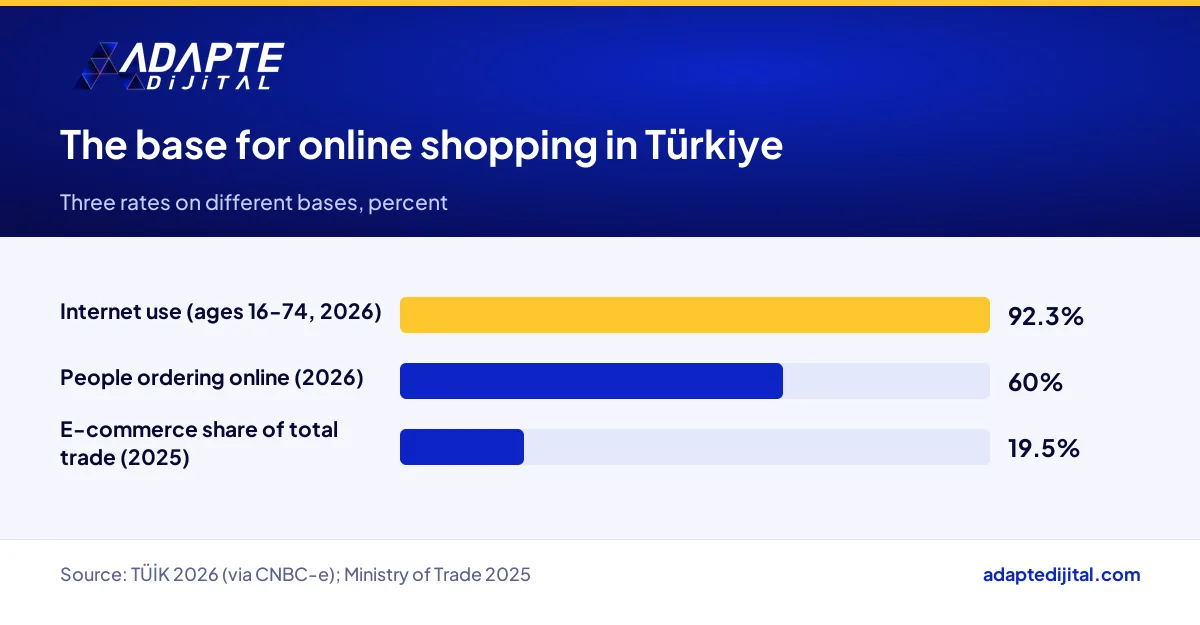
The base is broad. E-commerce volume in Türkiye grew 52.2% in 2025 to TL 4.567 trillion and made up 19.5% of total trade (Ministry of Trade). According to 2026 data from TÜİK, the Turkish Statistical Institute, the share of people ordering goods or services online has passed 60% for the first time. That 60% is not MAYA AI’s add-to-cart rate; they measure different things.
The title should hold brand, product type, weight or volume and any variant. A till abbreviation like “Cheese 500” is vague for people and machines alike.
The assistant matches context, not just the product: which meal it suits, who it is for, what it goes with. Without that context, the product stays off the list even when the question is right.
Structured data marks up the price, stock and product name on a page in a standard format that machines can read. A product feed exports your whole product list to other platforms in a single file. At AINEO we work on the same principle: AINEO Motor runs calculation engines embedded in business articles on defined inputs. If the inputs are messy, the output cannot be trusted.
Every product needs a unique SKU code, current stock information and a consistent category. If stock changes several times a day, the system has to reflect that. An assistant built without this groundwork is like dressing the shop window when the till isn’t ringing.
The customer adds the suggested item, then finds out it is out of stock. Trust breaks on the first try, and next time the customer does not come back to that channel.
No, the same logic applies to store decisions. We cover a platform that lets mall tenants compare their sales with the mall average in our piece on ECE Türkiye’s ECEConnect.
Start with the items that move fastest at the till, because those are most likely what customers search for. Then move to the local or specialty products that set you apart, since they give an assistant the strongest reason to recommend you.
Write a natural question with your neighbourhood and a product you sell. Check whether your business appears, whether product details are right and whether address and hours are current.
The person who keeps the product list and the person who runs the website should sit at one table and update the data from one place. We also do this work, preparing product data for AI channels, as part of our AI consultancy.
The coverage says MAYA AI is reached by selecting Migros from the apps tab in ChatGPT. Whether the assistant is also available inside Migros’s own app is not clear from the news.
No. 60% is the share of MAYA AI product searchers who add the suggested item to their basket. No data on sales, orders or revenue growth has been released.
Migros’s setup is an integration built in partnership with OpenAI. For a small grocer, the realistic step today is to clean up product data and keep it consistent on readable channels such as a website and marketplaces.