
Mobildev adds loyalty card verification, what must retailers do before 28 February 2027?
Mobildev has introduced Wentro Verify, a platform that verifies customers at the till by QR code, barcode or one-time password (OTP) whenever they use a loyalty card, campaign, discount or points (Perakende.org, 20 August 2026). The product is positioned as an answer to Principle Decision 2026/266 on loyalty cards, issued by KVKK, Türkiye’s personal data protection authority. The compliance deadline for that decision has moved from 28 August 2026 to 28 February 2027.
What it means for you: if you run a loyalty card, points or discount programme in Türkiye in autumn 2026, you have less than five months to stop letting customers spend points just by saying a phone number at the till. Choosing a verification method and changing your till software and staff routine all take time. Leave it to the last week, and it comes back to you as a queue at the checkout.
What does KVKK Decision 2026/266 change for loyalty cards?
The decision ends unverified use of loyalty cards. When someone at the till gives the cardholder’s phone or card number and spends their points or discount, the Board treats that as a data security risk (Cottgroup; BloombergHT). From now on, the till must confirm by a reliable method that the card really belongs to the person using it.
Why is the loyalty card verification deadline now 28 February 2027?
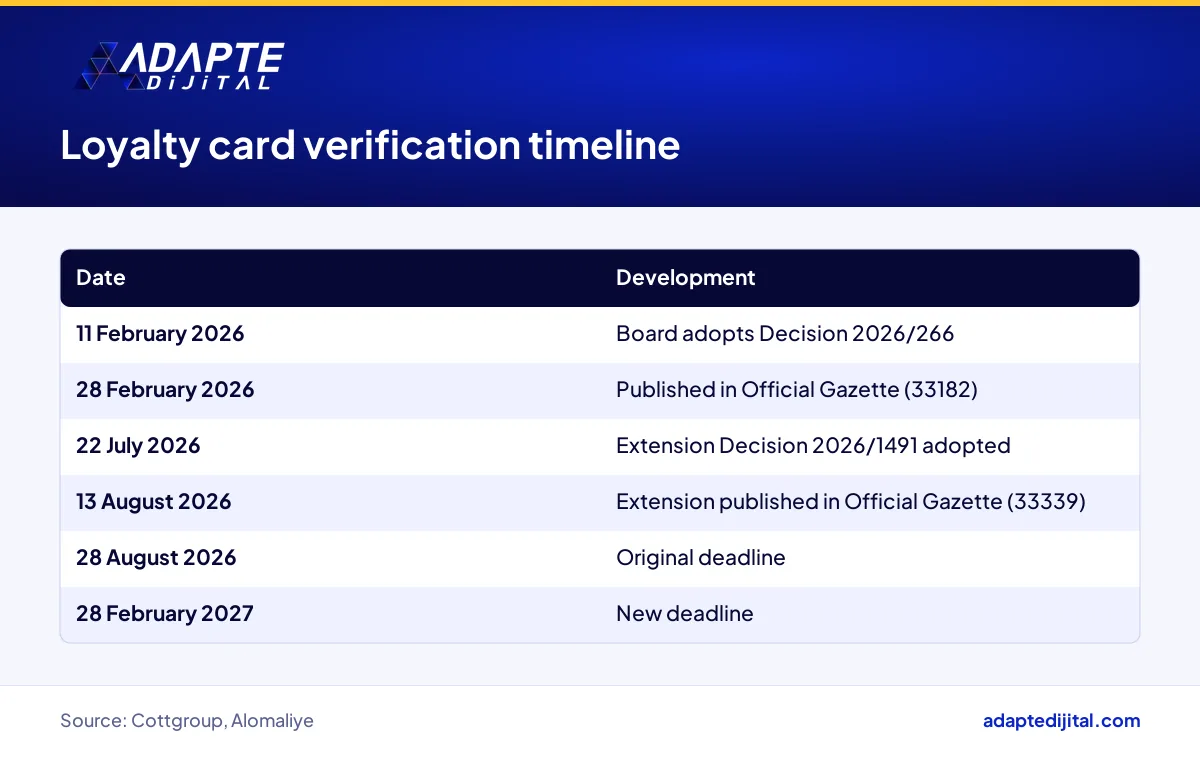
It was extended at the sector’s request. The original deadline was 28 August 2026; the Board’s Decision 2026/1491 of 22 July 2026 pushed it to 28 February 2027 (Alomaliye). The extension was published in the Official Gazette on 13 August 2026 (issue 33339).
What does loyalty card verification mean for you, and who does it affect?
BU BÖLÜMÜN ÖZETİ
- Under pressure: chains without an app that rely on phone numbers
- Easier switch: brands with an app and a dynamic barcode
- Indirectly affected: till software and loyalty programme providers
The retailers hit hardest are those that let customers use points and discounts with a phone number at the till, such as grocery chains, cosmetics and fashion stores. A chain with its own mobile app makes the switch more easily. The news does not say how the decision covers single-store or small loyalty programmes. POS and CRM software providers are affected indirectly.
Under pressure: chains without an app that rely on phone numbers
If a phone number is the customer’s only key, every transaction means waiting for an SMS code. A few extra seconds at each till stretch the queue at peak hours. For these retailers, checkout time per transaction becomes a new line to measure.
Easier switch: brands with an app and a dynamic barcode
A customer who shows a dynamic QR code or barcode in the app gets verified without saying a number. For these retailers, the job is to align the existing flow with the wording of the decision and keep a record of it.
Indirectly affected: till software and loyalty programme providers
The arrival of Wentro Verify signals new demand for products in this space. POS and CRM providers can expect integration requests from their clients. We gather developments like this on our retail page, where we read the Turkish retail agenda for you.
What does Mobildev’s Wentro Verify do at the till?
Wentro Verify is a platform that verifies the customer by QR code, barcode or OTP during loyalty, campaign, discount and points transactions. It works through a POS API integration or a Cashier Web Panel. It connects to existing CRM and POS systems, manages verifications centrally and keeps a record of each one (Perakende.org).
What does loyalty card verification change for apps, SMS and CRM?
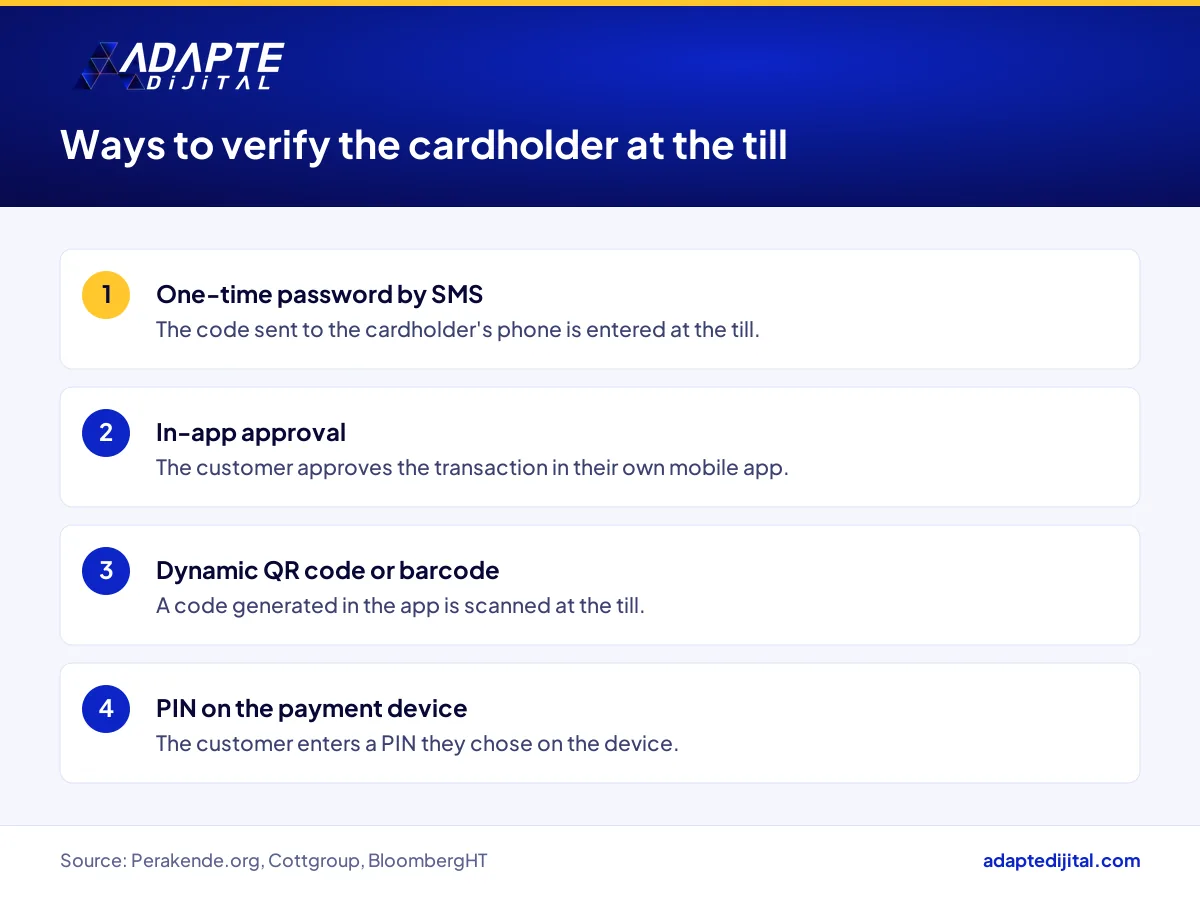
Verification moves the loyalty programme from the till to digital channels. SMS codes, in-app approval and dynamic QR codes or barcodes are the main methods, and alternatives are needed for accessibility (Cottgroup). That means planning app downloads, SMS sending capacity and CRM records together.
What should a retailer with a loyalty programme do this week?
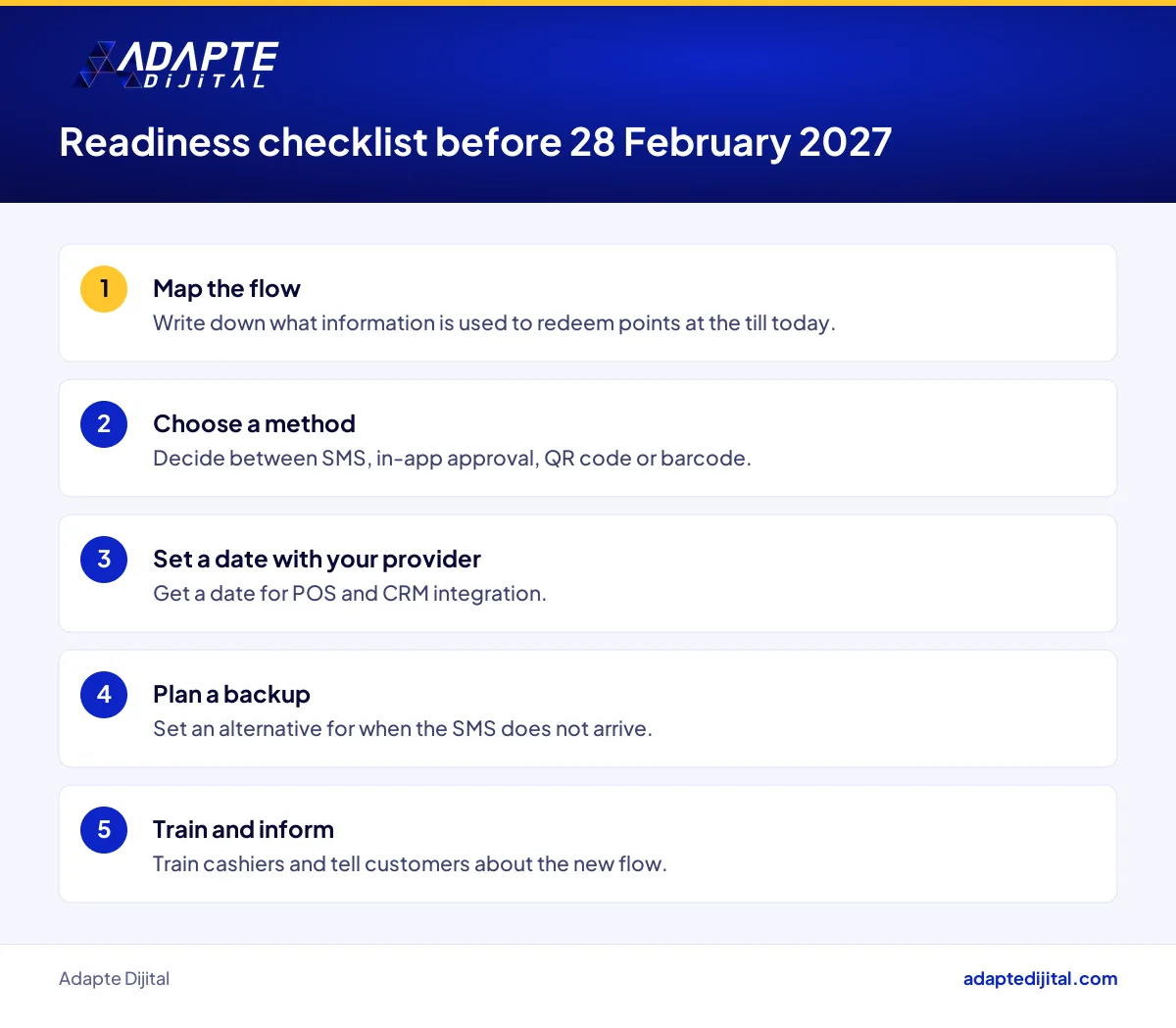
Do three things this week. Write down how points and discounts are used at your till today, ask your POS and CRM provider for a date to integrate verification, and decide which method you will use. Leave room for testing and staff training before 28 February 2027.
Quick Summary
- Mobildev introduced Wentro Verify, which verifies loyalty transactions by QR code, barcode and OTP (Perakende.org, 20 August 2026).
- KVKK Decision 2026/266 was published in the Official Gazette on 28 February 2026 with a six-month compliance window (Cottgroup; Alomaliye).
- The original deadline of 28 August 2026 was extended to 28 February 2027 by Decision 2026/1491 (Alomaliye).
- Wentro Verify has no Board approval; it is one of the tools that make compliance easier.
- The sources give no sanction amount, and responsibility for compliance stays with the retailer.
Short Glossary
- OTP
- OTP is the abbreviation used for a password generated for a single transaction that expires within a short time.
- Principle decision
- A principle decision is the term used for a general ruling by the Board that guides all data controllers on an issue.
- Data controller
- A data controller is the term used for the person or organisation that decides why and how personal data is processed.
Frequently Asked Questions
Next Step
If you want to plan how your loyalty flow at the till will change before 28 February 2027, fill in the consult your expert form.
Sources: Perakende.org, 20 August 2026 · KVKK, Principle Decision 2026/266 · Official Gazette, 28 February 2026 (issue 33182) and 13 August 2026 (issue 33339) · Cottgroup · Alomaliye, 13 August 2026 · BloombergHT
Updated: October 2026
Sık Sorulan Sorular
The Personal Data Protection Board adopted Decision 2026/266 on 11 February 2026. It appeared in the Official Gazette, Türkiye’s journal of record, on 28 February 2026 (issue 33182) and gave data controllers six months to comply from publication (Cottgroup; Alomaliye). You can read the text on KVKK’s principle decision page.
According to BloombergHT, the authority received a large number of complaints on the issue. The core complaint is simple: someone says your number, spends your points, and you never notice. The Board’s interest in loyalty cards is not new either; it issued Decision 2019/82 on a supermarket chain’s loyalty card scheme.
No, the extension is only about time. The duty to verify stays exactly as it was. What changed is the preparation window for data controllers.
BloombergHT refers to administrative sanctions under Law 6698, Türkiye’s personal data protection law, for those who fail to comply. Neither the news nor the secondary sources give an amount. Verify with the official source; this is not legal or financial advice.
Picking a method, getting it integrated into your POS software, training cashiers and informing customers are separate jobs. In a multi-store chain, not every store runs the same till setup. The new year and the campaign season also fall right in the middle of this calendar.
Mobildev CEO Ozan Özgür Erdoğan frames the need as being able “to verify the customer reliably at the moment of the transaction”. The news does not give the product’s price, launch date or any reference retailer.
No, there is no Board approval or full compliance certificate for this product. Treat it as one of the tools that make compliance easier. Responsibility for compliance stays with the retailer as data controller.
Being able to prove later that verification happened matters as much as the verification itself. A central log shows which transaction was approved by which method when a complaint arrives.
Yes, the fastest verification is usually a dynamic code in the app. A cashier saying “scan it from the app” gives a download campaign a natural reason. Your app store listing and the loyalty page on your website should explain the new flow.
A code sent with every transaction raises SMS volume and adds waiting time at the till. If the code is late, the customer may leave the basket and walk out. Retailers that verify customers over the phone face a similar question; we look at the AI voice assistant side in our piece on ebebek’s AILin.
Each verified transaction shows a purchase that truly belongs to the cardholder. Average basket value and purchase frequency on the customer card become cleaner as a result. We explain how to combine this data with the customer’s purchase motive in our piece on OBASE AIR.
Stand next to a cashier for half an hour and watch how points get used. Note whether the customer says a number, hands over a card or opens an app. Those notes show which method suits you.
Ask where verification records are stored, how long POS integration takes and what the backup method is when an SMS does not arrive. We run this process as part of a wider plan under our digital transformation management service.
The news and the sources reviewed do not make clear how the decision applies to small businesses. If you run a loyalty programme, verify with the official source; this is not legal or financial advice.
The product has no Board approval. The tool makes verification easier, but responsibility for compliance stays with you as the data controller.
You can, but at the moment of the transaction you need to confirm the card belongs to that person by a method such as an SMS code, in-app approval or a dynamic QR code.