
OBASE AIR lets CRM read why customers buy, how does AI interpret customer data?
Turkish software company OBASE is positioning OBASE AIR, a tool built on large language models (LLMs), to read chat logs, call transcripts and emails so that a CRM system can work out why a customer buys (Perakende.org, 5 August 2026). The claim is simple: CRM will try to understand not just what people bought, but why. The news does not mention the product’s price, launch date or any reference customer.
Here is what it means for you. The conversations piling up on your phone, inbox and messaging line say what your sales report never will. A customer leaves the “what” on the receipt and the “why” in the conversation. For a Turkish retailer holding customer data in autumn 2026, the question is no longer collecting data but reading the records already in the system.
Where does OBASE AIR differ from a classic CRM?
OBASE AIR aims to give CRM the ability to read unstructured data. A classic CRM stores name, order date, amount and product code line by line. OBASE AIR sets out to draw meaning from free text, such as chat logs, call transcripts, emails and social media messages, and to turn the system into one that keeps learning (Perakende.org).
How does AI pull a purchase motive out of a customer conversation?
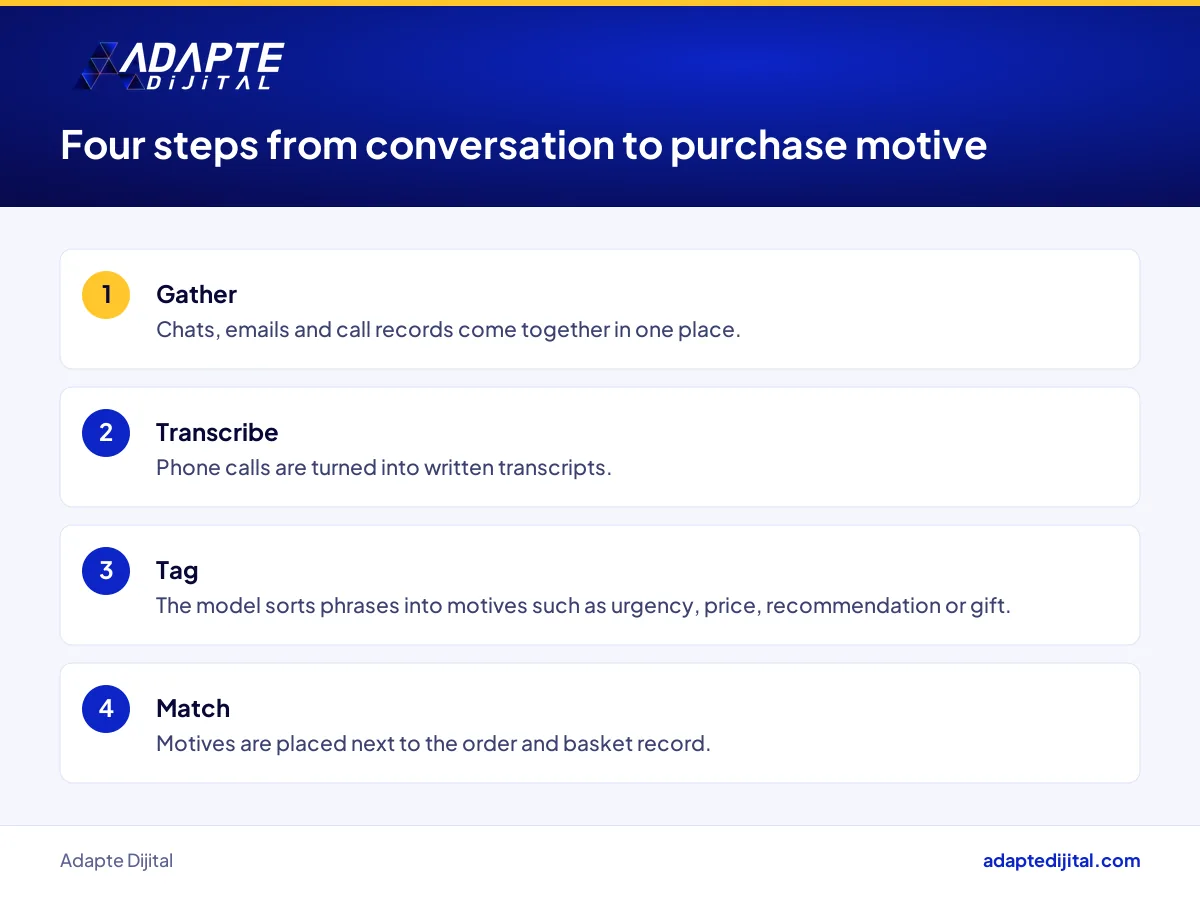
It works in three moves. First it turns the conversation into text, then it tags the intent inside that text, and finally it matches those tags to the order record. The answer to “why did this customer buy” then comes from the conversation, not the receipt. The news does not detail OBASE AIR’s steps; this is the general logic of LLM-based CRM.
Which retailers does the OBASE AIR approach affect, and how?
BU BÖLÜMÜN ÖZETİ
- Winners: chains with busy customer lines
- Under pressure: till sales that leave no conversation behind
- A lesser-known detail: this tool comes from a Turkish exporter
- Indirectly affected: CRM vendors and call centre firms
The businesses that store the most conversations gain the most: chains with a call centre, live chat or messaging line, and online stores. A neighbourhood shop that leaves no record at the till cannot benefit directly. CRM and call centre service providers feel it indirectly.
Winners: chains with busy customer lines
Fashion, electronics and mother-and-baby retailers with busy service lines produce free text every day. Read it, and return reasons and product expectations come into view.
Under pressure: till sales that leave no conversation behind
In a neighbourhood store, the customer explains the problem to the cashier and nothing gets written down. However smart the software is, no text means no result. These businesses first need the habit of recording what customers say.
A lesser-known detail: this tool comes from a Turkish exporter
Most retailers picture foreign software when they hear “CRM”. Yet OBASE is a domestic software company, and a February 2024 report in Para Dergi, a Turkish business magazine, said it exports to 20 countries and earns roughly a quarter of its revenue abroad. The same report mentions an R&D centre of about 120 people in Ümraniye, Istanbul.
Indirectly affected: CRM vendors and call centre firms
LLM-based reading changes how CRM vendors pitch their products. Call centre providers may also be asked to analyse what was said, not just count calls.
What does purchase motive data turn into on your website, in search and in ads?
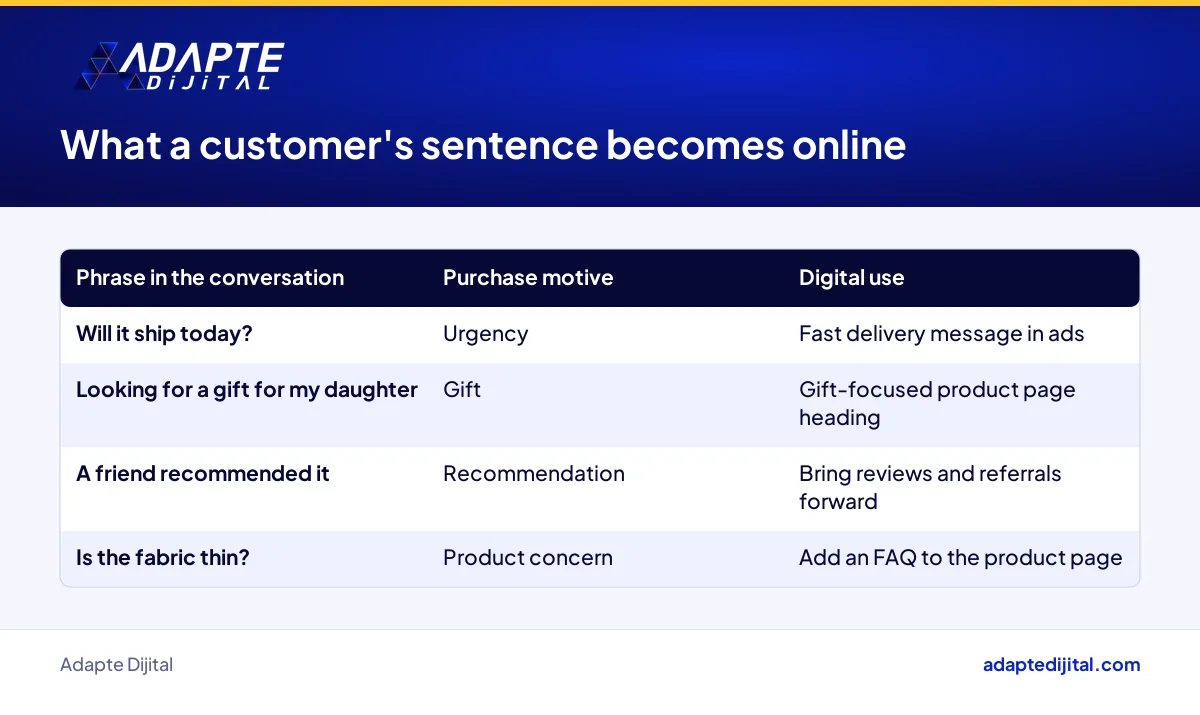
On the digital side, a purchase motive turns straight into message and targeting decisions. The customer’s own words move into ad copy, product page headings, FAQs and keyword lists, so your site speaks the customer’s language.
How can a small business apply LLM-based CRM logic to its own data?
You can start small, without a big software project. Gather conversation records in one place, strip out personal data, then let a model read and tag a limited sample. The first goal is to see which motives repeat most, not to automate everything.
What should a business owner sitting on customer data do this week?
Three tasks are enough this week. Collect the last month of customer messages in one folder, read twenty conversations by hand and note the motives, then put those motives next to your sales report. This small test shows, with your own data, whether AI is worth the investment.
Quick Summary
- OBASE aims to let CRM analyse purchase motives with its LLM-based OBASE AIR (Perakende.org, 5 August 2026).
- The product processes unstructured data such as chat logs, call transcripts, emails and social media.
- The news does not give the product’s price, launch date or any reference customer.
- Chains and online stores that store many customer conversations stand to benefit most from this approach.
- A small business can test the same logic without new software by gathering and hand-tagging its messages.
Short Glossary
- LLM
- LLM is the abbreviation used for AI models trained on large bodies of text to understand and produce language.
- Unstructured data
- Unstructured data is the term used for free text that does not fit into a table, such as chats, emails and call transcripts.
- Transcript
- A transcript is the term used for the written version of a spoken conversation.
Frequently Asked Questions
Next Step
If you would like to see which purchase motives your customer conversations could reveal, fill in the consult your expert form; we will look at your records and agree on the first step together.
Sources: Perakende.org, 5 August 2026 · KAP, OBASE company information · Para Dergi, February 2024
Updated: October 2026
Sık Sorulan Sorular
Here’s something most people don’t know: most of what customers tell you never fits a table. Unstructured data covers it all, from “I’m looking for a gift for my daughter” to an angry note about a late parcel or a sizing question on a call. In a classic CRM these notes gather dust in a comment field; an LLM-based system promises to read and sort them.
According to the news, the product can be trained specifically on corporate data. In plain terms, the model learns your product names, campaign wording and customer questions on top of its general language skills. The news does not say which model sits underneath or how the training works.
The news attributes the statement to Bülent Dal, described there as OBASE’s CEO and co-founder: “Large language models (LLMs) are now changing this process from the ground up.” The company is listed on Borsa Istanbul. On the company’s record on KAP, Türkiye’s public disclosure platform, his role appears as vice chair of the board and general manager.
A transcript is a phone call written out as text. A language model reads text, not sound. Skip it and a phone-order business loses its richest data.
The model groups phrases like “I need it urgently”, “the price is right” or “a friend recommended it” under shared labels: urgency, price, recommendation, gift. Think of it as a shop assistant who boils a five-minute story down to one word and never once gets bored.
After matching, average basket value, product group and purchase motive sit on the same row. A gift basket looks different from an urgent-need basket. Campaign and stock decisions can follow that difference.
If “Will it ship today?” keeps coming up on calls, urgency is the purchase motive. Your ad then leads with fast delivery, not a discount.
A question a customer asks on the phone is a question your page failed to answer. Moving it onto the page cuts phone traffic and supports search visibility. Clear question-and-answer text is also easier for AI-driven search tools to pick up and quote.
Yes, marketplace reviews and Q&A sections are unstructured data as well. A review saying “the fabric is thin” tells you which SKU comes back and why. We cover developments like this regularly on our retail page, where we read the Turkish retail agenda for you.
Start with your business messaging account, inbox, live chat and call notes, and have recorded calls transcribed.
The OBASE news does not address the product’s approach to personal data. Chat and call records contain personal data, so privacy notices, cases that require explicit consent and sending data to a model abroad all need separate review under KVKK, Türkiye’s personal data protection law. We looked at the new loyalty card verification rule in our piece on Mobildev and the 28 February 2027 deadline. Verify with the official source; this is not legal or financial advice.
A business that hands calls to an AI assistant already holds the text of every conversation, a ready-made source for motive analysis. We discuss the same question from the call side in our piece on ebebek’s voice assistant AILin.
Reading by hand shows what a model would need to learn. You see why customers walk out without buying and which question stalls the sale.
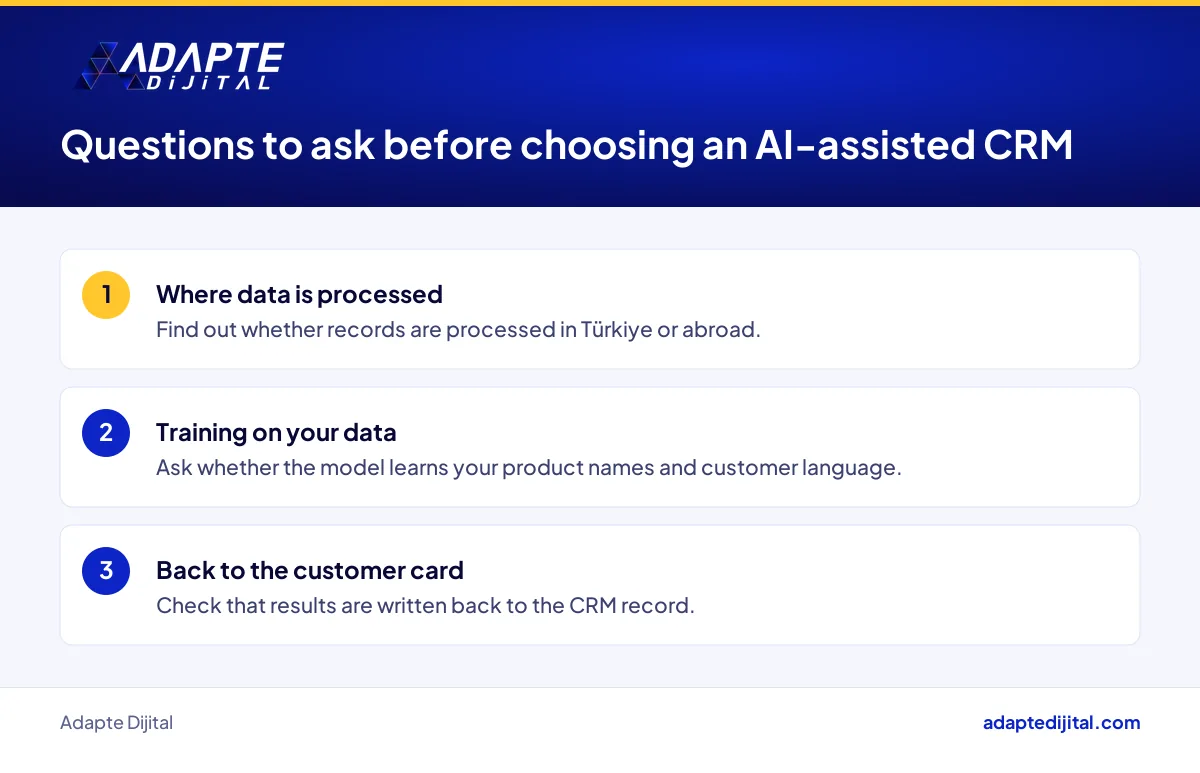
When you assess any solution, OBASE AIR included, ask three things: where is the data processed, can the model be trained on your own data, and does the result get written back to the customer card in your CRM. Price and launch date are not in the news, so ask the company directly.
We build the flow that turns conversation data into purchase motives as part of our AI consultancy work. And now you know: a CRM is worth what it can read in a conversation, not how many rows it stores.
The news does not mention the product’s price, packages or target business size. Check suitability directly with OBASE; you can still test the logic with your own records.
Processing records that contain personal data falls under KVKK, Türkiye’s personal data protection law. Check the rules on privacy notices, consent and transfers abroad with the official source; this is not legal or financial advice.
No, to begin with, your message records, a spreadsheet and regular reading are enough. CRM comes in when you want to scale the work and link the results to each customer card.