
ebebek launches AI voice assistant AILin, can small firms hand calls over to AI?
Turkish mother-and-baby retailer ebebek has launched AILin, an AI-powered voice assistant that answers questions on product details, stock, shipment tracking and order status in natural spoken language (Perakende Türkiye, 23 August 2026). AILin works around the clock on the 0216 325 11 11 line and passes the call to a human agent when a case gets complicated. The news does not give the launch date, the technology provider or a resolution rate.
What it means for you: any business that takes phone orders and shipping questions can now put “hand some of these calls to a machine” on the table as a serious option. In autumn 2026, for mother-and-baby, fashion and online retail in Türkiye, the question is not “should we get an assistant” but “which calls should go to it”. The answer depends on how many of your calls are the same questions asked again and again.
Which customer calls does ebebek’s voice assistant AILin handle?
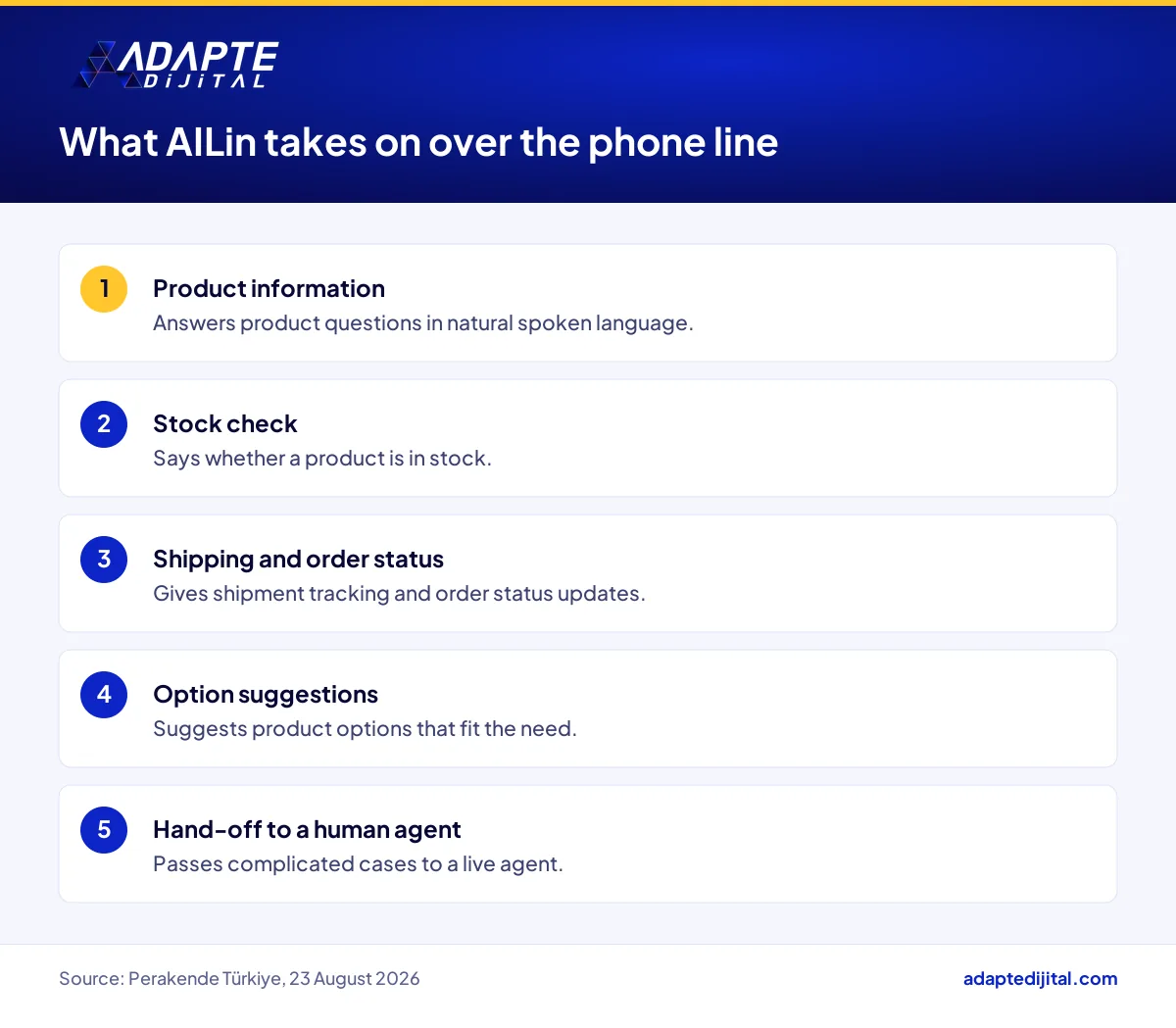
AILin handles four kinds of questions: product information, stock checks, shipment tracking and order status. On top of that, it suggests options that fit the customer’s need. The point that stands out is that the assistant does not try to solve everything itself. When a complicated case comes up, it hands the call to a human agent (Perakende Türkiye).
Which customer calls can you leave to AI, and which should stay with people?
A call whose answer already sits in your system can go to AI; a call that needs judgement or empathy stays with a person. “Where is my parcel”, “what is my order status” and “is this in stock” are simply data lookups. A return dispute, a faulty product or a question carrying a health or safety worry belongs to a human.
Which businesses does the voice assistant decision affect, and how?
BU BÖLÜMÜN ÖZETİ
- Winners: businesses that track orders and shipping digitally
- Under pressure: the shop that keeps stock in a notebook and orders in a chat
- Indirectly affected: call centres and outsourcing firms
The winners are online stores and omnichannel chains with a heavy load of repeat calls. Small businesses with scattered systems struggle, because an assistant is only as smart as the data behind it. The indirect effect falls on call centre providers and on the software firms that hold order and shipping data.
Winners: businesses that track orders and shipping digitally
A business that keeps orders, stock and shipment status in one system can connect an assistant to it and answer night-time calls too. The assistant never gets tired, never takes a lunch break and never says “please hold” before wandering off to put the kettle on.
Under pressure: the shop that keeps stock in a notebook and orders in a chat
If stock lives in a notebook and orders sit in a messaging group, what is the assistant supposed to look at? This business needs order first. Otherwise the machine just becomes the most expensive way to say “I don’t know”. Moving stock into a system also makes it easier to track sales and average basket value, assistant or not.
Indirectly affected: call centres and outsourcing firms
As repeat calls shift to assistants, the share of difficult calls in call centres rises. That calls for more experienced agents and training that leans in that direction. We follow developments like this on our retail page, where we read the Turkish retail agenda for you.
What does a voice assistant change for your website, search and customer data?
A voice assistant turns the phone line into a data source. Every call becomes text, and you can see which questions customers ask and how often. That knowledge feeds your site’s FAQ, your product pages and your ad messages.
What should a small business measure before moving to a voice assistant?
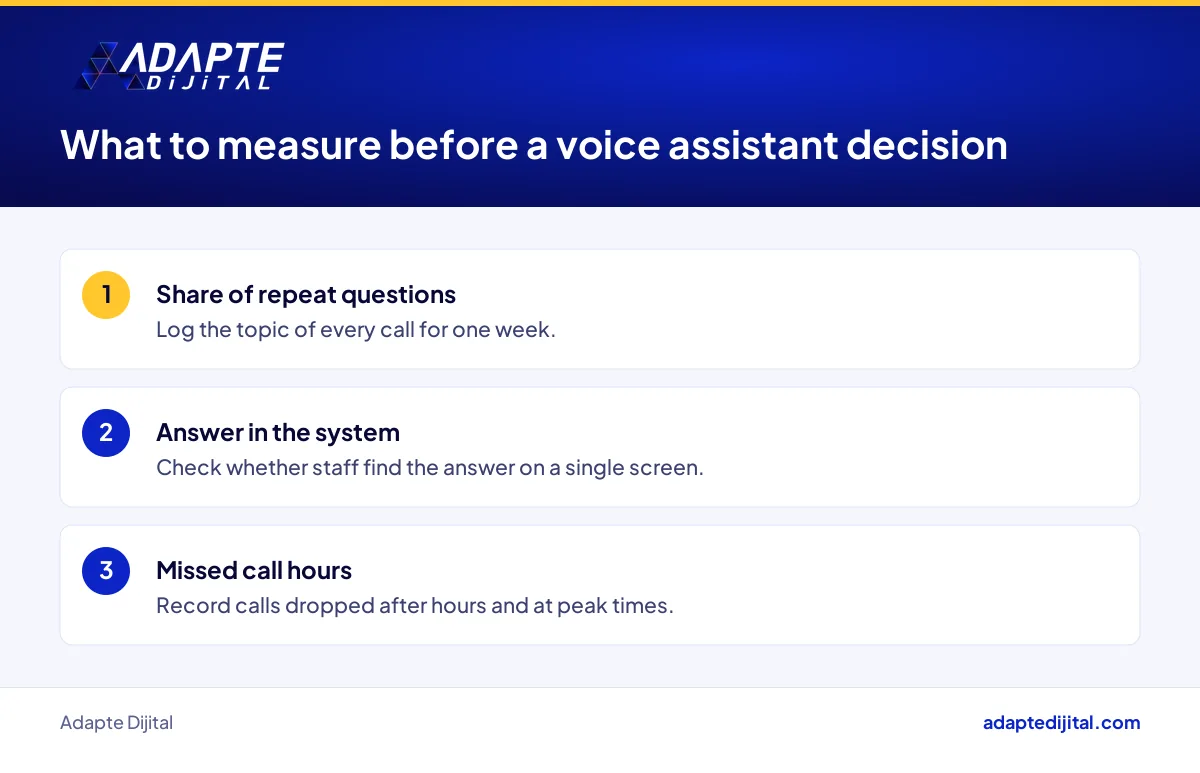
It should measure three things: how many calls are repeat questions, whether the answer is ready in the system, and at what times missed calls pile up. Without these three, the assistant decision is a guess. With them, the decision almost makes itself.
What should a business owner who takes phone orders do this week?
This week, start a call log, update the answers to the five most common questions on your website and note the times of missed calls. Don’t rush to buy an assistant; first see which calls are green. By the end of the week you will have real data, not a guess, for an investment decision.
Quick Summary
- ebebek has launched AILin, an AI-powered voice assistant (Perakende Türkiye, 23 August 2026).
- AILin answers product, stock, shipping and order questions and hands complicated cases to a human agent.
- The news does not give the launch date, the technology provider or a resolution rate.
- Repeat calls whose answers already sit in the system are the best fit for automation.
- A small business can base its assistant decision on a one-week call log.
Short Glossary
- Voice assistant
- A voice assistant is the term used for software that talks to customers on the phone in natural language and answers their questions.
- Human hand-off
- A human hand-off is the term used for an assistant passing a call it cannot resolve to a live staff member.
- Call traffic light
- The call traffic light is the name used for a method that sorts calls into green, yellow and red for the assistant, a shared flow and a person.
Frequently Asked Questions
Next Step
If you would like to see which of your calls suit an assistant, fill in the consult your expert form and we will go through your call log together.
Sources: Perakende Türkiye, 23 August 2026 · KAP, ebebek Mağazacılık company information · Foreks, 8 September 2026
Updated: October 2026
Sık Sorulan Sorular
ebebek serves mother and baby needs from before birth up to age four, through stores and online; the company has been registered in Istanbul since 2000 (company information on KAP, Türkiye’s public disclosure platform). These customers call at night too. A parent whose baby has just fallen asleep does not want to wait until nine in the morning to ask about an order.
The news mentions AILin only on the phone line. It does not say whether the assistant also works in the app or on the website. Look, this is not a small detail. For many customers the phone is still the first reflex, and for some it is the only channel.
Picture this: a customer explains the problem three times, and the machine on the other end repeats the same sentence. The call ends, but that customer never calls again. The hand-off is the moment the assistant admits its limit, and that is exactly what protects trust.
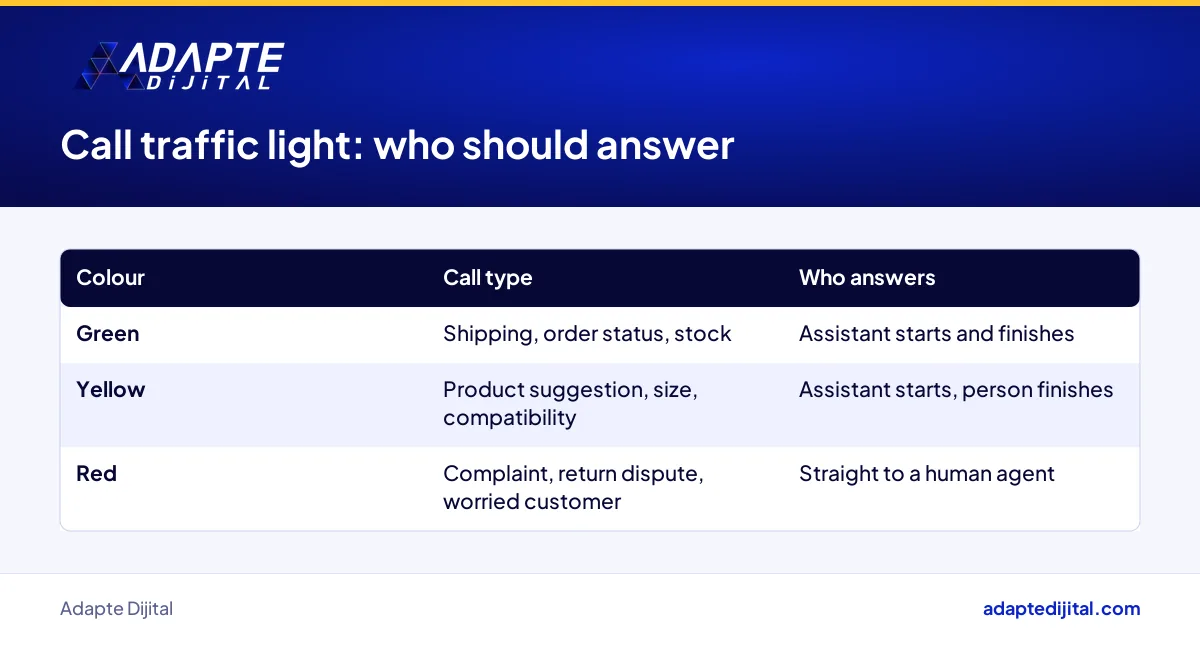
There is, and I call it the call traffic light. A green call starts and ends with the assistant: shipping, order status, stock. A yellow call starts with the assistant and ends with a person: product suggestions, sizing or compatibility. A red call goes straight to a human: complaints, return disputes, a worried parent.
AILin suggests options that fit the need, and that is the job closest to a sale. But a wrong suggestion brings a return, and a return eats your margin. In a small business, let the assistant open the suggestion and let an experienced staff member give the final answer. A one-week trial where a person signs off every suggestion is the cheapest way to see its quality.
The angry customer’s call. Let’s say a parcel is three days late and the customer calls in a temper. The assistant reads out a tracking number, while the customer is waiting for an apology and a fix. If that call does not reach a person, the customer walks away for good and writes about it in the reviews.
A call transcript tells you why the customer called and why they bought. We cover pulling purchase motives out of these conversations in detail in our piece on OBASE AIR. A business with an assistant produces this data for free, but if nobody reads it, it just gathers dust.
Here’s the thing I keep seeing: a large part of the phone load comes from questions the website never answers. If delivery times, return terms and the size chart are not written clearly, the customer picks up the phone. Moving those answers onto product pages also supports your visibility in search engines and in AI-assisted search.
The news does not say how AILin processes voice recordings. Recording, the privacy notice and identity checks all need separate review when you set up your own line under KVKK, Türkiye’s personal data protection law. For businesses that verify customers with an SMS code, KVKK’s Principle Decision 2025/1072 is also relevant. Verify with the official source; this is not legal or financial advice.
For one week, log every call in a single line: shipping, order, stock, suggestion, complaint. At the end of the week, look at the table. I read customer questions in my own work regularly too, and the same handful keep coming back around.
Let me ask you one thing: when a customer says “where is my order”, how many screens does your staff check to find the answer? If it is on one screen, an assistant will find it too. If it lives in someone’s memory, that knowledge has to go into the system first.
Partly. ebebek reported to KAP that it sold 10,737,113 units across its stores in Türkiye and its online channel in August 2026 (Foreks, 8 September 2026). At that scale, order and shipping questions naturally multiply. But your decision rests on your own call log, not on ebebek’s volume.
A simple sheet is enough: date, time, topic, solved or not, who solved it, and could the customer have found this answer on the site. Everyone who picks up the phone writes in the same sheet. If most answers in the last column are yes, fix the website first and think about the assistant second. After a week, the split between green, yellow and red calls shows up too.
Partly, yes. A dealer or customer in another time zone expects an answer outside your working hours. We talk about the other conditions for reaching export shelves in our piece on Dardanel and Walmart Canada.
We build call sorting and assistant flows as part of our AI consultancy work. My decision is clear: give the repeat question to the machine, and the customer with a real problem to a person.
It can make sense if a large share of your calls are repeat questions about shipping, orders and stock, and the answers are ready in your system. Keep a call log for one week first, then decide.
An assistant that does not pass complicated or angry calls to a person can lose you customers. A hand-off step to a human agent, as in the AILin example, reduces that risk.
A voice recording contains personal data and requires a privacy notice under KVKK. Check the conditions with the official source; this is not legal or financial advice.