
Loops AI raises 3.5 million dollars, should a store swap its search box for an assistant?
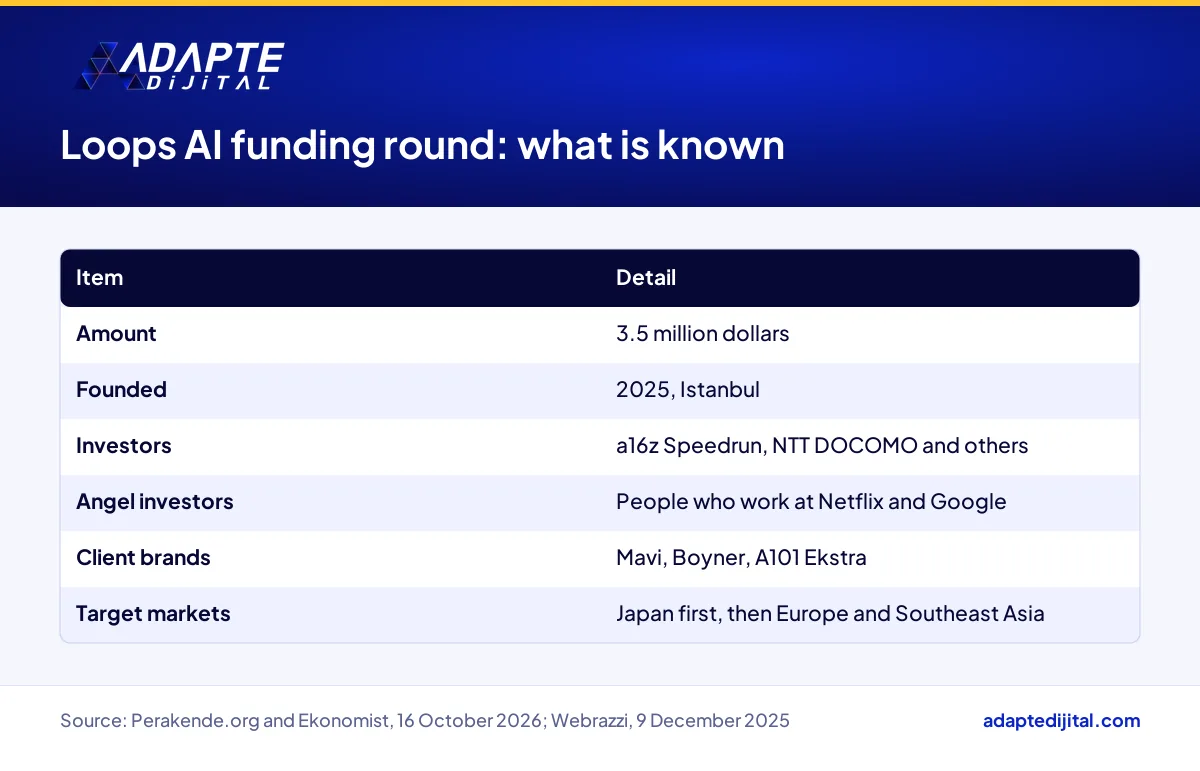
Loops AI, an artificial intelligence start-up founded in Istanbul in 2025, has closed a 3.5-million-dollar funding round for its shopping assistant, which lets shoppers describe what they want in everyday language (Perakende.org; Ekonomist, 16 October 2026). Investors in the round include a16z Speedrun, NTT DOCOMO, Connecticut Innovations, Monday Capital and Alumni Ventures, along with unnamed angel investors who work at Netflix and Google.
For a retailer running a mid-sized online store in Türkiye in autumn 2026, the question is this: does your site search understand a sentence like “a winter coat that keeps you warm without making you sweat”? If it does not, the shopper hits a zero-results page and walks out. The move to an assistant should be decided by how clean your product data is and what your search logs say.
What is known about Loops AI’s 3.5-million-dollar funding round?
What is known covers the amount, the investors, the client brands and the target markets. Loops AI closed a 3.5-million-dollar round; only Perakende.org describes it as a seed round. The company was founded in Istanbul in 2025, and a16z Speedrun first invested in December 2025 without disclosing an amount (Webrazzi).
How does Loops AI’s shopping assistant differ from classic site search?
A classic search box wants keywords; an assistant accepts sentences. According to Perakende.org, Loops AI lets shoppers describe their need in everyday language, then matches the request to the brand’s catalogue and business rules to suggest products. Co-founder İlker Selim Zorluoğlu puts the gap plainly: “Asking a language model a question and getting an answer is easy.” The hard part is tying that answer to the right product in stock.
When should a mid-sized online store like Loops AI’s clients switch search to an assistant?
When three signs show up together: longer, sentence-style queries are rising in the search logs, the zero-results rate is high, and the catalogue is clean enough to keep product attributes in order. A messy catalogue gives a messy assistant. In that case, fix the product data first and bring the assistant in later.
Who does the spread of shopping assistants like Loops AI affect, and how?
Fashion, baby products, grocery and electronics retailers with large catalogues and tidy product data could come out ahead. Small online stores with messy product data and old search systems have a harder time. Firms offering catalogue management, product content and e-commerce infrastructure feel the effect indirectly.
What does natural language search like Loops AI’s change for product data and visibility?
It shifts visibility from keywords to descriptions. When a shopper describes a product to a search engine or an AI assistant, a product page without the details that match that description does not get listed. So product descriptions, attribute fields and FAQs do the same job for an on-site assistant and for outside search.
What should a business owner looking at assistants like Loops AI do this week?
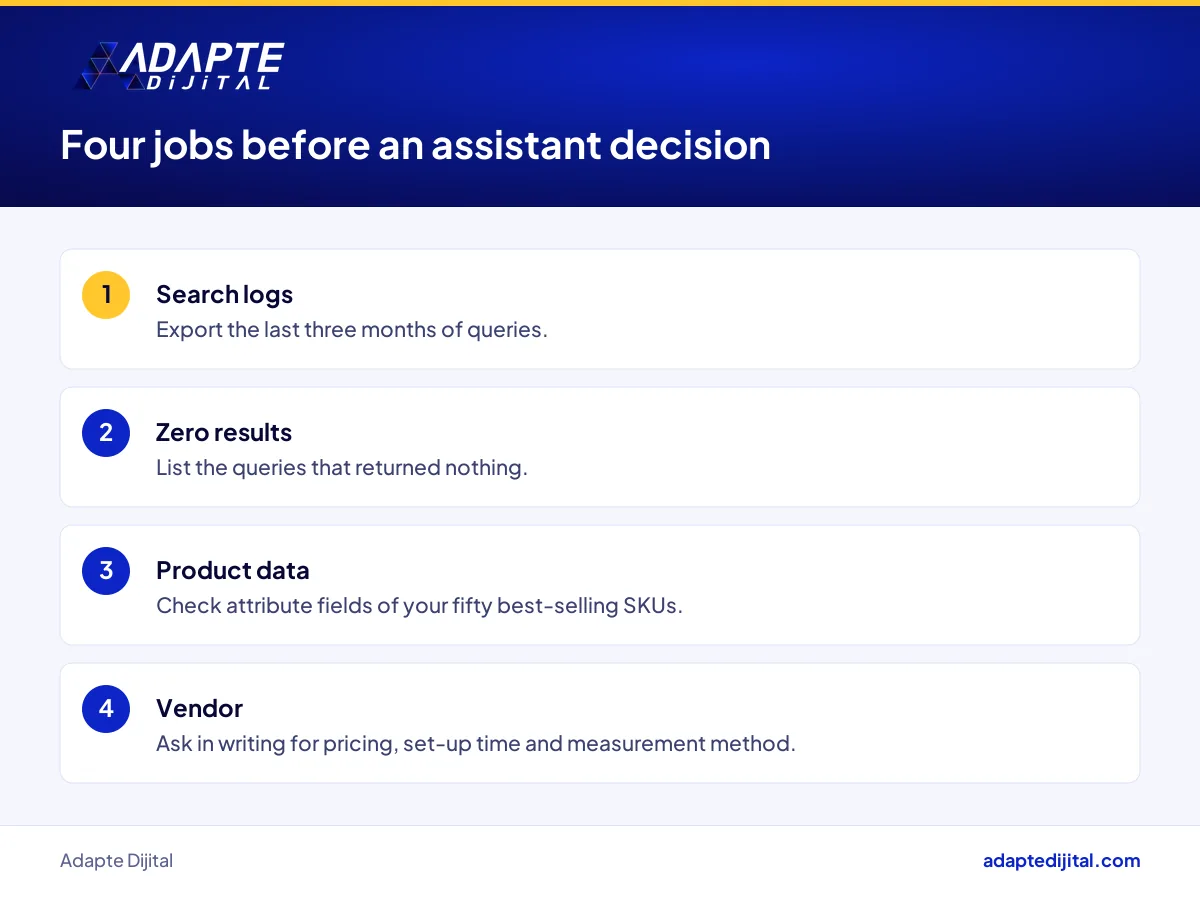
Three jobs: export the last three months of site search logs and list the zero-results queries, check the attribute fields of your fifty best-selling SKUs, and ask assistant vendors in writing for pricing, set-up time and measurement method. That list moves the assistant decision from instinct to data.
Building search and product data together
Setting up site search, product data and a measurement plan together is part of the work we do in e-commerce consulting.
Quick Summary
- Loops AI closed a 3.5-million-dollar funding round (Perakende.org; Ekonomist, 16 October 2026).
- The round included a16z Speedrun, NTT DOCOMO and angel investors who work at Netflix and Google (Ekonomist).
- Mavi, Boyner and A101 Ekstra are named among the brands using the assistant (Perakende.org; Ekonomist).
- The company’s performance figures appear in a single source, and the measurement method was not disclosed.
- Search logs and product data should be reviewed before any assistant decision.
Short Glossary
- Zero-results page
- A zero-results page is the term used for a site search that lists no products at all.
- Natural language search
- Natural language search is the method used to let shoppers search with everyday sentences instead of keywords.
- Business rule
- A business rule is the setting used to make a recommendation system follow store preferences such as stock, price and promotions.
Frequently Asked Questions
Next Step
If you would like to weigh your site search and product data decision against your own data, fill in the Consult Your Expert form.
Sources: Perakende.org, 16 October 2026 · Ekonomist, 16 October 2026 · Webrazzi, 9 December 2025 · Ministry of Trade of Türkiye, e-commerce FAQ (linked in the text)
Updated: October 2026
Sık Sorulan Sorular
The investors are a16z Speedrun, NTT DOCOMO, Connecticut Innovations, Monday Capital and Alumni Ventures (Perakende.org; Ekonomist). Unnamed angel investors who work at Netflix and Google also joined; the companies themselves are not investors. Valuation and each investor’s stake were not disclosed.
The clients named across sources are Mavi, Boyner and A101 Ekstra. Perakende.org also lists Tudors and Petrol Ofisi. The sources say nothing about pricing, set-up time or fit for small businesses.
According to figures shared by the company, shoppers at A101 Ekstra who used the assistant converted 83% more often and added to basket 77% more often than a comparison group (Perakende.org). According to the company, Wee Baby saw an 11% higher average basket, 26% higher spend per customer, and 32% of shoppers buying after the first question. These figures appear in a single source and come from the company; the measurement period, sample and comparison group set-up are unknown.
According to the company’s plan, Japan comes first, followed by Europe and Southeast Asia. It also plans to adapt the product for finance and energy, beyond retail (Perakende.org).
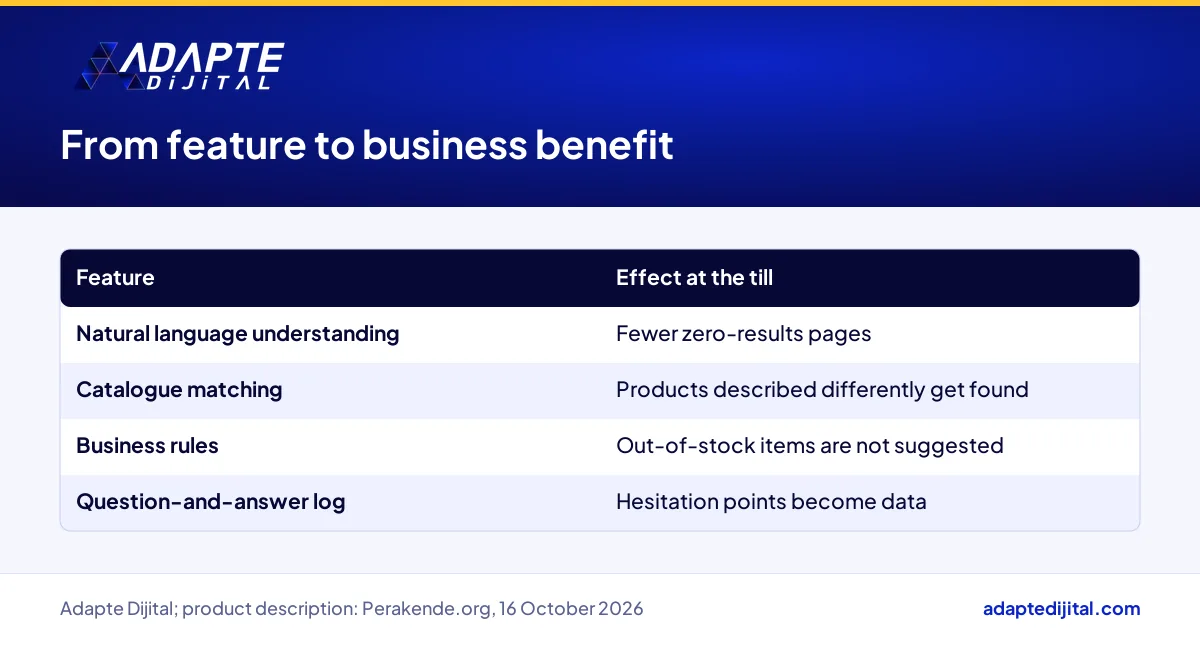
Business rules are the store preferences an assistant follows when it suggests products: not recommending items out of stock, putting promoted items first, staying within a price range. The term sounds technical, but in everyday terms it is the set of rules inside a good sales assistant’s head on the shop floor.
Natural language understanding cuts zero-results pages, so the shopper does not walk out. Catalogue matching brings forward products that sit on the shelf because shoppers describe them in other words. Business rules block out-of-stock suggestions and tie the average basket to campaign goals, while the question-and-answer log turns the moment a shopper hesitates into data.
It does not have to. For a shopper who knows the product code or brand, classic search is still the fastest route. On most sites the right set-up offers both paths side by side and measures which one turns into more sales.
Which words shoppers use, which searches return nothing and whether a purchase follows the search. Export the last three months of logs and review the top hundred queries, and the need for an assistant stops being a guess.
Every SKU should have attributes such as category, colour, size, material and use in separate, consistently written fields. Information buried in the description makes matching harder for an assistant.
Show part of your visitors the assistant and the rest classic search, then compare conversion, average basket and return rate between the two groups. Set the measurement period and sample size in writing at the start. That is exactly the information missing from the company’s figures.
In a large catalogue, finding the right product gets harder, and every lost search shows up at the till. Mavi, Boyner and A101 Ekstra being named as clients shows that big players are trying this route. We look at a different Boyner move on the shopper side through its price guarantee.
Once shoppers get used to searching in sentences on large sites, keyword search on a small site feels lacking. That means faster exits from zero-results pages. If the gap does not close, a small site selling the same product loses the shopper in the search box.
The questions an assistant collects speak the same language as the questions store staff hear most. That data can shape in-store product talk and shelf layout.
Who the product is for, in which situation, and which problem it solves. Write the use case as well as size and material. If a shopper searches for “a jacket for cycling in the rain”, the page needs an answer to that scenario.
Yes. A product that is searched often but rarely sold is either out of stock or described the wrong way. We look at that link through MediaMarkt’s September search trends.
The shopper sentences an assistant logs are a ready source of language for ad copy and search targeting.
How catalogue matching works, who manages the business rules, where the data is stored, how a comparison group will be set up for a trial and how long the contract runs. Also ask for the measurement period and sample behind any performance figures shared.
The sentences an assistant collects from shoppers may contain personal data, so privacy notices and data processing agreements need a review. According to the e-commerce FAQ page of Türkiye’s Ministry of Trade, a business selling through its own website must register with ETBİS, the national e-commerce information system. Verify with the official source; this is not legal or financial advice.
According to Perakende.org and Ekonomist on 16 October 2026, Loops AI closed a 3.5-million-dollar funding round.
Look at search logs and product data first. If sentence-style queries and a high zero-results rate show up and the catalogue is tidy, a trial makes sense; if not, fix the product data first.
Check the share of zero-results queries in the last three months of search logs and the purchase rate after a search. Products that are searched often but rarely sold are another sign.