
Why a Jewellery Workshop Enters a Different Class from the Shop

A jewellery shop and the workshop behind it are two businesses in the municipality’s eyes, even when one door serves both. The shop sells; the workshop works metal. That distinction settles which desk your file is opened on.
Below we follow a story that repeats itself often. A trader has dressed the window, begun selling, and six months on wants a small bench at the back. With that bench we see how the file grows heavier and which threshold is crossed.
Where the story begins: a shop with a retail licence
The trader takes a shop in the bazaar. He defines his activity as the sale of finished goods and takes the workplace opening and operating licence under a sanitary assessment. Till, window, camera and scales are in place.
The first months pass quietly. Then demand turns: a broken chain to be soldered, a ring sized up, old gold cast afresh. There is money in it, and the bench is decided on.
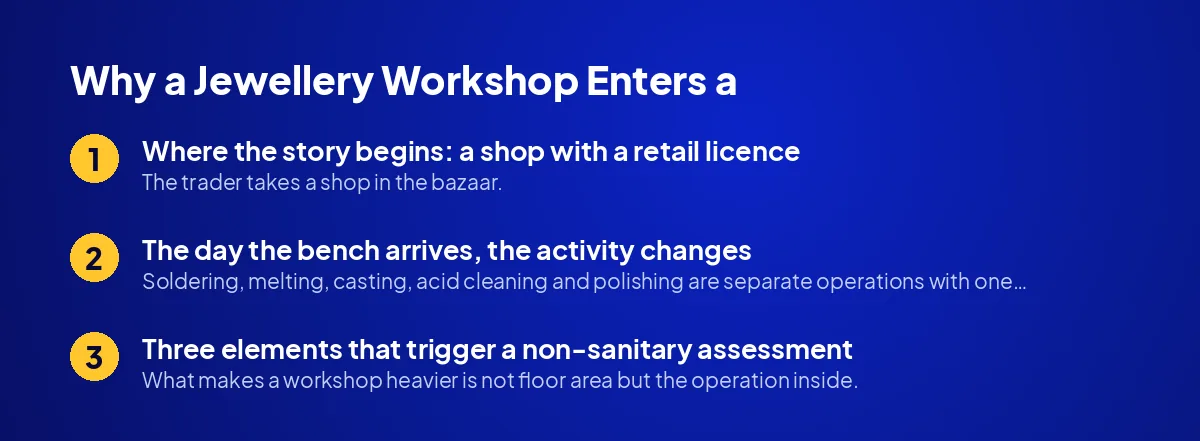
The day the bench arrives, the activity changes
Soldering, melting, casting, acid cleaning and polishing are separate operations with one result: the business no longer sells a product, it works on one. The activity slides from retail towards manufacture.
That slide shows on paper. Once the declared activity parts company with the work actually done, it is the first question an inspection asks. Update the definition before the bench goes in.
Three elements that trigger a non-sanitary assessment
What makes a workshop heavier is not floor area but the operation inside. Three elements come forward, all judged on site.
- Acid and chemical use: cleaning and assaying liquids open a storage heading and a waste heading
- Melting and casting: high heat, a furnace and gas cylinders bring fire and occupational safety in
- Ventilation and extraction: released vapour and dust make the ventilation of the premises decisive
Where the three come together, the business may be assessed as a non-sanitary establishment (second or third class). Which operation crosses that threshold alone depends on the address, the building and the volume of work. Rather than hunt for a fixed measure, put your plan in writing and ask for an assessment.
Shop and workshop side by side
| Heading | Retail shop | Workshop carrying out operations |
|---|---|---|
| Character of the activity | Sale of finished goods | Working, repair and casting |
| Class direction | Sanitary assessment common | Non-sanitary assessment likely |
| Ventilation | General conditions suffice | A separate arrangement may be required |
| The waste side | Not on the agenda | Chemical and metal waste headings open |
| Occupational certificate | May not be expected | Mastership or qualification arises |
| Suitable building | A commercial street or bazaar | An industrial estate or suitably zoned plot |
| Acceptance within the building | Possible beneath dwellings | Harder on the condominium side |
The seventh row is where the story breaks. Retail selling may run beneath a residential building, yet melting metal there opens a separate file on both the consent and class sides.
The trader’s first surprise: the address
Once the bench was decided on, the first wall was the address. The bazaar shop’s occupancy permit suited commercial use, but manufacture was not looked upon with the same ease.
Two roads open. Either the workshop goes to a suitably zoned plot elsewhere and the shop stays as it is, or a fresh assessment is sought for the existing address. The second looks shorter, but where it ends cannot be foreseen.
What a workshop file typically asks for
The body of the file is familiar. These headings are typically sought; the final list comes off the district’s own form.
- Application form and an activity declaration listing the operations
- Lease agreement or title deed
- Occupancy permit and a statement of the zoning position
- Tax certificate, commencement notice and chamber registration
- Layout plan listing benches, furnaces and equipment
- Project information on the ventilation and extraction arrangement
- Mastership certificate or vocational qualification certificate (MYK)
- A fire safety measures report according to activity and area
- Condominium consent in a residential building
- Social security workplace notification if staff will be employed
The hallmark and the identity of the piece
The fineness of a piece worked at the bench is declared, and that declaration must be traceable. The hallmark arrangement concerns the workshop more closely than the counter.
The fineness of the old gold a customer brings, what came out, and the difference between them all belong in a record. Without it a workshop has nothing to say in a dispute.
Identification and reporting duties reach the workshop too
Businesses in the precious metals field carry customer identification and suspicious transaction reporting duties. Even where a workshop makes no sale, it takes metal in and hands it back.
Accept from the outset that the duty exists and build the routine around it. Thresholds, reporting manner and scope are set by legislation and updated over time; take confirmation from your accountant and from the legislation as it stands.
How the waste side is arranged
The moment acidic liquid, polishing sludge and filings appear, a waste record is born. That record is not merely the business’s own ledger; there is a declaration side.
The hazardous waste declaration and the wastewater connection permit arise here. Which waste falls under which scope shifts with the chemical and the volume. Instead of expecting a fixed filter or treatment condition, set your list of operations before the provincial directorate of environment and urbanisation and ask for a written opinion.
The arrangement the trader settled on
At the close of the story a two-address structure stood. The bazaar shop stayed retail and the workshop moved to a suitably zoned plot. Repair work was taken in at the shop, done at the workshop and handed back at the shop.
That means two files and two fee items. Against forcing everything onto one address it works comfortably, under inspection and as the business grows. Fees follow each municipality’s own schedule and are refreshed annually; reckon on that item arising twice with two addresses.
Five questions to ask before installing a bench
- Do the operations I plan carry my activity definition to the manufacturing side
- In which class will this address be assessed with the operations I have in mind
- What is expected of me on the ventilation and extraction side
- Which waste heading do the chemicals I shall use open
- Is a mastership or vocational qualification certificate sought here
Put the five in writing to the district licensing unit and to the provincial directorate of environment and urbanisation. We have laid the general order of the authorities out on the business licence roadmap; for the investment and expenditure bands, look in on our jewellery and accessories sector page. Should design draw you, our jewellery design studio article follows on from this file, as does our assay and hallmarking service article.
In Short
- A retail shop and a working workshop are two businesses on the document side
- Soldering, melting, casting and acid cleaning carry the activity towards manufacture
- The three triggers of a non-sanitary assessment are chemicals, heat and ventilation
- The threshold rests on the operation and an on-site assessment, not floor area
- A workshop beneath dwellings grows harder on the consent side
- The activity definition must be updated before the bench goes in
- Fineness declarations matter more in the workshop than at the counter
- Identification and reporting duties apply in the precious metals field
- Acidic liquid and polishing sludge open the waste and wastewater headings
- A two-address arrangement gives rise to two files and two fee items
- Fees follow the municipal schedule and are refreshed annually
Quick Glossary
Non-sanitary establishment: the class of workplace whose effect on its surroundings and on those working in it is assessed separately because of the activity carried on. Melting: bringing metal to a liquid state with heat so that it can be formed anew. Wastewater connection permit: the certificate of suitability taken from the relevant authority before a business may discharge into the network. Hazardous waste declaration: the arrangement by which a business notifies the authority of harmful waste it produces.
Next Step
Let us settle at which address and with which operations your workshop will be built: consultation request form.
Frequently Asked Questions
Updated: September 2026
Sık Sorulan Sorular
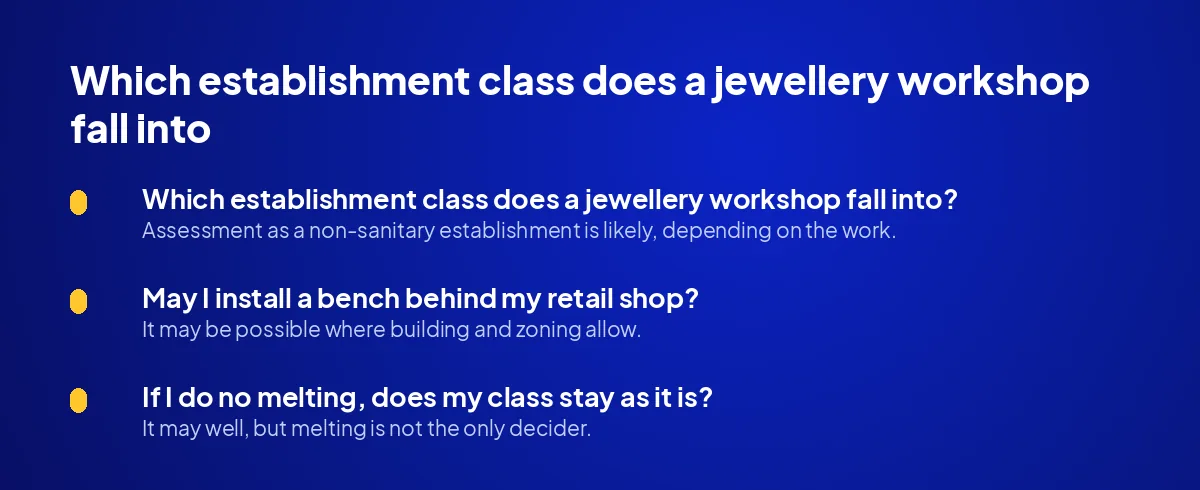
Assessment as a non-sanitary establishment is likely, depending on the work. The district municipality decides once it has seen your operations and the address.
It may be possible where building and zoning allow. The activity definition is updated, though, and the whole business may then be judged by its heaviest operation.
It may well, but melting is not the only decider. Acid use and ventilation needs also enter the assessment.
Mastership and vocational qualification both come up here. Ask about the scope with your own list of operations.
No single measure is given. The extraction arrangement is settled by the premises, the operation and the authority’s assessment.
The routine runs according to the nature of the waste. Set your operations before the provincial directorate of environment and urbanisation and ask for a written opinion.
By the nature of the work, the fineness and quantity taken in and handed back go on record. That record is your only footing in a dispute.
It is not obliged to be, but a suitably zoned plot eases the file markedly. Settle the address before signing a lease.
Where you use two addresses, a file is opened for each. To bring them together at one address, obtain a written assessment first.