
MANGO plans 10 new stores in Türkiye for 2026, how can a small fashion boutique keep up?

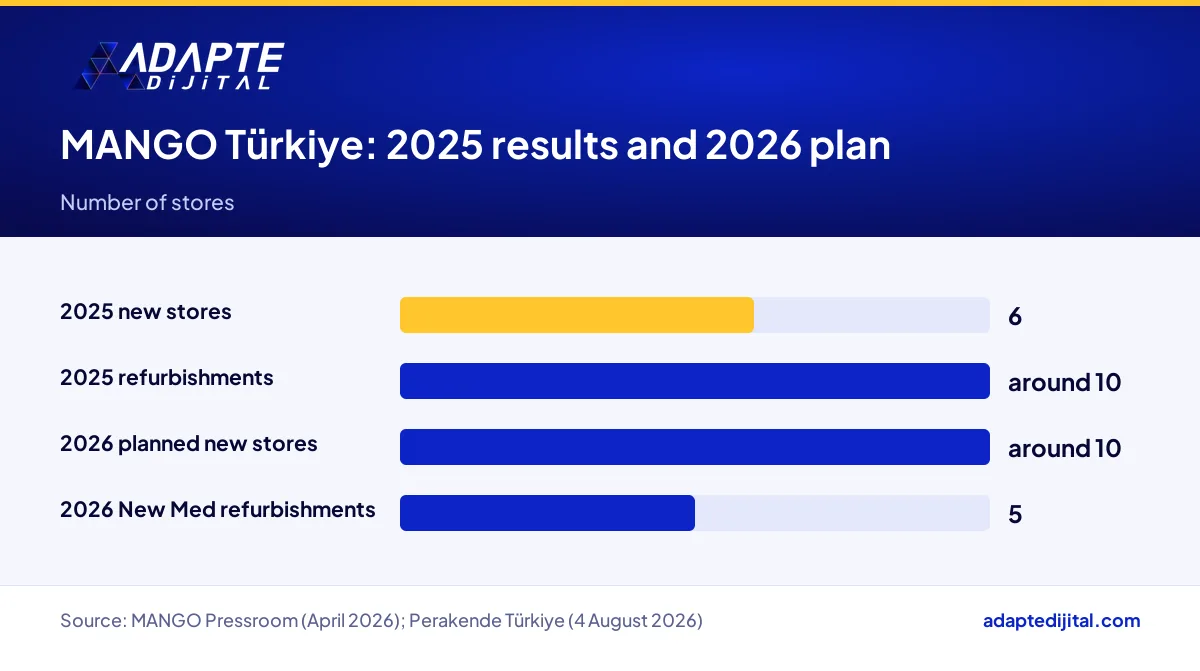
MANGO plans to open around 10 new stores in Türkiye during 2026, taking a network that closed 2025 with more than 70 points of sale to 80 stores by year end, with openings concentrated in Istanbul and Ankara (Perakende Türkiye, 4 August 2026). Perakende Türkiye, a Turkish retail trade publication, is re-reporting an April 2026 announcement from MANGO’s pressroom. Five existing stores also get a New Med design refresh.
Here is what it means for you. In autumn 2026, the fight for fashion locations in Istanbul and Ankara malls goes on. The independent boutique has neither the chain’s pricing power nor its ad budget. It has location, concept and brand difference, and if you do not manage those on purpose, the till stops ringing.
What exactly does MANGO’s 2026 growth plan for Türkiye include?
The plan has three parts: around 10 new stores, 5 refurbishments in the New Med concept, and a target of 80 stores by year end. Openings lean towards Istanbul and Ankara. Malls, streets and dates are not public. It sits within MANGO’s “4E” strategic plan for 2024-2026.
Which fashion businesses do MANGO’s Istanbul and Ankara openings affect, and how?
BU BÖLÜMÜN ÖZETİ
- Under pressure: the basics seller in the same corridor
- Gaining: the businesses that serve the chain’s customers
- Indirectly affected: boutiques in other cities
The biggest impact falls on independent womenswear boutiques and mid-market local brands that share a mall corridor with the chain. A shop in the same tenant mix, selling basics in a similar price band, feels the pressure directly. Mall management gains a strong anchor tenant; tailors, accessory sellers and cafés feel it indirectly.
Under pressure: the basics seller in the same corridor
If you sell plain T-shirts, denim and seasonal jackets, you are effectively sharing a shelf with the chain, and shoppers compare on price and size range. A small business cannot match the chain’s SKU depth, and the stock just sits on the rail.
Gaining: the businesses that serve the chain’s customers
A well-known chain pulls traffic into the corridor, and an alterations workshop, jewellery kiosk or café can take a share. A business that fills a gap in the chain’s service can come out ahead.
Indirectly affected: boutiques in other cities
Because the openings focus on Istanbul and Ankara, boutiques elsewhere do not face direct competition. Even so, refurbished chain stores raise what shoppers expect from their neighbourhood boutique. We gather news like this in one place on our retail page, where we interpret the retail agenda for you.
Where can a small fashion boutique stand apart from a chain like MANGO?
BU BÖLÜMÜN ÖZETİ
- Let’s say your boutique is two doors down from a new chain store
- A narrow edit beats a wide range
- Personal service is an advantage that does not scale
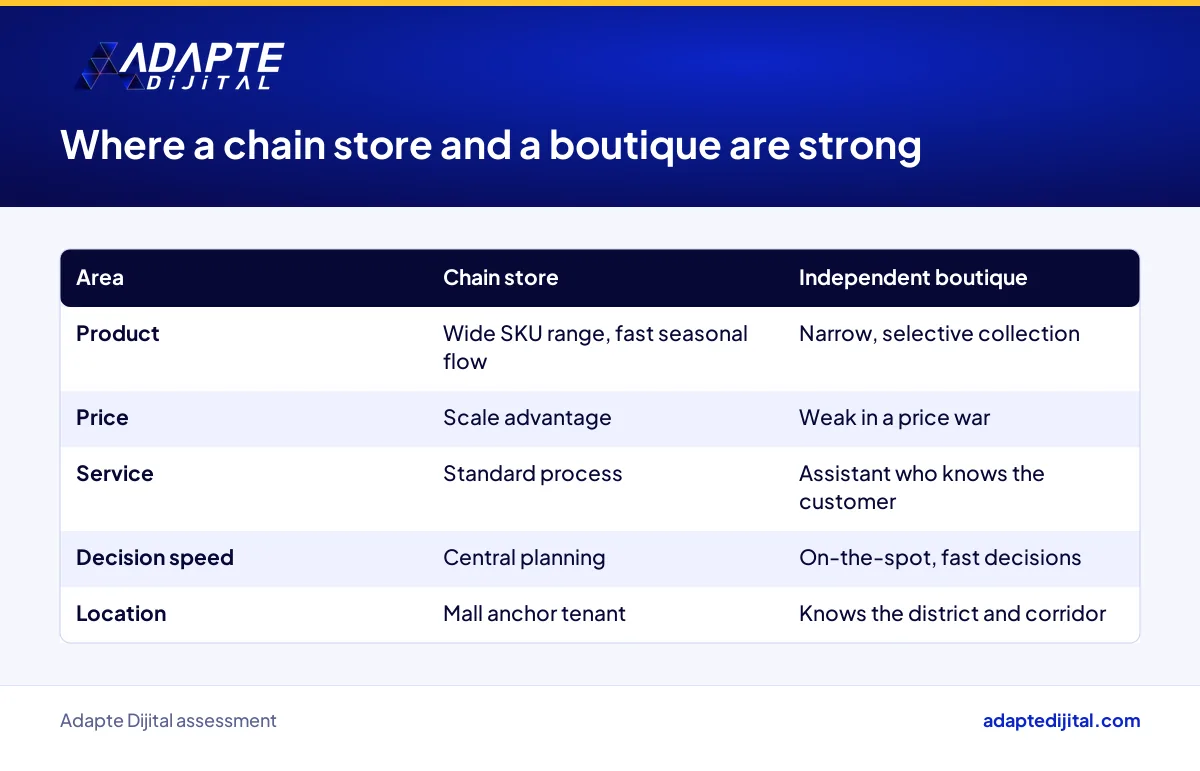
In three places: location, curation and the relationship with the customer. A chain wins on scale; a boutique wins on closeness, selectivity and speed. Selling the same product for less is not a lasting strategy; personal service and a narrow, clear collection are firmer ground.
Let’s say your boutique is two doors down from a new chain store
Let’s say you run a womenswear boutique in an Ankara mall, and a chain store opens two doors away. On a busy Saturday, people glance into your shop and walk on. Customers turn around at the door, because the first thing they see looks like what is next door. Yet the same person stops at your handmade accessories rack and asks questions.
A narrow edit beats a wide range
A chain arrives with a large number of SKUs and a fast seasonal flow, and a boutique cannot copy that. A consistent edit built around one customer type works better, improves stock turn and eases your cash flow.
Personal service is an advantage that does not scale
A sales assistant who knows a customer’s size, style and what she bought last season is rare in a chain. A boutique uses that knowledge to put items aside, send a message and arrange alterations. That lifts the average basket and weans customers off waiting for the sale. If you would rather bring a strong foreign brand onto your shelves than grow your own, we look separately at the licensing deal between Mothercare and ebebek.
What do MANGO’s New Med refurbishments tell a boutique owner?
They say the store itself is a product. MANGO is refurbishing 5 stores in 2026 with the New Med design concept, and its Antalya TerraCity store was recently redone in the same style. A tired window quietly drags sales down.
How does a fashion boutique stay visible on Google and social media against MANGO’s growth?
By staying visible in local search and on its own channels. People search for a chain by its brand name; they find a boutique through local searches such as “womenswear” plus the name of their district. A Google Business Profile, fresh photos and a simple page with stock information answer those searches.
Your Google Business Profile is a second shop window
Even if you are inside a mall, customers look for you on the map first. The right floor, accurate hours, new-arrival photos and review replies keep it alive. An empty or outdated profile means a customer gives up before reaching your door.
Instagram and WhatsApp extend your sales assistant
A personal message showing new arrivals to a regular can beat a mass campaign email. Run it in your sales assistant’s voice, not a corporate one.
What should a boutique owner do this week after the MANGO news?
BU BÖLÜMÜN ÖZETİ
- 1. Identify the overlapping products
- 2. Calculate sales per square metre by product group
- 3. Boil your brand story down to one sentence
Four concrete things: remove the products that overlap with the chain, calculate sales per square metre by product group, boil your brand story down to one sentence, and update your Google Business Profile. Points on rent, investment or pricing are general information. This is not investment advice.
1. Identify the overlapping products
Walk through the nearest chain store and note the items that do the same job as yours. Reduce stock depth on those rather than fight on price, and give the space to what sets you apart.
2. Calculate sales per square metre by product group
Put the space each product group takes up next to the sales it brings in. A group that sells little but takes a lot of space is dead stock on the rail. The table also helps in rent talks with mall management.
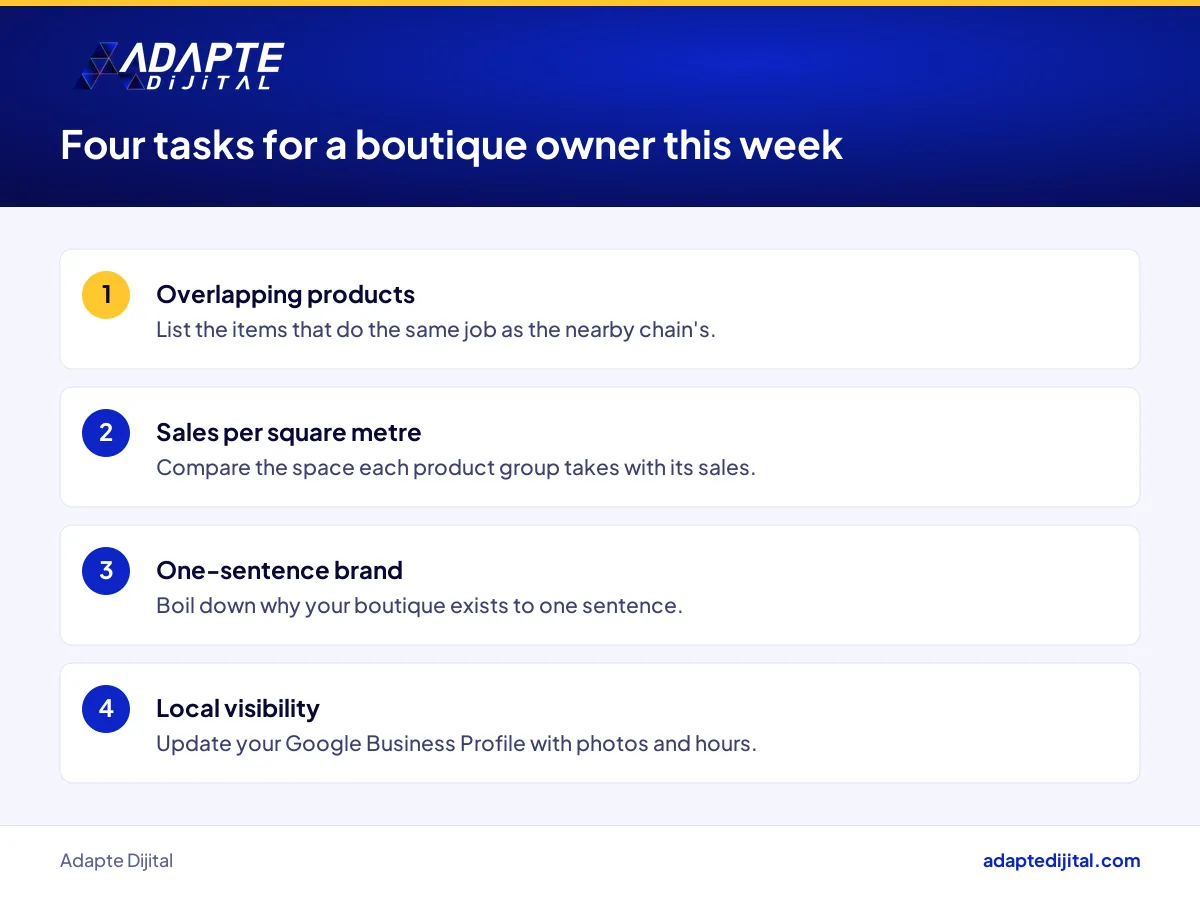
3. Boil your brand story down to one sentence
If you cannot say in one sentence why your boutique exists, your customers cannot either. That sentence should be the same in the window, on your profile and in your sales assistant’s words. We build brand positioning for boutiques together with their owners through our brand consultancy service. One principle is enough: do not do a smaller version of what the chain does, do what the chain cannot.
Quick Summary
- MANGO plans around 10 new stores in Türkiye in 2026 and a network of 80 stores by year end (MANGO Pressroom, April 2026).
- Openings lean towards Istanbul and Ankara, and the locations and dates have not been announced.
- The chain opened 6 stores and refurbished around 10 in 2025, and is refurbishing 5 more in the New Med concept in 2026 (Perakende Türkiye).
- The roughly 20% turnover growth is not labelled nominal or real, so it should not be read as real growth.
- An independent boutique stands apart through curation, personal service and local visibility, not price.
Short Glossary
- Tenant mix
- Tenant mix is the term used to describe the spread of categories and brands among the stores in a shopping mall.
- Sales per square metre
- Sales per square metre is the metric used to measure how much revenue a store generates for each unit of floor space.
- Anchor tenant
- Anchor tenant is the retail term used to describe a large brand store that draws visitors into a mall or a corridor.
Frequently Asked Questions
Next Step
If a chain is opening near your boutique, or you are thinking about refreshing your concept, describe your situation in a short form and we will map out a route for your store and channels: Consult Your Expert form.
Sources: Perakende Türkiye, “MANGO Türkiye’de 10 yeni mağaza açacak”, 4 August 2026; primary source: MANGO Pressroom, April 2026; the same announcement ran on CNN Türk on 28-29 April 2026.
Updated: October 2026
Sık Sorulan Sorular
Not quite. Perakende Türkiye writes “10”, while MANGO’s own pressroom says “around 10”. Nobody says whether stores close along the way, so read it as a plan, not a fixed list.
In 2025 MANGO opened 6 new stores in Türkiye, completed around 10 refurbishments and grew turnover by roughly 20%. Lira or euros, nominal or real: the company does not say, so with Turkish inflation in the background, do not read it as real growth. The telling detail is that the chain refurbished more stores than it opened.
Hüseyin Gölçük, MANGO’s International Retail Director for MENAI, Türkiye and Asia, describes the plan as a clear sign of the brand’s long-term commitment to the market. MANGO entered Türkiye in 1997, and its collections are designed in Barcelona by a team of 500 people. You can read the full details in MANGO’s corporate press release.
Not always. A boutique refresh does not have to match a chain’s scale. Lighting, window layout, fitting rooms and the till area are all concept decisions. The test is whether a change keeps the customer inside for longer.
Passers-by not coming in, a window unchanged for months, dated photos on social media: the signal is there. We look at what a concept refresh adds to sales through MAD Parfumeur’s refurbishment of its Kahramanmaraş Piazza store.
Broad fashion ads put you in the chain’s auction; tight targeting around your store and clear interests makes more sense. Measure messages and direction requests.
Nobody knows yet. The malls and streets for the new stores have not been announced, only that openings lean towards Istanbul and Ankara. Ask your mall management about their tenant plans.
Usually not. The player with the bigger scale wins a price war. Cutting overlapping stock and leaning on what sets you apart is more sustainable.
Not on its own. The figure was given as roughly 20%, but the company did not say whether it is in lira or euros, nominal or real. With inflation in the picture, it should not be read as real market growth.