
Boutique and AI: how your vintage or antique shop gets mentioned when clients ask in 2027
The link between a boutique and AI comes down to one question as 2027 approaches: when a discerning client asks an assistant something, does your shop’s name appear in the answer? For a vintage or antique shop, that question usually targets the piece, not the shop. Someone typing “where can I find a 1970s ceramic lamp in Kadıköy” is looking for an object. The shop that makes it into the answer is the shop that has described that object in writing.
According to Google’s announcement, AI Mode and AI Overviews have been available in Turkey since 18 February 2026. AI Mode takes questions by text, voice or a photo taken with the camera, and searches by breaking them into subtopics. Tomorrow a client could photograph a lamp in your window and ask “where can I buy something like this”. The core of getting ready is simple: write every piece up with a readable record card.
Say you run a vintage shop in Moda: which road do clients take to reach you?
BU BÖLÜMÜN ÖZETİ
- The client from the street
- The client from Instagram
- The client from an assistant
Say you sell lamps, ceramics and small furniture from the 1960s and 1970s on a side street running down to Moda Avenue in Kadıköy. The shutters go up at eleven. Some visitors drop in while walking past, some find you on Instagram. A third road is growing toward 2027: a client photographs an empty corner at home and asks an assistant what would suit it.
The client from the street
They look at the window, step inside, touch the piece. For this client, the smell of the shop, the light and your story are enough. But their number is capped by foot traffic on the street.
The client from Instagram
They like a photo, send a message, ask the price. The decision is often made in the chat. The feed moves fast; yesterday’s post is gone today.
The client from an assistant
They do not know you yet. They ask about an object, a period or a corner of their home. They hear your name only if an answer sits on a page the assistant can read.
The unexpected finding: the assistant searches for the piece, not the shop
Most owners assume the assistant answers “which is the best vintage shop”. Yet a vintage client’s question usually starts with an object: period, material, colour, size. Google describes a query fan-out technique that breaks a question into subtopics and searches each one separately. A shop’s name enters the answer because it gives a clear written answer to one of those sub-questions.
One-of-a-kind stock becomes an advantage
A chain store sells the same product a thousand times. The 1974 ceramic vase on your shelf is unique. A well-written single-piece page is an answer nobody else on the internet can give.
A photo question is matched with text
Even when the client sends a photo, the assistant builds its answer in words. If your photo has no text beside it naming the period, material and size, the piece may be seen but cannot be described.
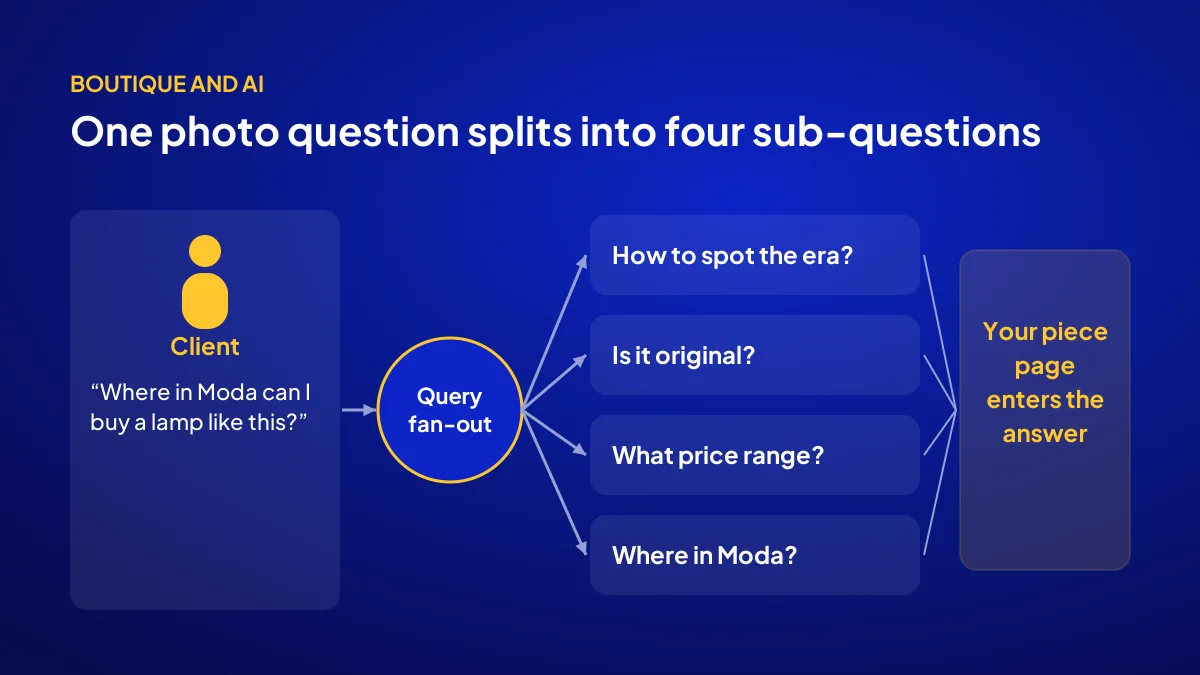
How does query fan-out break up a vintage question?
The table below shows possible sub-questions behind a single client question, and where in the shop each one is answered. The way an assistant splits a question changes every time; the table is an example, not a rule. The logic holds, though: when every sub-question meets a sentence on your site or profile, your name is more likely to come up. An unanswered sub-question opens another shop’s door.
| Sub-question | What the client has in mind | Where the shop answers |
|---|---|---|
| How do I recognise a 1970s ceramic lamp? | Period | Category article: materials and marks of the era |
| Is it original or a later copy? | Trust | Origin and condition lines on the piece record |
| What is the price range? | Budget | Price or a clear price policy on the piece page |
| Where is it sold in Moda? | Address | Google Business Profile and contact page |
| Do you deliver? | Time | Delivery and packing page |
| Can I reserve without seeing it? | Risk | Reservation and returns page |
The address question is answered by the profile
The answer to “where is it sold” often comes from the map. We walk through category, hours and photo fields in the boutique Google Business Profile article.
The trust question is answered by the record
A discerning client asks “is it original”. The best answer is not an inflated adjective but an honestly written condition line.
The single-piece record: six lines an assistant can read
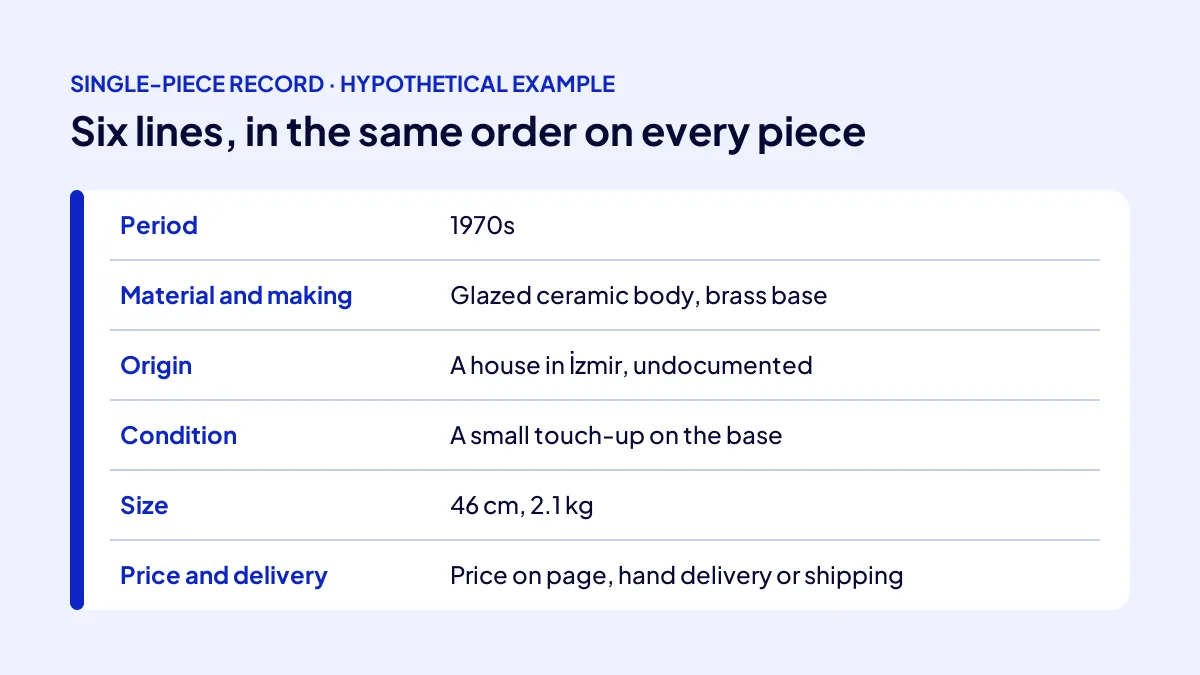
A piece record is a short six-line identity card at the top of every product page. Period, material, origin, condition, size and price-and-delivery appear in the same order. The client and the assistant find what they need in the same place. You set it up once, then fill it in five minutes for each new piece. As the shop grows, it becomes your inventory ledger too.
- Period: “1970s”, or the year if known.
- Material and making: glazed ceramic, handmade, brass base.
- Origin: where it came from, any document or maker’s mark.
- Condition: repairs, scratches, missing parts; honestly.
- Size: height, width, weight.
- Price and delivery: price, reservation, shipping or hand delivery.
The condition line carries the trust
A page that hides a flaw gets caught at the first question. A shop that writes “there is a small touch-up on the base” is taken seriously by a discerning client.
A sold piece keeps its page
When a piece sells, do not delete the page; add a “sold” note and link to similar pieces. Your answer stays online and the visitor does not leave empty-handed. We list the page structure in the boutique website article.
Which sentences should an antique shop never write?
BU BÖLÜMÜN ÖZETİ
- Unproven provenance
- Reviews that cannot be verified
- Old pieces that may need a permit
An assistant may summarise your sentence and pass it on. So a claim you cannot verify travels from your page into the answer. Unproven lines such as “museum quality”, “definitely original” or “from a pasha’s mansion” carry the biggest risk. Then there are reviews: fake reviews, or reviews whose purchase cannot be verified, are also a regulatory matter from 2026.
Unproven provenance
If you have no document, do not even write “legend has it”. Saying “provenance is undocumented” sounds more honest to a discerning client.
Reviews that cannot be verified
Under the amendment to Turkey’s Regulation on Commercial Advertising and Unfair Commercial Practices, published in the Official Gazette on 1 July 2026, consumer reviews whose purchase cannot be verified may not be published. Keep this rule in mind when you bring reviews onto your site.
Old pieces that may need a permit
Trading old objects that may count as cultural property can be subject to a permit. If you plan to sell such a piece, consult the museum directorate of the Ministry of Culture and Tourism before you open the shutters.
How many of these questions can 108 articles answer for a digital brand?
108 articles across six keyword groups give enough ground to write answers to most of the sub-questions above: period guides, material articles, care and delivery questions. The Senin de Dijital Markan Olsun (Your Own Digital Brand) campaign builds this together with brand consulting, a six-page brand site and structured data. Nobody can guarantee a recommendation from an assistant; what you get is readable ground.
What changes toward 2027, and what stays put?
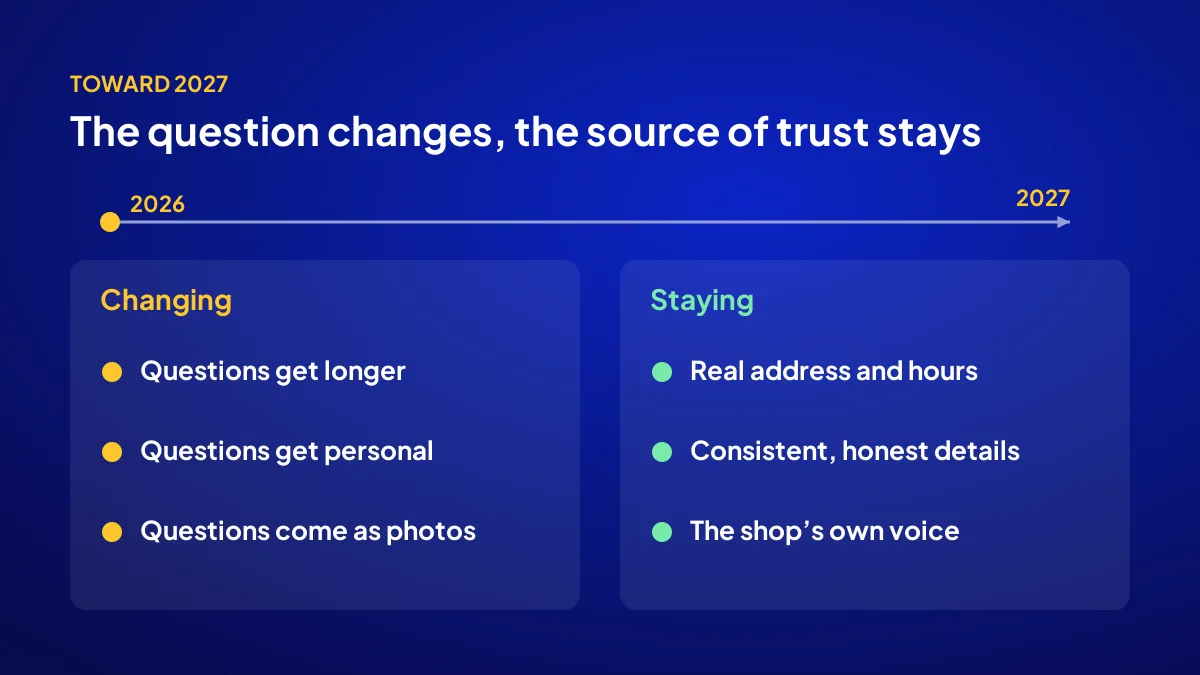
What changes is the shape of the question: longer, more personal and increasingly visual. What stays is the source of trust: a real address, consistent information, honest description and the shop’s own voice. Nobody can say for certain how many clients will arrive from assistants in 2027. But every record card written today is an answer already waiting when that day comes.
Questions grow longer and more visual
As camera search spreads, clients show a photo instead of describing. The shop that ties photos to text gets its share of these questions.
The first sale still runs on trust
The assistant brings the client to the door; you still make the first sale of the day. Your voice telling the piece’s story and its flaws is something no summary can replace.
One principle is enough: the shop an assistant can describe is the shop that describes its pieces first.
Quick Summary
- Vintage clients mostly ask assistants about the piece, not the shop.
- AI Mode and AI Overviews have been available in Turkey since 18 February 2026.
- The assistant splits a question into sub-questions; each needs a sentence on a page.
- Every piece gets a six-line record: period, material, origin, condition, size, price and delivery.
- No unproven provenance claims and no unverifiable reviews.
- A sold piece keeps its page and links to similar ones.
Short Glossary
Query fan-out: Query fan-out is the method AI search uses to split a single question into subtopics and search each one separately.
Piece record: A piece record is a short identity card used to give the period, material, origin, condition, size and price of a single vintage or antique item in a fixed order.
AI Mode: AI Mode is the Google search experience used to ask questions by text, voice or photo and get an answer built with generative AI.
Next Step
To move your boutique’s pieces onto brand ground an assistant can read, apply to the Your Own Digital Brand campaign. Fill in the form, mention the coupon, and we start with a consulting session.
Frequently Asked Questions
Source: Google Turkey Blog — AI Mode and AI Overviews era begins in Turkey
Sık Sorulan Sorular
TRY 36,000 + VAT, fixed and paid upfront; at 20% VAT that is TRY 43,200, but check the current rate on the invoice. There is a 10% coupon; just mention the code when you apply. 12 brand places, deadline 1 November 2026. Details are on the Your Own Digital Brand page.
If you want to see where you stand before starting, run the check in how does my brand appear in AI. The boutique’s overall promotion plan is in the new boutique promotion guide, and the first three months in the first 90 days article.
Nobody can guarantee that. What can be done is to write the shop’s and the pieces’ information in a consistent, honest and readable way. An assistant builds its answer from sources it can read; a shop with no source cannot appear in the answer.
It is not required, but with one-of-a-kind stock it is the strongest answer. If you have many small pieces, category pages and period articles come first, and featured pieces get their own page with a record card. A sold piece’s page stays with a “sold” note.
The domain is registered in the client’s name. The package is TRY 36,000 + VAT, fixed and paid upfront; domain, one year of hosting, a six-page brand site and 108 articles are included. Second-year hosting renewal is the client’s responsibility.
Updated: October 2026