
Dry cleaning industry in numbers: what demand, competition and spending data say
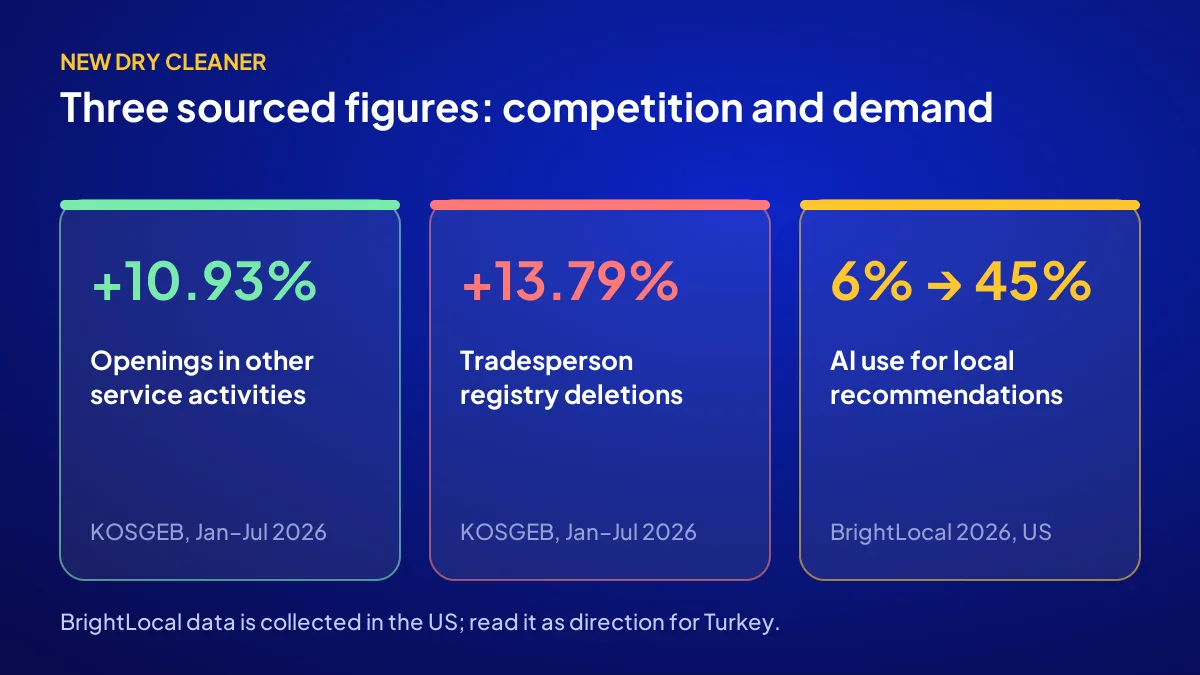
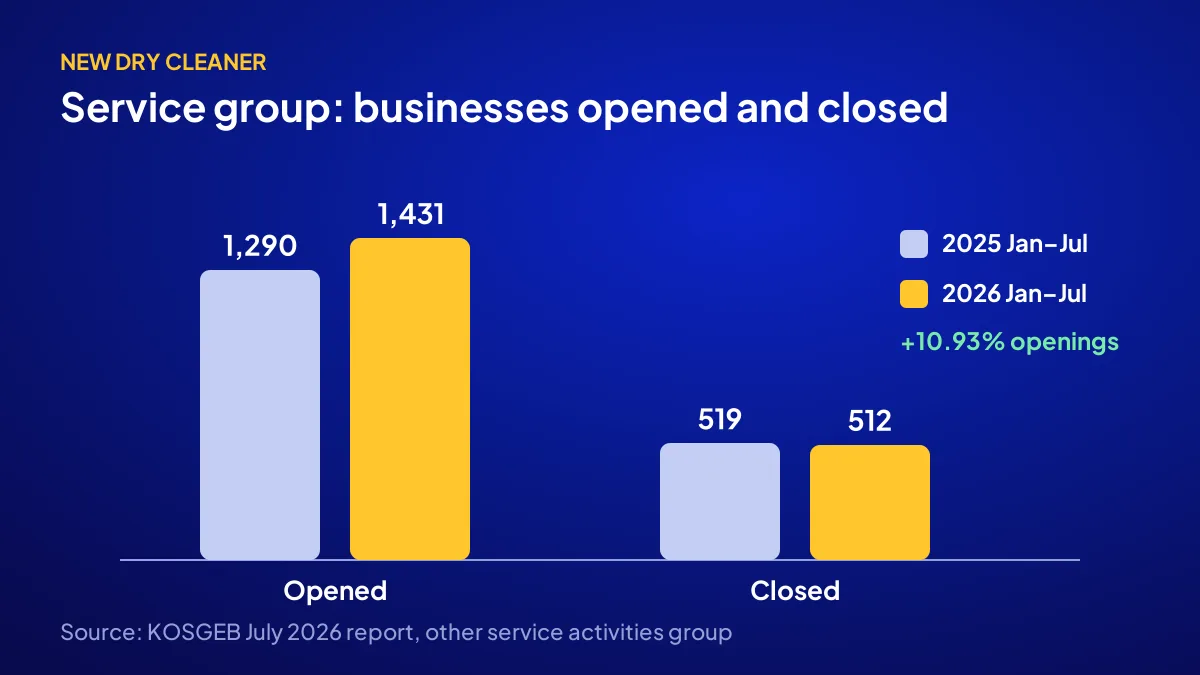
Read the dry cleaning industry in numbers and the first finding is this: there is no current, public, official count of dry cleaners and tailors in Turkey. The wider service group is clear, though. KOSGEB’s July 2026 report shows 1,431 companies and businesses opening in “other service activities” in January–July 2026, up 10.93% on last year, while closures stay flat at 512.
For a new premium dry cleaner and tailor, rivals are rising and clients decide on a screen. In BrightLocal’s 2026 US survey, 97% of consumers read reviews for local businesses, and AI use for local recommendations jumps from 6% to 45% in a year. Each figure below comes with source, year and a one-line comment.
Why is there no separate official count for dry cleaners?
Official statistics count dry cleaning in one large group of personal services, alongside laundries and hairdressers. Tailoring falls under different codes depending on whether the shop makes or alters garments. So “how many dry cleaners are there in Beşiktaş” has no single-table answer. Solid data comes from two places: the service group’s openings and closings, and how clients decide.
What do the numbers show about competition?
BU BÖLÜMÜN ÖZETİ
- The group grows, the clients may not
- Exits speed up among tradespeople
- The wider picture
In the service group, entries rise and exits stay flat; among small tradespeople the picture turns around. KOSGEB reports tradesperson registrations down 8.04% to 169,835 in January–July 2026, while registry deletions rise 13.79% to 57,992. More open as companies, and more shutters come down for sole traders.
The group grows, the clients may not
Openings climb from 1,290 to 1,431, closures dip from 519 to 512. Comment: more businesses chase the same clients, and a shop that cannot stand out drifts into a price race.
Exits speed up among tradespeople
A deletion removes a tradesperson’s registry record; not every closing shop opened that year. Comment: if the till is not turning in the first months, the cash plan comes before the ad plan.
The wider picture
All company types: 77,831 openings. More in new and closed companies in numbers.
How do clients decide on the demand side?
Clients weigh a dry cleaner on their phone first. In BrightLocal’s Local Consumer Review Survey 2026, 97% of consumers read reviews for local businesses, 47% will not use one with fewer than 20 reviews, and 74% look for reviews from the last three months. The survey is US-based; read it as direction for Turkey.
A silk blouse asks for trust
A premium client leaves a silk blouse, a cashmere coat or an evening dress at the counter. Comment: the more the item is worth, the harder it is to walk in unread.
The fresh review advantage
The 74% checking recent reviews is good news for a newcomer. Comment: a rival’s old reviews do not outweigh your fresh ones on their own.
How many clients ask AI?
Growing fast. In BrightLocal’s 2026 data, use of tools like ChatGPT for local recommendations rises from 6% to 45%, now third behind Google and Facebook. TurkStat’s 2026 Survey on ICT Usage in Households puts generative AI use in Turkey at 37.6% for ages 16 to 74. Google’s AI Mode is available in Turkish since 18 February 2026.
Long question, detailed answer
Clients ask for “a place in Kadıköy that cleans leather jackets same day”. Comment: if your site does not list services, fabrics and turnaround, your name is not in the answer.
Fewer clicks when a summary appears
Pew Research Center’s March 2025 study of 900 US adults finds a traditional result is clicked in 8% of searches with an AI summary, against 15% without. Comment: missing from the summary means fewer visits. We follow this trend into 2027 in dry cleaners and AI.
All the figures in one table: source, year and comment
Nine figures in one place. Turkish data is from KOSGEB and TurkStat; review and click data from US research. The last column says what each means for a new shop.
| Indicator | Figure | Source and period | Comment for a new shop |
|---|---|---|---|
| Openings in other service activities | 1,290 → 1,431 (+10.93%) | KOSGEB, Jan–Jul 2025 and 2026 | More rivals for the same clients |
| Closures in the same group | 519 → 512 | KOSGEB, same period | Flat exits, the crowd stays |
| Tradesperson registry deletions | 57,992 (+13.79%) | KOSGEB, Jan–Jul 2026 | A cash plan is a must |
| Read reviews for local businesses | 97% | BrightLocal, 2026 (US) | A profile without reviews is skipped |
| Skip businesses with under 20 reviews | 47% | BrightLocal, 2026 (US) | First target: 20 reviews |
| Look at last 3 months of reviews | 74% | BrightLocal, 2026 (US) | Fresh reviews help the newcomer |
| Use AI for local recommendations | 6% → 45% | BrightLocal, 2025 and 2026 (US) | Questions move to assistants |
| Generative AI use (ages 16-74) | 37.6% | TurkStat, 2026 | A large audience in Turkey too |
| Clicks when an AI summary shows | 8% (15% without) | Pew Research, 2025 (US) | Not in the summary, no click |
Figures missing from the table
Shop counts, prices and district income have no sourced version. Comment: your counter fills this gap.
How do these figures read in an affluent district?
In Beşiktaş, Sarıyer, Kadıköy, Bakırköy, Çankaya or Mavişehir, clients look at care before price. The figures agree: rivals multiply, and clients want written facts and fresh reviews. Without fabric details, turnaround, alterations and service area in writing, the client never walks through the door. District searches are covered in visibility in affluent districts.
One set of facts, four shop windows
Maps, site, Instagram and the assistant should show the same hours and address. Comment: mismatched hours warn a client off.
The full map and the plan
See the new dry cleaner promotion guide and the first 90 days.
Where do you find spending data?
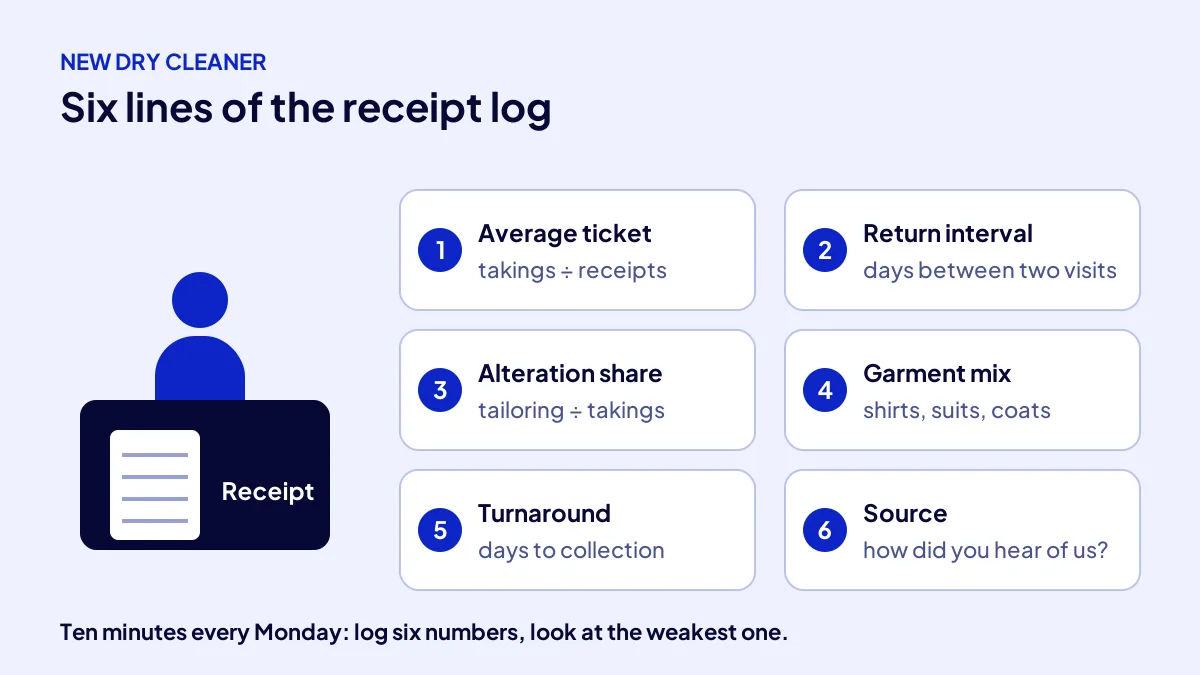
We find no current Turkish data on dry cleaning spend by district or income group. The most reliable spending data sits at your counter: the receipt. A shop that logs six numbers weekly for its first 90 days produces what no market report gives its district. Here are the six lines.
- Average ticket: weekly takings divided by receipts issued.
- Return interval: days between two visits by the same client.
- Alteration share: tailoring work as a percentage of takings.
- Garment mix: the share of shirts, suits, coats and evening wear.
- Turnaround: average days from counter to collection.
- Source: how answers to “how did you hear about us” split.
A hypothetical week
Say you have just opened in Bakırköy and issue 40 receipts in week one. With TRY 30,000 in takings, your average ticket is TRY 750. If 12 receipts include alterations, tailoring touches about a third of the work. The figures are hypothetical; the logic is the same.
Getting the setup done in one place
To set up the profile, a mobile sales page and visitor tracking together, the Website Recipe in the Get Visible Online campaign covers all three: TRY 36,000 + VAT, upfront and fixed, for 3 months, with results reviewed together after month one. Details are on the campaign page.
Quick Summary
- No official count of dry cleaners and tailors exists.
- KOSGEB: openings in the service group up 10.93%, closures flat.
- Tradesperson registry deletions rise 13.79% in January–July 2026.
- US data: 47% skip businesses with under 20 reviews.
- AI use for local tips climbs from 6% to 45%.
- A six-line receipt log gives you spending data.
Short Glossary
Registry deletion: Registry deletion (terkin) is the official procedure used to remove a closed tradesperson’s record.
Activity code: An activity code is the NACE-based number used to classify what a business does in registration and statistics.
Average ticket: Average ticket is the measure used for spending per client: takings divided by receipts.
Next Step
To build the path these figures point to, apply to the Get Visible Online campaign. Fill in the needs form and get a recipe suggested for your shop.
Frequently Asked Questions
Source: KOSGEB — Statistics on Businesses Opened and Closed, July 2026 (in Turkish)
Sık Sorulan Sorular
A business in Turkey registers its work under a NACE-based activity code, and statistics are grouped by it. Comment: the code you pick decides which figure you are counted in.
We give no shop counts or income by district, because we find no sourced figure. Comment: you build that picture with the receipt log further down.
KOSGEB reports monthly; TurkStat renews its survey yearly. Comment: review the table every three months and never set budgets on an old share.
A shrinking return interval means trust is settling. A high alteration share means tailoring should lead in the window. A weak Google line means the problem is visibility, not the shop.
No current public figure counts dry cleaners and tailors separately; statistics group them with other personal services. Count rivals in your district on the map.
No separate figure exists. In the service group that includes it, KOSGEB’s July 2026 report shows openings up 10.93% in January–July 2026, closures flat.
No. The package is TRY 36,000 + VAT, upfront and fixed; with 20% VAT it is TRY 43,200, but check the current rate on the invoice. With the Google Ads or Meta Ads Recipe, the ad budget is paid to the platform separately.
Updated: October 2026