
New medical practice digital marketing: how Adapte’s recipe reaches selective patients
We start new medical practice digital marketing not with ads but with one question: who is looking for this polyclinic, and what are they asking? In high-income districts, patients search with conditions: hours, district, doctor’s title, parking, language. We line these questions up on nine axes with our 1K9N method and match each axis to a rule-compliant page. Then the Website Recipe sets up the profile, mobile website and visitor tracking.
Because health promotion in Turkey is limited by regulation, our order differs from other sectors. Rules first, information second, measurement last. Here is how we handle a polyclinic: a method, not a sales pitch.
Where do we start with a new polyclinic?
In the first conversation we talk about the polyclinic’s patients, not its specialties. That is the “1K” in 1K9N: who is searching. An executive working in Etiler, a parent in Caddebostan looking for a weekend doctor, a foreign patient in Çankaya looking for a consultation in English. A website built without knowing their doors is a shop with its shutters up but no sign.
The needs form
The form you fill in when applying asks for specialties, number of doctors, opening date and district. The opening date matters to us, because the sponsored promotion window starts from it.
Rules check
We put the health promotion regulation of 12 November 2025 first for every polyclinic. Prices, discounts, superiority claims and patient review campaigns never enter our plans. Check the current text yourself before publishing too.
How does a selective patient’s decision path work?
BU BÖLÜMÜN ÖZETİ
- Question and summary
- Profile and website
- Phone
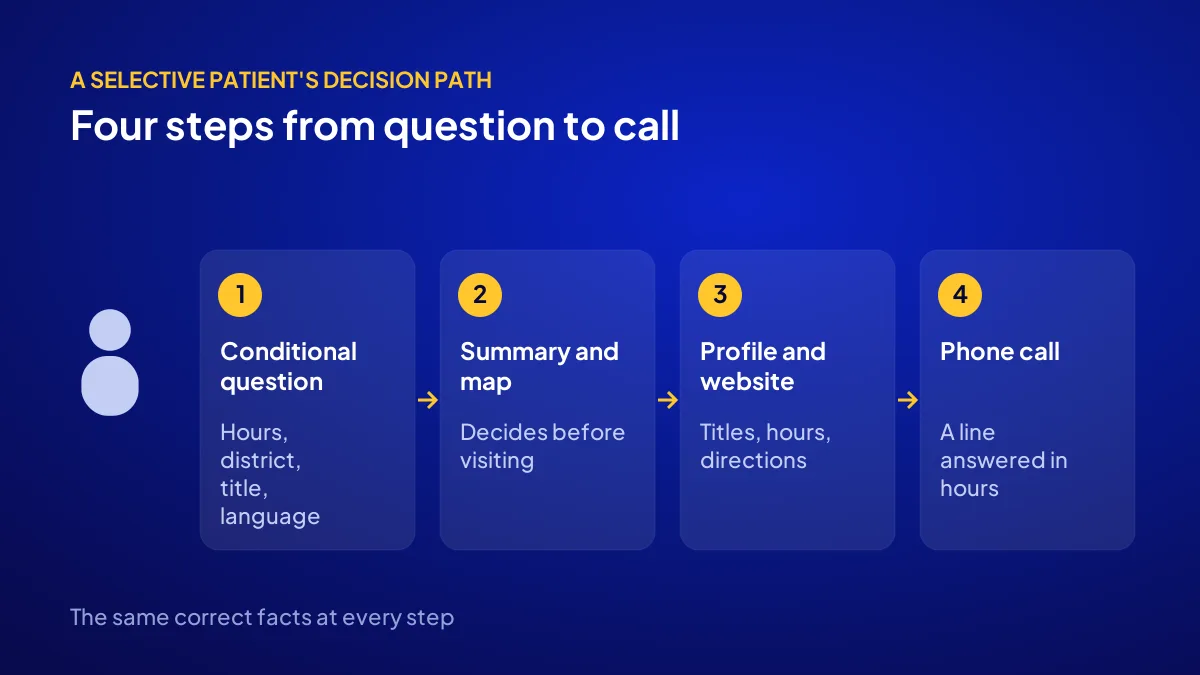
In our observation, a selective patient decides in four steps: they ask a conditional question, look at the summary or map listing, open the profile or website, then call. What breaks trust is different at each step. Our job is to put the same correct information on every step.
Question and summary
In the first two steps patients often decide without entering your site. So hours, titles and address are written in a way the summary can read.
Profile and website
At the third step the patient checks the detail: doctors’ titles, consultation hours, getting there. A single inconsistent fact here raises the “is this the same place?” doubt.
Phone
The last step is a call. A line that goes unanswered during opening hours leaves all the effort at the door.
Reading 1K9N for a polyclinic: 9 questions, 9 pages
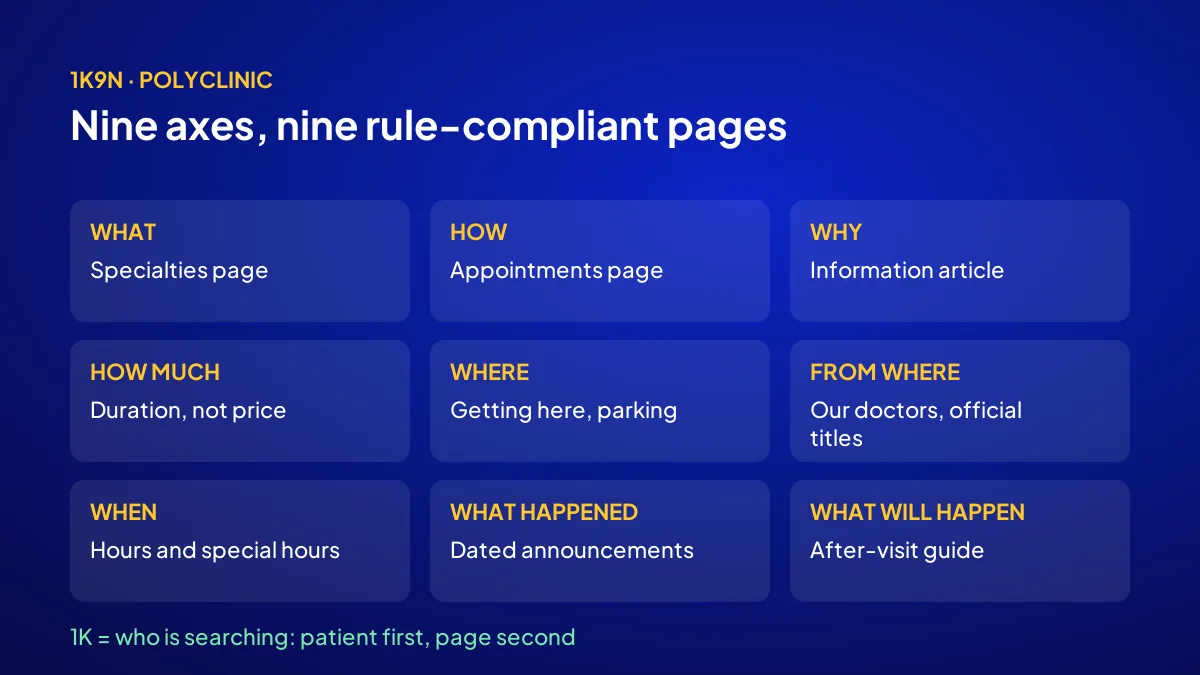
The “9N” in 1K9N stands for the nine Turkish question axes: What, How, Why, How Much, Where, From Where, When, What Happened and What Will Happen. For a polyclinic we reread these axes through the health rules. The clearest difference is on “How Much”: since prices are not published in healthcare, this axis describes duration and waiting, not fees.
| Axis | Patient question (example) | Page we match | Rule note |
|---|---|---|---|
| What | Which specialties does the polyclinic offer? | Specialties page | Only licensed specialties |
| How | How do I book an appointment? | Appointments page | No fee information |
| Why | Why have a check-up? | Information article | No steering |
| How Much | How long does a consultation take? | Patient guide | Duration, not price |
| Where | Is there parking, how do I get there? | Getting here page | Free information |
| From Where | Where did the doctor specialise? | Our doctors page | Official title, no superiority |
| When | Is it open on Saturday? | Contact and hours | Special hours kept current |
| What Happened | Has a new doctor joined? | Announcements | Dated, not promotional |
| What Will Happen | What happens after the consultation? | After-visit guide | No outcome promise |
Why page count matters
Nine axes mean nine core pages, and each axis has dozens of questions beneath it. We give the core page list with a checklist in medical practice website pages.
Every page is written to FORM-97
FORM-97 is our writing standard: the full answer in the first paragraph, short sentences, clear headings, a glossary and FAQs at the end.
From our own data: being seen is not being clicked
BU BÖLÜMÜN ÖZETİ
- Intent questions, not generic words
- The phone screen first
- Professionals also search “opening”
In adaptedijital.com’s Search Console data for 14 June to 13 September 2026, the query “dijital ajans” (digital agency) gets 478 impressions, sits at an average position of 66 and brings not a single click. In the same period, the mobile click-through rate is 1.86 percent against 0.57 percent on desktop. These two observations confirm two principles of our polyclinic plan.
Intent questions, not generic words
Being seen alone brings no patients. So we write pages for intent-rich questions like “internal medicine in Kadıköy open on Saturday”, not for a generic word like “polyclinic”.
The phone screen first
Mobile click-through is more than three times desktop. We design polyclinic pages for the phone screen first and put the call button where the thumb reaches.
Professionals also search “opening”
In the same data, “avukatlık bürosu açmak kaç para” (cost of opening a law office) has 47 impressions at an average position of 8.9. Professionals ask before they open.
Which recipe do we recommend, and which do we postpone?
The Get Visible Online campaign has three recipes: Website, Google Ads and Meta Ads. For a new polyclinic we usually recommend the Website Recipe. In healthcare, ad recipes are squeezed into the first month after opening; once that month has passed, the regulation closes paid promotion. What lasts is the profile and the website.
Second layer: AI
Once the foundation is in place, the AI SEO Campaign, which spreads patient questions across 108 articles, can be discussed as a second layer. Lay the foundation first, then add the next floor.
How do we introduce a polyclinic to machines?
Patients read the page; search engines read structured data. In its local business structured data guidance, Google recommends using the most specific subtype possible and marking up the address, phone and opening hours. For a polyclinic we use schema.org’s MedicalClinic type, and Physician for the doctors. That way address, hours and titles become one record for machines too.
Name, address, phone
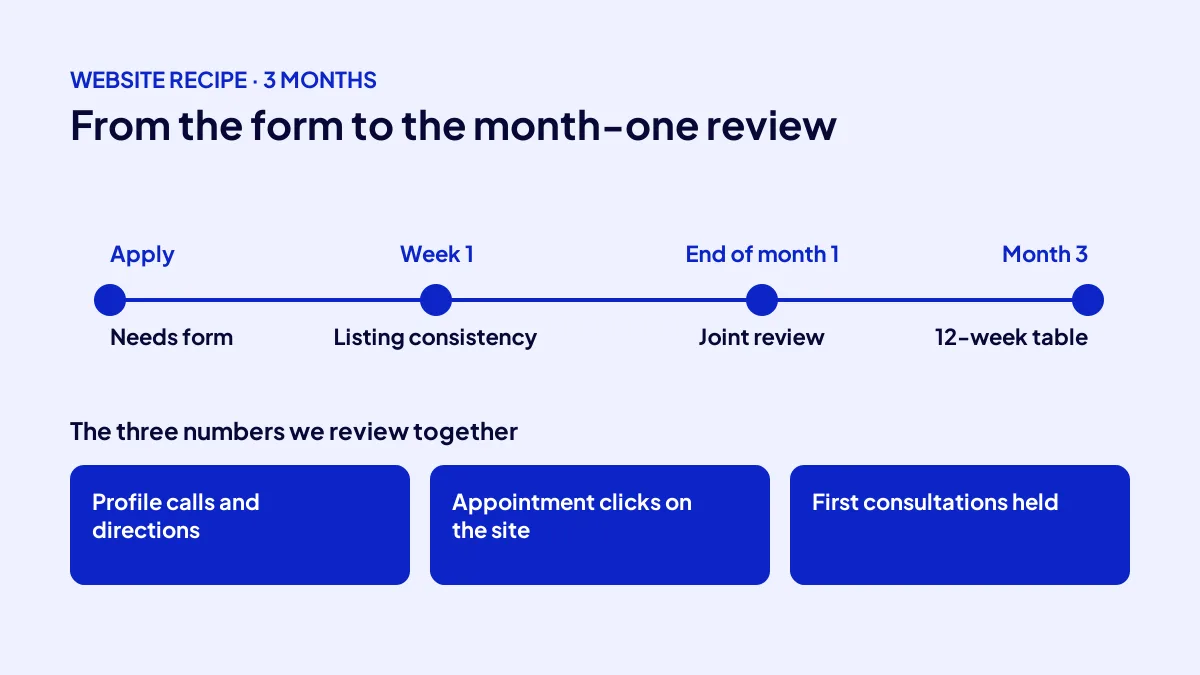
Name, address and phone are written letter for letter the same on the profile, the website and directories. We call this listing consistency; it is week one’s job.
Doctor pages linked to the facility page
Every doctor page links to the polyclinic, and the polyclinic page links to every doctor. That closes the “is this the same place?” question for both patient and machine.
What do we review together at the end of month one?
By campaign rule, we review results together at the end of the first month. For a polyclinic we look at three numbers: calls and direction requests from the profile, appointment clicks on the site, and first consultations that actually happened. Decisions follow these three numbers, not a hunch.
At the end of three months
You are left with a 12-week table and a working foundation. The full path for a new polyclinic is in the new medical practice promotion guide, and the 90-day plan in a new practice’s first 90 days.
Quick Summary
- The start is “who is searching”, not advertising.
- In healthcare, 1K9N’s “How Much” axis covers duration, not price.
- In our own data a generic word gets 478 impressions and 0 clicks.
- Mobile click-through is more than three times desktop.
- For a new polyclinic the Website Recipe is usually recommended.
- Three numbers are reviewed together at the end of month one.
Short Glossary
1K9N: 1K9N is the Adapte content method used to plan who is searching for a topic together with nine question axes.
Structured data: Structured data is the code used to mark up a page’s address, hours and titles so machines can read them.
Listing consistency: Listing consistency is the discipline used to keep name, address and phone identical across every channel.
Next Step
Let’s choose the right recipe for your polyclinic together. Apply for the Get Visible Online campaign, fill in the needs form, and remember to include your opening date.
Frequently Asked Questions
Source: Google Search Central — Local business (LocalBusiness) structured data
Sık Sorulan Sorular
A mobile-friendly sales page, contact buttons, Google Business Profile, basic SEO and visitor tracking. TRY 36,000 + VAT, paid upfront at a fixed price, over a 3-month period. Details are on the campaign page.
The form comes in, we recommend the right recipe, and delivery starts with payment. The full workings are in how the recipe system works; channels for a polyclinic are compared in medical practice promotion channels compared.
If profile searches are few, we return to category and district details; many calls but few bookings, to the phone line; bookings but no-shows, to directions and hours.
For most new polyclinics we recommend the Website Recipe, because sponsored promotion in healthcare is limited to the first month after opening. The decision follows your needs form; once you fill it in, Adapte recommends the right recipe.
In the Get Visible Online campaign, the coupon code is given when you apply or during the call. Writing it on the application form or mentioning it in the call is enough.
The campaign runs for a 3-month period, and results are reviewed together at the end of the first month. For a polyclinic, profile calls, appointment clicks and completed first consultations are checked.
Updated: October 2026