
Polyclinic AI answers in 2027: how a new practice gets named when selective patients ask
Say you are opening a new polyclinic in Caddebostan, Istanbul, with two internal medicine specialists and a cardiologist. One evening a patient types into their phone: “Which internal medicine polyclinic in Kadıköy is open on Saturday and has parking?” For polyclinic AI answers heading into 2027, one condition stands out: your name, specialties, hours and address must be readable online and written the same way everywhere. An AI assistant only knows you as far as it can read you.
The Google Business Profile, the website and directory listings confirm each other. Common patient questions get rule-compliant answer pages. No mention is guaranteed, but a readable polyclinic stands ahead of an invisible one.
What do selective patients ask AI?
BU BÖLÜMÜN ÖZETİ
- The question starts with a condition
- The answer is woven from several sources
- Sometimes the patient asks for the doctor
In high-income districts, patients do not ask for “the best doctor”. They write their conditions: hours, district, parking, the doctor’s title, waiting time for an appointment, a consultation in English. The assistant builds its answer from places that meet those conditions and state them clearly.
The question starts with a condition
For an executive in Levent, “same-day appointments” or “open until 8 pm” matters before the specialty does.
The answer is woven from several sources
The assistant does not look at one site. When the map listing, the web page and the directory entry say the same thing, the polyclinic name enters the answer. We cover the general side of this in how does my brand appear in AI.
Sometimes the patient asks for the doctor
In questions like “female cardiologist in Bakırköy”, the doctor’s name is what gets searched. So the name and title must match everywhere, letter for letter.
What changed in Turkish search in February 2026?
On 18 February 2026, Google announced that it was starting to roll out AI Mode and AI Overviews in Turkey. AI Overviews show a short summary with source links above the search results. AI Mode splits a complex question into subtopics and runs several searches at once.
The question is split into parts
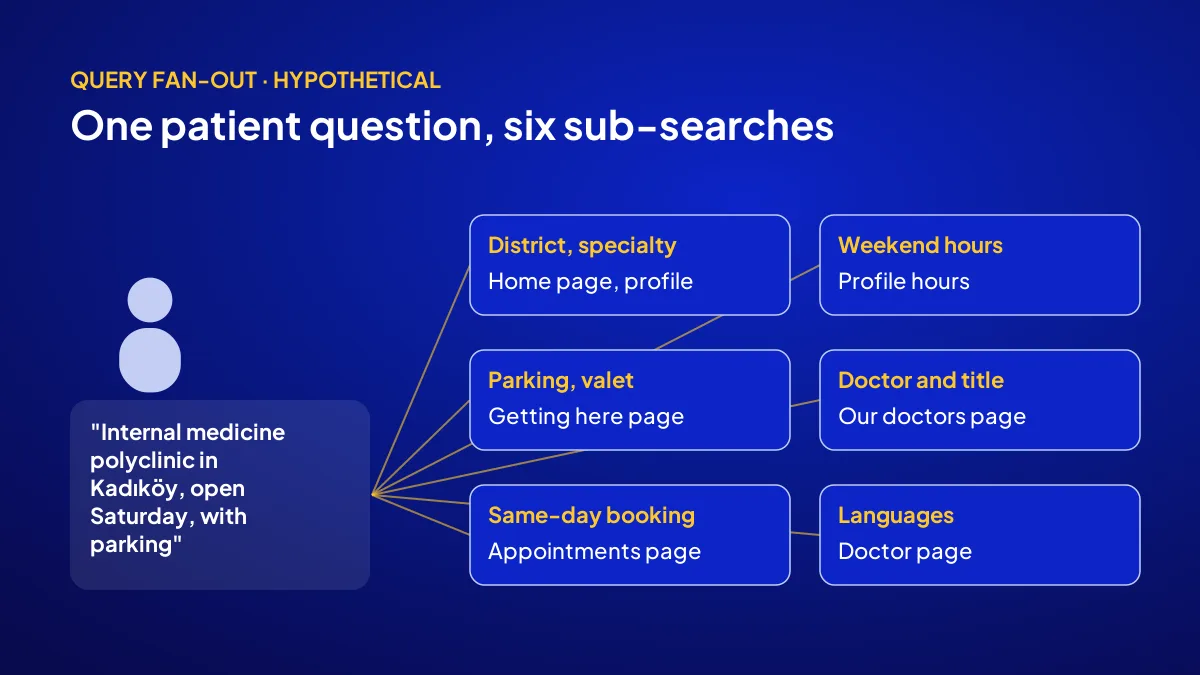
Google calls this query fan-out. One patient question is split into district, hours, specialty and access.
Voice and camera count too
According to the announcement, AI Mode accepts text, voice and photos taken with the camera.
The surprising finding: clicks halve when a summary appears
BU BÖLÜMÜN ÖZETİ
- Deciding without walking in
- The summary is your page, shortened
- Fewer clicks put the phone first
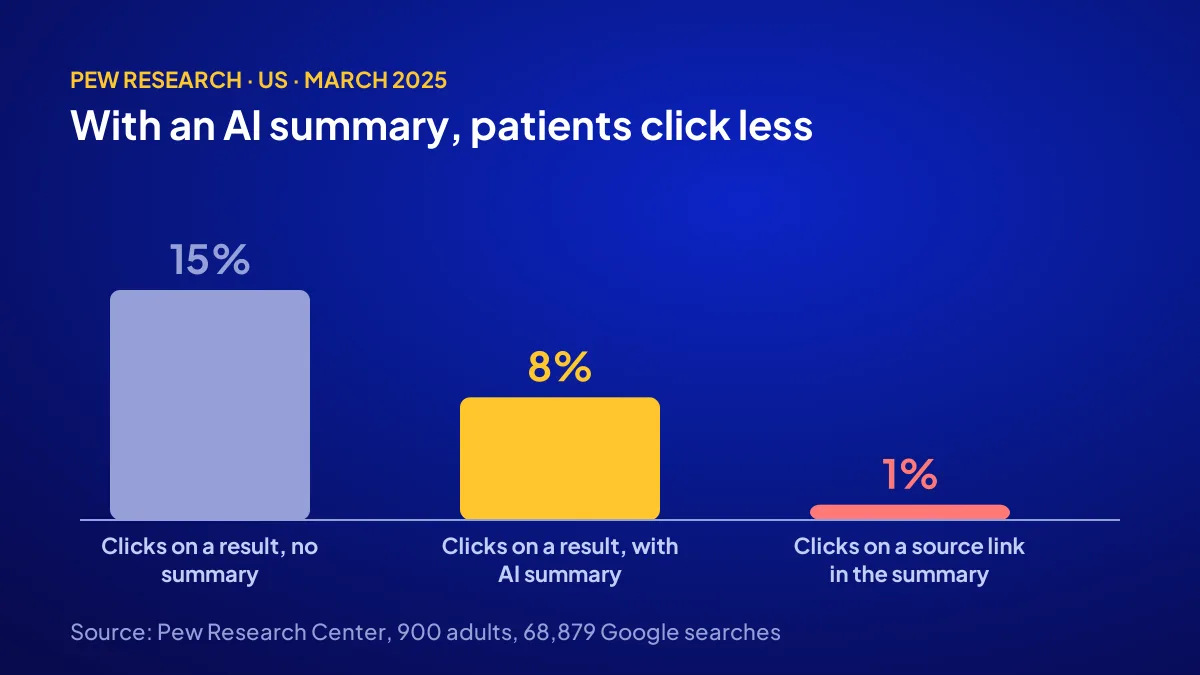
Pew Research Center tracked 68,879 Google searches by 900 US adults in March 2025. When an AI summary appeared, users clicked a result in 8 percent of visits; without a summary, the rate was 15 percent. Clicks on a source link inside the summary made up just 1 percent of visits. Patients often decide without visiting your site. I found no comparable Turkish data; the trend is clear enough.
Deciding without walking in
The moment shopkeepers call “they looked at the window and walked on” is becoming measurable online. A wrong or missing name in the summary gets no second chance.
The summary is your page, shortened
The summary feeds on what you write. If the page has no clear hours, titles and address, the summary cannot state them either.
Fewer clicks put the phone first
A patient who does not click calls or asks for directions. An answered profile number matters more than any ad.
Which sub-questions does one patient question ask a polyclinic?
Back to Caddebostan. “Internal medicine polyclinic in Kadıköy, open Saturday, with parking” can split into at least six sub-searches. Each one looks for a single piece of information on your pages. The table below is hypothetical: it shows a structure, not a promise of results.
| Sub-search | Information sought | Where to write it |
|---|---|---|
| Internal medicine polyclinic Kadıköy | District and specialty | Home page title, profile category |
| Polyclinic open on Saturday | Weekend opening hours | Profile hours, contact page |
| Polyclinic with parking Caddebostan | Parking or valet details | Getting here page |
| Internal medicine specialist name | Doctor’s name and official title | Our doctors page |
| Same-day appointment | Booking route and hours | Appointments page |
| Consultation in English | Languages spoken | Doctor page, profile attributes |
An empty row drops out of the answer
If one of the six is missing, the assistant looks for that condition on another polyclinic’s page. When customers are not walking through the door, an empty row is often why.
The district name is its own door
How to show up in district-name searches is covered in visibility in affluent districts.
What will change by 2027, and what will stay?
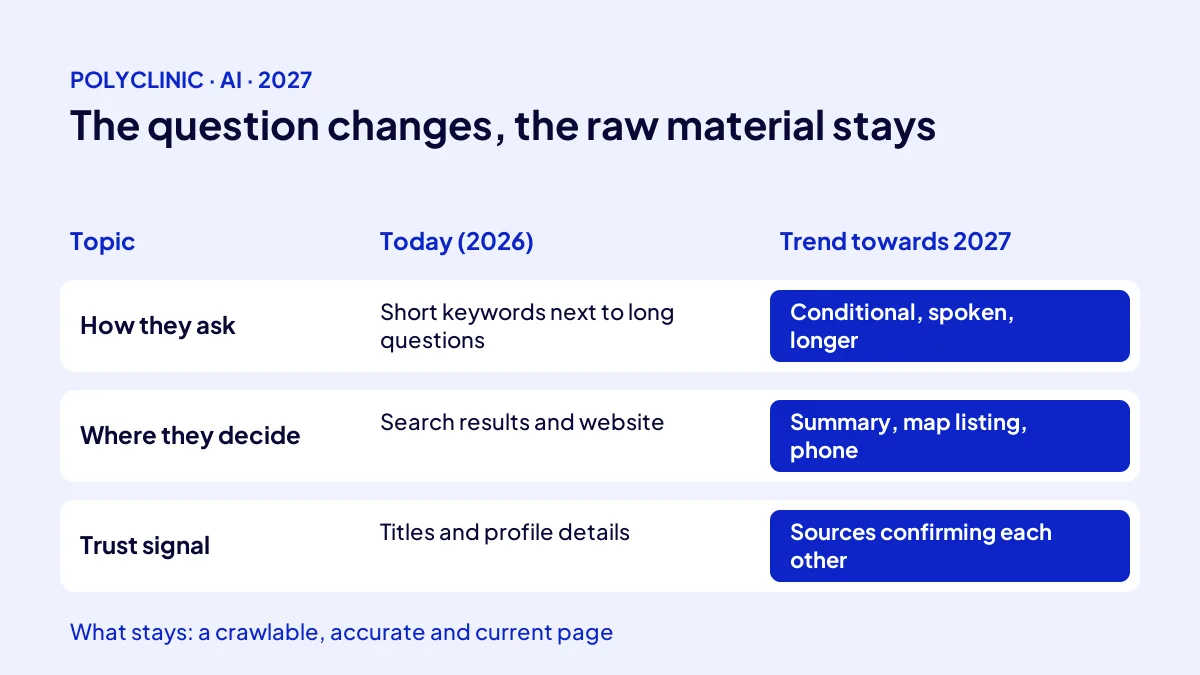
What changes is where and how the question is asked: the search box talks, questions get longer, answers get summarised. What stays is the raw material of the answer: a crawlable, accurate and current page. An older rival’s history counts, but inconsistent information weakens it; a new practice that starts in order can close the gap faster.
| Topic | Today (2026) | Trend towards 2027 |
|---|---|---|
| How patients ask | Short keywords next to long questions | Conditional, spoken, longer questions |
| Where they decide | Search results and the website | Summary, map listing, phone |
| Trust signal | Titles and profile details | Sources confirming each other |
No shortcuts
Google says plainly that no extra requirements or special optimisation are needed to appear in its AI features. Do not wait for a magic file.
Consistency gains weight
A full name in one place and an abbreviation in another are hard to link. Write the name exactly as it is on the licence, everywhere.
How do Turkey’s health promotion rules limit an AI-ready page?
The Regulation on Promotion and Information Activities in Health Services, published in Turkey’s Official Gazette on 12 November 2025, says nothing about AI, yet everything you put on your website falls under it. Sponsored promotion is allowed in the first month after opening; after that, paid promotion is not. Prices, discounts and superiority claims stay out at all times.
- Do not publish consultation fees, discounts or campaign offers.
- Do not use superiority claims such as “the best” or “the only”.
- Do not turn patient thanks or reviews into promotional material.
Check the regulation first
The text and its enforcement can change, so check the regulation and your provincial health directorate’s notices before publishing. The full list of what can and cannot be said is in medical practice advertising rules.
The rules make good material
Plain, dated information with correct titles is what both the regulation and an assistant want.
How does a new polyclinic build this foundation?
Adapte’s AI SEO Campaign sets up 108 articles across 6 question groups, entity structure, structured data and AI traffic measurement in GA4 for a fixed TRY 36,000 + VAT, delivered in 30 days. No recommendation is guaranteed; a readability and recognisability foundation is built and measured with start and end diagnosis cards.
Articles written within the rules
Each article answers one patient question and intent: no prices, no superiority claims, a clear date. You will find the full digital path for a new polyclinic in the new medical practice promotion guide, and the first 90 days in a new practice’s first 90 days.
Places and coupon
The campaign works with 12 businesses per period and there is a 10 percent coupon; just mention the code when you apply or during the call. At the standard 20 percent VAT rate, TRY 36,000 + VAT comes to TRY 43,200; check the current rate on the invoice. See the AI SEO Campaign page for details.
One principle remains: even when the patient never visits your site, the answer is written from your page, so do not leave that page empty.
Quick Summary
- Selective patients ask AI with conditions, not specialties.
- Google AI Mode and AI Overviews have been in Turkey since February 2026.
- Pew 2025: clicks fall from 15 to 8 percent when a summary appears.
- One question splits into six sub-searches, each wanting one fact.
- Everything on the website falls under the health promotion regulation.
- No mention is guaranteed; being readable can be measured.
Short Glossary
AI Overview: An AI Overview is the Google Search feature used to show a short answer compiled from several sources above the results.
Query fan-out: Query fan-out is the method used to split one question into subtopics and run several searches at the same time.
Entity: An entity is the concept search engines use to recognise a polyclinic, with its name, address and doctors, as a single record.
Next Step
To see how your polyclinic looks in AI today, start with a diagnosis. Apply for the AI SEO Campaign and share your website and the patient questions you want to answer.
Frequently Asked Questions
Source: Google Turkey Blog — The era of AI Mode and AI Overviews begins in Turkey
Sık Sorulan Sorular
Yes. On 18 February 2026, Google announced that it was starting to roll out AI Mode and AI Overviews in Turkey. The features are opening gradually in the Google app and on search results pages.
No. The AI SEO Campaign gives no recommendation guarantee. It builds the foundation a polyclinic needs to be read and recognised by AI, measured with start and end diagnosis cards.
Paid promotion is limited by the regulation after the first month, but informative content is allowed. Write pages that answer a single patient question without prices, discounts or superiority claims, and check the regulation before publishing.
Updated: October 2026