
Therapy practice promotion methods: 4 channels from maps to AI, compared on 6 criteria
Therapy practice promotion methods come down to four channels: the Google Maps profile, the website, social media and AI answers. Weighed on six criteria, the winner for a newly opened practice in Turkey is the website; the maps profile is the second leg right next to it. Social media works in the narrowest space because of the rules. AI is the layer that leans on the website and pays off last.
The criterion behind this ranking is one that rarely comes up in other sectors: privacy. Someone looking for a therapist usually searches, reads and decides without leaving a trace. Turkey’s health promotion regulation also bans fees, discounts and client testimonials in promotion. Below, in a table, is what each channel can do inside those two limits.
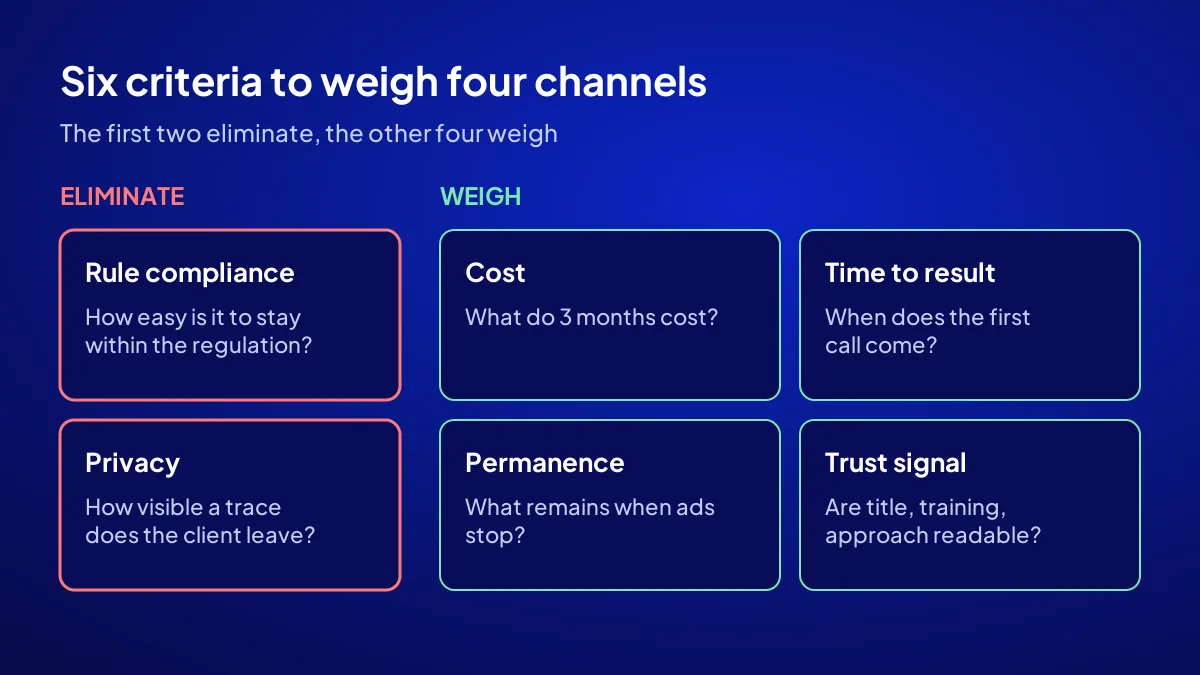
Which 6 criteria weigh the four channels?
We use six: rule compliance, privacy, 3-month cost, time to first result, permanence and trust signal. The first two are specific to a therapy practice and they eliminate; if a channel is weak on either, being cheap won’t save it. The last four are the questions any business asks.
Two criteria that eliminate
Rule compliance: how easily does the channel keep you within the regulation? Privacy: how visible a trace does a client leave while finding you?
Four criteria that weigh
Cost, time to first result, what remains when ads stop, and the trust information a selective client looks for: title, training, areas of work, approach.
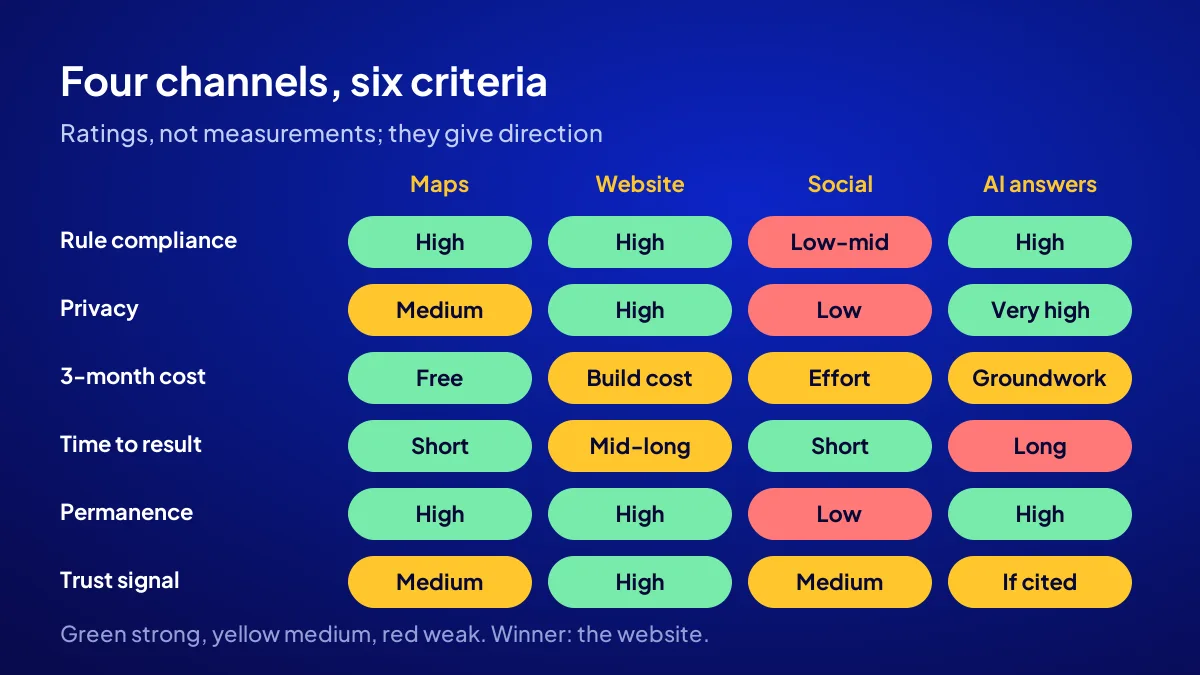
Four channels side by side: what does the table say?
The most balanced row is the website: high on rules, privacy, permanence and trust, its only weakness being slow results. The maps profile is free and fast but tells the trust story briefly. Social media is fast but carries the most risk on rules and privacy. AI is the quietest channel, and its outcome cannot be guaranteed.
| Criterion | Maps profile | Website | Social media | AI answers |
|---|---|---|---|---|
| Rule compliance | High | High | Low to medium | High |
| Privacy | Medium | High | Low | Very high |
| 3-month cost | Free profile | Build cost | Effort; sponsored only in month one | Content groundwork |
| Time to first result | Short | Medium to long | Short | Long, uncertain |
| Permanence | High | High | Low | High |
| Trust signal | Medium | High | Medium | High if cited |
| Best for | Everyone, week one | Practices expecting selective clients | Those who can inform | Practices with a site ready |
How to read the table
Don’t add up the rows. Look at the first two first; a channel marked “low” there can only be used with restraint and care. Then pick your own priority among the remaining four.
Why does privacy weigh so much for a therapy practice?
Because the client’s path to the door is quiet. People share a café they like; most don’t share their therapist. Following your account, liking a post or writing a maps review is a visible trace for them. So even word of mouth travels in a whisper. Reviews grow slowly, and follower counts understate real demand.
The phone reality
In Adapte’s own Search Console data for 14 June – 13 September 2026, about three quarters of clicks came from mobile. Your client is most likely reading about you on a phone, in a moment no one else sees.
What do the maps profile and the website do together?
The maps profile makes the practice findable; the website makes it choosable. The profile gives address, hours, title and category. The selective client wants more: your areas, training, how a first session goes, how confidentiality is kept. That lives on the site.
Say you’ve just opened in Bakırköy
Your profile is verified and the photos are plain. A client taps “website”. If your title, areas and directions appear, they call; if an empty page appears, they hit back. For setting up the profile correctly see the therapy practice Google Business Profile article.
Why the website wins
It is the only channel high on four criteria, and it is the source AI reads. Even when ads stop and feeds scroll on, the page stays put.
How far does social media go within the rules?
Social media works as an information channel, not a sales channel. Sponsored posts are possible only in the first month after opening; after that, no boosting. Client stories, before-and-after narratives and “discounted first session” posts are banned. What’s left is calm, informative content on topics like anxiety, sleep or relationships. That makes a shop window, not a place where the decision is made.
Instagram’s real job
It introduces your voice; the client gets the “I could talk to this person” feeling there and decides on the site. More detail is in the is Instagram enough for a therapy practice article.
The inbox risk
Don’t give therapeutic answers to direct messages. A short piece of information and a way to book are enough, and confidentiality stays intact.
Is being cited by AI the same as being recommended?
No. Being cited means an AI answer to a question like “what’s the difference between anxiety and a panic attack” links your page as its basis. Being recommended means your practice’s name comes up for “suggest a couples therapist in Kadıköy”. The first grows with content; the second with content, profile and consistent details together. Google shows supporting web links in AI Overviews and AI Mode; neither comes with a guarantee.
What it means for a new practice
Site first, then content. How AI picks local businesses is covered in how AI recommends local businesses.
Who needs which, and which one wins?
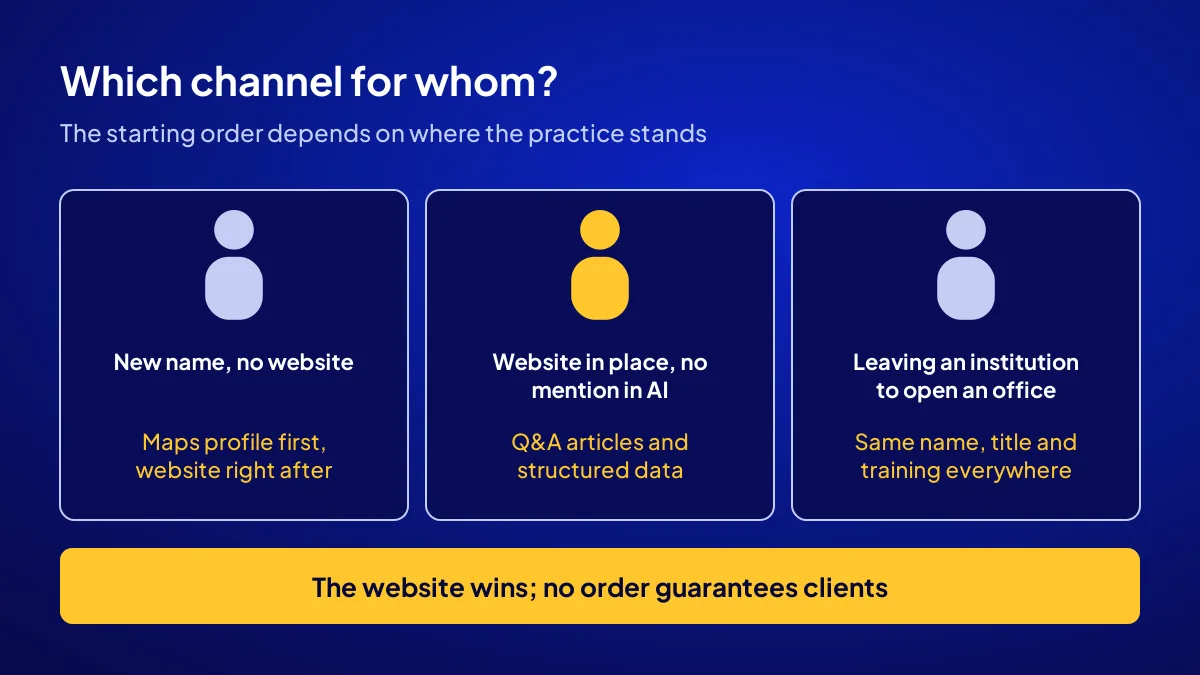
The website wins because it passes both eliminating criteria and the other three channels rest on it. The starting order depends on where the practice stands. If you have just opened your doors, set up the maps profile in week one. If your site is ready, the next job is filling it with question-and-answer content AI can read. No order guarantees clients.
- New name, no website: maps profile first, website right after.
- Website in place but no mention in AI: question-and-answer articles and structured data.
- A known therapist leaving an institution to open their own office: same spelling of name, title and training on site and profile.
All layers together
For the order and rules of every channel in one place see the new therapy practice promotion guide, and for the calendar the first 90 days plan.
Quick Summary
- The website wins; the maps profile is the second leg.
- Rule compliance and privacy are the criteria that eliminate.
- Social media is a shop window; sponsored posts only in month one.
- Don’t ask clients for reviews; reply without mentioning the client.
- Being cited by AI and being recommended are different things; neither is guaranteed.
- Order depends on the practice: profile, website, then Q&A content.
Short Glossary
Being cited: Being cited is a term used when an AI answer links to the page it relied on.
Trust signal: A trust signal is a cue, such as title, training or approach, used by a client to decide whether to trust a practice.
Structured data: Structured data is markup used so search engines can machine-read details such as name, address and title on a page.
Next Step
To get your website into a shape AI can read, apply to the AI SEO campaign. It starts with a diagnosis card; there is a 10% coupon, just mention the code when you apply.
Frequently Asked Questions
Source: Google Search Central — AI features and your website
Sık Sorulan Sorular
Ratings, drawn from how each channel works and the regulation’s text. They give direction, not scores; your own numbers come from the first 90 days.
The regulation bans turning client satisfaction into promotional material, and professional ethics asks you not to load the therapeutic relationship with that kind of request. Don’t ask clients for reviews. Reply to an unsolicited review with a short thank-you that says nothing about the client’s situation.
According to Google’s help page, there is no extra requirement or special file needed to appear in AI features; the usual search rules apply. This traffic is reported in Search Console under the “Web” search type.
The AI SEO campaign is built for clinics and consultants who have a site but don’t come up in AI: AI visibility diagnosis, entity setup, structured data, llms.txt, 108 articles and AI traffic measurement in GA4. TRY 36,000 + VAT fixed, delivery in 30 days, 12 businesses per round. Details are on the campaign page.
Across six criteria the most balanced channel is the website, with the maps profile completing it. Social media is used for information, and sponsored posts are possible only in the first month after opening. Check the regulation for your own status first.
No. No recommendation is guaranteed; the groundwork for being readable and recognisable is built and measured with start and end diagnosis cards. Every article is written for a specific question and intent.
Don’t. The regulation bans using client satisfaction in promotion, and professional ethics asks you not to put that request on the therapeutic relationship. Reply to unsolicited reviews with a short thank-you that doesn’t mention the client’s situation.
Updated: October 2026