
93.6% Access, 17.3% Cloud Use
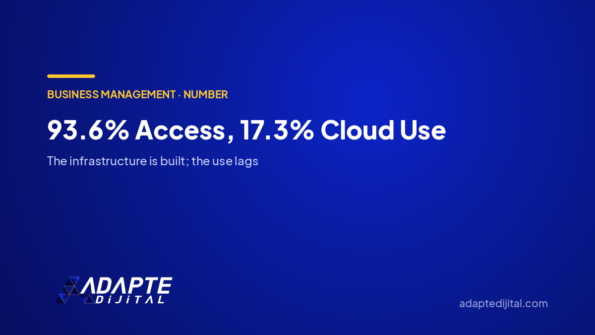
Internet access is nearly complete. Tool use lags far behind. The official study puts two figures side by side: 93.6 percent of enterprises use fixed-line internet, while paid cloud use among firms with ten to forty-nine employees stays at 17.3 percent.
That gap is not a connection problem. It is a usage problem. The tool sits there and nobody picks it up. Access was never the barrier. The barrier sits on the decision side. Nobody made the call to start. And nobody asked the question either. A single decision would change it.
What the Number Says
BU BÖLÜMÜN ÖZETİ
- The infrastructure is finished
- Use runs behind
- The gap widens with size
Three findings.
The infrastructure is finished
Almost every enterprise has a connection. This no longer counts as an achievement. What everyone has produces no advantage; the difference forms elsewhere. Two firms on the same line end up far apart. What separates them is choice. Technology stands equally close to both.
Use runs behind
Cloud use in small firms sits near one in six. Among larger firms it runs three times higher. The gap comes straight from scale, and larger businesses adopt faster. Yet the reason is not budget. Entry costs sit within reach of any firm.
The gap widens with size
Businesses working in the same country with the same infrastructure sit far apart. The cause is not technical. A difference in decisions and habits opens this gap. It can also be closed. Small businesses close it faster than large ones. Few users mean a quick switch.
What the Headline Misses
BU BÖLÜMÜN ÖZETİ
- Cost is not the main obstacle
- Not using it carries a cost too
- Being small helps here
Three details.
Cost is not the main obstacle
Cloud services start with a monthly payment. The entry price stays low. So the obstacle does not sit on the price side. It sits in knowledge and habit, and both clear with a single decision. No large budget is required.
Not using it carries a cost too
Data sits on separate computers. Nobody takes backups and shared work gets harder. That cost never appears on an invoice. But it gets paid daily and nobody keeps the tally. An invisible cost never enters the discussion. So it never shrinks either. Making it visible is the first move.
Being small helps here
Few users means a fast switch. The same move takes months in a large organisation. So this gap can be closed, and closed faster than the large firms manage.
What a Business Should Do
BU BÖLÜMÜN ÖZETİ
- Cost: one hour to see the picture
- First step: move one job
- Next step: measure access
Three steps.
Cost: one hour to see the picture
Where does your data sit? On whose computer, in which folder? That question usually produces an uncomfortable answer, and discomfort is what prompts action.
First step: move one job
Do not move everything at once. Pick the most frequently used item; frequent repetition builds the habit within three weeks. The priority order shows which comes first.
Next step: measure access
How many people can reach a given file? If the answer is one, that is a risk. When that person is away, the work stops. The cost calculation makes the risk visible.
Everyone has the connection. What makes the difference is what gets done with it.