
CarrefourSA names 2 deputy general managers, what changes after the ownership shift?
CarrefourSA has named Hamit Baykal deputy general manager for category and marketing (CCO) and İsmet Öker deputy general manager for digital technologies (CTO), with both appointments effective from 1 October 2026 (Dünya, 7 October 2026). Separately, 89.28% of the supermarket chain’s share capital passed to Yeni Mağazacılık on 31 July 2026, according to a filing on KAP, Türkiye’s public disclosure platform.
What does this mean for you? If you supply CarrefourSA, or you run a grocery store on the same street as one, two key seats at the table now have new people in them at the same time. Category decisions shape the shelf; technology decisions shape the flow of orders and data. The company does not link the two facts, and neither do we.
What do CarrefourSA’s appointments of Hamit Baykal and İsmet Öker mean for suppliers?
The short answer: new counterparts at the category desk and at the technology desk. CEO Hatice Evren presented the appointments as a way to strengthen commercial and technological transformation and raise competitiveness, according to the company as reported by Dünya. That is a stated aim, not a change that has already happened.
What professional background do CarrefourSA’s new CCO and CTO bring?
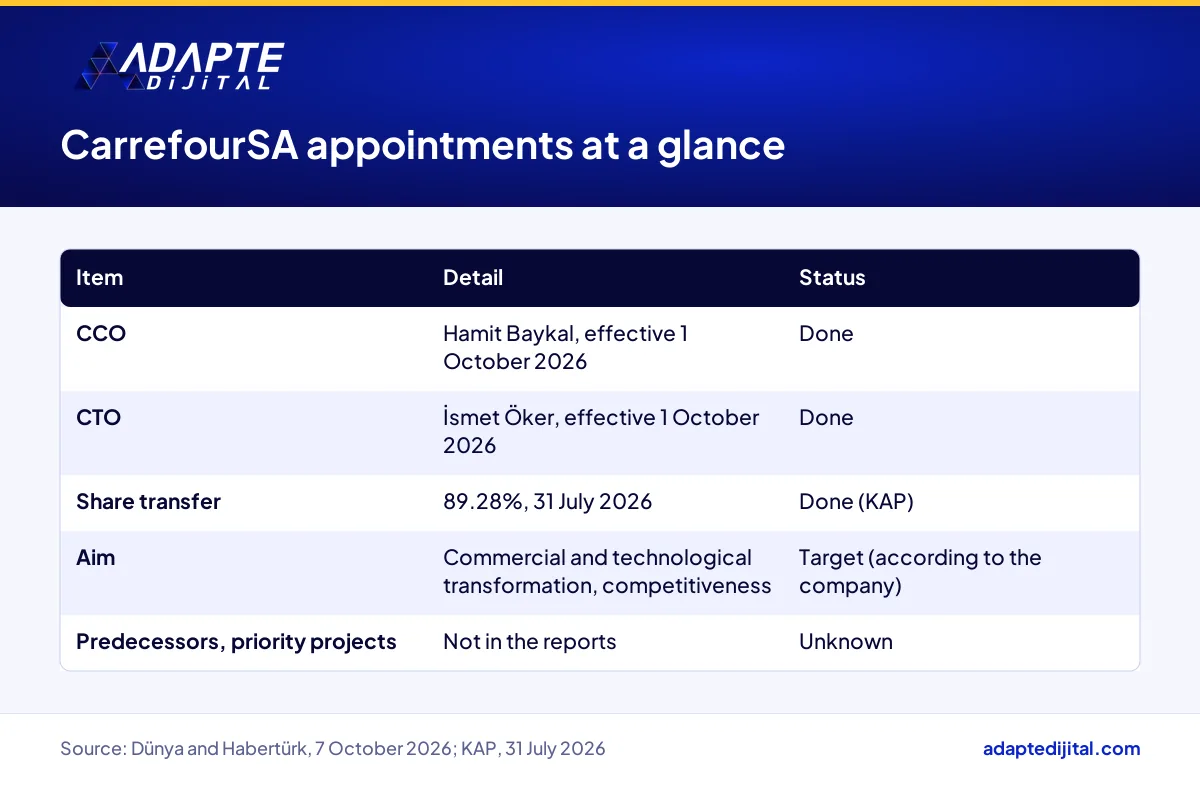
Both come from retail-related roles: one from the category side, the other from technology. The details below are only the titles and roles made public in Habertürk’s and Dünya’s reports of 7 October 2026.
| Item | Detail | Status |
|---|---|---|
| CCO | Hamit Baykal, effective 1 October 2026 | Done |
| CTO | İsmet Öker, effective 1 October 2026 | Done |
| Share transfer | 89.28% to Yeni Mağazacılık, 31 July 2026 | Done (KAP) |
| Aim | Commercial and technological transformation, competitiveness | Target (according to the company) |
| Predecessors, priority projects | Not in the reports | Unknown |
On what timeline did CarrefourSA’s share transfer and management appointments happen?
Three dates matter: 30 July, 31 July and 1 October 2026. The Turkish Competition Authority gave conditional approval to the transfer on 30 July, and the transfer was completed on 31 July (CarrefourSA’s KAP filing). The appointments took effect on 1 October and appeared in the press on 7 October.
Who does the management change at CarrefourSA affect, and how?
The most direct effect falls on food and cosmetics suppliers selling to CarrefourSA, on software and integration firms, and on independent grocers in the same neighbourhoods. The direction of any change is not yet clear. What is clear is that the people across the table have changed.
What does CarrefourSA’s digital technologies seat raise for e-commerce, data and marketplaces?
It raises three topics: order and stock data, the online sales platform, and data sharing with suppliers. The new CTO’s background includes an SAP migration and online grocery retail (Habertürk). The company has not announced any project in these areas.
What should a CarrefourSA supplier or small grocery owner do this week?
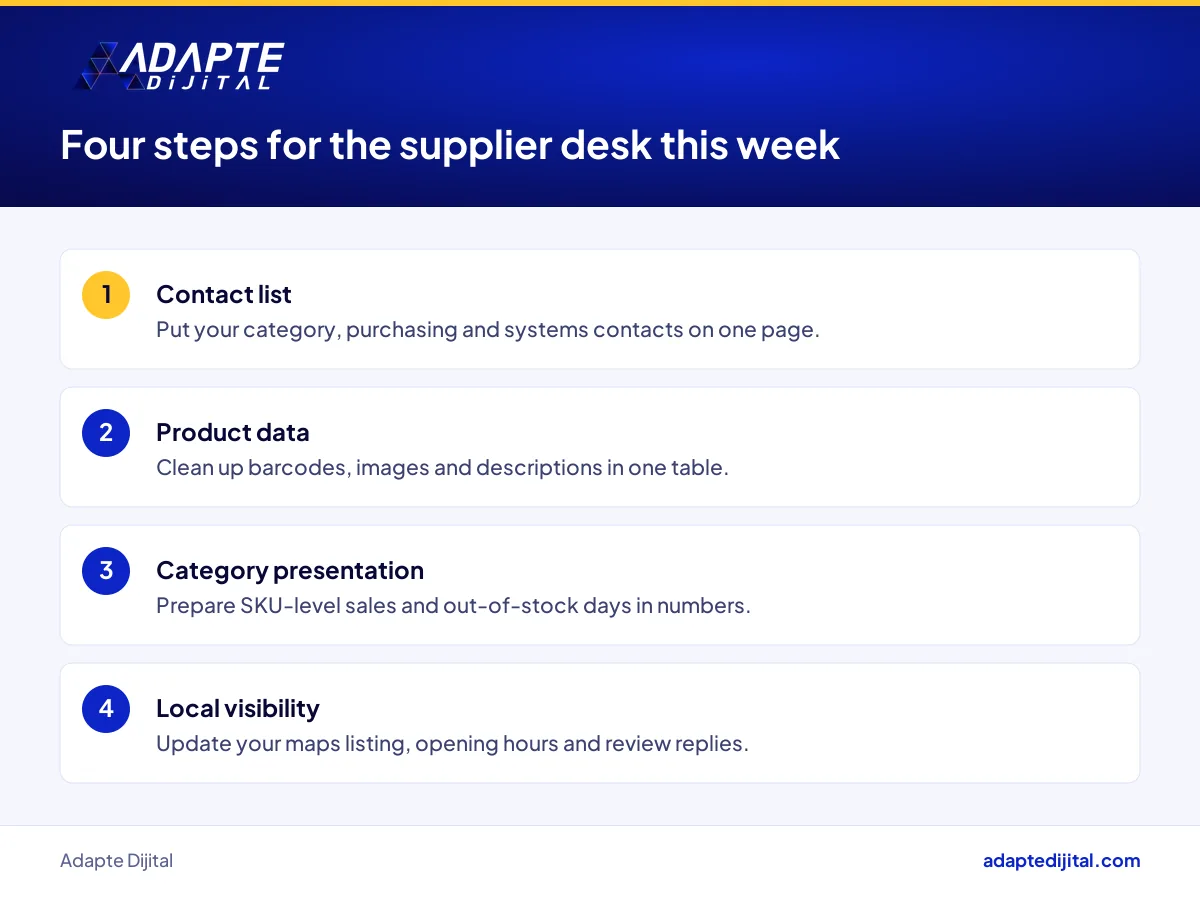
Three jobs fit into this week: update your list of contacts, clean up your product data and prepare a category presentation built on numbers. The suggestions here are general business information, not legal, financial or investment advice.
Quick Summary
- CarrefourSA appointed Hamit Baykal as CCO and İsmet Öker as CTO, effective 1 October 2026 (Dünya, 7 October 2026).
- 89.28% of the company’s share capital was transferred to Yeni Mağazacılık on 31 July 2026 (KAP).
- The company has not drawn a cause-and-effect link between the appointments and the share transfer.
- The stated aim is commercial and technological transformation and competitiveness; it is a target, not a result.
- For suppliers, the first step is to update contacts, product data and the category presentation.
Short Glossary
- CCO
- CCO is the abbreviation used to describe the senior executive responsible for commercial decisions, in this case category and marketing.
- Category management
- Category management is the retail method used to run a product group as its own business unit through shelf, price and promotion decisions.
- Mandatory tender offer
- A mandatory tender offer is the capital markets rule used to require whoever takes control of a listed company to make an offer to the other shareholders.
Frequently Asked Questions
Next Step
Let’s map out product data, order integration and local visibility for your supplier desk together; fill in the consult your expert form.
Sources: Dünya, report on two new appointments in CarrefourSA’s senior management, 7 October 2026 · Habertürk, report on senior appointments at CarrefourSA, 7 October 2026 · KAP, CarrefourSA material event disclosure on the share transfer, 31 July 2026
Updated: October 2026
Sık Sorulan Sorular
It decides which products make it onto the shelf, how much space they get and how the promotion calendar is built. Category management means running a product group as if it were its own business unit. For a supplier, this is the desk that decides whether a product sells or just sits on the shelf gathering dust.
It decides which systems carry order, stock and sales data. The order screen a supplier sees, invoice matching and the online sales platform all run through this desk.
The reports do not say whom the two executives replace or whether the roles are newly created. No KAP filing or company press release about the appointments could be found either.
Baykal entered food retail in 2003 and has more than 20 years of experience (Habertürk; Dünya). He worked as a category manager in hypermarket and wholesale food retail, covering categories such as cosmetics, baby, confectionery, dairy, bakery and deli. He was food category leader from 2015 to 2019, and category director and board member at Metro Türkiye from 2024 to 2026.
Öker has more than 15 years of experience in technology (Dünya). According to Habertürk, he led the move to SAP as technology director at Getir from 2021, and served as vice president of technology at an online grocery retailer in the United States. His most recent role was CTO of an AI-focused startup he co-founded.
They suggest that category management and the ERP side are on the table at the same time. ERP is enterprise software that brings purchasing, stock and accounting into one system. This is a reading of the backgrounds, not a plan the company has announced.
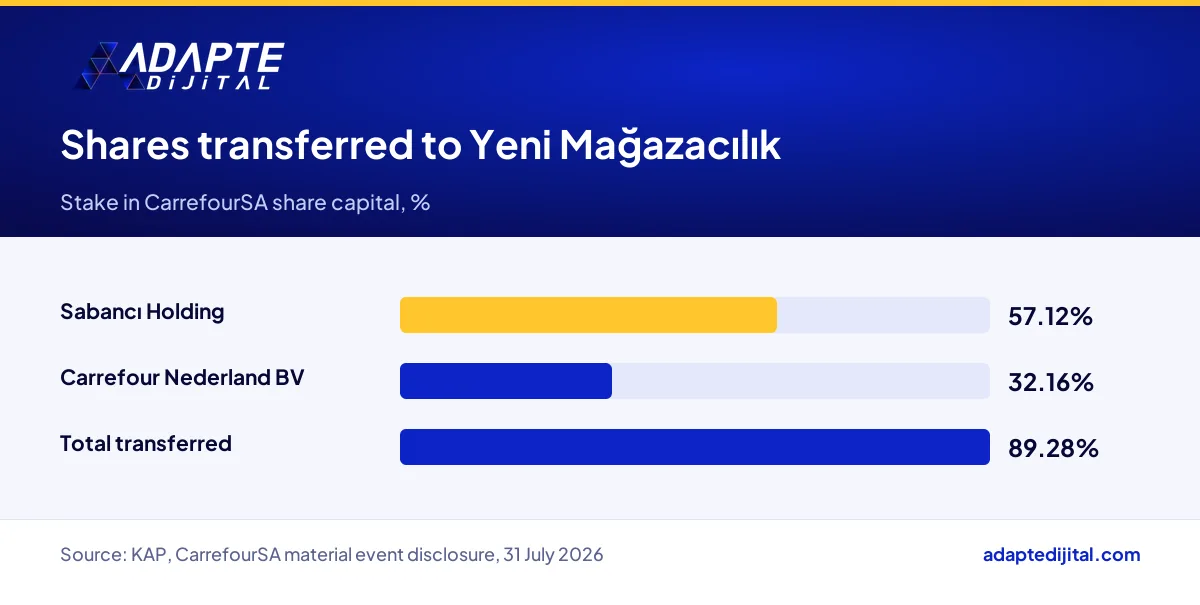
Sabancı Holding’s 57.12% stake and Carrefour Nederland BV’s 32.16% stake, 89.28% in total, were transferred to Yeni Mağazacılık (KAP). The sellers no longer hold any shares in the company. The filing does not state a sale price.
No. The KAP filing says the approval was conditional but does not list the conditions. The outcome of the application for an exemption from a mandatory tender offer is also unknown. This is a report of facts only; this is not investment advice.
Only the order of events: first the ownership change, then two senior appointments. The company has not stated any cause between the two.
Suppliers with clean product data, SKU-level sales and stock reports, and promotion history they can show in numbers. At a first meeting, the supplier that brings data steers the conversation; the one with only a price list ends up on the defensive.
Small producers that still handle orders and invoices by hand. If a chain changes its systems, data formats, delivery windows and invoice matching can change too. For an unprepared supplier, that can mean delayed orders and cash that stops coming in.
Because a large chain’s category and promotion decisions shape price perception across the whole neighbourhood. If the promoted item is cheaper across the road, shoppers turn around at the door. The local answer is a sharper strongest category, not a price war.
Online, shoppers find a product on a screen, not on a shelf. A product with missing images, messy descriptions or a wrong barcode does not show up in search. Clean data in one table fits whatever system comes next.
The opening hours and promotion details a chain shows in local search results affect the visibility of the independent grocer nearby. For a local store, a maps listing, up-to-date hours and replies to reviews are the cheapest digital defence. How customer content turns into sales is covered in our piece on Teknosa’s Totem 2002 campaign.
A marketplace seller should watch how large chains move on data and technology in online grocery and everyday goods. The path of a brand that grew on marketplaces and then built its own production is explored in our piece on Şımart Teknoloji’s Ankara plant. Make your channel decision with your own average basket size and return rate.
Write down on one page whom you work with on the category, purchasing and systems sides.
Your own numbers: unit sales by SKU, shelf turnover, the sales difference during promotions and the number of out-of-stock days. Keep targets in one column and actual results in another. Recorded results make a stronger case than estimates.
Product data, order integration and local visibility are linked jobs, and planning them in one table saves time. We run this work for businesses under digital transformation management. Other chain and appointment news is interpreted for you on our retail page.
The reports say nothing about contracts. Take any questions on contract terms to your counterparts and your legal adviser; this is not legal advice.
The company has not made that link. The share transfer was completed on 31 July 2026 and the appointments took effect on 1 October 2026; the two facts only sit side by side on the calendar.
A large chain’s category and promotion decisions shape price perception in the neighbourhood. Sharpening your own strongest category and your local digital visibility is a sounder path than a price war.