
Ödero and Otokar digitise dealer collections, how do you collect payments 24/7?
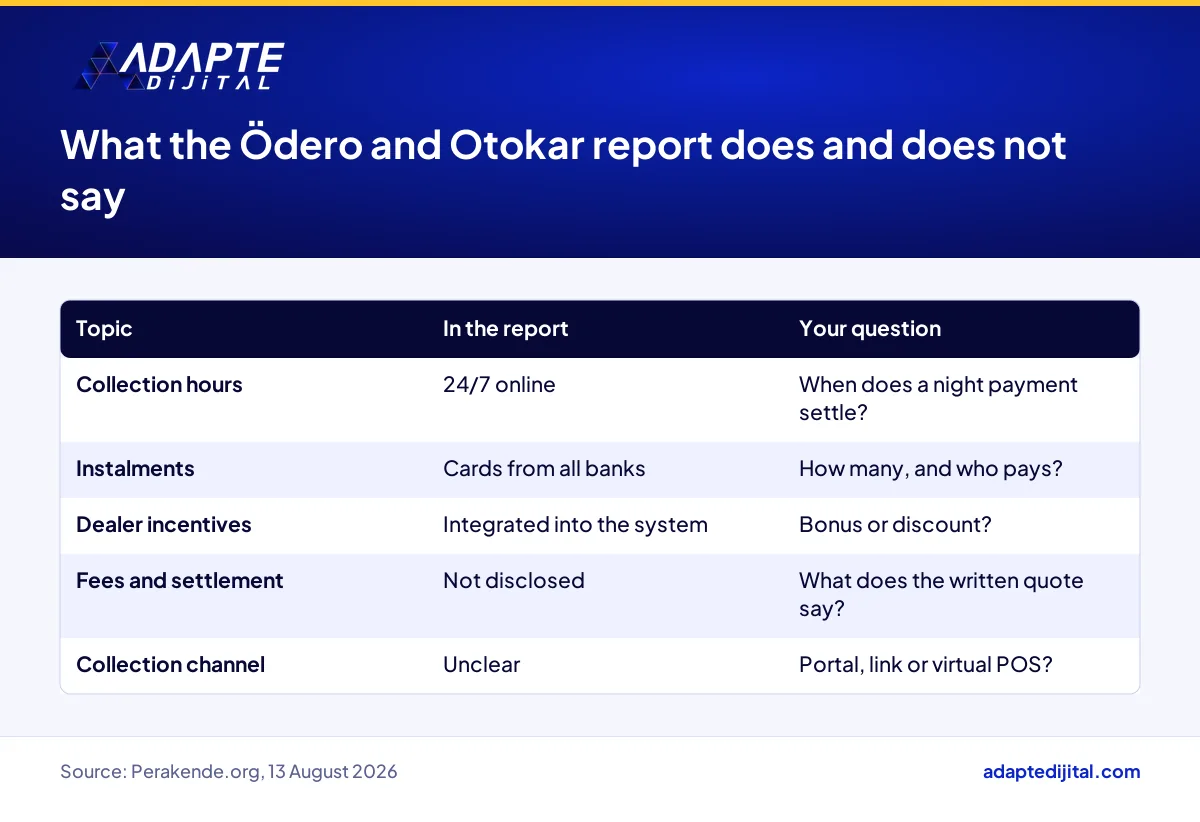
Ödero and Otokar have signed a strategic partnership that digitises payment and collection for Otokar’s dealers (Perakende.org, 13 August 2026). According to the report, the system offers 24/7 online collection, instalment payments with cards from all banks and integration of Otokar’s dealer incentive system, and both dealers and Otokar customers use it.
Here is what it means for you. If you sell through dealers or distributors, collections, instalments and incentive calculations no longer have to sit on three separate desks. A mid-sized business can bring all three into one flow with a licensed payment institution too.
What does the Ödero and Otokar partnership change in dealer collections?
It changes three things: when payment happens, how it happens and where the incentive is calculated. Dealers and customers can pay at night or at weekends, in instalments with any bank’s card, and the incentive system sits on the same infrastructure. Ödero is the payment brand of Token, a Koç Group company, and Otokar is the Koç Group’s maker of buses and Atlas light trucks.
How does a business with a dealer network set up 24/7 online collection, step by step?
BU BÖLÜMÜN ÖZETİ
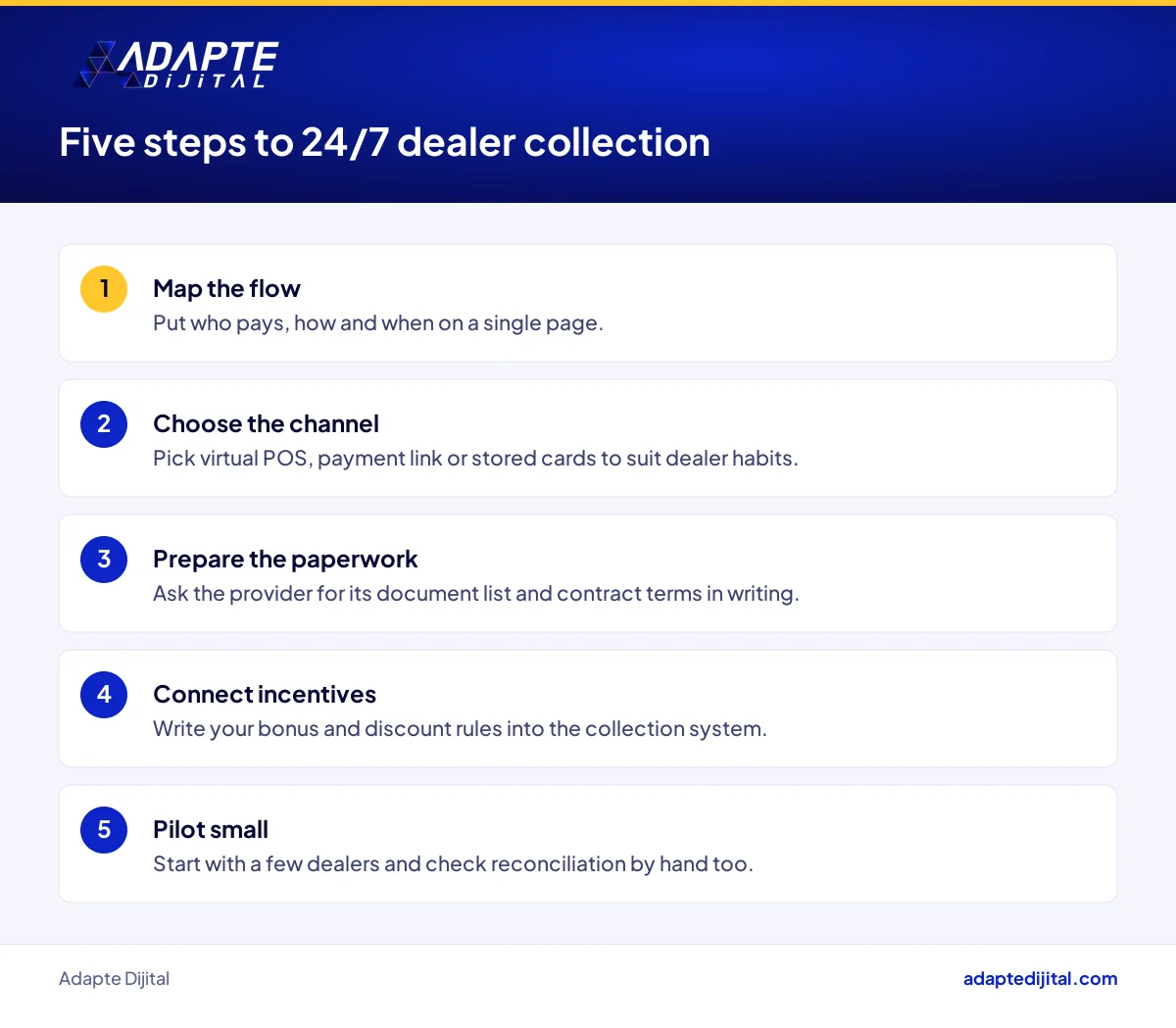
- 1. Map today’s collection flow on paper
- 2. Choose the collection channel
- 3. Prepare the paperwork and the contract
- 4. Connect incentives and instalments, then start small
It takes five steps: map the flow, choose the channel, prepare the paperwork, connect incentives and instalments, then pilot with a small group of dealers. Time and cost depend on your structure, and the report gives no figures. At every step, get your own quote and ask for it in writing.
1. Map today’s collection flow on paper
How does your dealer pay today: bank transfer, cheque or card at the till? Who issues the invoice, who does the reconciliation, and in which spreadsheet is the incentive bonus calculated? It takes a meeting or two of your team’s time.
2. Choose the collection channel
Providers such as Ödero offer virtual POS, payment links, e-wallets and card storage. If a dealer pays on a regular monthly rhythm, stored cards may cause less friction; if payments are irregular, a payment link may suit better. Which one Otokar uses is unknown, so choose based on your own dealers’ habits.
3. Prepare the paperwork and the contract
The document list differs from provider to provider, and the report does not give one. Ask for the full list in writing when you request your quote. The contract should cover fees, settlement time, refunds and chargebacks as separate clauses.
4. Connect incentives and instalments, then start small
Whatever rule drives a bonus, a volume discount or an early-payment discount, write that rule into the system. Then run a short pilot with a small group of dealers and check reconciliation by hand as well. If nothing breaks, open it to the whole network.
What should you check when choosing a licensed payment institution for dealer collections?
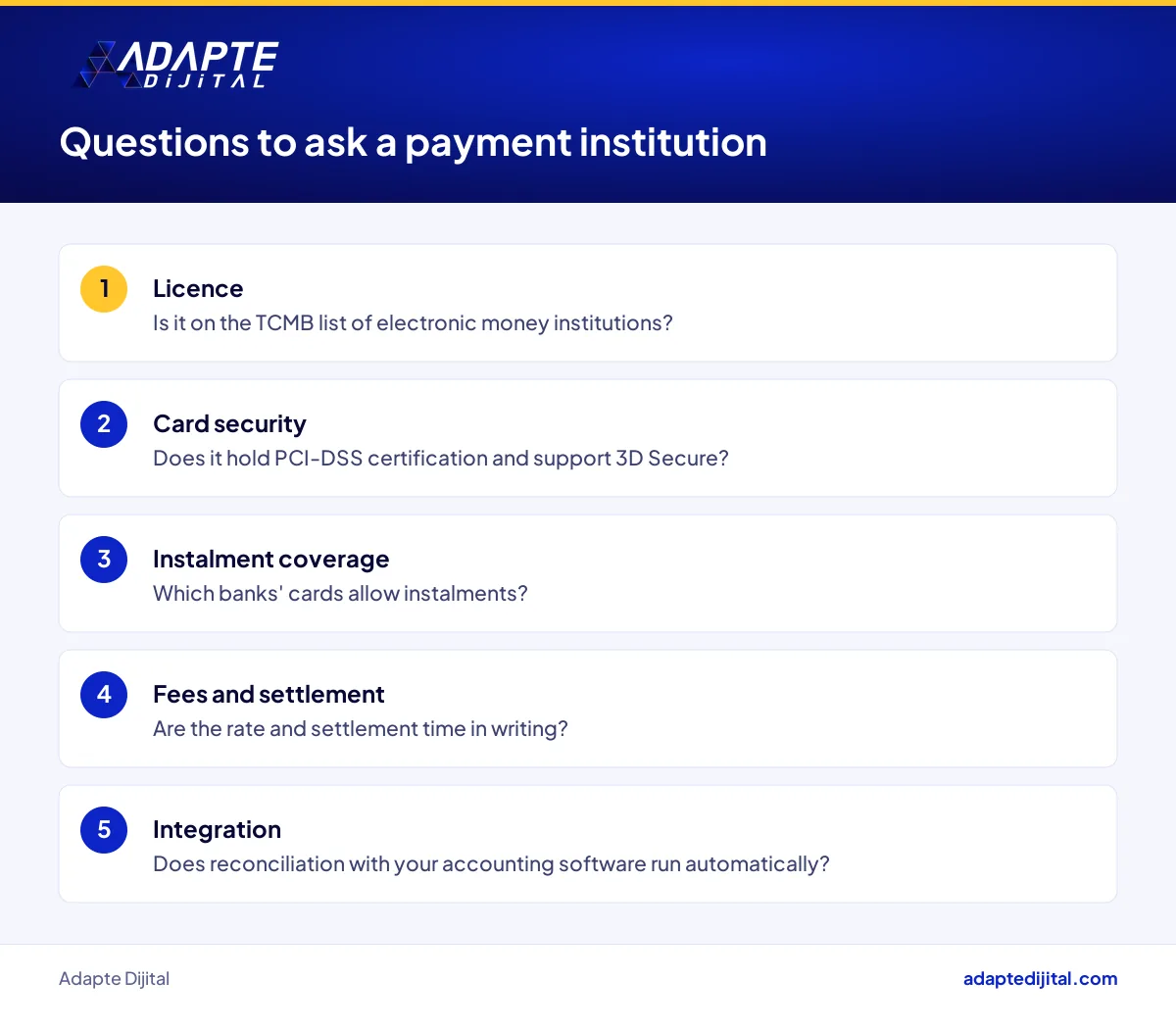
Check four things: the licence, the security certification, instalment coverage across banks and how transparent the contract is. You verify the licence on the TCMB list and card security through PCI-DSS certification. Instalment coverage and fees differ from provider to provider, so compare written quotes.
Common mistake: looking only at the fee
The most common mistake is picking the provider with the lowest fee and never asking about settlement time, refunds or accounting integration. A low fee does not help if the money reaches your account late; cash flow still gets tight and the till stops turning. If reconciliation stays manual, your accounting team carries the same load at every month end.
Which businesses does digital dealer collection affect, and how?
The biggest winners are manufacturers that sell through dealers or distributors: commercial vehicles, white goods, building materials, farm machinery and food distribution. Small dealers who still collect in cash and by cheque will find it harder. Accounting offices and SMEs building their own distribution networks feel it indirectly. We read similar moves in the sector for you on our retail page.
What does online dealer collection require on the website, data and search side?
It needs a secure dealer login area, a payment page that works properly and clean customer data. In autumn 2026, among Turkish manufacturers that sell through dealers, we still often see the website used only as a shop window. A payment page on your own site keeps trust and data in one place.
What should an owner with a dealer network do this week?
Do three things this week: put your collection flow on a single page, ask more than one licensed payment institution for a written quote, and set a pilot timetable with a few dealers. Do not choose a system before all three are done. We also look at how management changes in the supply chain can affect payment terms in our CarrefourSA article.
Quick Summary
- Ödero and Otokar signed a partnership to digitise dealer payment and collection (Perakende.org, 13 August 2026).
- The system covers 24/7 collection, instalments with cards from all banks and dealer incentive integration.
- The number of dealers, fees, number of instalments and collection channel are not disclosed.
- Token is one of 56 electronic money institutions on the TCMB list (TCMB).
- The key to setup is linking incentives and accounting to collection in one flow.
Short Glossary
- Settlement time
- Settlement time is the term used to describe the day a card payment actually lands in the business’s bank account.
- Electronic money institution
- An electronic money institution is the name used for a company that provides payment and e-money services under a TCMB licence.
- Dealer incentive system
- A dealer incentive system is the arrangement used to calculate the bonuses and discounts a manufacturer gives its dealers.
Frequently Asked Questions
Next Step
If you would like to talk through where to start bringing your dealer collections into one flow, fill in the consult your expert form.
Sources: Perakende.org, 13 August 2026 · Central Bank of the Republic of Türkiye, list of electronic money institutions · Capital, 2022 · Turkish Ministry of Trade, 2025 e-commerce data
Updated: October 2026
Sık Sorulan Sorular
Four points are clear: 24/7 online collection, instalment payments with cards from all banks, integration of the dealer incentive system, and use by both dealers and customers. Hande Sarıdal, General Manager of Token, says the company develops “payment solutions that can be customised to the needs of different sectors” (our translation).
Dealer numbers, launch date, instalment count, fees and settlement time are all missing. It is also unclear whether collection runs through a payment link, a virtual POS or a dealer portal. Nor does it explain whether the incentive integration means bonus calculation or discounts, so you have to fill these gaps in your own design.
Token, the company behind Ödero, appears with an operating licence on the list of electronic money institutions kept by the TCMB, the Central Bank of the Republic of Türkiye. The list holds 56 institutions. Check every payment provider you plan to work with against this list yourself.
PCI-DSS is the card data security standard, and Ödero highlighted its certification when it launched in 2022. According to Ministry of Trade data, two thirds of payments in Türkiye in 2025 went through card systems, and 64% of those were confirmed with 3D Secure. If your dealers pay by card, ask how this verification step fits into your flow.
On licences, contracts and tax, this page gives information only. Verify with the official source; this is not legal or financial advice. Have your accountant and lawyer read the contract.
When money can arrive at night, days sales outstanding shrink and the overdue receivables list gets shorter. When the incentive calculation sits next to collection, the month-end argument over bonuses fades.
For a dealer used to cash, a new system means a new screen, a new password and a new contract. If nobody makes clear who carries the card fee, the dealer joins reluctantly. Training and support matter as much as the technology.
With a handful of dealers this can look premature, but switching later costs more. To think about collections together with your books, read our piece on keeping SME bookkeeping in one place.
A dealer portal shows the current account, invoices and past payments together. A payment link is quick to set up but leaves the data scattered. If your network is large, start with a portal; if it is small, a link can be a sensible first step.
Which dealer paid on which day, with which card and over how many instalments gives your sales team a real map. You spot falling order values and slipping payments early.
Before paying, a customer searches for your company name. If the payment page is not on your own domain, or your local listings are incomplete, the customer walks away at the door. Keep the payment address, contact details and dealer list consistent across your site.
Bring your number of dealers, your average monthly collection count, the accounting software you use and your incentive rules. Then ask the provider about TCMB authorisation, PCI-DSS certification, instalment coverage, fees, settlement time, the refund process and accounting integration.
Do not announce the change in a single email; give a short walkthrough and a written guide. State clearly from day one who carries the card fee. If anything stays vague, the system just gathers dust on the shelf.
Designing collections, accounting and the web side together is transformation work. At Adapte Dijital, we build this setup with businesses as part of our digital transformation management service.
Yes, payment institutions also offer virtual POS and payment links at SME scale. Confirm the terms and costs with your own quote.
That depends on your dealer agreement. Decide before you switch the system on and tell your dealers in writing.
You can look up the company’s registered name on the TCMB list of payment and electronic money institutions.