
Sunar Yatırım exports to over 110 countries, where should a small producer start abroad?
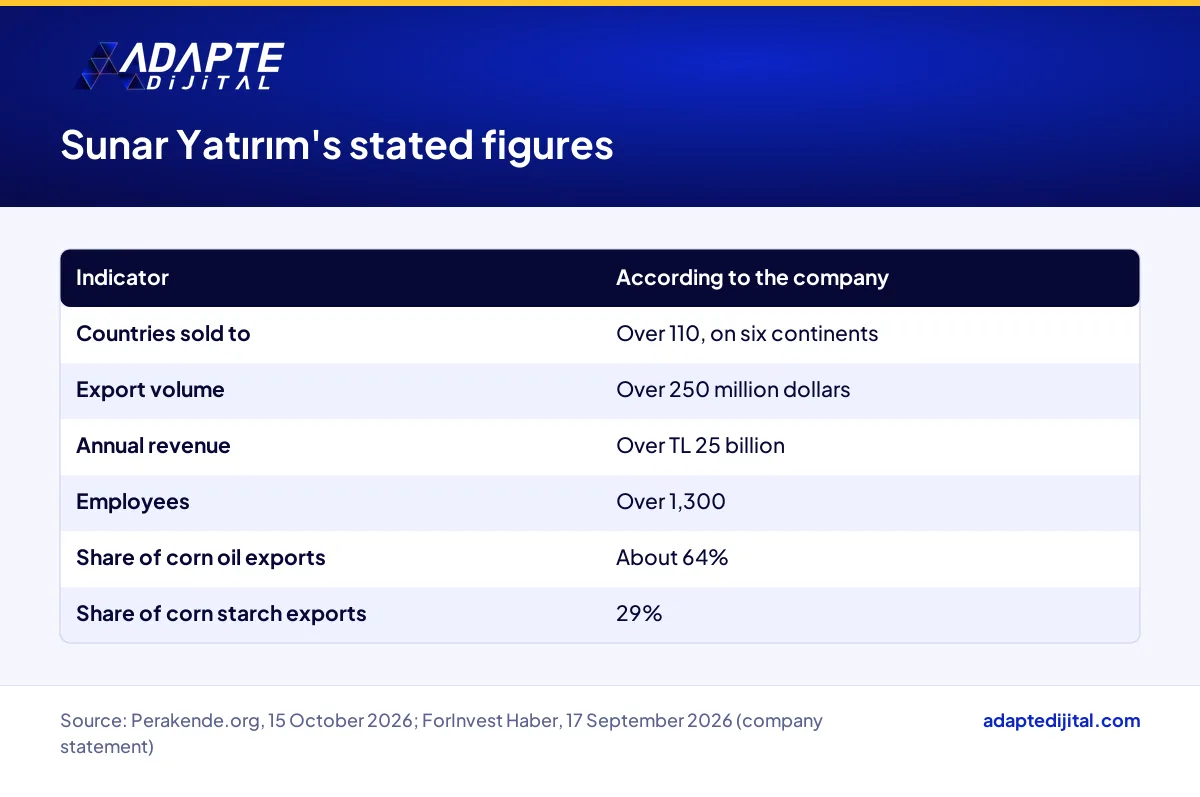
Sunar Yatırım, a farming, food and bio-industry group based in Türkiye’s Çukurova region for more than 50 years, says it sells to over 110 countries on six continents and exports more than 250 million dollars a year (company statement via ForInvest Haber, 17 September 2026). The plan, announced in September 2026 and carried again by Perakende.org on 15 October, also includes an industrial investment in Hungary aimed at reaching the European market.
For a mid-sized food producer in Türkiye in autumn 2026, these numbers work less as a target and more as a map. The real question is how to enter a foreign market: with one product, through a trade fair, or by producing close to the buyer.
What figures did Sunar Yatırım share about its exports?
The statement covers country count, export volume, revenue, headcount and the group’s share of two Turkish export categories, and every figure is a company claim. According to the company, the group sells to over 110 countries, exports more than 250 million dollars, has annual revenue above TL 25 billion and employs more than 1,300 people (Perakende.org; Para Dergi). The statement does not say which period they cover; the group spans food, flour and feed, vegetable oils and starch.
Should a mid-sized food producer start exporting like Sunar Yatırım, product by product?
In most cases, yes, and with one product first. A single product lets you solve packaging, labelling, certificates and pricing once, and any mistake stays inside one line. Sunar itself frames its export story around a small number of strong categories.
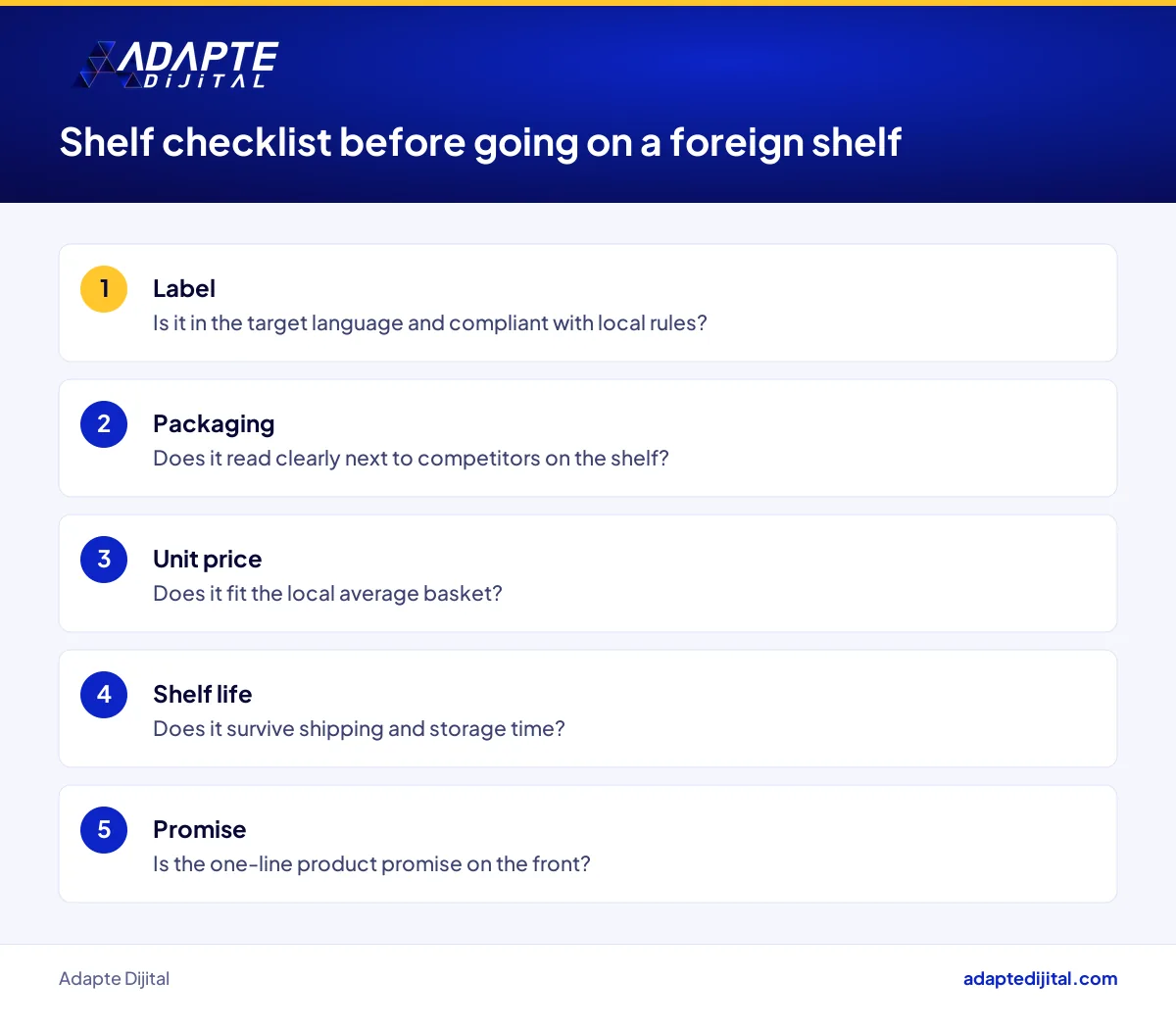
The shelf checklist: what to check before going on a foreign shelf
On the shelf in your target country, a shopper gives your product a few seconds, and the first impression forms in that short window. The shelf checklist asks five questions: is the label in the target language and compliant with local rules, does the pack read clearly next to competitors, does the unit price fit the local basket, does shelf life survive shipping and storage, and is the one-line promise on the front. If any answer is unclear, the product may clear customs but it will not clear the shelf.
What does Sunar Yatırım’s Hungary plan say about trade fairs and producing near the market?
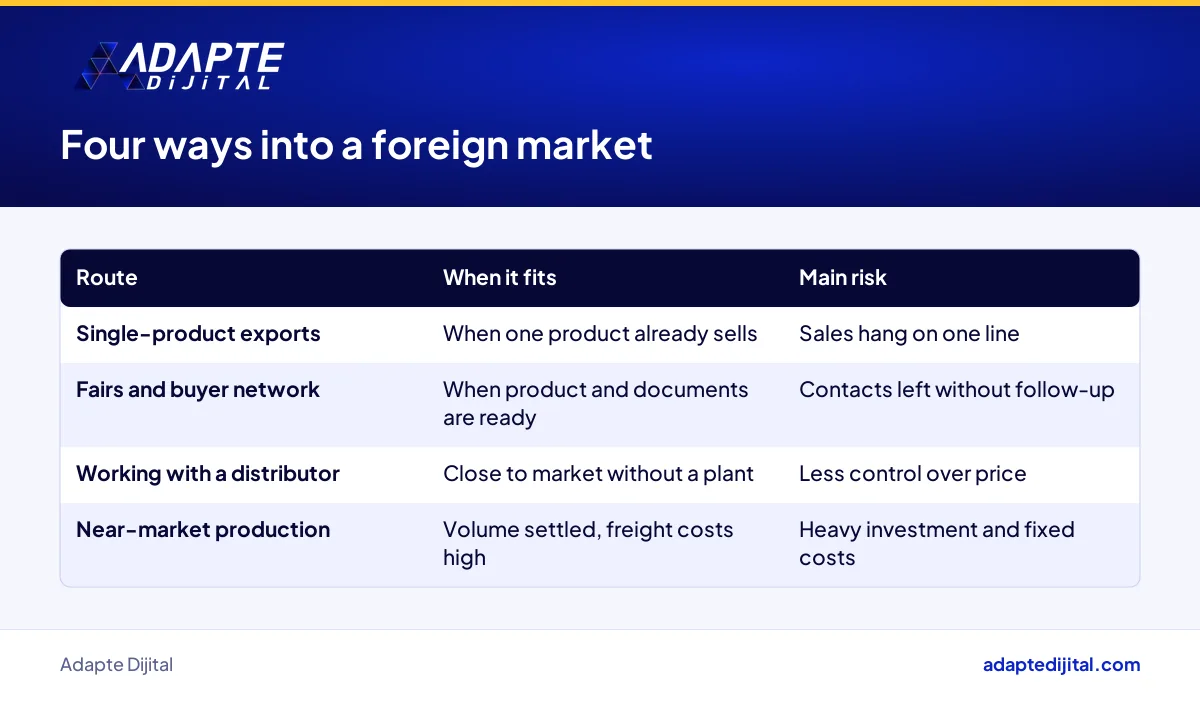
It says that producing near the market is the top step of the ladder, not the first one. According to the company, the Hungary investment will first make sorbitol and polyols, and its purpose is access to the European market (ForInvest Haber). For a small producer the order usually runs the other way: product first, then fairs and buyers, and a plant abroad last.
Who does Sunar Yatırım’s export growth affect, and how?
The most direct effect falls on corn growers in Çukurova, flour and feed suppliers, and mid-sized plants exporting in the same categories. As a group grows, demand for raw materials rises, but so does price pressure on small producers chasing the same buyers. Packaging, logistics and fair service firms feel it indirectly.
How should a food producer exporting like Sunar Yatırım show up online?
A foreign buyer searches for you online before the fair and again after it. A product page in English and in the target language, a downloadable spec sheet, a certificate list and a clear contact form form the first threshold. A producer with a Turkish-only website has a harder time: the buyer does not walk out of the shop, the buyer never finds the door.
What should a food producer planning exports like Sunar Yatırım do this week?
Four concrete jobs: choose the first export product, fill in the shelf checklist for it, name two target countries, and make the stand decision against December’s fair calendar.
Product, country and channel belong in one plan
Building product, country and channel choices into a single plan is part of the work we do in foreign trade consultancy.
Quick Summary
- According to the company, Sunar Yatırım sells to over 110 countries on six continents (ForInvest Haber, 17 September 2026).
- According to the company, exports exceed 250 million dollars and annual revenue exceeds TL 25 billion, with no period stated (Perakende.org).
- According to the company, the group holds about 64% of Türkiye’s corn oil exports and 29% of its corn starch exports (Perakende.org).
- A plant in Hungary is planned to make sorbitol and polyols for Europe, with no amount or timeline disclosed (ForInvest Haber).
- For a small producer, the usual order is one product, then fairs and buyers, and near-market production last.
Short Glossary
- Shelf life
- Shelf life is the term used to describe how long a product can be sold while keeping its quality.
- Private label
- Private label is the term used when a producer’s goods are sold under the retailer’s own brand.
- Near-market production
- Near-market production is the term used for making goods in or close to the region where they are sold.
Frequently Asked Questions
Next Step
If you would like to weigh your first export product and target market against your own data, fill in the Consult Your Expert form.
Sources: ForInvest Haber (Foreks), company statement, 17 September 2026 · Perakende.org, 15 October 2026 · Para Dergi, 21 September 2026
Updated: October 2026
Sık Sorulan Sorular
According to the company, the group accounts for about 64% of Türkiye’s corn oil exports and 29% of its corn starch exports (Perakende.org; ForInvest Haber). They do show that the company builds its export story around two product groups.
The Sunar Mısır R&D centre received approval from Türkiye’s Ministry of Industry and Technology in 2018, and the company describes it as the “first and only” R&D centre in the starch sector (Para Dergi). A 15-million-dollar feed plant is planned in the Diyarbakır OSB, an organised industrial zone, and ForInvest Haber says the project is at an early planning stage. In the words of Chairman and CEO Mustafa Nuri Çomu: “We aim to become a bigger player in the feed sector.” (Perakende.org)
A product with a long shelf life, that travels well and already has a settled price at home. Anything that needs a cold chain or spoils quickly multiplies cost on the first attempt. A product gathering dust on a Turkish shelf will not perform a miracle once it clears customs.
It can be for a producer with idle capacity. Making private label goods for a foreign chain hands shelf space and distribution to the buyer. In return, your own brand stays invisible and the buyer holds the power in price talks.
A fair comes in when the product is ready and the paperwork is done but buyers are missing. Sunar presented new products, from baklava flour to a corn-starch bioplastic bag, at Foodist 2026 at TÜYAP on 1-4 September 2026 (Para Dergi). We look at the stand-or-visit decision separately through WorldFood İstanbul’s December dates.
When you sell large volumes to the target market on a regular basis, when freight and customs costs eat the margin, and when buyers ask for local production. Without all three, a plant abroad behaves like a branch opened too early: it pays rent but the till never really turns. The amount, city and timeline of the Hungary investment are not in the statement.
Yes. A distributor in the target country lets you stay close to the market without building a plant. The questions to ask a distributor are close to those an investor asks of a franchise brand at home. The brand checklist from the Be My Franchise expo is a useful guide here too.
Corn and wheat growers that supply the group, packaging suppliers and hauliers moving export loads. If the Diyarbakır feed plant goes ahead, feed raw material suppliers in that region may join the list.
A small plant that is just starting to export corn oil or starch. According to the company, about 64% of Türkiye’s corn oil exports and 29% of its corn starch exports sit with one group. The way to stand apart is a niche product, a different pack size or faster delivery.
Product group pages, a technical and packaging sheet for each product, a quality certificates page and an export contact page. The details a buyer asks first, such as the HS code, shelf life and pallet layout, should sit in one place.
No. For a producer without a buyer network, a marketplace listing works as a shop window. The buyer still checks your site afterwards, so product details must match.
Before the fair, reach buyers with your stand number and product sheet. After it, merge every business card into one list and reply to each contact within a week. A stack of business cards left on the desk means the fair budget stays on the desk too.
Pick two countries where buyer interest already exists, logistics are short and label rules are easy to meet. Base the choice on the last two years of quotes and order emails, not on a hunch.
Public support for fair participation or certification is not covered in the news, and the terms of such schemes change over time. Verify with the official source; this is not legal or financial advice.
For most producers, starting with one product is safer. A single product keeps labels, documents and pricing simple, and the range can grow after the first orders.
No, they are company claims. The statement does not say which period the country count, export volume and product shares cover, and there is no independent confirmation.
When regular, large-volume sales to the target market are established, freight and customs costs eat the margin, and buyers ask for local production. Without these conditions, a distributor carries less risk.