
IPA puts Istanbul whole wheat bread at 34%, how should bakeries and grocers adapt?
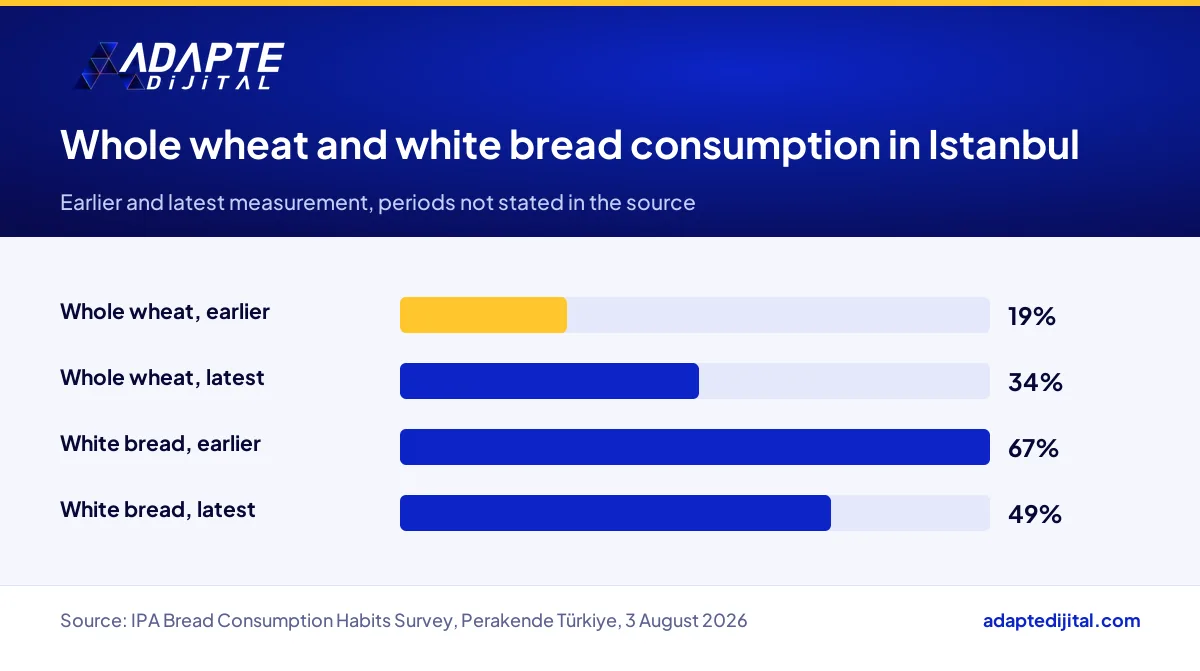
Whole wheat bread consumption in Istanbul rises from 19% to 34% while white bread falls from 67% to 49%, according to the Bread Consumption Habits Survey by the Istanbul Planning Agency (IPA), a body of the Istanbul Metropolitan Municipality (Perakende Türkiye, 3 August 2026). The survey was already reported in May 2026, and neither source says between which two periods the change was measured.
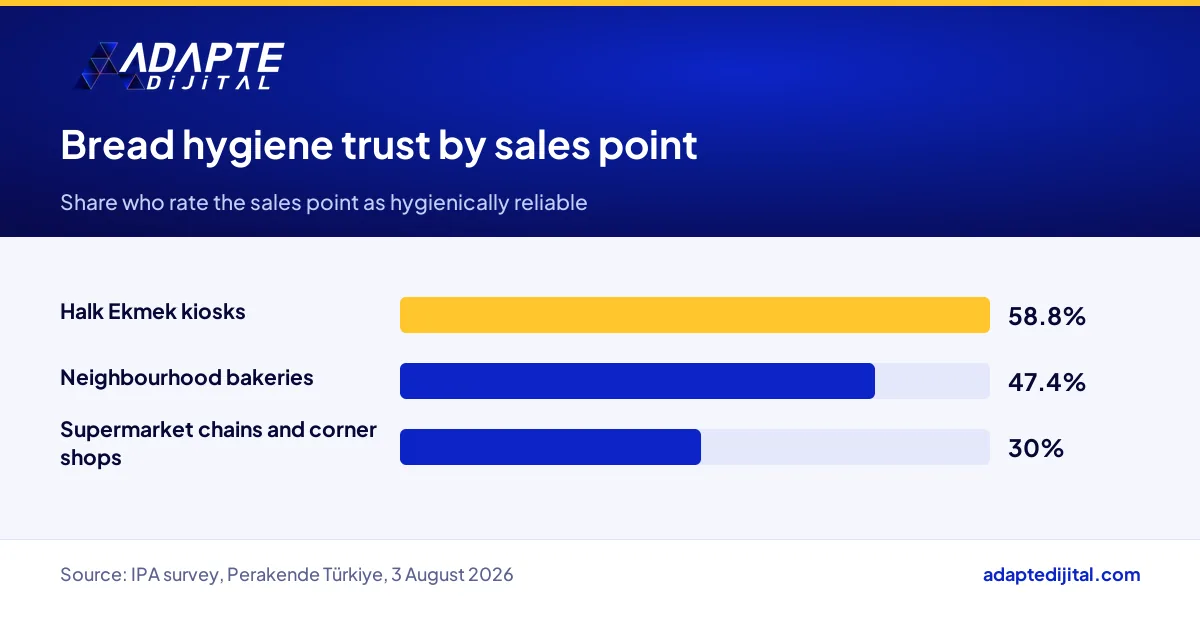
For bakeries, corner shops and supermarkets the message is plain: shoppers no longer pick bread on price and freshness alone, but on health and hygiene trust too. Respondents rate hygiene reliability at 58.8% for Halk Ekmek kiosks, the city-run bread outlets, 47.4% for neighbourhood bakeries and 30% for supermarket chains and corner shops. Shelf layout and communication need a rethink.
How is bread preference in Istanbul changing, according to the IPA survey?
Preference is moving from white to whole wheat. Whole wheat reaches 34% of consumption, white bread drops to 49%. Some 51% of respondents firmly consider white bread unhealthy, citing weight gain, additives and fast blood sugar spikes. Those who choose alternative breads (37.1%) and those who do not (36.9%) are almost evenly split.
How does a neighbourhood baker meet customers turning to whole wheat bread?
The scene below is illustrative; it describes no one from the survey, just any baker living through this shift. Early morning, the bakery opens. The window holds the usual rows of white loaves, with a few whole wheat ones in the corner. A customer walks in, looks at the corner first, sees the whole wheat is gone, hesitates, and walks out.
Why do supermarket chains and corner shops trail bakeries on bread hygiene trust?
Because shoppers cannot see where the bread comes from or whose hands it passes through. Halk Ekmek kiosks earn 58.8% trust and neighbourhood bakeries 47.4%, while supermarket chains and corner shops stay at 30%. The report gives chains and corner shops in a single line, so it is unclear whether they were measured separately or together. Still, the message is clear: the supermarket bread aisle has a trust gap.
Which businesses gain and which struggle as Istanbul shoppers shift to whole wheat?
BU BÖLÜMÜN ÖZETİ
- Gaining: The bakery that explains its ingredients
- Struggling: Grocers that stock one kind of bread
- Indirectly affected: Suppliers and food producers
Neighbourhood and artisan bakeries that explain whole wheat and alternative breads well stand to gain. Supermarket chains and corner shops that fill the bread aisle with white loaves alone come under pressure. Flour, yeast and packaging suppliers feel it indirectly; as demand for whole wheat grows, supply and packing routines change too.
Gaining: The bakery that explains its ingredients
A bakery that already enjoys relatively high hygiene trust can widen that lead with more variety and open ingredient information. The baker standing at the door sells better than an unattended aisle.
Struggling: Grocers that stock one kind of bread
If the planogram gives bread a small, single-type slot, the shopper looking for whole wheat turns around at the door. The loss shows up in basket size too, because a shopper who comes in for bread usually picks up other items. For why growing revenue does not equal profit on the chain side, see our reading of a discount grocer’s first-half results.
Indirectly affected: Suppliers and food producers
Food brands that can name their difference stand out on every shelf; we look at the export version of that in our piece on Dardanel reaching Walmart Canada’s shelves. Other food retail developments are collected on our retail page, where we interpret the retail agenda for you.
How can bakeries and supermarket bread aisles show hygiene trust online?
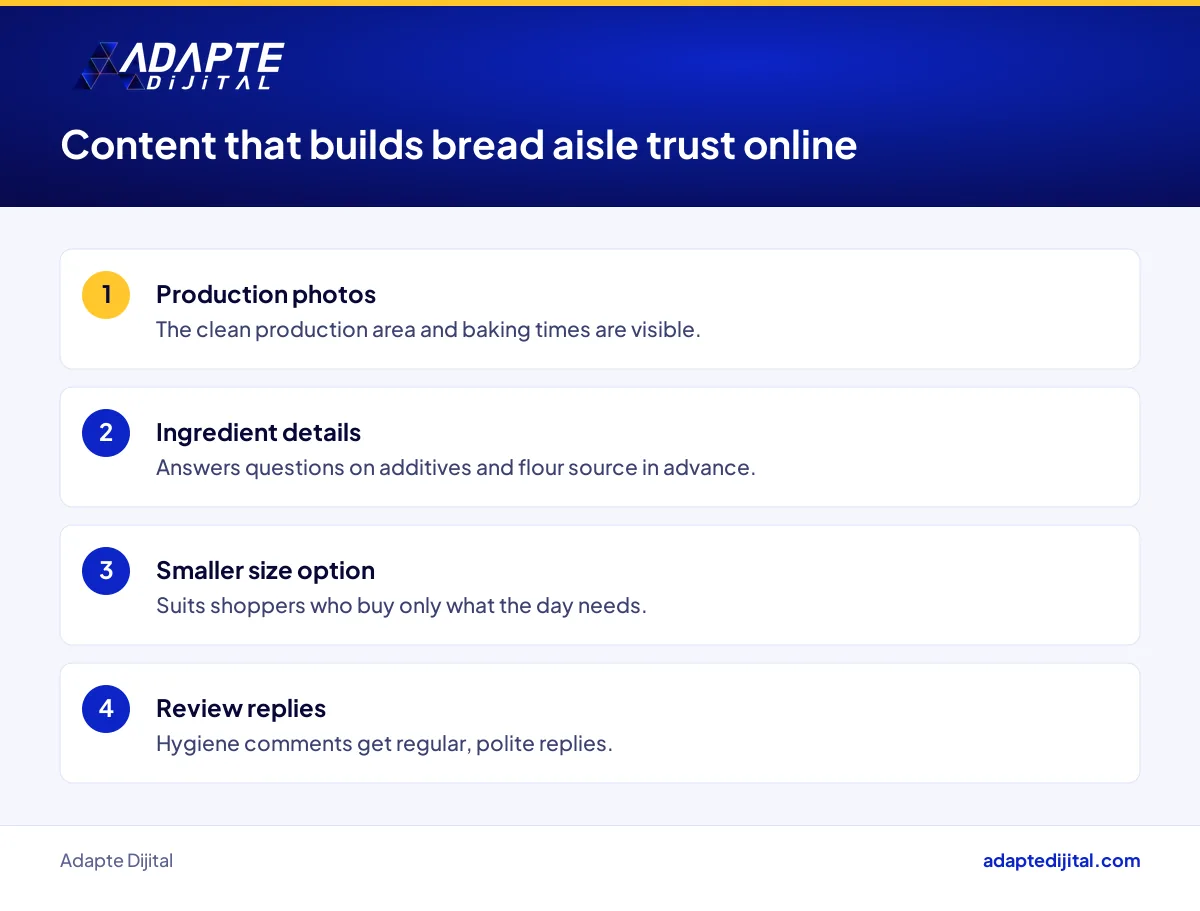
With content that makes trust visible. In local search, a bakery’s Google Business Profile, with ingredient and production photos and current opening hours, is the customer’s first point of contact. For supermarkets, the bread category in the app and on the website can carry ingredient and bakery details. When the health and hygiene concern the survey shows goes unanswered online, shoppers head elsewhere.
What should bakery and grocery owners change on the bread shelf this week?
Three changes fit into this week: put whole wheat and alternative breads on the shelf in smaller sizes, add an ingredient and source card to the aisle, and make open-rack bread hygienic with tongs and bags. According to BBM Magazine, 36.8% of people who do not choose healthier breads say they are simply not used to them; a tasting is the shortest way past that barrier. We build local visibility and shelf communication with businesses through our digital marketing work.
Quick Summary
- According to the IPA survey, whole wheat bread consumption in Istanbul rises from 19% to 34% (Perakende Türkiye, 3 August 2026).
- In the same survey, white bread falls from 67% to 49%; the measurement periods are not stated.
- On hygiene trust, Halk Ekmek kiosks score 58.8%, neighbourhood bakeries 47.4%, and supermarket chains and corner shops 30% (Perakende Türkiye).
- Some 46.3% of respondents buy only what the day needs to avoid wasting bread (Perakende Türkiye).
- The survey was already reported in May 2026 (BBM Magazine, 8 May 2026).
Short Glossary
- Pack weight
- Pack weight is the measure used to state the weight at which a loaf or packaged product is sold.
- Waste rate
- Waste rate is the indicator used to show the share of total output that spoils or is thrown away unsold.
- Planogram
- A planogram is the layout plan used to show in what order and space products are placed on a shelf.
Frequently Asked Questions
Next Step
If you would like to review the trust communication of your bakery or supermarket bread aisle together, fill in the consult your expert form.
Sources: Perakende Türkiye, “İstanbul’da tam buğday ekmeği tüketimi yüzde 34’e yükseldi” (Whole wheat bread consumption in Istanbul rises to 34%), 3 August 2026 · BBM Magazine, 8 May 2026 (earlier report of the survey) · Istanbul Planning Agency publications section (institutional link). The survey’s own report page on the IPA site could not be found.
Updated: October 2026
Sık Sorulan Sorular
Breakfast comes first at 45.4%, dinner second at 37.4%. Those two time slots are the real calendar that sets a bakery’s baking times and a grocer’s restocking times.
The most common method is buying only what the day needs, cited by 46.3% of respondents. That means smaller, more frequent purchases. The big loaf that goes stale by evening just sits on the shelf.
There is no way to say. The sources do not give the two measurement periods, the sample or the fieldwork dates. Read the figures as a sign of direction, without attaching a year to them. IPA’s publications section does not list a separate page for this survey.
Not at the till, but on the counter in the evening. Some white loaves are left unsold, while the whole wheat is gone before noon. The till keeps ringing, but with the wrong product; waste grows and the bread people want runs short.
The turning point comes when customers start asking about trust rather than product. One asks whether the bread has additives, another where the flour comes from. For the first time, the baker has to describe the bread. From that morning on, a small card listing the ingredients sits by the counter, and whole wheat also comes in a smaller size.
Let’s say the customer has not changed; the question has. The bakery’s advantage is a person at the door who can explain the bread. In the survey, hygiene trust in neighbourhood bakeries sits above supermarket chains and corner shops, and that trust turns into sales once it is spoken out loud. When this question comes up at your counter, is your answer ready?
Bread sitting in open baskets, handled by one shopper after another, makes people uneasy. Simple measures such as wrapping, tongs and bags ease that worry once they are visible. A precaution nobody can see does not count for the customer.
It should. When the aisle shows which bakery the bread comes from, when it was shelved and what is in it, the supermarket borrows some of the bakery’s closeness. A silent shelf sends the shopper to the bakery.
Its bread varieties, baking times and clean photos of the production area. A customer searching for whole wheat bread nearby who does not see it on the profile walks straight past the bakery.
With ingredients, weight and the supplying bakery next to the product name. A smaller size option answers directly to the shopper who buys only what the day needs to avoid waste.
A customer’s comment on hygiene is more convincing than anything the business says about itself. Replying to reviews regularly and politely is what trust looks like online.
A shopper who is not used to a bread will not buy one they have never tasted. A small tasting by the till at breakfast time makes trying it easy.
Move whole wheat to eye level and put white bread next to it. Give more shelf share to what sells out before evening and bake less of what is left over; your waste rate will show you which is which.
The person at the till should be able to say, in one sentence, what is in the bread and which bakery it comes from. Answering “I don’t know” pushes trust right off the shelf.
Yes. The survey belongs to the Istanbul Planning Agency and looks at bread consumption in Istanbul. The sources do not give the sample or fieldwork dates.
It can start by buying small quantities of whole wheat bread in smaller sizes from a nearby bakery. Writing the ingredients and source on the shelf is the easiest way to raise hygiene trust.
No, white bread still makes up a large share of consumption. What you need to do is set its shelf share by when it sells out and give whole wheat a visible place.