
Metro Türkiye makes its 10th stop in Ayvalık, how do GI products sell on the shelf?
Metro Türkiye took its “Yerelin İzinde” (On the Trail of the Local) project to Ayvalık, an olive-growing district of Balıkesir province on Türkiye’s Aegean coast, and put Metro Chef Naturel Sızma Ayvalık Zeytinyağı, its own-label natural extra virgin Ayvalık olive oil, at the centre of the visit (Perakende.org, 7 October 2026). According to Ekrem Altın, Food Category Group Manager at Metro Türkiye, the project started in 2022 and this is its 10th stop. Guests joined the olive harvest, watched the oil being made on site and tasted the new, unfiltered oil.
What it means for you: A geographical indication does not sell a bottle on its own; it gains value when someone explains it on the shelf and on the menu. A large wholesaler now builds that explanation under its own brand. For a local producer, a small grocer or a restaurant, the question is no longer “do I have the registration” but “how do I show it to the customer”.
What did Metro Türkiye show at its “Yerelin İzinde” stop in Ayvalık?
It showed the product’s journey from grove to bottle. The report says guests took part in the harvest using both modern and traditional methods, then watched cleaning, pressing and separation on site. Dinner is served at L’Arancia, with a menu by Chef Çiğdem Seferoğlu, who joins the project for the first time.
What does the Ayvalık olive oil geographical indication guarantee in the bottle?
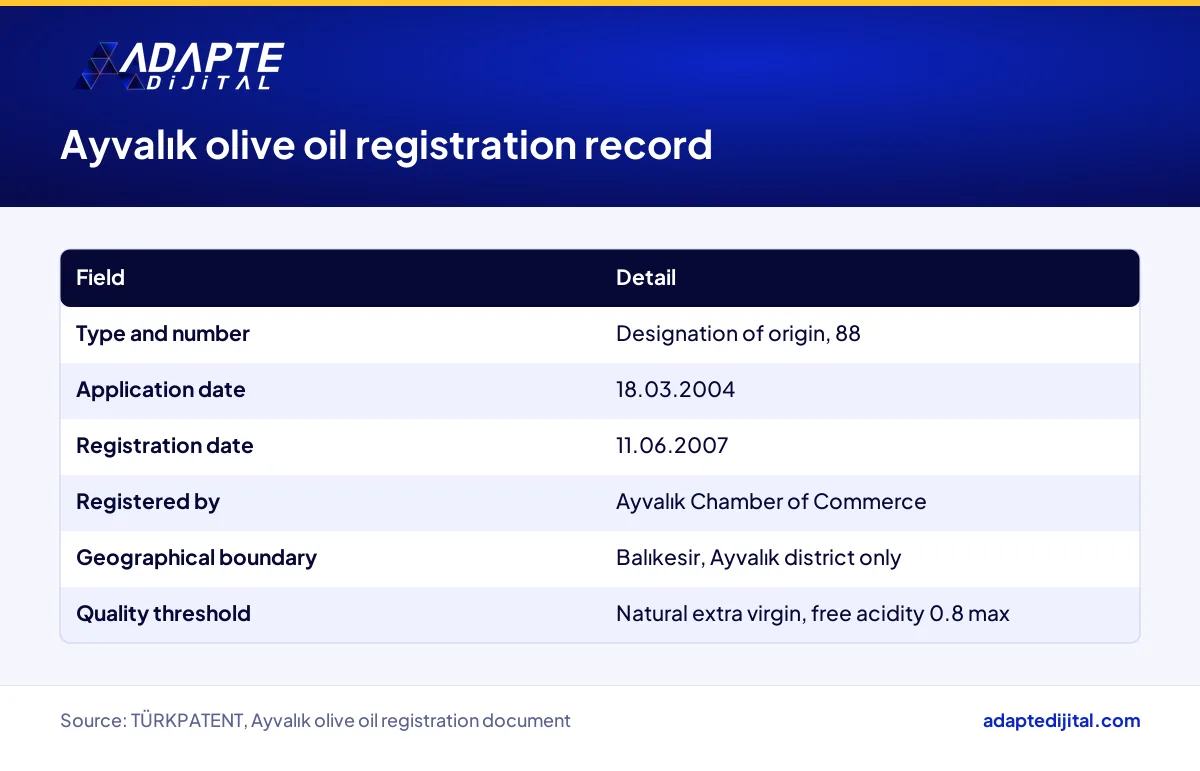
It guarantees three things: place, olive variety and a quality threshold. The Ayvalık olive oil registration document from TÜRKPATENT, the Turkish Patent and Trademark Office, records the product as designation of origin number 88. The geographical boundary is the Ayvalık district of Balıkesir only. The registering body is the Ayvalık Chamber of Commerce.
Who is affected by Metro’s Ayvalık olive oil move, and how?
It affects local brands sharing the same shelf the most. When a retail chain sells a geographically protected product under its own label, the customer’s yardstick rises. Sellers who show their story, traceability and quality threshold gain ground, while those who only print “Ayvalık” on the bottle struggle.
How does a geographical indication product gain value on the shelf and the menu?
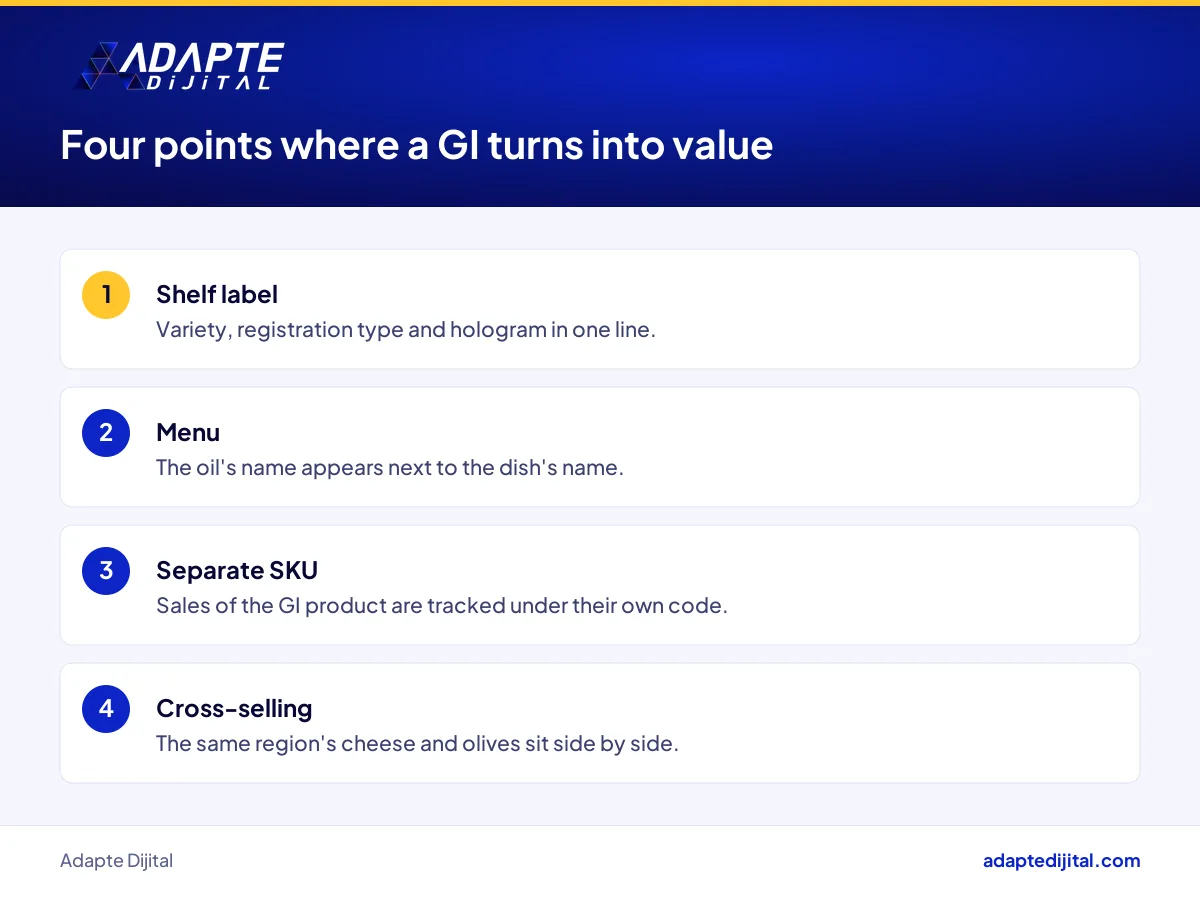
It gains value when the proof moves to eye level. In autumn 2026, with the olive harvest under way along the Aegean, the difference on a grocery shelf comes from explaining the registration to the customer in three seconds.
What should a geographical indication product show in its digital shop window?
Everything you say on the shelf needs a digital match. The product page should show the registration number, the geographical boundary and a photo of the hologram. Customers who search on their phone before buying should find a page at least as clear as the shelf label, or they walk away.
What should a grocer or producer selling a geographical indication product do this week?
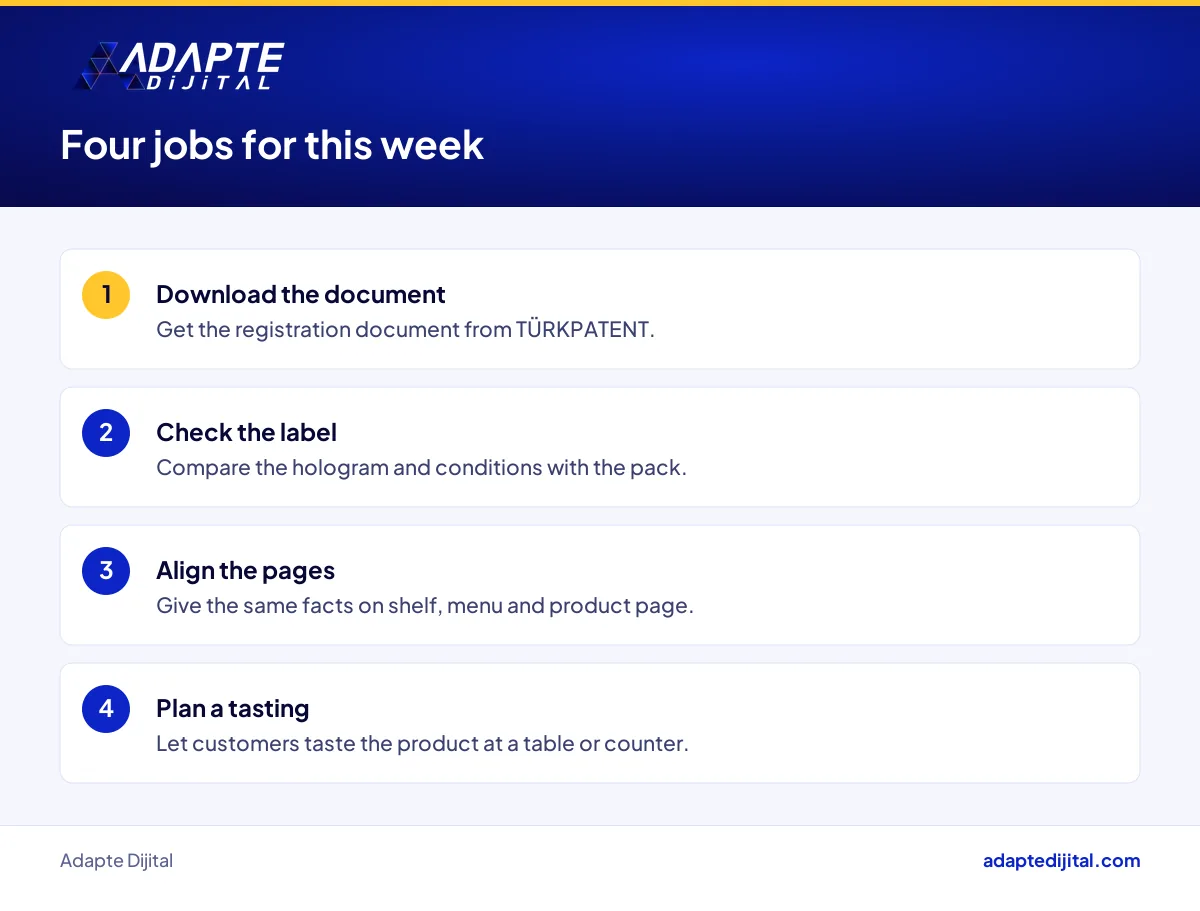
There are four jobs for this week: download the document, check the label, align the shelf and the product page, and plan a tasting. For geographical indication and labelling rules, verify with the official source; this is not legal or financial advice.
Quick Summary
- Metro Türkiye held what Altın calls the 10th stop of its “Yerelin İzinde” project in Ayvalık (Perakende.org, 7 October 2026).
- Ayvalık olive oil was registered as designation of origin number 88 on 11 June 2007 (TÜRKPATENT).
- The registration requires the Ayvalık variety, natural extra virgin oil, free acidity of 0.8 at most and a serial-numbered hologram (TÜRKPATENT).
- A geographical indication turns into value when it is explained on the shelf, on the menu and on the product page.
- The first step for a local seller is to download the document and compare it with the label and the product page.
Short Glossary
- Designation of origin
- Designation of origin is the type of geographical indication used to tie a registered product to a defined area, such as the Ayvalık district for Ayvalık olive oil.
- Traceability
- Traceability is the record-keeping system used to show which stages a product passes through from raw material to shelf.
- Private label
- Private label is the type of brand used by a retailer to sell products under its own name.
Frequently Asked Questions
Next Step
If you want to talk through how to present a geographically protected or local product on the shelf and online, fill in the consult your expert form.
Sources: Perakende.org, 7 October 2026 · TÜRKPATENT, Ayvalık olive oil geographical indication registration document · Metro Türkiye company statement via AA, 10 June 2026
Updated: October 2026
Sık Sorulan Sorular
No. The report gives only its publication date, not the day the event took place. It does not give the number of guests or the name of the producer or mill Metro works with in Ayvalık.
On the second day, breakfast includes products such as Metro Chef Bergama Tulumu and Ayvalık Sepet Peyniri, two regional cheeses. Putting the same area’s cheese next to its olive oil is cross-selling on stage, the kind that lifts average basket value.
His line in the report is short: “Olive oil is one of the most sensitive products in terms of food safety.” A sensitive product needs proof.
According to the document, the oil must come from the Ayvalık olive variety and be natural extra virgin. Free acidity can be 0.8 at most. Every package must carry a serial-numbered Ayvalık olive oil hologram.
The official document gives an application date of 18 March 2004 and a registration date of 11 June 2007. In the report, Altın describes the registration as the first one obtained for olive oil in Türkiye, in 2006. We suggest you rely on the official document for the date and read the “first registration” point as Altın’s own assessment.
The hologram is the registration made visible on the shelf. A serial-numbered label is a concrete sign that separates the real product from an imitation. Customers who do not know this simply ignore it.
Ayvalık producers and cooperatives that can document the registration conditions gain, because the category gets attention. Aegean restaurants that name the source of their oil on the menu also share in that interest. Delis selling regional cheeses gain room for cross-selling.
Sellers with no hologram on the label, those selling loose oil and those who cannot document the source struggle. A boutique brand that keeps its price high but cannot explain the difference ends up gathering dust on the shelf. When customers cannot tell two bottles apart, they reach for the cheaper one.
Hotels and food businesses in Ayvalık feel it indirectly, because a harvest trip sells the area through food. ETİ starting to make TRUBAR bars in Türkiye raises the same issue of how a brand explains local production on the shelf.
The shelf label should give the registration type, the boundary and the hologram in one short line. Three facts such as “Ayvalık variety, natural extra virgin, hologram on pack” do more work than a long leaflet. All of it is already in the registration document.
Restaurants can write the oil’s name next to the dish: “with Ayvalık olive oil”. Metro chose to present its oil through a chef’s menu, which tells you something about where the product is easiest to remember. Keep the invoice and the label for every geographical indication you name on the menu.
Yes, a separate SKU, or stock-keeping unit, lets you measure its sales. If you keep the protected oil under the same code as ordinary extra virgin oil, you cannot see which one keeps the till ringing. Set shelf share from sales data.
Metro’s Ayvalık olive oil carries a QR code on the bottle that gives access to 20 pieces of information, from the harvest area to production, according to a company statement reported by AA, Türkiye’s state news agency (10 June 2026). The same statement says every batch passes 76 quality steps. A small producer cannot match that scale, but it can link a QR code to its own harvest page.
A shop or olive oil mill selling in Ayvalık should add the district name, the registered product name and its tasting hours to its business profile. A visitor searching “where to buy Ayvalık olive oil” tends to go to the first place the map shows.
The listing title should include the geographical indication, the images should include a close-up of the hologram, and the description should link to the document.
Download the registration document for the product you sell from TÜRKPATENT and compare its conditions with the label. If the hologram is missing, ask your supplier.
Write a two-sentence text about the product’s place, variety and harvest season, and use the same text on the shelf, the menu and the website. Fitting a geographical indication product into your brand voice is part of our brand consultancy work.
Placing the same region’s cheese or olives next to the oil is the shelf version of Metro’s breakfast table. For another case of turning sales outside the core category into a campaign, look at Tchibo’s 9,000-product campaign. We collect similar cases on our retail page, where we interpret retail news for you.
According to the TÜRKPATENT registration document, the geographical boundary is the Ayvalık district of Balıkesir only. Read the document for your own product and verify with the official source.
Check that the pack carries a serial-numbered hologram and that the product meets the registration conditions, using the documents from your supplier.
No. The report does not give the product’s price, sales volume or store count.