
Tchibo promotes 9,000 products with Ezgi Mola, how can coffee shops grow non-food sales?
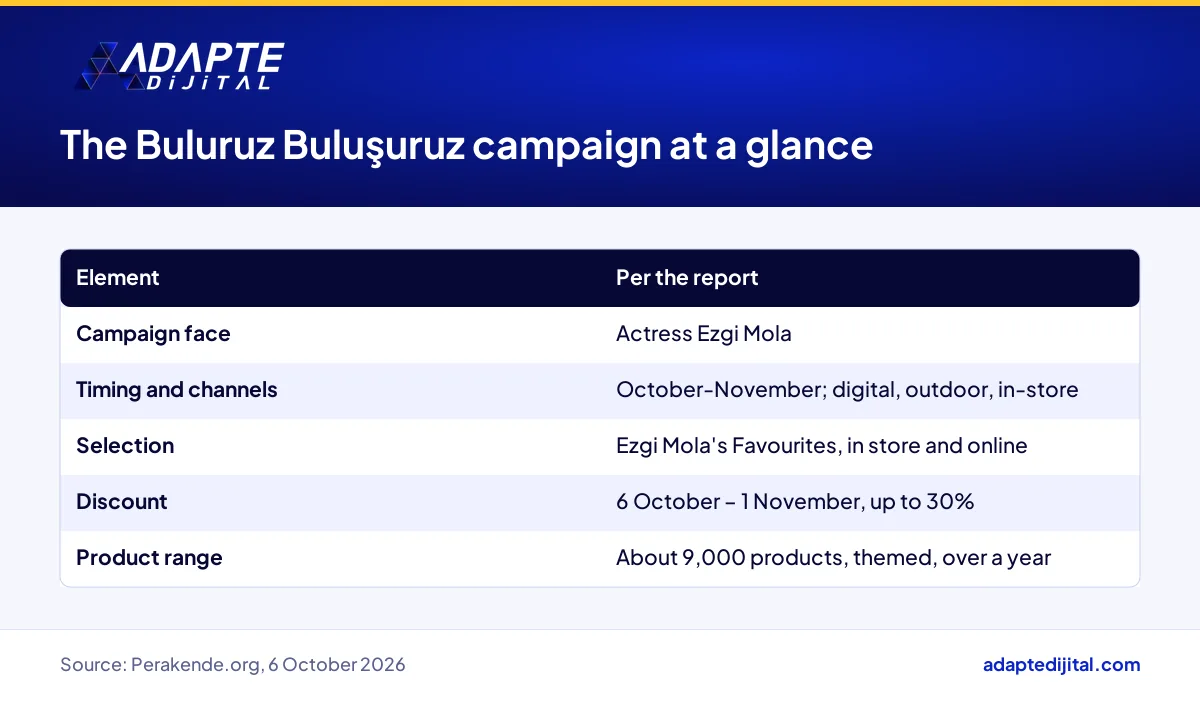
Tchibo has launched a new campaign in Türkiye, “Buluruz Buluşuruz Tchibo’da” (roughly, “We find it, we meet at Tchibo”), with actress Ezgi Mola as its face (Perakende.org, 6 October 2026). The campaign positions the brand as a “finding point” for the things people need, alongside the coffee they meet over. It runs through October and November across digital channels, outdoor and in-store events, with discounts of up to 30% on many non-food products between 6 October and 1 November.
What it means for you: a brand known for coffee is building a full campaign to move part of its sales beyond the cup. For a neighbourhood coffee shop, a boutique café or a gift shop, the question is the same. How do you make the shelf next to your core product visible? The answer lies less in a famous face and more in a curated selection and a time-limited offer.
What is Tchibo telling customers with its “Buluruz Buluşuruz Tchibo’da” campaign?
It is telling them they can find what the home needs next to their coffee. The ad film in the report opens with a thermos and builds a story of discovery that moves on to a backpack, a foldable pet bowl, a vegetable peeler and an ironing board cover. The categories are kitchen, home organisation, sport, personal care and pets.
How can a coffee shop build non-food sales the way Tchibo does, step by step?
BU BÖLÜMÜN ÖZETİ
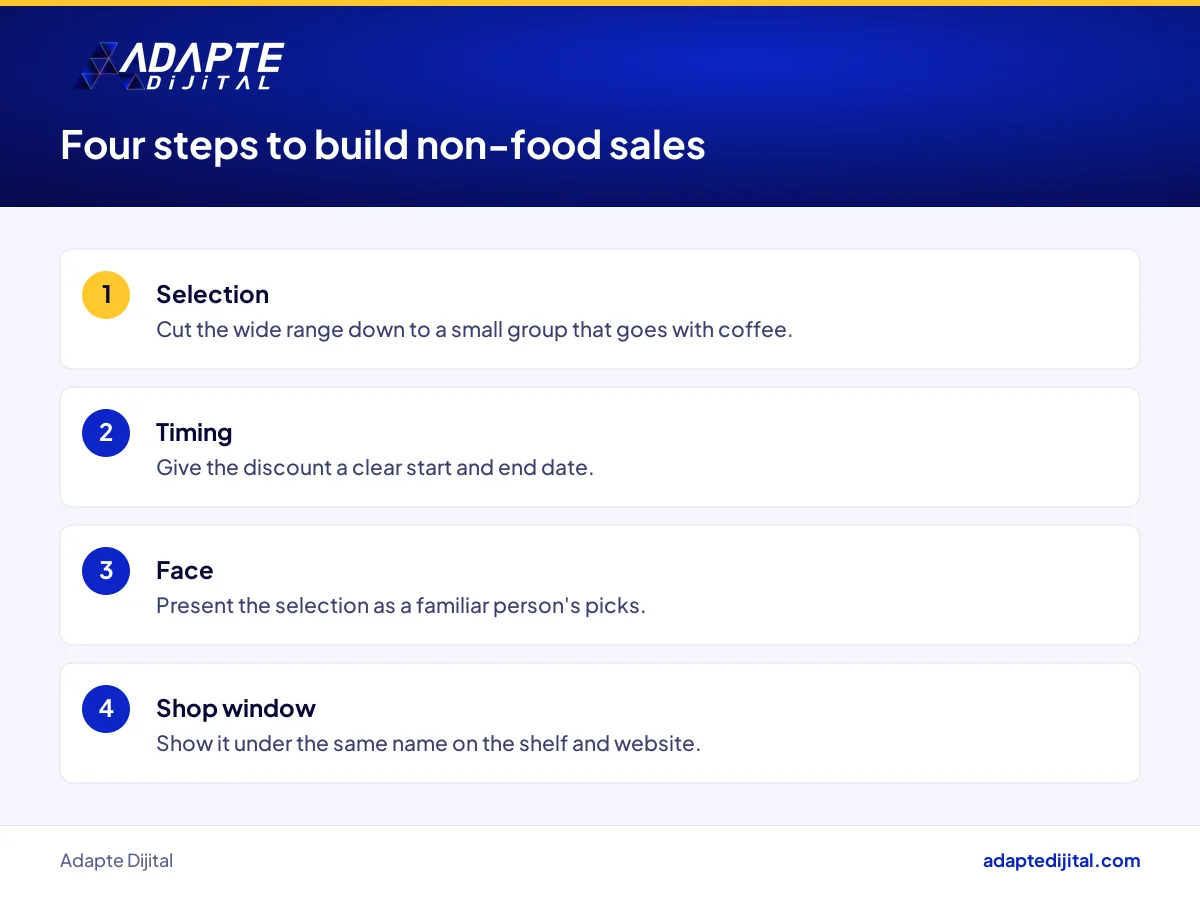
- Step 1: Cut a wide range down to a small selection
- Step 2: Give the discount a clear start and end date
- Step 3: Find a familiar face for the selection
- Step 4: Match the store shelf and the website
It can do it in four steps: selection, timing, face and shop window. Tchibo’s campaign uses all four at once. You can work through them one at a time at your own scale. The report gives no cost figures, so at every step you need to get your own quote.
Step 1: Cut a wide range down to a small selection
Build a selection from a few items that go with coffee, such as a thermos, a mug or a grinder. Give it a name and place it next to the till. Time and cost depend on your supplier, so get your own quote. The documents you need are supplier invoices and product labels.
Step 2: Give the discount a clear start and end date
Tchibo limits its discount to 6 October to 1 November. Your offer needs a calendar too. A discount with no end date leaves customers thinking “it is always on anyway”. Verify with the official source that your discount announcement meets the rules; this is not legal or financial advice.
Step 3: Find a familiar face for the selection
A celebrity face needs a large budget, and this report does not disclose the agency or the budget either. For a small business, a familiar face can be a regular customer or your barista. A “Our barista’s picks” tag does the same job on a smaller scale. Put any fee and permission in a written agreement.
Step 4: Match the store shelf and the website
Show the selection under the same name on the shelf and on your site. Tchibo does this with the same selection in its stores and on tchibo.com.tr. A product photo and a short description per item are enough; time and cost depend on who takes the photos, so get your own quote.
Who does Tchibo’s non-food campaign affect, and how?
It affects retailers that sell coffee and household goods to the same customer the most. Coffee chains, home and kitchen stores and gift shops compete for the same shopper’s attention. Those working with themes and selections gain ground, while those with mixed, unsorted shelves struggle.
What is the common mistake coffee shops make with non-food sales?
The common mistake is trying to fit a big number onto a small shelf. An owner who hears about Tchibo’s 9,000 products may think a wider range means more sales. The pattern in the report points the other way: a wide yearly range is split into themes and selections in store.
How can a coffee shop make its non-food products visible online?
It does it with a separate page and a separate search phrase for the selection. Tchibo puts its selection on the tchibo.com.tr home page. For a small business, the equivalent is a single selection page on the website, product photos on the business profile and a dated announcement on social media.
What should a coffee shop or boutique store owner do this week?
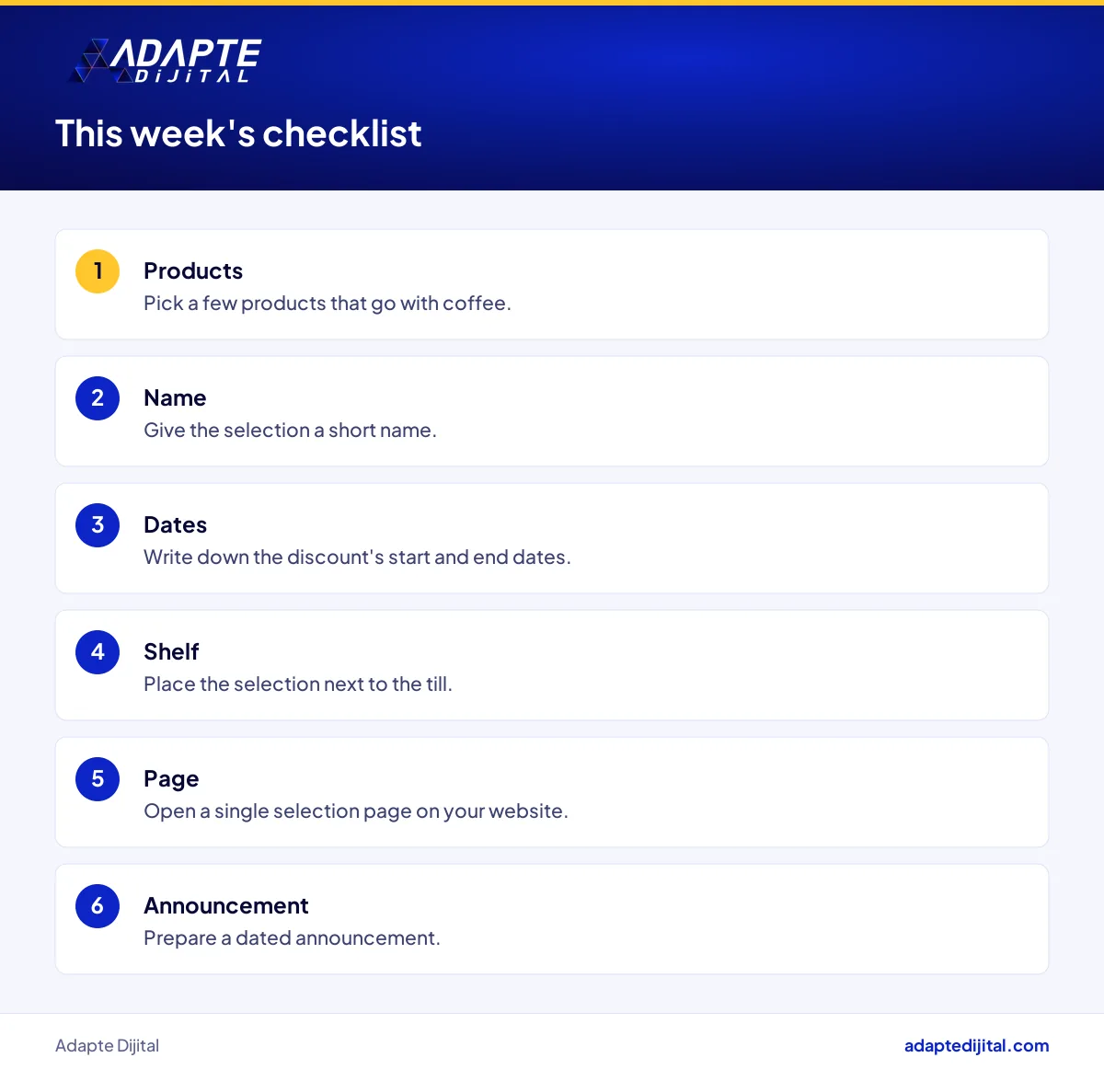
This week, decide on one selection, one date range and one shop window. Tchibo’s discount ends on 1 November, so decide now whether your own offer will overlap with that period. The checklist below sums up a week of work.
- Pick a few products that go with coffee.
- Give the selection a short name.
- Write down the discount’s start and end dates.
- Place the selection next to the till.
- Open a single selection page on your website.
- Prepare a dated announcement.
Quick Summary
- Tchibo launched its “Buluruz Buluşuruz Tchibo’da” campaign with Ezgi Mola as its face (Perakende.org, 6 October 2026).
- The figure of around 9,000 products is the total offered across different themes over a year (Perakende.org).
- Many non-food products carry discounts of up to 30% between 6 October and 1 November (Perakende.org).
- The campaign runs with the same celebrity selection in stores and on the website.
- The lesson for a small business is to cut a wide range down to a small, dated selection.
Short Glossary
- Non-food product
- Non-food product is the term used for the home, kitchen, care and similar items a food or coffee retailer sells beyond food and drink.
- Curated selection
- Curated selection is the term used for a small group of products picked from a wide range under one theme or one person’s name.
- Average basket value
- Average basket value is the measure used to track the average amount each customer spends per purchase.
Frequently Asked Questions
Next Step
If you want to turn the shelf next to your core product into a campaign, fill in the consult your expert form.
Sources: Perakende.org, 6 October 2026 · Tchibo Türkiye official website, tchibo.com.tr
Updated: October 2026
Sık Sorulan Sorular
No. The report says Tchibo offers around 9,000 products across different themes over the course of a year. That is not the number of items sitting in one store at once. It is the yearly total of a range that rotates theme by theme.
According to the report, the selection, “Ezgi Mola’s Favourites”, will appear in all Tchibo stores and on tchibo.com.tr. Tchibo Türkiye’s website shows a section of Ezgi Mola’s favourite Tchibo products along with a basket discount note. The campaign builds the same shop window in store and online.
The report says the brand has more than 75 years of coffee expertise and more than 20 years of retail experience in Türkiye. İlknur Aksoy Şen, Marketing Director of Tchibo Türkiye, puts it this way: “We make a difference with more than 20 years of unique retail experience.” These figures are the brand’s own words.
Boutique cafés that sell thermoses, mugs and brewing gear next to their coffee gain, because customers get used to the pairing. Home and kitchen stores that build their own selection can also win attention in the same period.
Stores that hold hundreds of items with no selection struggle. When customers do not know what to buy or why, products end up gathering dust on the shelf. A discount window running from early October to 1 November also sharpens price comparison.
Small shops selling pet, sport and personal care products feel it indirectly, because the campaign reaches into those categories too. Food businesses choosing a location face a related question about where their shoppers come from; Dürümle’s new branch at Next Level mall looks at that choice from another angle.
In a small business, a wider range ties up stock and the till stops ringing. Every SKU, or stock-keeping unit, needs shelf space, counting and supplier follow-up. A selection gives customers a ready-made suggestion and lightens the decision.
An open-ended discount lowers the product’s value for good. A short, dated offer like Tchibo’s 6 October to 1 November window gives customers a reason to buy now.
Customers look around while they wait for their coffee, and that is where they notice things. Put non-food items in a dead corner by the door and your average basket value stays where it is.
Put the selection’s name in the page title and the discount dates in the first paragraph. Under each product, add one sentence on how it goes with coffee. This page becomes the single address for both ads and social posts.
Adding product photos to your business profile gives searches like “thermos near me” or “coffee gear” something to match. Label the photos with the selection’s name.
Spell out shipping and return terms for each non-food item before the first order arrives. If you plan to ship abroad, the EU’s €3 e-commerce duty changes your price calculation.
Each item asks for one decision: the selection’s name, the products, the dates, the shelf spot, the web page and the announcement. Once all six are ticked, your offer is ready.
Building the selection, the calendar and the channel plan together is what we do as a digital marketing agency. You can follow similar campaigns on our retail page, where we interpret retail news for you.
According to the report, many non-food products carry discounts of up to 30% between 6 October and 1 November. The report does not make clear which products are included.
Yes. Products picked by a regular customer or the barista can do the celebrity’s job on a small scale.
No. The report does not name the campaign’s agency or give its budget.