
Pınar enters cold coffee with 4 flavors, how should a brand enter a new category?
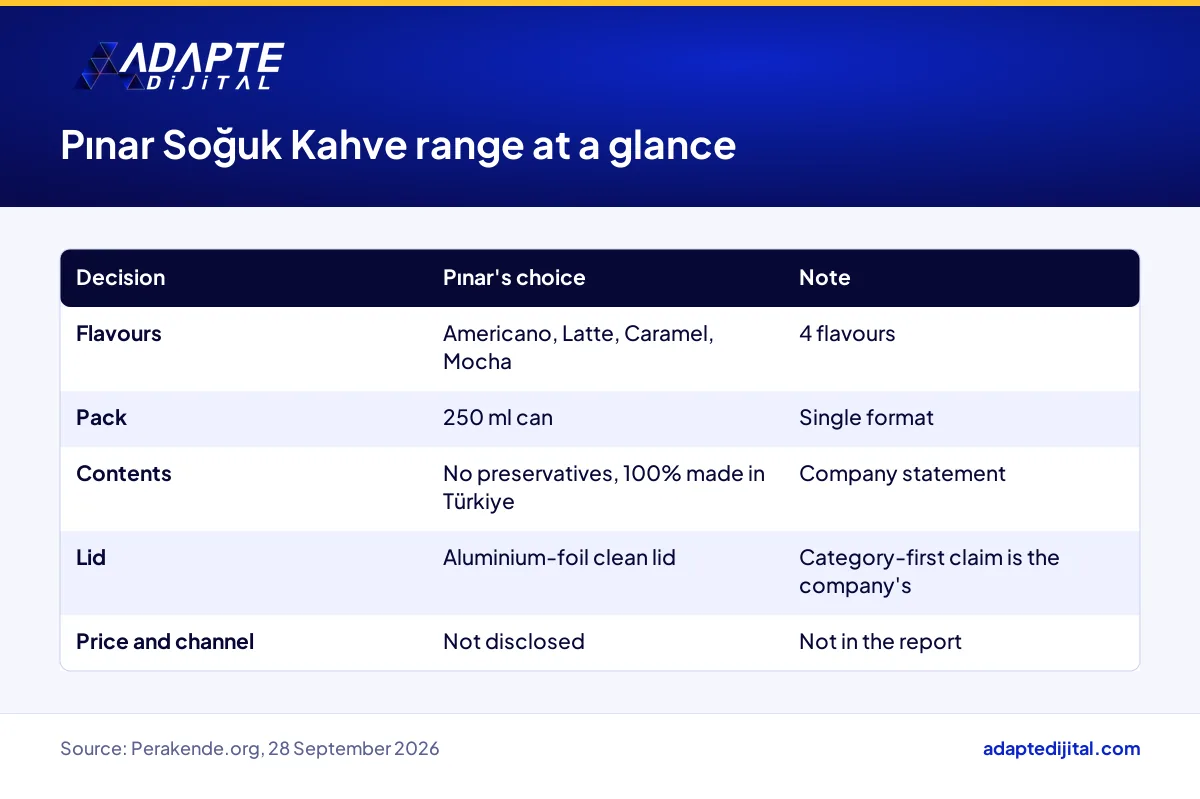
Pınar Su ve İçecek is entering the cold coffee category for the first time with its Pınar Soğuk Kahve range, made up of 4 flavours (Americano, Latte, Caramel and Mocha) in a 250 ml can (Perakende.org, 28 September 2026). The products contain no preservatives, are presented as 100% made in Türkiye, and reach the shelf with an aluminium-foil “clean lid”.
If you are a producer or retailer who wants to carry existing brand trust into a new category, this launch offers a concrete pattern. It rests on a limited range, a single pack format and a difference you can state in one sentence. Below, we walk through how to set up those three decisions step by step, for the ready-to-drink shelf in Turkish supermarkets in autumn 2026.
Which products is Pınar Su ve İçecek using to enter cold coffee?
Four flavours: Americano, Latte, Caramel and Mocha. All come in a 250 ml can, without preservatives, and made in Türkiye. Marketing Director Nilüfer Özeren sums it up: “we are entering this category for the first time with four different flavours” (Perakende.org, translated). The product is positioned for the habit of carrying a drink with you through the day.
How does a brand like Pınar enter a new drinks category, step by step?
BU BÖLÜMÜN ÖZETİ
- Step 1: Read the shelf and know your rivals
- Step 2: Limit the number of flavours
- Step 3: Choose one pack format
- Step 4: Boil the difference down to one sentence
In four steps: read the category and the competing shelf, limit the range, choose a single pack format and boil the difference down to one sentence. The time and cost of each step depend on the product and the production model. The report gives none of these figures, so get your own quote for each step.
Step 1: Read the shelf and know your rivals
The cold coffee shelf already carries retailers’ private labels. One example is the 250 ml Migros Soğuk Kahve Mocha, made in Türkiye under the label of Migros, a major Turkish supermarket chain. If you enter without listing which flavours and sizes are already there, your product ends up gathering dust on the shelf. For time and cost, get a quote for your own field research.
Step 2: Limit the number of flavours
Pınar enters with four flavours. That number gives shoppers a choice while keeping the SKU load manageable. More flavours mean more shelf space and more stock. In a new category, it is safer to start with few SKUs and watch the rate of sale first.
Step 3: Choose one pack format
The whole range comes in a 250 ml can. One format simplifies the production line, the case layout and the shelf plan. Get your own quote from your packaging supplier for tooling and print costs.
Step 4: Boil the difference down to one sentence
Pınar’s difference rests on no preservatives and the clean lid. Shoppers decide in a few seconds in front of the shelf. If your difference cannot be read on the front of the pack, the shopper does not reach for it.
Which producers and retailers does Pınar’s cold coffee launch affect, and how?
It matters most for small producers fighting for space on the ready-to-drink shelf, and for supermarket chains with their own private label there. A well-known water brand entering the category can draw attention to it. It can also make the fight for shelf share tougher. Cafes and kiosks are affected indirectly.
How should a brand entering a new category like Pınar build its difference claim?
It should build it on a feature that can be checked. Pınar’s two features, no preservatives and the clean lid, are concrete differences that can be shown on the pack. Instead of an unmeasurable claim like “tastes better”, a feature the shopper can see on the can gives them a solid reason to decide.
How should a new product like Pınar’s cold coffee launch online?
Through three channels: the product page, search and marketplaces. When we checked Pınar’s corporate website, no product page for the range was visible yet. In a new category, that gap can send searching shoppers to a rival page. For publicly listed companies, investors are a separate audience too; Pınar’s investor relations page publishes its 2026 financial reports.
What should a brand owner planning a category move like Pınar’s do this week?
Three jobs fit into this week. Take a photo record of the target shelf, write down in one sentence what your main brand is known for, and decide how many SKUs you will launch with. Check food labelling and packaging rules with the official source. Verify with the official source; this is not legal or financial advice.
Quick Summary
- Pınar Su ve İçecek enters the cold coffee category for the first time with 4 flavours (Perakende.org, 28 September 2026).
- The range comes in a 250 ml can, without preservatives and 100% made in Türkiye (Perakende.org).
- The claim of being first in the category with a clean lid is a company statement.
- Price, channels, distribution timeline and market size have not been disclosed.
- A category entry rests on reading the shelf, a limited range, one format and a provable difference.
Short Glossary
- Private label
- Private label is the term used for products a retailer has made under its own name and puts on its own shelf.
- SKU
- SKU is the stock code used to track each product variant and size separately.
- Shelf share
- Shelf share is the metric used to describe the proportion of a category shelf that one brand occupies.
Frequently Asked Questions
Next Step
If you are planning to take your brand into a new category, fill in the consult your expert form, and our team will map out your entry steps for your business.
Sources: Perakende.org, 28 September 2026 · Pınar Su ve İçecek corporate website and investor relations page
Updated: October 2026
Sık Sorulan Sorular
Pınar is described as Türkiye’s first packaged water brand, and it highlights roughly 40 years of history in bottled water. The company is based in Bornova, Izmir, and is part of Yaşar Holding. It has recently opened up to products beyond water, such as Pınar Sparkling.
The cans use clean lid technology with aluminium foil. According to the report, this is the first product in the cold coffee category to bring this technology to the shelf. That is a company statement, and there is no independent confirmation of it.
The shelf price, sales channels, distribution timeline, production site and investment amount are not in the report. No figure on the size of the cold coffee market is shared either.
Supermarket chains that want to grow the category, and neighbourhood stores widening their ready-to-drink shelf, could benefit. A new brand on the shelf may bring more shoppers to look at the category.
Small cold coffee producers without a clear difference will struggle. Next to a known brand, an unfamiliar can without a price advantage stays on the shelf, and the till does not ring.
Cafes making their own cold coffee, kiosks and petrol station shops are part of this competition. If the habit of carrying coffee on the go grows, these outlets may need to review their range.
In our reading, the trust a water brand holds is tied to a sense of purity. No preservatives and a clean lid bridge that sense over to coffee. A difference you build without knowing what your main brand stands for feels foreign to the shopper.
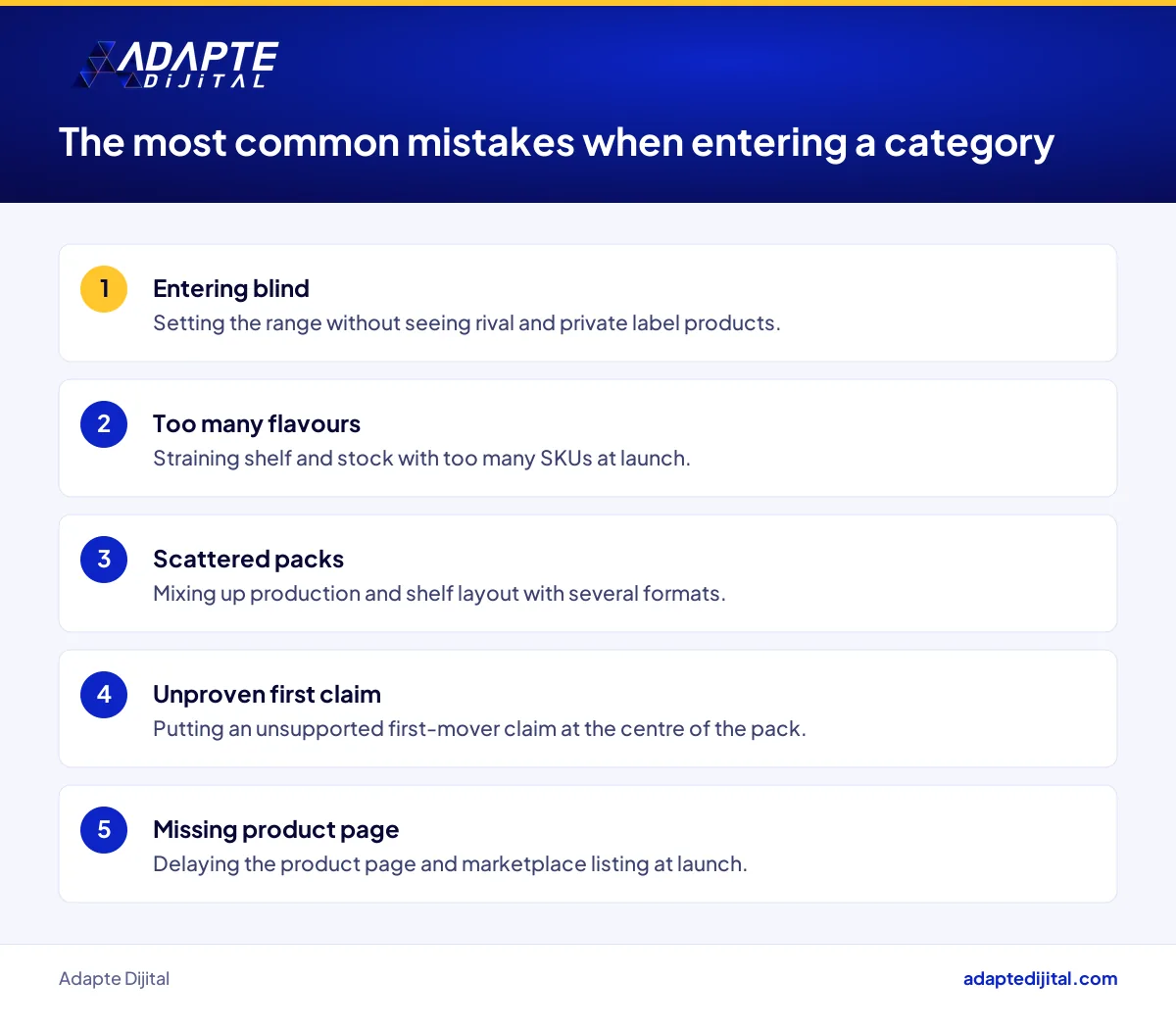
The most common mistake is putting a “we were first” claim at the centre of the pack without proof. Even Pınar’s first-mover claim is reported as a company statement. If you plan to use a claim like this, keep the evidence ready; otherwise the sentence meant to build trust ends up costing it.
A retailer’s private label often competes on price. A branded product can hold its place by explaining its origin, ingredients and pack difference. In front of the shelf, it talks in reasons rather than in price.
Each flavour needs its own page, with the ingredient list, pack details and a clear statement of the difference. Search engines and AI assistants learn about the product from pages like these.
If the product title, image and category match in a grocery app are wrong, shoppers cannot find the product. Checking these listings in launch week raises the chance of the product landing in the basket.
The A101 Pati case, where a supermarket chain opens a new vertical under its own brand, and our piece on Ranchero, a restaurant brand heading abroad, answer the same question from other sectors.
Photograph the category shelf in a few branches of your target chains. Put flavours, sizes and private label presence into one table. That table strengthens your hand in category management meetings.
Place the sentence on a pack draft and show it to a few people from shelf distance. If they cannot read it or do not get it, simplify it.
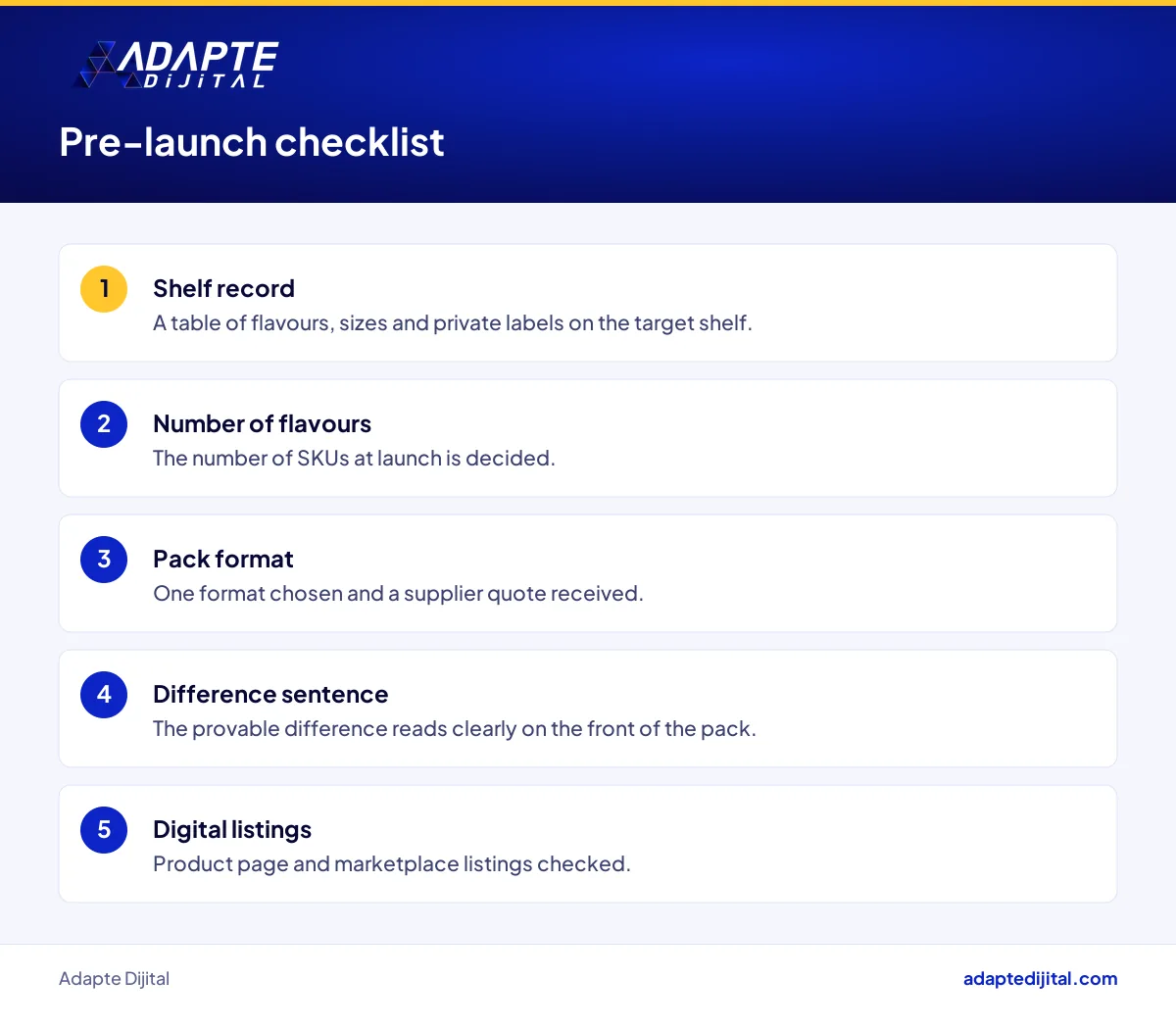
The shelf record, the number of flavours, a single pack format, a provable difference sentence, the product page and marketplace listings are the core lines. We build brand architecture and difference claims as part of our brand consultancy work. You can find similar launches on our retail page, where we interpret the retail agenda for you.
According to the report, sales channels and the distribution timeline have not been announced. For current information, check the company’s official channels.
There is no fixed number; Pınar enters with four. Starting with a few SKUs and watching the rate of sale lowers your stock risk.
You can, but you should keep the evidence ready. A “first” claim without proof creates doubt instead of trust.