
Dardanel puts 3 tuna pouches on Walmart Canada shelves, what does export shelf space take?
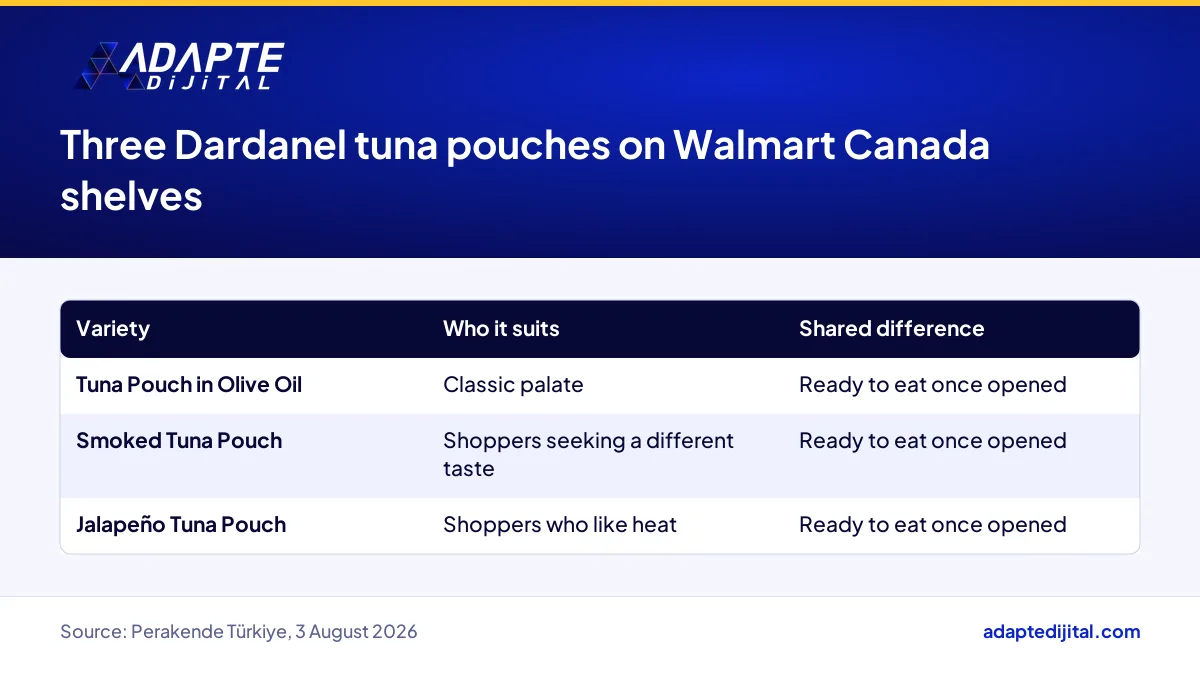
Dardanel’s Tuna Pouch range is now on sale in Walmart’s stores in Canada, with three varieties on the shelf: Tuna Pouch in Olive Oil, Smoked Tuna Pouch and Jalapeño Tuna Pouch (Perakende Türkiye, 3 August 2026). According to the report, the Turkish tuna producer already exports to 41 countries, and Walmart is described as one of the widest retail networks in North America.
What it means for you: a foreign chain’s shelf opens to the brand that can name one clear difference. Dardanel’s is a pouch that is ready to eat once opened. According to the company, no one else in Türkiye produces this format. The report does not say how many stores carry the range, from what date, or under which deal model.
What product difference put Dardanel on Walmart Canada’s shelves?
One difference carries it: once the pouch is open, the tuna can be eaten with no further preparation. On a canned tuna shelf where everyone offers a similar tin, a format difference is the first thing a buyer notices. The company says it is the only producer of this format in Türkiye; that is the company’s own claim, not an independently verified fact.
How does a Turkish food brand prepare for a foreign chain’s shelf, step by step?
BU BÖLÜMÜN ÖZETİ
- Step 1: Reduce your product’s difference to one sentence
- Step 2: Make your traceability record easy to show
- Step 3: Learn the target market’s label and channel rules
- Common mistake: Trying to enter the shelf with your whole range
It prepares in four steps, and the order matters: product difference, traceability record, the target market’s labelling and certification rules, then the sales channel. Time and cost differ for every product, market and channel, so get your own quotes for each item.
Step 1: Reduce your product’s difference to one sentence
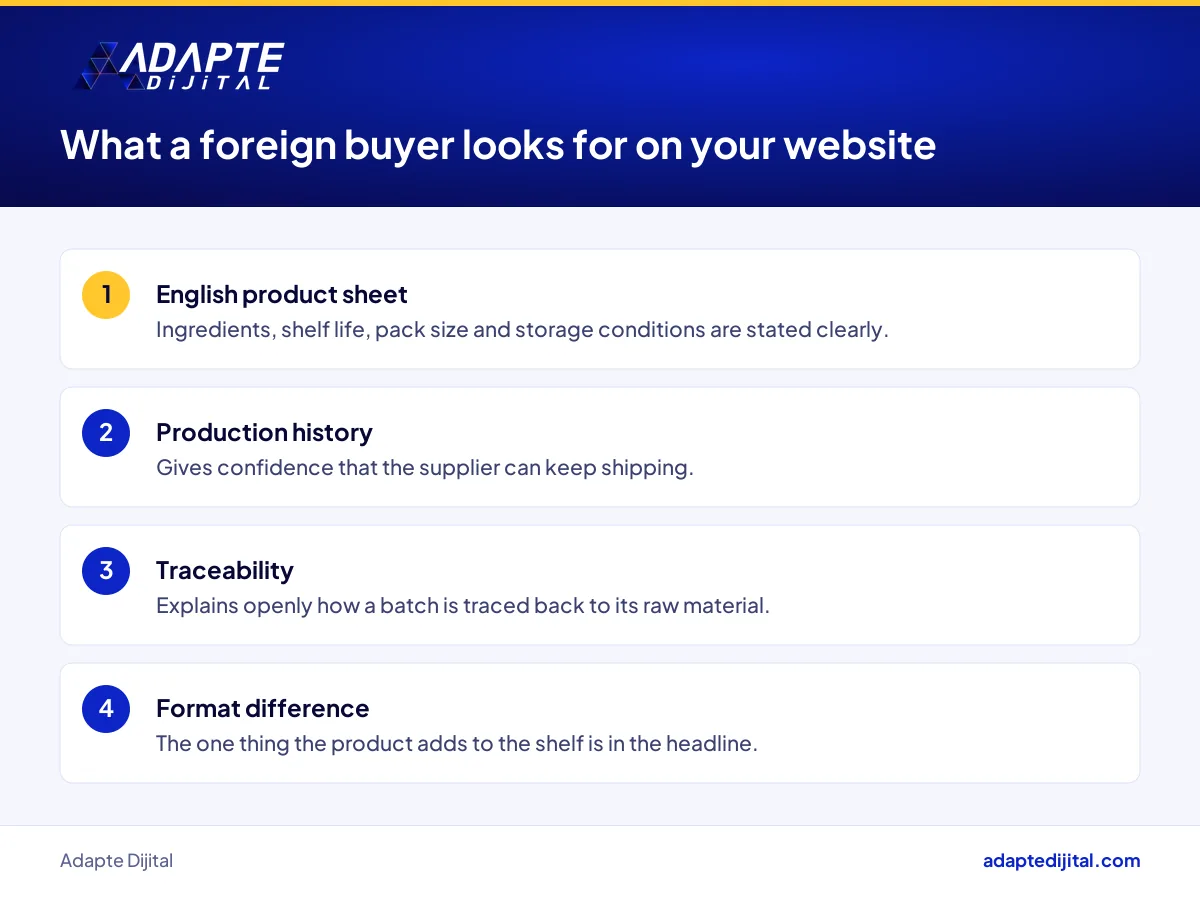
The buyer’s first question is what your product adds to the shelf. If your answer runs to a paragraph, you are not ready. Dardanel’s answer is close to two words: ready to eat. The document you need is a product specification file plus a product sheet with photos that show that difference.
Step 2: Make your traceability record easy to show
A record that lets you trace a batch back to its raw material is a precondition for any export conversation. If that record lives in scattered spreadsheets, you cannot answer a buyer’s question for days. Get separate quotes for software and consulting.
Step 3: Learn the target market’s label and channel rules
Every country sets its own rules on packaging language, ingredients and allergens. Here you also decide between selling to the chain directly or through a distributor or importer. The report does not say which model Dardanel uses; your model should be set with an adviser who knows the target market.
Common mistake: Trying to enter the shelf with your whole range
Putting the whole catalogue in front of the buyer is the most frequent mistake. Shown fifteen products, the buyer remembers none, and your file gathers dust in a drawer. Dardanel’s three varieties show the opposite: a small series built around one difference.
Why does traceability work as Dardanel’s entry ticket to export shelves?
Because a foreign buyer can only trust an unfamiliar producer through records. Dardanel’s corporate website says its traceability system lets a fish be looked up among 4.2 million records. Read that number less as a marketing line and more as a concrete way of telling the buyer, “I can show you the history of every can.”
Who gains and who struggles after Dardanel’s Walmart Canada listing?
Three groups feel it differently. Producers of ready-to-eat goods and new packaging formats get an example to point to. Producers who sell on price alone find foreign shelves harder to reach. Packaging suppliers and export logistics firms feel it indirectly, because new formats need new packaging and shipping.
Gaining: Food producers with a distinct format
Makers of ready meals, snacks, pouches and single portions can cite the Dardanel case in buyer meetings. It shows a Turkish product built on one clear format can reach a North American chain.
Struggling: Producers who compete only on price
If price is the only thing that separates your product from a rival’s, a foreign buyer turns it away at the door. These producers should work on a product difference first and open the export file second.
What do the website, search and marketplaces change for a food brand chasing export shelves?
A foreign buyer’s first contact is often your website. Before the meeting, the buyer searches your brand and checks your English pages for production and traceability details. Dardanel’s English page presents both side by side. Without them, you are screened out at the digital door.
What should a food producer do this week to get closer to an export shelf like Walmart’s?
BU BÖLÜMÜN ÖZETİ
- Monday: Write your product difference sentence
- Wednesday: Test your traceability record
- Friday: Complete the checklist
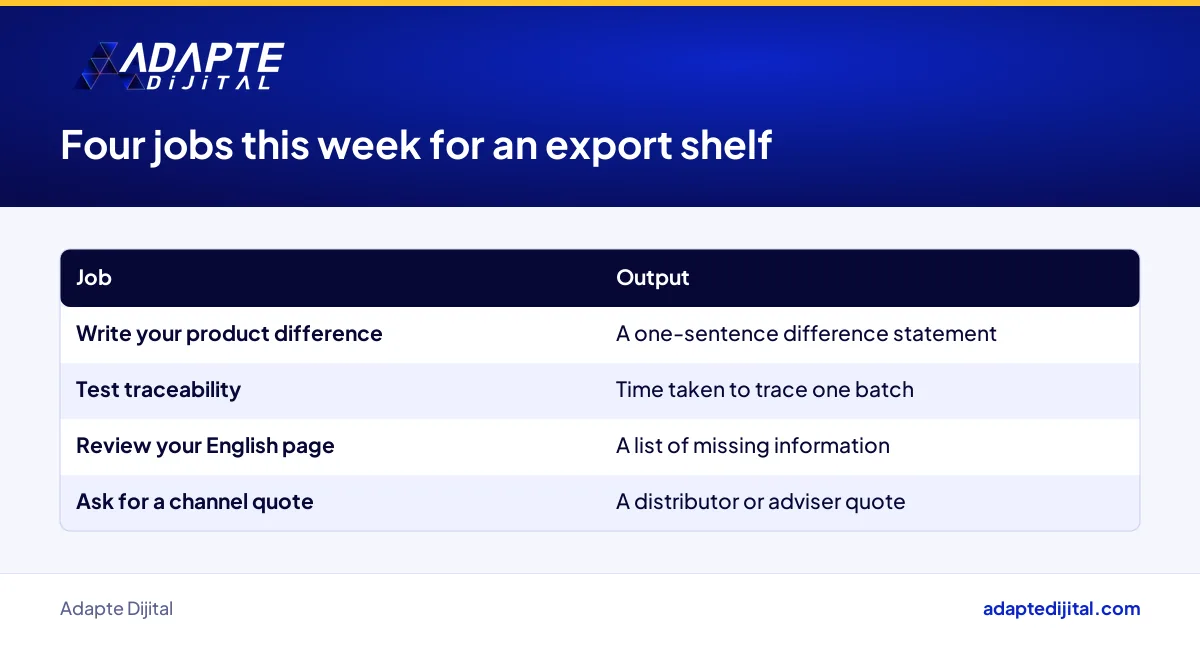
Focus on four jobs this week: write your product difference in one sentence, check your traceability record, list what your English product page is missing, and ask a channel adviser for a quote. Together they prepare you for an export meeting’s first questions. We work through foreign trade preparation with producers as part of our foreign trade consultancy.
Monday: Write your product difference sentence
Sit down with your team and answer, in one sentence, what your product adds to the shelf. If the answer mentions price, rewrite it. That sentence heads your product sheet, website and buyer deck.
Wednesday: Test your traceability record
Pick a batch at random, trace it to its raw material and time it. If you fail, invest in your record system before opening an export file.
Friday: Complete the checklist
Checklist: a one-sentence product difference, a product specification file, the result of your traceability test, an English product page, the target market’s labelling rules and a quote for your channel choice. Any item left open becomes next week’s first job. To see how shopper preferences are shifting on the food shelf, read our piece on the move toward whole wheat bread in Istanbul.
Quick Summary
- Three Dardanel tuna pouch varieties went on sale in Walmart’s stores in Canada (Perakende Türkiye, 3 August 2026).
- According to the report, the company exports to 41 countries; that figure could not be found on its corporate website.
- The product’s difference is that it is ready to eat once opened; according to the company, no one else in Türkiye produces this format.
- The corporate website describes a traceability system that lets a fish be looked up among 4.2 million records (Dardanel corporate website).
- The number of stores, the start date and the deal model are not given in the report.
Short Glossary
- Traceability
- Traceability is the system used to follow every stage of a product, from raw material to shelf, backwards through records.
- SKU
- SKU is the stock code used to identify each product variety separately on the shelf or in the warehouse.
- Distributor
- A distributor is the intermediary company used to get a producer’s goods to chains and points of sale in the target market.
Frequently Asked Questions
Next Step
If you would like to assess together whether your product is ready for a foreign shelf, fill in the consult your expert form and we will get back to you on product difference, traceability and your digital door.
Sources: Perakende Türkiye, “Dardanel, Walmart Kanada raflarına girdi” (Dardanel enters Walmart Canada shelves), 3 August 2026 · Dardanel corporate website (English page, for the 1984 and traceability details). No separate announcement from Walmart Canada or Dardanel could be found.
Updated: October 2026
Sık Sorulan Sorular
Three varieties give a buyer choice and a simple start. Olive oil covers the classic palate, smoked offers a different taste, and jalapeño suits people who like heat.
A product that competes on price disappears at the first discount war. A format difference touches habits instead: a lunch you eat at your desk or on the road. For the buyer, that adds a new moment of use to the category.
The company says it brought its first canned tuna to Turkish tables in 1984. A long history quietly answers the buyer’s question of whether this supplier can keep shipping. A newer brand builds that confidence with documents.
It means keeping in one place where each batch’s raw material came from, when it was processed and which shipment it joined. A paper ledger works to start; a digital record answers a buyer in minutes.
Once it is visible, it becomes a trust tool. Dardanel puts traceability up front on its corporate site; on your own site, a batch lookup or an open production page can do the same job at a smaller scale.
A producer who cannot tell which batch went to which store has to recall the entire shipment. Traceability is a risk tool as much as a sales tool.
We follow shelf moves like this one on our retail page, where we interpret the retail agenda for you. For why sales growth and profit need to be read separately at home, see our look at ŞOK Marketler’s first-half revenue and results.
The buyer should be able to read your product sheet in their own language: ingredients, shelf life, pack size and storage conditions. Raw machine translation leaves the wrong impression of the product.
Buyers search by category and origin. State product type, place of production and format clearly in English, and you show up in more of those searches.
Yes. The report does not say whether Dardanel sells through Walmart’s online channel. A physical shelf and an online listing need different content, images and stock planning.
Yes, but it has to explain its product difference clearly and be able to show its traceability record. For a small producer, going through a distributor or importer rather than straight to the chain may be more realistic.
The report does not say. The number of stores, the start date of sales and whether the products are sold online have not been disclosed.
Start by reducing your product’s difference to one sentence. Then test your traceability record and prepare an English product page; get your own quotes for cost and timing.