
Saruhan Kimya’s Başak Erdoğan backs green chemistry, how can brands prove eco claims?
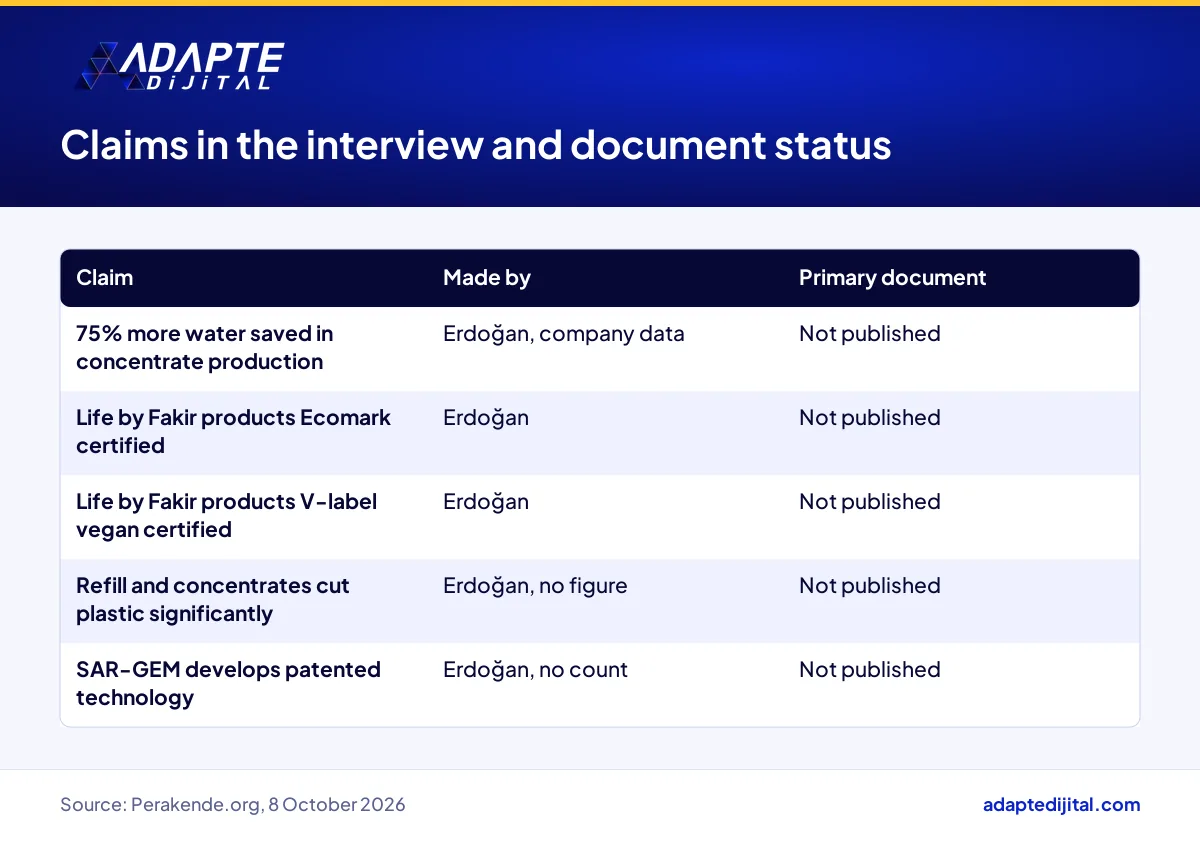
Başak Erdoğan, Marketing Manager at Turkish cleaning products maker Saruhan Kimya, links the future of the cleaning industry to green chemistry, the circular economy and digitalisation, and says the company’s concentrated products save 75% more water in production (Perakende.org, 8 October 2026). According to Erdoğan, every product in the Life by Fakir range carries Ecomark and V-label vegan certification. The figures and certificates in the interview are company statements; no primary documents have been published.
For cleaning, home care and cosmetics brands, the takeaway is clear: an environmental claim is no longer a slogan but a statement that needs paperwork. Türkiye’s Ministry of Trade has a guideline on environmental claims in force, and its Advertising Board has penalised vague “nature-friendly” claims that could not be proven. Every green word on a shelf or product page needs a file behind it.
Which environmental claims does Başak Erdoğan make for Saruhan Kimya?
Four kinds of claim stand out in the interview: R&D and production capacity, certificates, water and plastic savings, and a forecast for the sector. All of them are Erdoğan’s statements. Perakende.org publishes the interview in question-and-answer form, and no primary company document appears on the page.
What does Türkiye’s Ministry of Trade guideline on environmental claims ask of brands?
The guideline sets a framework for advertising that contains environmental claims, and Advertising Board decisions show that vague, unprovable claims can lead to penalties. The Ministry of Trade’s Guideline on Advertisements Containing Environmental Claims came into force on 13 December 2022, based on Law No. 6502 on consumer protection and the Regulation on Commercial Advertising and Unfair Commercial Practices. Read the full text for detail; verify with the official source, as this is not legal or financial advice.
How can a brand document “nature-friendly”, “vegan” and “water saving” claims like Saruhan Kimya’s?
By opening a file for every claim. The file holds the exact wording, the products it covers, the evidence, the date of the evidence and who produced it. A certified claim stays within the scope of its certificate; an in-house measurement is kept together with its method.
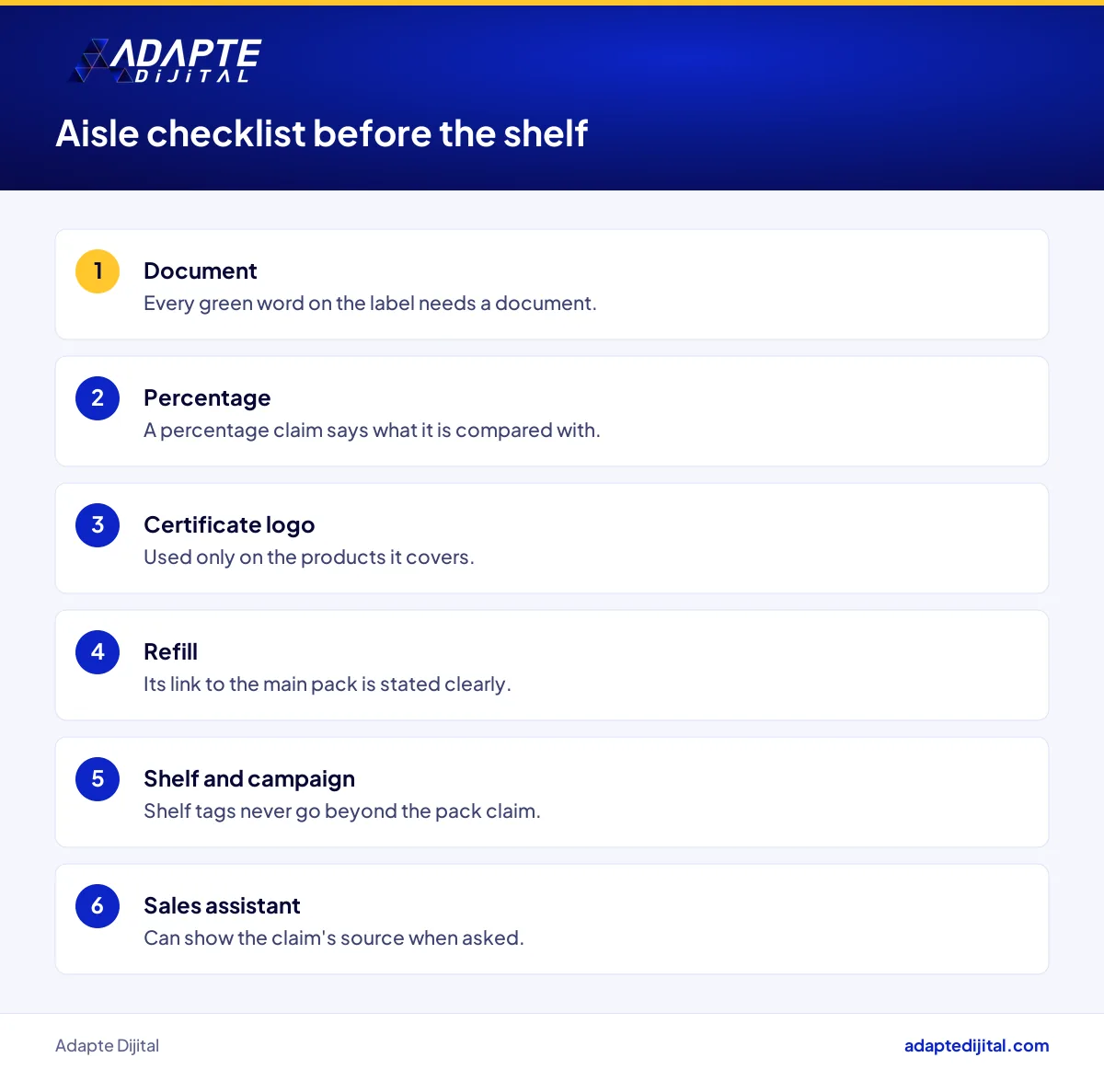
- Is there a document behind every green word on the label?
- Does a percentage claim say what it is compared with, on the front or back?
- Is the certificate logo used only on the products it covers?
- Is the link between a refill and its main pack stated clearly?
- Do shelf tags and campaign materials go further than the claim on the pack?
- Can the sales assistant show the source of the claim when asked?
Who do green claim rules affect in Türkiye’s cleaning and home products market, and how?
Producers with documents ready gain; brands chasing shelf space with undocumented claims come under pressure. Supermarket chains, marketplaces and advertising agencies are affected indirectly, because they carry the claim to the shelf and the screen. In autumn 2026, this is a live question in Türkiye’s cleaning and personal care aisles.
How can Saruhan Kimya-style eco claims be proven in e-commerce, marketplaces and search?
Online, proof should be one click away. The product page should show the document itself, or a summary of it, next to the claim. According to Erdoğan, the company reaches a wider audience for its brands through e-commerce and digital channels, which means the claim is in front of far more eyes than on a shelf alone.
What should a cleaning or home products brand do this week about eco claims?
Finish three jobs this week: put every green claim from every channel on one list, flag the ones without documents, and rewrite the undocumented ones. Have that list ready before shoppers walk away and before an inspector walks in.
Quick Summary
- In a Perakende.org interview, Başak Erdoğan puts green chemistry and the circular economy at the centre of Saruhan Kimya’s story.
- According to Erdoğan, concentrated products save 75% more water; the method has not been disclosed (Perakende.org).
- According to Erdoğan, all Life by Fakir products are Ecomark and V-label vegan certified; no primary documents have been published.
- The Ministry of Trade’s guideline on environmental claims came into force on 13 December 2022 (Ministry of Trade).
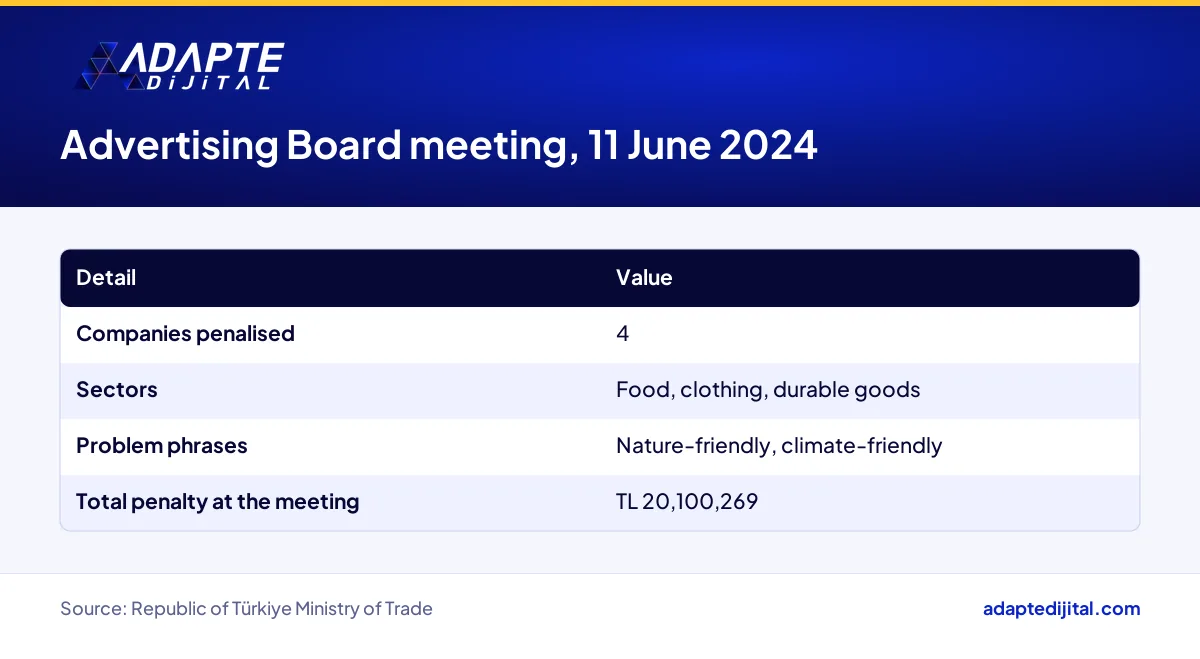
- On 11 June 2024, the Advertising Board penalised 4 companies over unprovable environmental claims (Ministry of Trade).
Short Glossary
- Greenwashing
- Greenwashing is misleading communication used to make a product or company look environmentally responsible without proof.
- Concentrated product
- A concentrated product is a cleaning product formulated with less water and designed to be diluted at the point of use.
- Refill system
- A refill system is the sales model used to cut packaging by letting customers refill the main container.
Frequently Asked Questions
Next Step
If you want to match the environmental claims on your products to documents and make them speak one language on the shelf and online, fill in the consult your expert form, and our desk will build your claims inventory with you.
Sources: Perakende.org, 8 October 2026 · Ministry of Trade, guideline on environmental claims · Ministry of Trade, Advertising Board announcement
Updated: October 2026
Sık Sorulan Sorular
According to Erdoğan, the company’s R&D centre, SAR-GEM, operates with approval from Türkiye’s Ministry of Industry and Technology and develops patented technologies; the number of patents is not given. She also says the company can produce core detergent ingredients in-house. These are statements about capacity, not measurements of environmental impact.
According to Erdoğan, every product in the Life by Fakir range is Ecomark and V-label vegan certified. The interview does not explain the relationship between Saruhan Kimya and the Fakir brand. The 75% water saving figure for concentrated products is company data; the product and period behind it are not stated.
According to Erdoğan, concentrated formulas and refill systems cut plastic and waste “significantly”, but no figure is given. Her view that green chemistry, the circular economy, product lifecycle management and digitalisation will shape the sector over the next five years is an opinion. Erdoğan describes breaking the bias that a nature-friendly product “cleans less” as the main goal.
Words like “nature-friendly”, “eco” or “green” do not say what improves, or by how much. Shoppers tend to apply the word to the whole product. The proof has to be as broad as the word: a document for one ingredient does not make the whole product “nature-friendly”.
At its meeting on 11 June 2024, the Advertising Board penalised 4 companies from the food, clothing and durable goods sectors over vague, unprovable environmental claims such as “nature-friendly” and “climate-friendly”. According to the ministry’s announcement, the total penalty imposed at that meeting was TL 20,100,269. The ministry gives this figure as the meeting total, so it should not be read as the amount for any single company.
A percentage claim like “75% water saving” should say what it is compared with. Without answers to which product, which period and which method, the number can be read but not understood. The desk recommends always printing the percentage together with its baseline.
A certificate should be named together with the feature it covers and the body that issued it. The interview does not say which organisation runs the Ecomark label or when the certificates were obtained. When you put a certificate on your own label, keep the issuer, the scope and the expiry date in the file.
For water, energy or plastic savings, the two products compared, the measurement period and the calculation method should be written down. An independent lab or auditor report makes the claim stronger. A percentage without a stated method struggles to stand up on its own when an inspector asks.
Picture the cleaning aisle of a supermarket chain: products stand side by side, and a shopper reads only a few words on each. The desk recommends running every product through this aisle checklist before it goes on the shelf:
Producers that have an R&D unit, take measurements and keep their certificate files in order gain. They can extend a claim across a product range and carry the documents with it. Private label manufacturers may also be preferred to the extent that they can hand documents to the chain.
Small brands that print “natural” or “eco” on the pack without documents come under pressure. Their products sit on the shelf, and when the chain’s category manager asks for documents, they can be delisted. According to Erdoğan, greenwashing damages consumer trust, and trust is built through transparency and provable benefit.
A supermarket chain may ask suppliers for documents to avoid reputational damage from a claim on its own shelf. A cosmetics or home products tenant in a shopping mall has to apply the same care to window displays and campaign copy. A campaign poster should never say what the pack does not.
For each claim, a short explanation, a link to the evidence and the date of the document are enough. A frequently asked questions block can answer questions like “compared with what?”. A sentence with a clear source is also easier for search engines and AI assistants to quote accurately.
Words squeezed into marketplace titles, such as “eco”, “natural” or “vegan”, should be backed up in the product description. When different sellers list the same product with different claims, both shoppers and inspectors get confused. We look at online and store retail working to the same rules in our article on ETİD joining TAMPF.
Influencer posts and brand events should not go beyond the claim on the pack. A “zero waste” line spoken at an event is a stronger promise than “reduced waste” on the product page. We explain how an experiential event is put together in our article on JYSK’s sleep event.
Put every environmental phrase from packs, shelf tags, product pages, marketplace listings, social media and campaign copy into one table. Next to each, write the document, its date and its owner. Any row with an empty document column is the first row to fix.
Replace the vague word with a concrete fact you can prove: instead of “nature-friendly”, name the feature you have evidence for; instead of “saves water”, give the percentage with its baseline. A concrete line looks less ambitious, but it lasts longer.
R&D, marketing and legal teams need to keep one shared claims file; in a small business, one person can own it. We align claim language with brand identity as part of our brand consultancy work. Our retail page, where we interpret the Turkish retail agenda, gathers similar decisions in one place.
Only if you can show concretely what improves and by how much. Naming a feature you can prove is safer than a vague phrase. Verify the rules with the official source; this is not legal advice.
A certificate applies only to the products it covers. Before using the logo, check in the document which products and which date range it covers.
Give the percentage together with what it is based on: the product compared, the measurement period and the method. The same details should match on your product page and in your claims file.