
Günsan seeks a stronger brand in 35+ export markets, how should Turkish makers position?
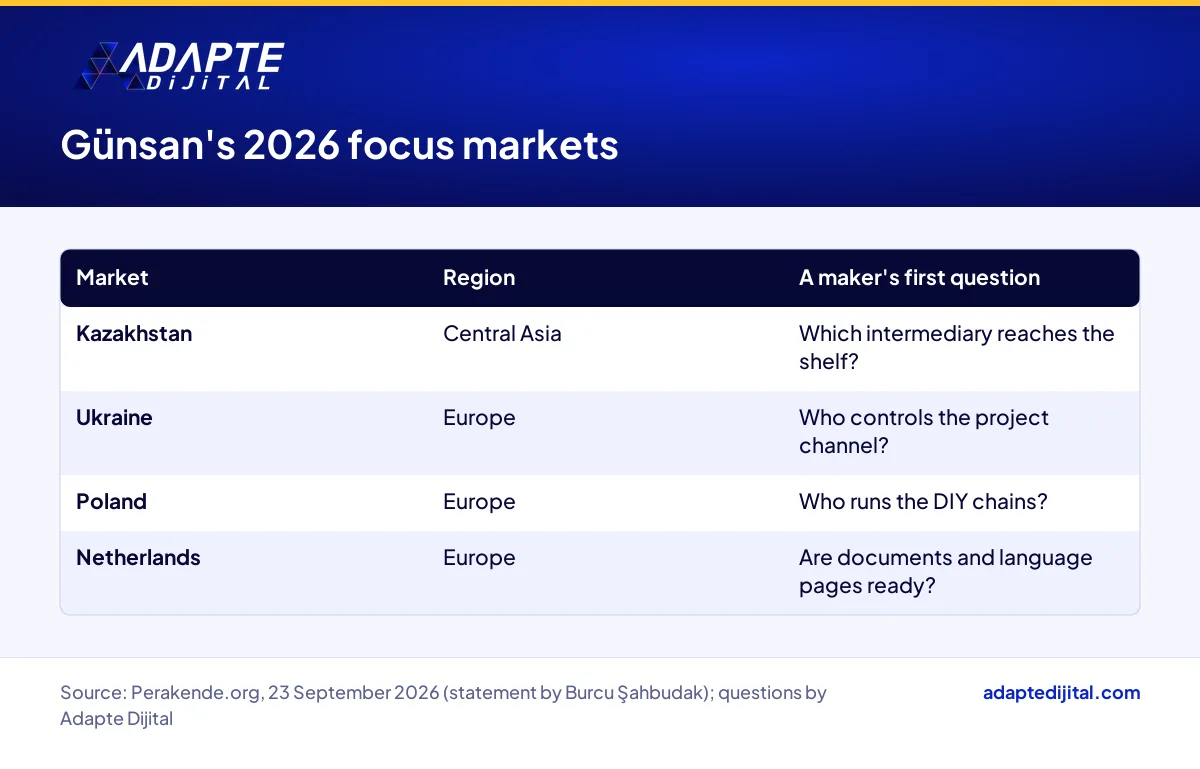
Günsan Elektrik wants to position itself as a stronger Turkish brand in international markets, its Marketing Director Burcu Şahbudak said in an interview (Perakende.org, 23 September 2026). According to Şahbudak, Günsan exports to more than 35 countries, its 2026 focus markets are Kazakhstan, Ukraine, Poland and the Netherlands, and it aims to lift annual capacity from about 60 million units to the 100 million level by the end of 2026.
For a manufacturer, the takeaway is this: exporting products and exporting a brand are two different jobs. The difference lies in managing capacity, market choice and reputation in one plan. If you make electrical supplies, DIY store products or home improvement goods in Türkiye in autumn 2026, the path Günsan describes gives you an order of steps you can apply.
Why does Günsan want to position itself as a brand in export markets?
Because the 3-5 year frame Şahbudak sets out is built on value, not volume. According to Şahbudak, the goals are higher value-added products, stronger technology and design, sustainable production and greater brand awareness in Europe and Central Asia. Exporting becomes the brand’s name abroad, not just a sales channel.
How can a Turkish manufacturer choose focus markets the way Günsan does?
With three filters: existing sales footprint, regional logic and channel access. Günsan’s list shows the pattern: Şahbudak’s awareness goal covers Europe and Central Asia, and the focus markets fall into those two regions. The interview does not explain the choice, so treat the filters below as a method for your own list.
Which steps take a manufacturer from contract exports to brand exports?
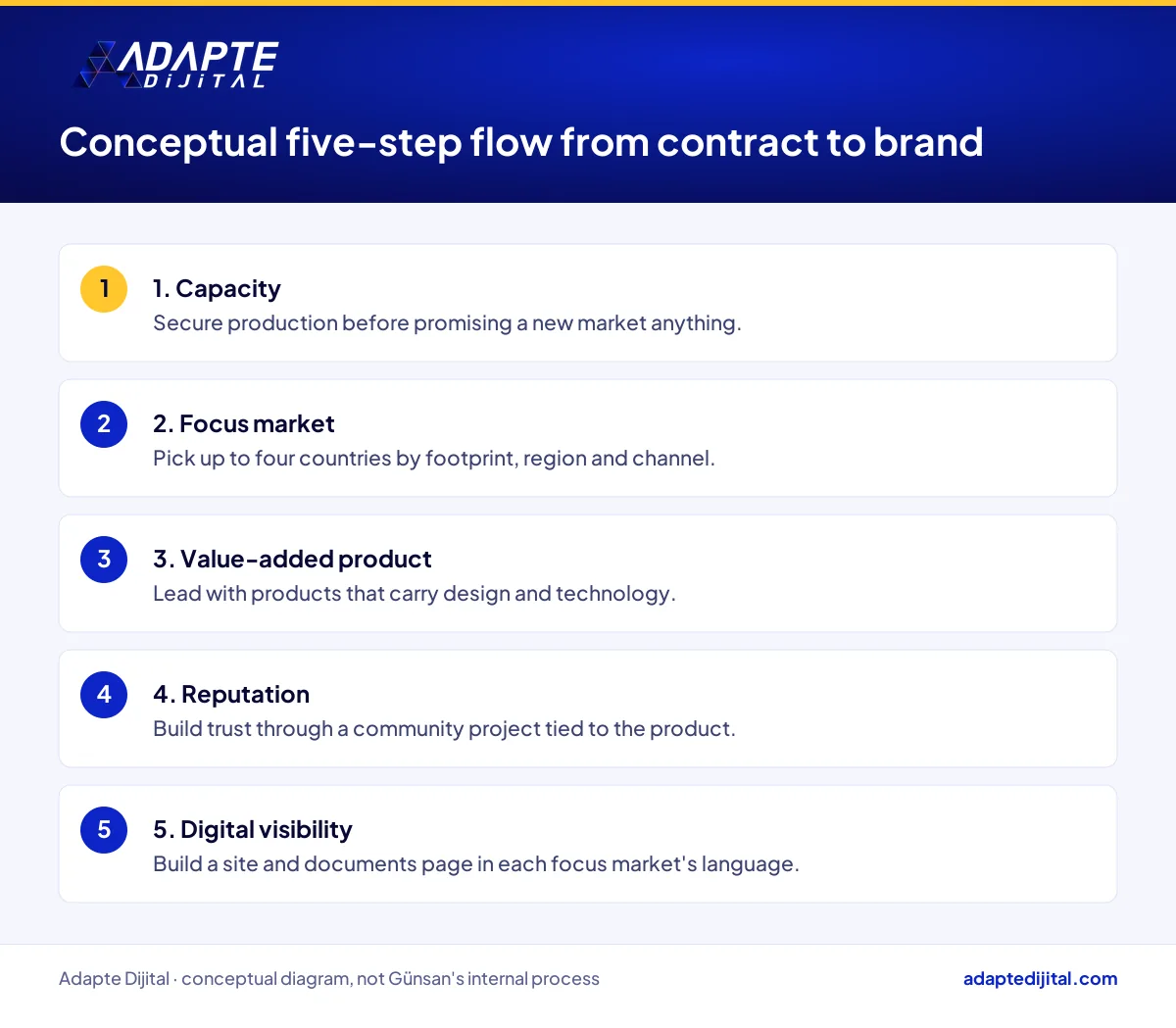
Five steps: secure capacity, choose focus markets, lead with value-added products, feed reputation with community projects, and build digital visibility in each market’s language. The flow below is a conceptual diagram drawn from the topics Günsan covers in the interview; it is not the company’s internal process.
Who does Günsan’s brand push affect, and how?
Directly affected are Turkish exporters of electrical supplies and home improvement goods, distributors in the focus markets, and DIY store chains. The winners are manufacturers looking for shelf space under their own brand. Under pressure are contract manufacturers that compete on price alone. Indirectly affected are electrical installers, contractors and trade fair organisers.
How does an exporting manufacturer build brand positioning online?
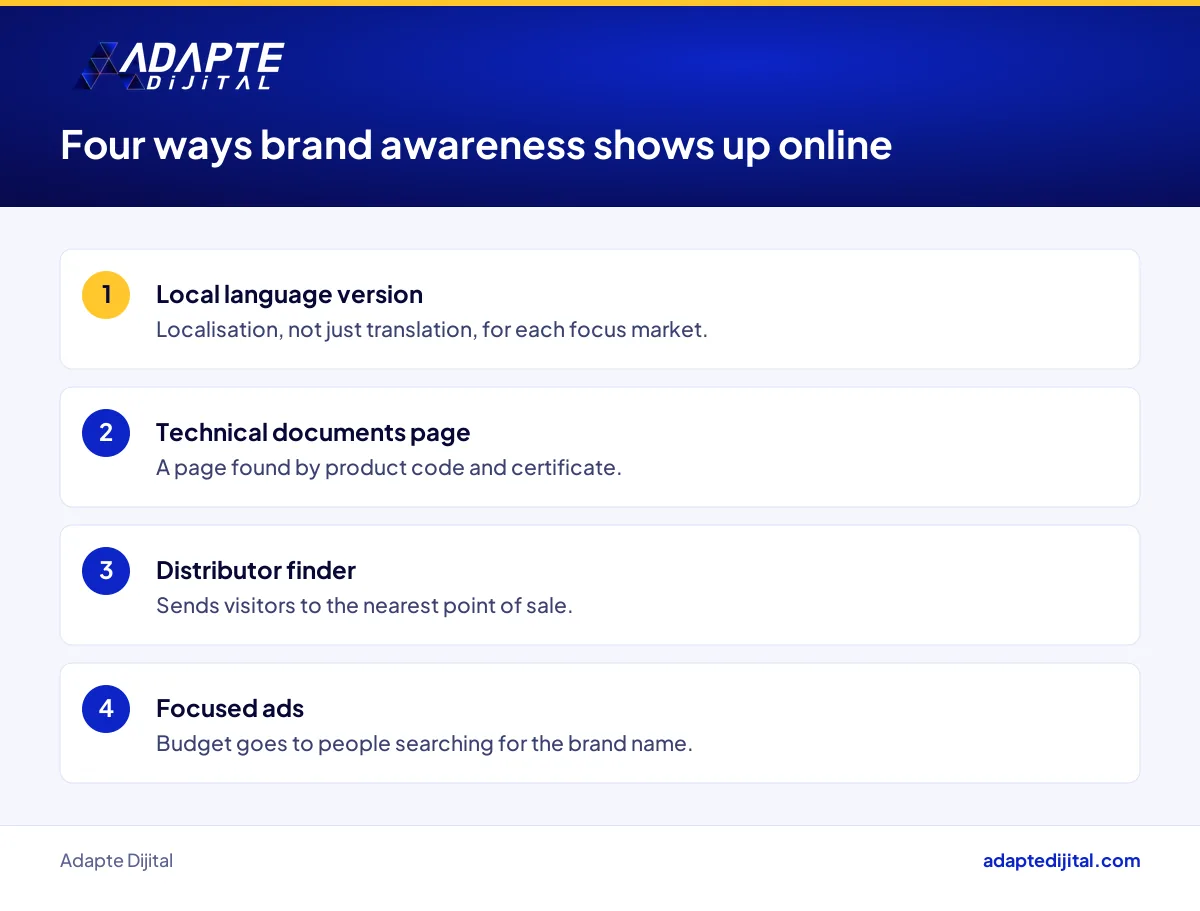
In the target market’s language, around how people in that market search. Let’s say an installer in Poland looks for your product: they search in Polish, often by product code or certificate number. A separate language version for each focus market, a technical documents page and a distributor finder are what brand awareness looks like online.
What should a manufacturer do this week after the Günsan news?
Do three things. From last year’s export records, list the countries where your product sells but your brand is unknown, mark no more than four as focus markets, and write down the channel that reaches the shelf in each. Then check whether your website has a page in each market’s own language.
How do you put capacity and the brand goal in one table?
- Write down current capacity and utilisation.
- Add expected demand from each focus market.
- Compare the two before you promise anything to a new market.
Overpromising risks a brand that misses its first order. Use actual figures from your own production records.
Quick Summary
- According to Şahbudak, Günsan exports to more than 35 countries (Perakende.org, 23 September 2026).
- According to Şahbudak, the 2026 focus markets are Kazakhstan, Ukraine, Poland and the Netherlands.
- According to Şahbudak, annual capacity of about 60 million units is targeted to reach 100 million by the end of 2026.
- According to Şahbudak, 10,000 copies of the book Kıpırdak Elektron Fiyuuu were printed, and it is also out as an audiobook.
- Exporting a brand means managing capacity, focus markets, value-added products, reputation and digital visibility in one plan.
Short Glossary
- Contract manufacturing
- Contract manufacturing is the term used for one company producing goods under another company’s name and order.
- Focus market
- Focus market is the term used for a chosen country where an exporter concentrates its resources for a set period.
- Capacity utilisation
- Capacity utilisation is the term used for the ratio of a plant’s actual output to its maximum output.
Frequently Asked Questions
Next Step
If you want to review your focus market list and brand positioning together, fill in the consult your expert form.
Sources: Perakende.org, Zeynep Zeytun, 23 September 2026 · ekonomim.com, 2022 · Günsan corporate website
Updated: October 2026
Sık Sorulan Sorular
According to Şahbudak, Günsan has more than 40 years of history and makes switches and sockets, switchgear products, miniature circuit breakers and residual current devices. Sales run through two main channels: projects and DIY stores. The full product range is on Günsan’s corporate website.
According to Şahbudak, the new-generation production facility is in Dilovası, Kocaeli. The aim is to reach the 100 million level by the end of 2026, once Dilovası runs at full capacity. That is a target, not a result. On the brand side, the logic is simple: when you open a shelf in a new market, reliable delivery is the first condition of reputation.
A 2022 report quoted General Manager Erhan Kaya as saying Günsan led the market in Bulgaria, Romania and Greece (ekonomim.com, 2022). The country count in that report differs from the figure in the 2026 interview, and the reason for the gap has not been explained. So we use Şahbudak’s figure of more than 35 countries as the current reference.
In countries you already ship to, the distributor, the certificates and the logistics are in place. Choosing a country where your product sells but your name is unknown costs less than opening a market from scratch.
Regional logic lets you share advertising, trade fairs and a sales team. Poland and the Netherlands sit in Europe, Kazakhstan in Central Asia; reputation built in one part of a region carries into the next market.
Whatever shelf your product sells on, you need the intermediary who reaches that shelf in the target market. Günsan’s pairing of project sales and DIY stores in Türkiye is a useful model: one channel reaches contractors, the other reaches end users. Picking a market without knowing who controls those two channels is like leaving your goods waiting at the port.
In contract manufacturing, profit is counted in cents and the buyer wants a fresh quote every year. A product with its own design and technology gets chosen for what it does, not for its price. That is why Şahbudak’s emphasis on technology and design in the 3-5 year goals sits at the centre of a brand plan.
According to Şahbudak, Günsan printed 10,000 copies of Kıpırdak Elektron Fiyuuu, a children’s book about electrical safety. She says 5,000 copies reached six provinces in partnership with the Bütün Çocuklar Bizim association, 120 libraries in Balıkesir received copies, and the book is also out as an audiobook. The project picks a topic tied directly to what the company makes. An electrical manufacturer teaching electrical safety builds a kind of trust that advertising cannot.
Attach a metric to each step and the flow stops being a paper plan. Useful metrics: capacity utilisation, active distributors per market, the share of value-added products in exports, and brand searches in each target country. AINEO Motor turns calculations like these into engines embedded in business articles; the reader enters their own numbers and sees the result on the page. Your data fills the metrics; the system provides the structure.
A manufacturer with its own design and certificates benefits when Turkish brands become more visible abroad. A contract manufacturer shipping unbranded goods to the same countries meets buyers who now expect a brand. Sooner or later the buyer asks, “Do you have your own brand?”
DIY chains and project firms in the focus markets gain another supplier option. In Türkiye, packaging, logistics and certification firms could see more work if capacity grows. International trade fairs are the showcase for moves like this; VitrA Tiles unveiling The Code at Cersaie 2026 shows the role a fair plays in exports.
Each language version should be localised, not just translated: product names, units, certificates and contact people are written for that market. If you have four focus markets, build four languages first. A single English page for the whole world produces visitors who arrive and leave.
If a distributor sells your products on online marketplaces, write into the contract that product pages must match your brand language. Instead of splitting the ad budget evenly across countries, concentrate it on people in focus markets who search for your brand name.
If distributor stock, order data and website traffic do not sit in one table, brand decisions turn into guesswork. We look at where a small business can start joining up this data in our piece on the ZMD retail technology awards.
Product certification, customs conditions and trademark registration vary from country to country in your target markets. Verify with the official source; this is not legal or financial advice. We are the team that plans market choice, channel setup and brand positioning together through our foreign trade consultancy work.
Yes. Starting with one or two countries where your product already sells but your name is unknown costs less than opening a market from scratch.
No, it is a target. According to Şahbudak, the plan is to reach that level by the end of 2026 once the Dilovası facility runs at full capacity.
A project tied to your product can build trust; Günsan’s electrical safety book is one example. You still need to track its effect with brand awareness data from your own market.