
fzlPLUS warns of silent churn, how can a business win back 6-22% of lapsed customers?
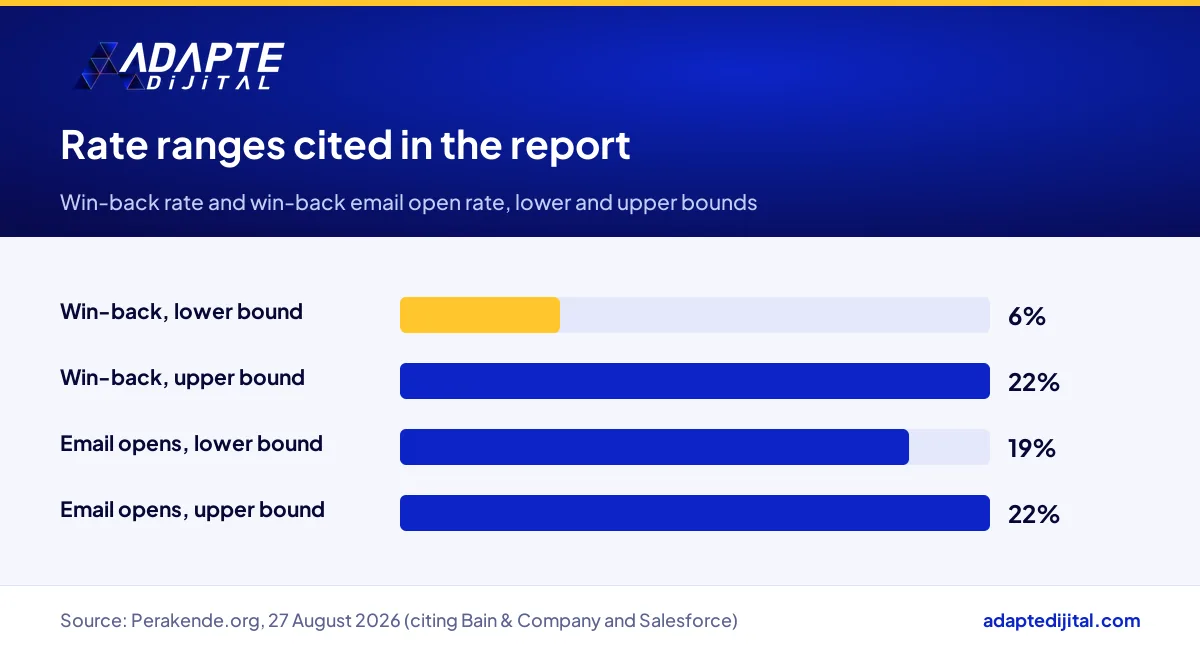
Hüseyin Yerçok, General Manager of fzlPLUS, is drawing attention to “silent churn”, where customers drift away from a brand without ever complaining, and cites Bain & Company to say that 30-90 day re-engagement work can bring back 6% to 22% of lapsed customers (Perakende.org, 27 August 2026). Citing Salesforce, the same report says open rates for win-back emails can stay in the 19% to 22% range.
What it means for you: the customer who costs you most is not the one who leaves shouting, but the one who quietly stops coming. To catch that loss early, you look at purchase frequency, not the complaints box. Win-back is possible, but read the sources behind the numbers carefully.
How does the silent churn fzlPLUS describes work in retail?
Silent churn means a customer buys less and less, then stops, without a complaint or a trace. The shopper who came every month comes every two months, then not at all. Yerçok puts it this way: some of the most valuable signals in a customer base lie “not in what the customer says, but in what they no longer do.”
How reliable is the 6-22% win-back rate for lapsed customers?
Useful as a direction, limited as a precise figure. The report attributes the 6% to 22% range to Bain & Company, but does not say which sector, year or study it comes from, and the primary document could not be found. The width of the range says results vary a lot by sector and execution. Read this number as a possibility, not a target.
Which retail businesses does silent churn affect, and how?
It hits businesses that depend on repeat purchases the hardest: the neighbourhood grocer, cosmetics and personal care stores, pet supply sellers, subscription e-commerce sites. Their customer value lies not in one basket but in repeat visits across the year. For Turkish retailers heading into the autumn 2026 campaign season, silent churn is a leak that shows up in revenue only months later.
How do win-back channels compare on cost and impact for silent churn?
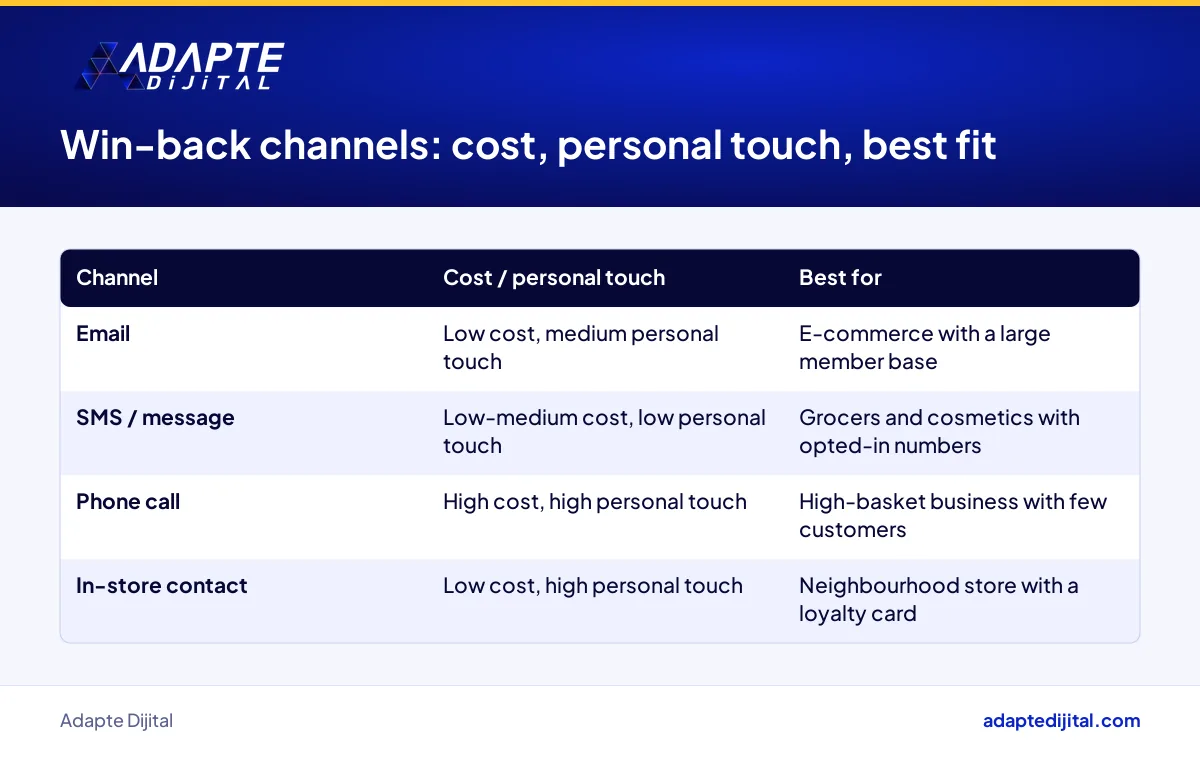
Compare them on four criteria: cost per person, personal touch, measurability and scalability. The table below gives a qualitative ranking, not numbers. Our verdict, and the reason: not one channel, but a tiered flow based on customer value. Cheap, measurable email for most customers, a personal call for the most valuable ones.
| Criterion | SMS / message | Phone call | In-store contact | |
|---|---|---|---|---|
| Cost per person | Low | Low-medium | High | Low |
| Personal touch | Medium | Low | High | High |
| Measurability | High | Medium | Medium | Low |
| Scalability | High | High | Low | Low |
| Best for | E-commerce with a large member base | Grocers and cosmetics stores with opted-in numbers | High-basket businesses with few customers | Neighbourhood stores with a loyalty card |
How do silent churn signals show up in customer data and digital channels?
They show up as longer gaps between purchases, a shrinking average basket and fading digital engagement. A customer who stops opening emails, skips the app or adds items to the cart without buying is sending a signal. These signals already sit in your CRM, e-commerce panel and loyalty system; in most businesses, nobody reads them.
What should store and e-commerce owners do about silent churn this week?
BU BÖLÜMÜN ÖZETİ
- Pull your lapsed customer list
- Write a message that asks one question
- Set up a record to measure returns
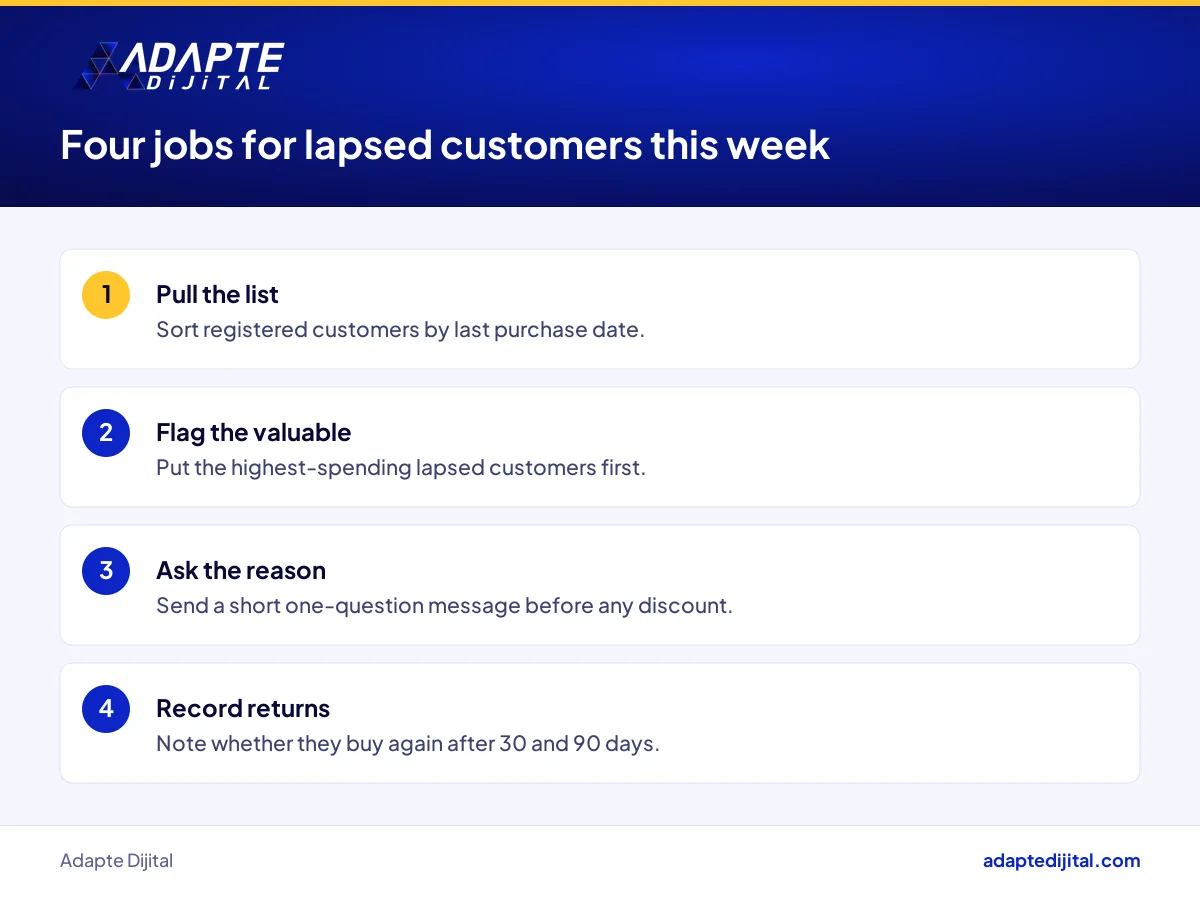
This week, sort your customer list by last purchase date and pull out those past their usual interval. Then write one short, personal message for that group. Putting the channel and order of messages into a written flow organises the rest of the work.
Pull your lapsed customer list
From your loyalty system or e-commerce panel, list registered customers who have not bought in the last 90 days. Mark the highest spenders first.
Write a message that asks one question
Before sending a discount code, ask the customer why they stopped coming. A one-question survey makes the reason behind silent churn visible.
Set up a record to measure returns
For every customer you message, record whether they buy within 30 and 90 days. Your own rate is worth more than the range in the report. We build this kind of segmentation and win-back flow with businesses as part of our digital marketing work.
If you want the same data habit on the stock side, our piece on MediaMarkt’s provincial sales data covers reading regional demand. For how a local grocer opening a new branch can protect its customer base, see our take on Onur Market’s Maslak opening.
Quick Summary
- fzlPLUS General Manager Hüseyin Yerçok highlights silent churn, the loss of customers who never complain (Perakende.org, 27 August 2026).
- Citing Bain, the report says 30-90 day re-engagement can win back 6% to 22% of lapsed customers; the primary document could not be found.
- Citing Salesforce, it puts win-back email open rates at 19% to 22% (Perakende.org).
- Per Salesforce, 61% of service professionals see their organisation as proactive, but only a third of customers agree (Salesforce Blog).
- In a tiered flow, email suits the broad base and personal contact suits the most valuable customers.
Short Glossary
- Silent churn
- Silent churn is the concept used to describe a customer buying less and drifting away from a brand without complaining.
- RFM segmentation
- RFM segmentation is the method used to group customers by recency, frequency and monetary value of their purchases.
- Re-engagement flow
- A re-engagement flow is the communication plan used to send a lapsed customer a sequence of messages at set intervals.
Frequently Asked Questions
Next Step
If you want to map silent churn risk in your customer list with us, fill in the consult your expert form and we will build the first segmentation together.
Sources: Perakende.org, 27 August 2026 · Salesforce Blog, proactive customer service, 14 November 2024 · Capital, 3 August 2026 · Para Dergi, 4 May 2026 · Yeni Birlik, 10 October 2025. You can also visit our retail page, where we interpret the retail agenda for you.
Updated: October 2026
Sık Sorulan Sorular
Because a complaint is a chance to fix something. A customer who stays silent gives you no chance to put it right. In a Para Dergi report dated 4 May 2026, Artiwise CEO Tanel Temel argues that surveys and NPS capture only about 5% of customer experience data.
The report presents fzlPLUS as a data-driven customer service operations company, part of Fuzul Holding. It gives no customer count or case data of fzlPLUS’s own.
The report gives the 61% figure as “brands”, but Salesforce frames it differently on its own page. According to Salesforce’s article on proactive customer service, 61% of service professionals say their organisation handles issues proactively. Only a third of customers agree.
A 19% to 22% open rate means most win-back emails go unopened. The report gives no breakdown by sector or country. An open is not a return either; whether the reader comes back to the store or site has to be measured separately.
No. Citing Bain, it says acquiring a new customer costs far more than keeping an existing one, but it gives no ratio. The multiples you often hear quoted cannot be pinned on this report.
According to a Capital report dated 3 August 2026, a Salesforce survey of more than 16,000 customers in 18 countries found that 43% list poor service among their reasons for leaving a brand. Not every exit is silent, but the cause often builds up on the service side.
The business that keeps customer records, with a loyalty card or membership system, wins. A store that can track purchase frequency sees the drop in the first month and acts.
The business that does not know its customers and only watches the till total struggles. There is no way to call back a customer whose name and contact details you never had. The till feels slow, but nobody knows which customers left.
E-commerce sites whose support lines get swamped during campaigns feel it indirectly. The same Capital report says transaction volume reaches about 2.9 times the daily average around events like 11.11, which strains support.
Because it is cheap and measurable. A 19% to 22% open range looks low, but on a large list the cost per person stays tiny. Non-openers get step two through another channel.
It pays off for a business with a high average basket and few customers. In a furniture, white goods or boutique store, one returning customer covers the cost of the call.
The first reminder goes out when a customer passes their usual purchase interval. If there is no response, the second touch uses a different channel. For high-value customers nearing day 90, personal contact steps in.
Days since last purchase, purchase frequency and spend. Together they form RFM segmentation, the simplest way to sort customers into risk groups. A customer who goes past twice their usual interval goes to the top of the risk list.
You can upload a lapsed customer list to ad platforms as a custom audience. Showing these people a message that recognises them works better than a new-customer ad. Verify with the official source the consent and notice rules for using personal data this way; this is not legal or financial advice.
First check their last purchase date and whether they have passed their usual interval. If they have, send a short, personal message asking why they stopped coming.
The report attributes this range to a study and does not name the sector. You only learn your own rate by tracking the customers you message for 30 and 90 days.
Not on its own. If the customer left unhappy with the service or product, a discount does not fix the cause; ask about the reason first.