
Teknosa plans in-store zones for Samsung foldables, do experience areas really lift sales?
Teknosa and Samsung have signed a new partnership for foldable devices, under which Teknosa stores will get dedicated experience zones and the two companies will run joint digital campaigns and trade-in schemes (Perakende.org, 16 October 2026). The agreement was made at Samsung’s headquarters in Korea; the number of stores and the start date have not been announced.
Here is why it matters to you: an expensive product nobody buys untried sells once it is in the customer’s hand. For any retailer selling phones, computers or white goods, the question is: when does it pay to give part of the shelf to an experience zone, give staff time to it and set up trade-ins?
What will the Teknosa and Samsung foldable partnership cover?
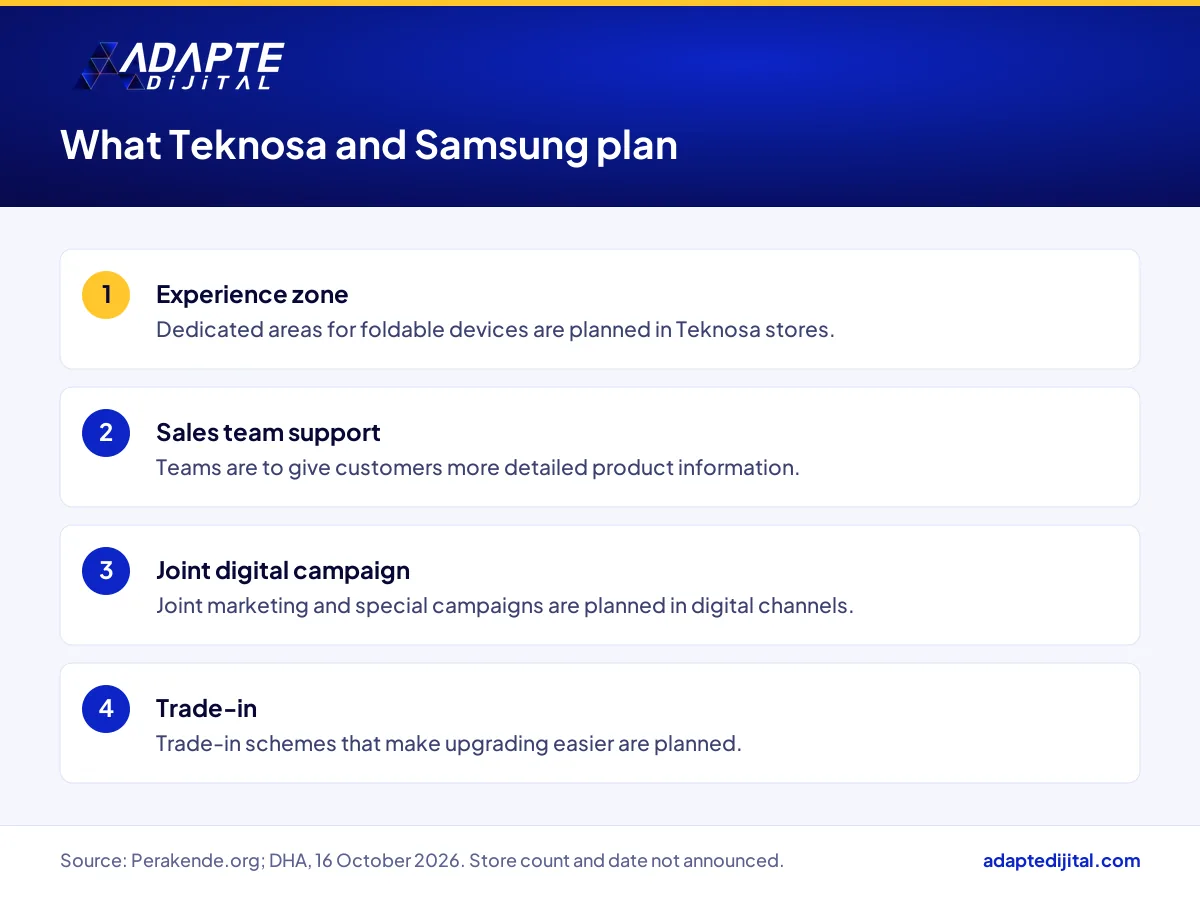
According to the plan, it will cover four areas: in-store experience zones, support for sales teams, joint marketing and campaigns in digital channels, and trade-in schemes that make upgrading easier (Perakende.org; DHA). The support for sales teams is meant to help them give customers more detailed product information. Whether this will mean training or extra staff has not been said.
How could Teknosa’s planned experience zones affect foldable phone sales?
By answering the customer’s biggest question in the store: how does this device feel in the hand? A foldable phone is hard to explain with a photo; a zone takes it out of the box and onto the counter. Whether the zone turns into sales will depend on an informed adviser standing next to it.
What will trade-ins and sales team support change in Teknosa’s stores and at the till?
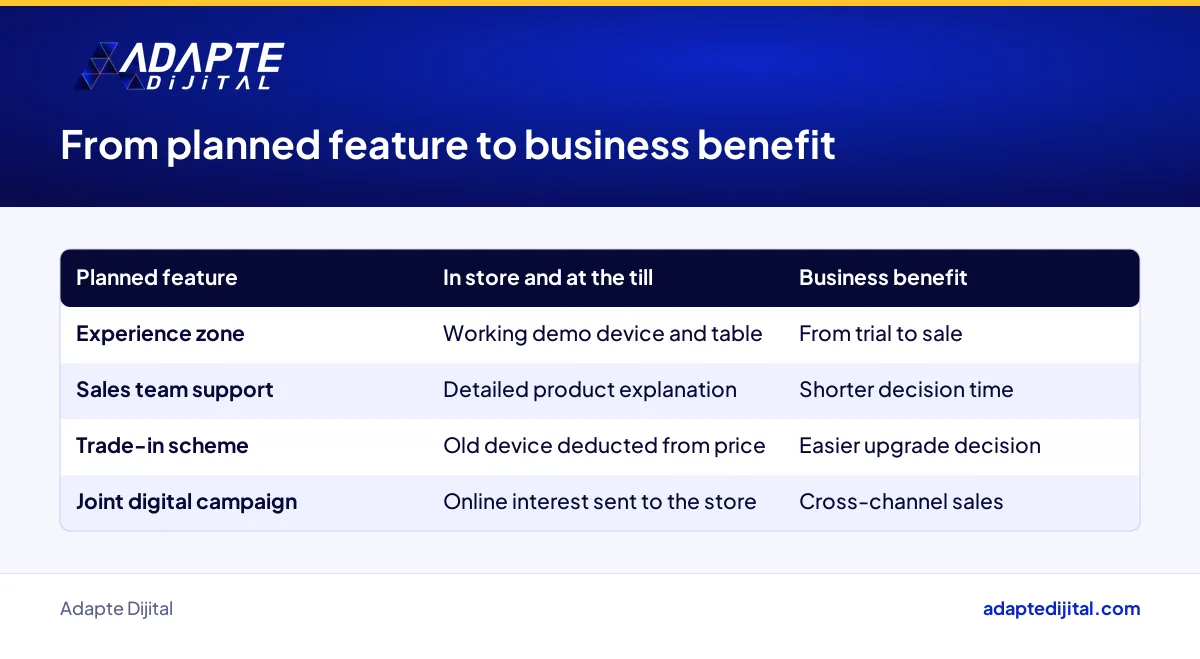
They target the two biggest barriers to buying: price and lack of information. A trade-in lowers the figure at the till by deducting the old device’s value from the new price. Informed staff answer questions like “will the screen get damaged when it folds?” on the spot. The table below maps the planned features to what they mean in store.
| Planned feature | In store and at the till | Business benefit |
|---|---|---|
| Experience zone | Working demo device and table | From trial to sale |
| Sales team support | Detailed product explanation | Shorter decision time |
| Trade-in scheme | Old device deducted from price | Easier upgrade decision |
| Joint digital campaign | Online interest sent to the store | Cross-channel sales |
Which technology retailers will the Teknosa and Samsung deal affect, and how?
Large chains that can set up campaigns and trade-ins directly with manufacturers gain. Small tech shops that stock the same product without a zone or trade-in struggle. In autumn 2026, premium phone sales in Türkiye are a contest of store experience as well as price. Refurbishers and accessory sellers feel it indirectly.
What will the Teknosa and Samsung digital plan change in search and advertising?
According to the plan, joint marketing and special campaigns will run in digital channels. Campaign terms have not been announced. The method is still clear: online ads create curiosity, and the store does the persuading.
What should a small tech retailer selling foldable phones do this week?
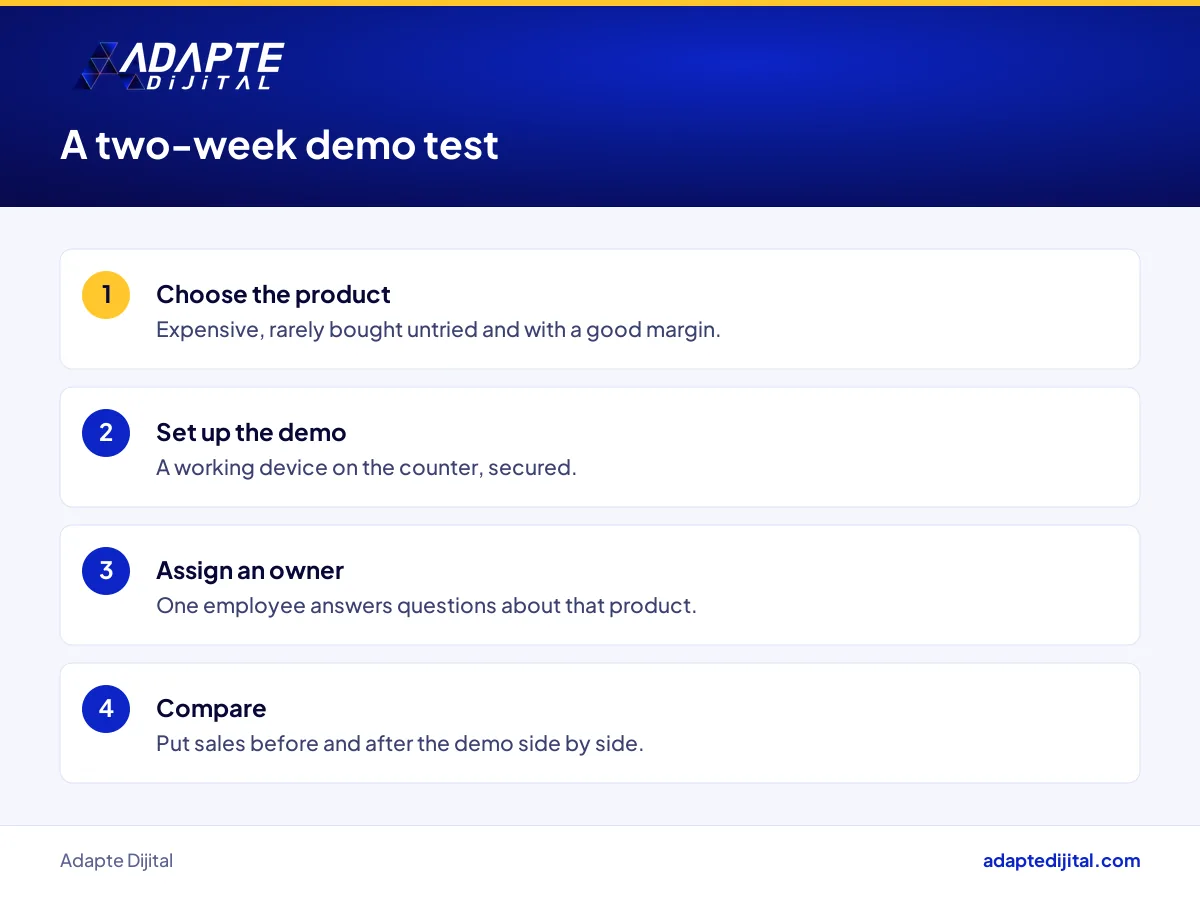
This week, look at how your five most expensive products sell: how many visits does a customer make, and on which visit do they buy? Set up a working demo of one of them on the counter and make one employee responsible for it. After two weeks, compare sales before and after the demo; decide on an experience zone only after this test.
Quick Summary
- Teknosa and Samsung have signed a new partnership for foldable devices (Perakende.org, 16 October 2026).
- According to the plan, Teknosa stores will get experience zones dedicated to foldable devices.
- Joint digital marketing, special campaigns and trade-in schemes are planned (Perakende.org; DHA).
- According to Samsung, the Galaxy Z series is in its eighth generation (DHA).
- The number of stores, the start date and trade-in terms have not been announced.
Short Glossary
- Experience zone
- Experience zone is the term used to describe a store area where products are shown switched on so customers can try them before buying.
- Trade-in
- Trade-in is the sales practice used to value a customer’s old device and deduct it from the price of a new one.
- Sales per square metre
- Sales per square metre is the productivity measure used to divide a store’s or a zone’s revenue by its floor area.
Frequently Asked Questions
Next Step
Let’s plan your store’s experience zone together with an online campaign; fill in the consult your expert form.
Sources: Perakende.org, report on the Samsung and Teknosa partnership, 16 October 2026 · DHA, 16 October 2026 · Samsung Türkiye newsroom, Billy Kim appointment, 13 April 2026
Updated: October 2026
Sık Sorulan Sorular
Teknosa is a technology retailer and an affiliate of Sabancı Holding; Samsung makes foldable phones in its Galaxy Z series. The announcement quotes Teknosa CEO M. Öget Kantarcı and Billy Kim, President of Samsung Electronics Türkiye. Billy Kim’s appointment as President was announced in April 2026 in the Samsung Türkiye newsroom.
According to Samsung, the Galaxy Z series is in its eighth generation of development (DHA). “We are shaping the future of mobile experience with foldable technology,” says Billy Kim (Perakende.org). Prices and technical specifications are not part of this announcement.
How many stores will get experience zones and when, trade-in values, campaign terms and the length of the agreement. Its financial size and any exclusivity have not been disclosed either. So the effect of the partnership cannot be measured yet.
It is a part of the store where the product is shown switched on and ready to try. Unlike a normal shelf, customers can use the product before buying it.
When the product is expensive, rarely bought untried and the customer spends time deciding. For cheap, fast-moving products, a separate zone is costly in sales per square metre. The rent on that space has to come out of the profit of the product you put there.
The customer tries the device, asks the price and buys it somewhere else. So the zone needs a next step: a reservation, a trade-in offer or a personal campaign code. Otherwise the customer walks out and your store becomes someone else’s showroom.
In general, the old device is checked, valued and deducted from the price of the new one. Teknosa and Samsung have not announced trade-in values or terms. A business offering trade-ins should check data wiping and paperwork rules with the official source; this is not legal advice.
The business ends up with second-hand stock, and that stock needs managing too. Options include refurbishing, wholesale transfer or promotional sales. We look at clearing slow-moving stock in our piece on Outlet Center İzmit’s bargain fair.
A foldable device does not sell without being explained. If staff do not know the product, the customer asks the question online and buys there too. Accessories that lift the average basket also need an informed adviser.
An experience zone does not need a separate room; a working demo on the counter and one well-informed employee can do the job. For trade-ins, an agreement with a refurbishing company is one option. The real difference is the time you give the customer.
An online seller cannot offer a zone, but it can offer product videos and comparison tables. If customers try in store and buy cheaper online, the price gap decides. The store’s answer is trade-in and after-sales service.
Counter space is limited; a zone for one brand takes space from the others. Choose using your own sales and profit data. If a manufacturer offers support, it should be written into the contract.
With a “try it in store” call in your ads and an accurate local search listing for the store. If opening hours, address and product details are out of date in local search, the call is wasted. A campaign-specific code helps you count the customers who come in.
Whichever model and feature people search for most on your site should be the star of the zone. We look at search tools that understand and answer customer questions in our piece on Loops AI and the search box. Online questions also give your sales adviser a list of questions to prepare for.
Co-marketing budgets between manufacturer and retailer are usually split by contract. Teknosa and Samsung have not disclosed their split. A small retailer receiving manufacturer support should put in writing which ad comes out of whose budget.
Pick one that is expensive, rarely bought untried and carries a good margin. A product customers often ask about but that just sits on the shelf is a good candidate. Factor in theft and damage risk.
Know in advance who will take the old devices and at what price. Write a valuation rule and apply it the same way to everyone at the till. Without a rule, every trade-in becomes a haggle and the till stops turning over.
When you lack the time or team to build the zone together with online ads and local search. We plan campaigns that link the store experience to online advertising through our digital marketing work. Retail news is interpreted for you on our retail page.
This has not been announced. The announcement says the zones are planned; it gives no store count or date.
Trade-in schemes are at the planning stage. Values and terms have not been announced; check the companies’ own channels for current information.
Yes, you can start with a working demo on the counter and one well-informed employee. Deciding after a few weeks of sales comparison lowers the risk.