
New and closed company statistics in Turkey 2026: what does the TOBB data say?
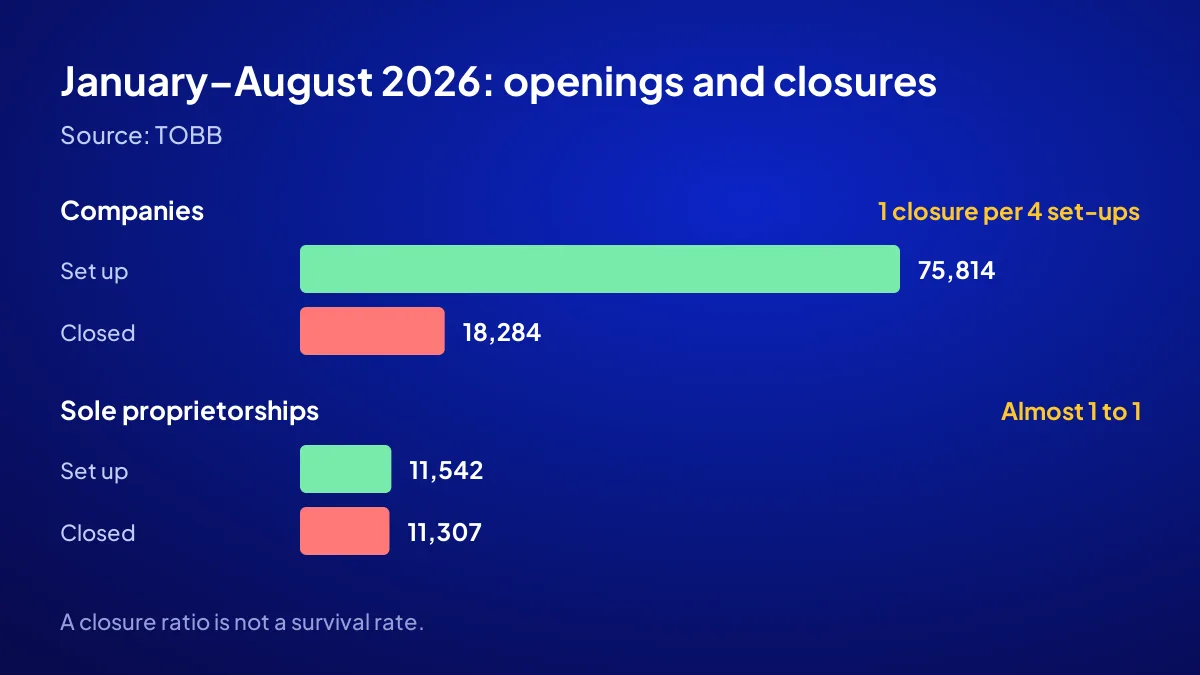
New and closed company statistics in Turkey tell two different stories in 2026. According to TOBB, the Union of Chambers and Commodity Exchanges of Turkey, 75,814 companies are set up and 18,284 close between January and August 2026. That is roughly 1 closure for every 4 new companies. For sole proprietorships, the same period shows 11,307 closures against 11,542 openings; openings and closures are almost level.
Tradesmen’s registers point the same way. According to the Ministry of Trade, in August 2026 new tradesman registrations fall 7.5 percent year on year while deregistrations rise 13 percent. Below, we place each figure with its source and a one-sentence comment. The aim is not to scare you, but to see the real table before you pull up the shutters.
How many companies are set up and closed in 2026?
According to TOBB data released in September 2026, 75,814 companies are set up between January and August, up 6.4 percent from 71,224 in the same period of 2025. Closed companies stand at 18,284, close to last year’s 18,482 and 1.1 percent lower. On the company side, set-ups are speeding up while closures hold steady. The table shows companies and sole proprietorships side by side.
| January–August | 2025 | 2026 | Change |
|---|---|---|---|
| Companies set up | 71,224 | 75,814 | +6.4% |
| Companies closed | 18,482 | 18,284 | -1.1% |
| Sole proprietorships opened | 11,304 | 11,542 | +2.1% |
| Sole proprietorships closed | 10,306 | 11,307 | about +10% |
August on its own
In August 2026, 9,212 companies are set up: 8,223 limited companies and 989 joint-stock companies. Comment: nine in ten new companies are limited companies, so small and medium ventures dominate.
The whole of 2025
According to the KOSGEB bulletin based on TOBB data, 113,779 companies are set up and 33,270 close over the whole of 2025. Comment: the first eight months of 2026 are running slightly ahead of last year’s pace of set-ups.
Why is the picture so different for sole proprietorships?
For sole proprietorships, the gap between openings and closures is very narrow. According to TOBB, across 2025, 17,972 sole proprietorships open while 16,286 close; roughly 9 closures for every 10 openings. In the first eight months of 2026 the ratio tightens further: 11,307 closures against 11,542 openings. A ratio that is 4 to 1 for companies is almost 1 to 1 for sole proprietorships.
This is not a survival rate
Not every closing business opened in the same year. Some are decade-old shops, some convert into companies. Comment: the ratio shows overall churn in the market, not the fate of individual businesses.
The small business cash wall
A sole proprietorship often opens on one person’s savings. Rent, deposit and fit-out drain the till in the first months. If cash runs out before the till starts turning, the shutters come down.
What do tradesmen’s registers say?
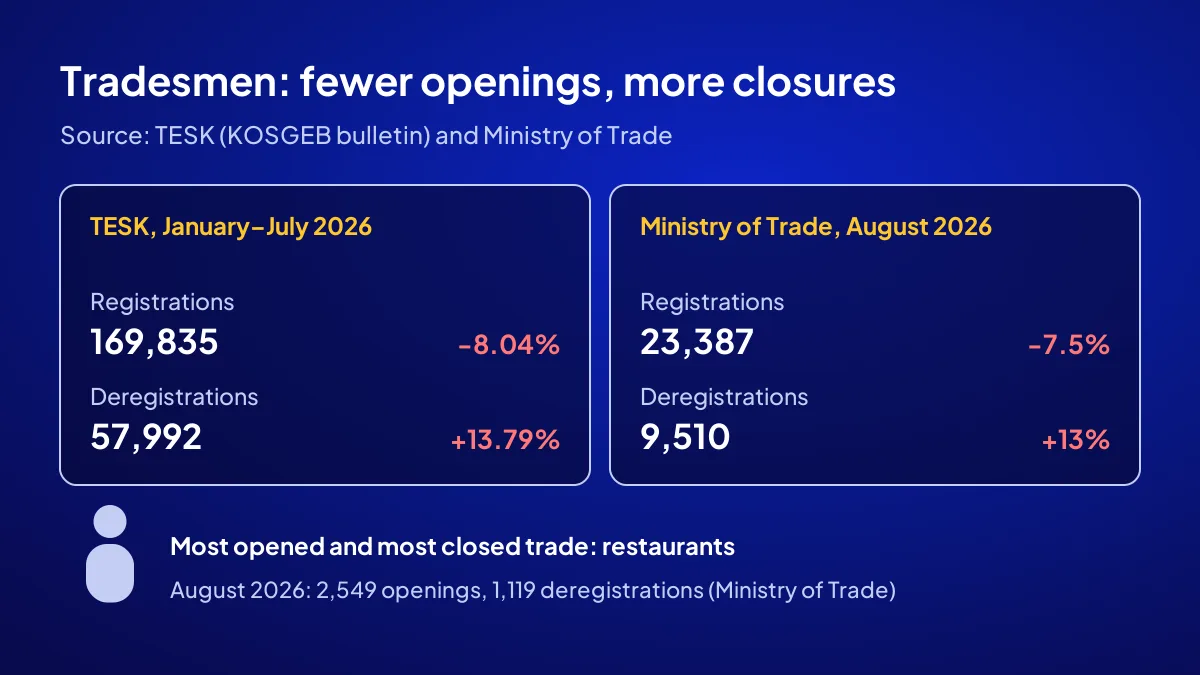
Tradesmen and craftsmen registers show a sharper decline. According to TESK data in the KOSGEB bulletin, from January to July 2026 tradesman registrations fall 8.04 percent to 169,835 while deregistrations rise 13.79 percent to 57,992. The Ministry of Trade’s August 2026 bulletin shows 23,387 registrations and 9,510 deregistrations, with 2,263,146 tradesmen in total.
| Tradesman record | Period | Count | Annual change |
|---|---|---|---|
| Registrations (TESK) | January–July 2026 | 169,835 | -8.04% |
| Deregistrations (TESK) | January–July 2026 | 57,992 | +13.79% |
| Registrations (Ministry of Trade) | August 2026 | 23,387 | -7.5% |
| Deregistrations (Ministry of Trade) | August 2026 | 9,510 | +13% |
What registration and deregistration mean
Registration (tescil) is a tradesman’s entry into the register. Deregistration (sicil terkini) removes the record when the activity ends; according to the definition in the KOSGEB bulletin, tradesmen should apply within 30 days of giving up the trade. Comment: deregistrations are the official trace of shutters coming down.
Two sources, one direction
TESK and Ministry of Trade data come from different record systems, so the numbers do not match one to one. Comment: both show falling registrations and rising deregistrations; the direction is consistent.
Which sectors see the most openings and the most closures?
The businesses at the top of the openings list are also at the top of the closures list. In TOBB’s August 2026 data, wholesale and retail trade leads with 3,276 set-ups and also leads with 717 closures. In the Ministry of Trade’s tradesman data for August, the most opened trade is restaurants (2,549), and the most closed are restaurants and grocery stores (1,119 each).
A crowded door
Where entry is easy, competition is heavy. Opening a grocery, a restaurant or a retail shop does not need a long licence chain or heavy machinery. Comment: easy entry means a crowded doorway.
The sector table
In August 2026, construction sees 198 closures against 1,212 set-ups and manufacturing 266 against 1,155 (TOBB). Comment: the ratio of set-ups to closures in retail (about 4.6 to 1) is similar to manufacturing (about 4.3 to 1), while construction is clearly lower on closures (about 6 to 1).
Where does Istanbul sit in this picture?
Istanbul is the busiest address for both openings and closures. According to TOBB, 37.5 percent of companies set up in August 2026 are in Istanbul. The KOSGEB bulletin shows 27,475 openings and 11,426 closures recorded in Istanbul for January to July 2026. TESK data for the same period shows 24,751 tradesman registrations and 7,796 deregistrations in Istanbul.
Big city, big noise
More customers, more competitors. A hairdresser in Beylikdüzü or Kadıköy speaks to the same customers as several rivals on the same street. Comment: opening a shop in Istanbul means competing for attention.
Comparing provinces
In August, 11.1 percent of new companies are in Ankara and 5.7 percent in Izmir (TOBB). Comment: the three largest cities gather more than half of all new companies.
Which 3 mistakes should you avoid when reading the numbers?
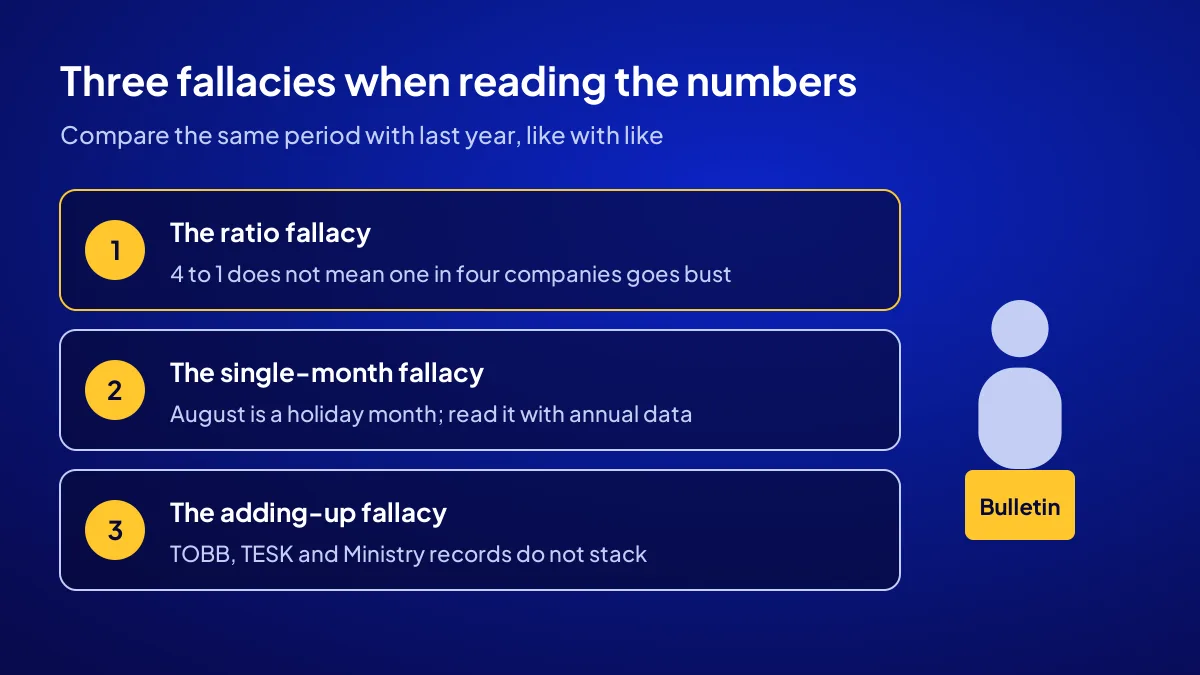
There are three common mistakes: treating the closure ratio as a survival rate, drawing a trend from one month and adding company and sole proprietorship figures together. Each pushes you towards needless fear or needless courage. The right reading compares the same period with last year and the same type with the same type.
- The ratio fallacy: 4 to 1 does not mean “one in four companies goes bust”.
- The single-month fallacy: August is a holiday month; read monthly data alongside annual data.
- The adding-up fallacy: TOBB, TESK and Ministry records are separate systems; they do not stack.
Keep the source next to you
Headlines often push a single number forward. The original bulletin states both the period and the comparison. Open the bulletin before sharing a figure.
What do these numbers tell someone about to start a business?
The numbers say that in easy-entry businesses, shutters go up fast and come down fast. This is not a “do not start a business” message; it is a “see demand before signing the lease” message. With sole proprietorship openings and closures running level, every step that lowers the cash load of the first months is worth taking. Measuring demand online first is one such step.
Demand first, rent second
In the Start a Business Online campaign, a website, 108 articles, a Google Business Profile and GA4 and Search Console measurement are set up for a fixed TRY 36,000 + VAT, with the schedule given in writing after the project plan is approved; with no shop, you appear through a service area. Details are on the Start a Business Online campaign page. The whole approach is in open online before you open a shop.
Cost and the future
The first-6-months comparison of rent versus digital is in shop first or online first. The place of businesses born online in the years ahead is in businesses born online by 2027. For the own site or marketplace question, see own site or marketplace.
Quick Summary
- January to August 2026: 75,814 companies set up, 18,284 closed (TOBB).
- Sole proprietorships: 11,307 closures against 11,542 openings; almost 1 to 1.
- Tradesman registrations fall, deregistrations rise (TESK and Ministry of Trade).
- The most opened sectors and trades are also the most closed.
- 37.5 percent of new companies are in Istanbul (August 2026).
- A closure ratio is not a survival rate.
Short Glossary
Sole proprietorship: A sole proprietorship (gerçek kişi ticari işletme) is the official term used for a business a person registers in the trade registry in their own name.
Deregistration: Deregistration (sicil terkini) is the procedure used to remove a tradesman whose activity has ended from the tradesmen’s register.
Liquidation: Liquidation is the process used to settle a closing company’s receivables and debts and distribute its assets.
Next Step
If you would rather start on the side of demand than the side of statistics, apply to the Start a Business Online campaign; open your business online before signing a lease; the last day to apply is 1 November 2026.
Frequently Asked Questions
Source: KOSGEB — Established and Closed Business Statistics, July 2026 (Turkish)
Sık Sorulan Sorular
According to TOBB, 75,814 companies are set up between January and August 2026, up 6.4 percent on the same period last year. 18,284 companies close in the same period.
The ratio between closures and set-ups shows market churn. Since not all closing businesses opened in the same year, it is not a survival rate.
Yes. In the Start a Business Online campaign, if you have no shop, you appear on Google Business Profile through a service area. The address is added when you open the shop.
Updated: October 2026