
Starting a Business with Agents, Year 1: Annual Review and the Growth Decision
Year one of starting a business with agents is when twelve months of records are read together, agent jobs are reworked and the growth direction for year two is drawn. The question is no longer “do agents work?” but “which agent job truly grew the business?” 📆
This page is the fifth step in the agent business horizon series. It covers what changes in a year, how to run the annual review, how to test the liability arrangement, this period’s mistakes and what is rising over this time frame. Forecasts are marked as forecasts.
What changes in a year?
BU BÖLÜMÜN ÖZETİ
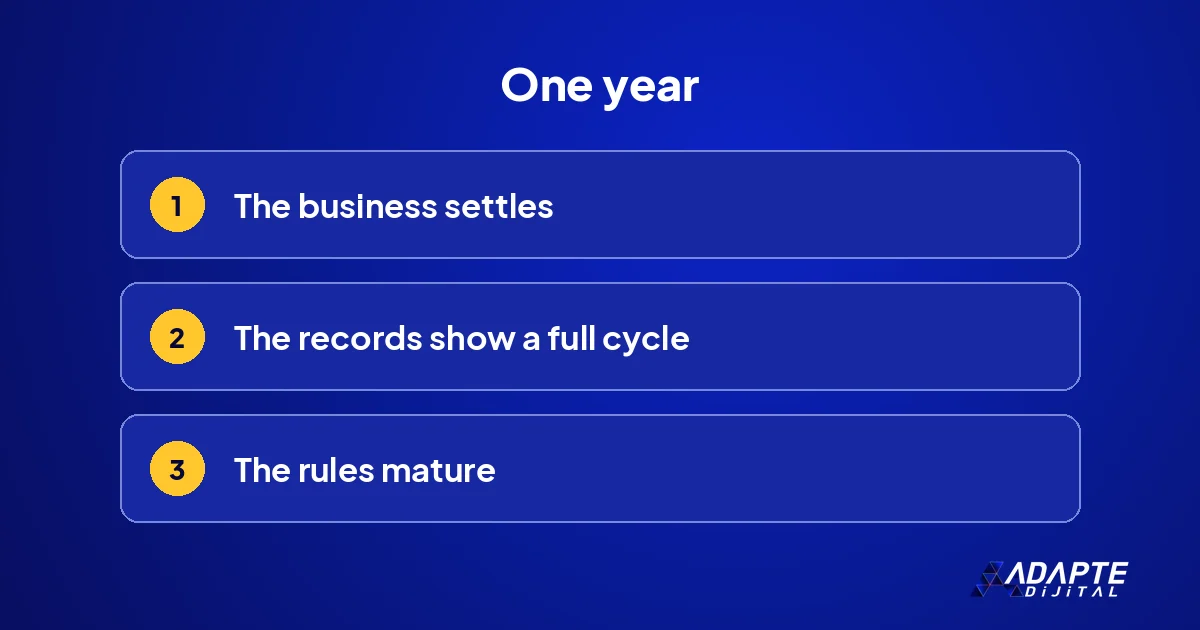
- The business settles
- The records show a full cycle
- The rules mature
A year is the time in which seasons, campaigns and tool changes have all happened at least once. For the first time, the records cover a full cycle.
The business settles
By the end of year one, the business’s product or service, pricing and customer base have largely become clear. Agent jobs have taken shape around that clarity. The arrangement first built through trial and error now reflects the business’s real needs. Jobs that have become unnecessary are visible at this point, and they can be closed without regret. 🏁
The records show a full cycle
Twelve months of records show busy and quiet periods, campaign effects and the results of tool changes together. Annual data filters out the noise of monthly data. This data shows which agent job pays off in every season and which only helps in busy periods. The plan for year two is built on that, rather than on the most recent month.
The rules mature
The rules built up over a year are the sum of the problems the business met and the decisions it made. A mature rules document is a short and usable one. In the annual review, rules nobody follows are deleted and rules often broken are rewritten. As the document gets simpler, the agents’ behaviour becomes clearer and easier to check. 📘
How is the annual review done?
BU BÖLÜMÜN ÖZETİ
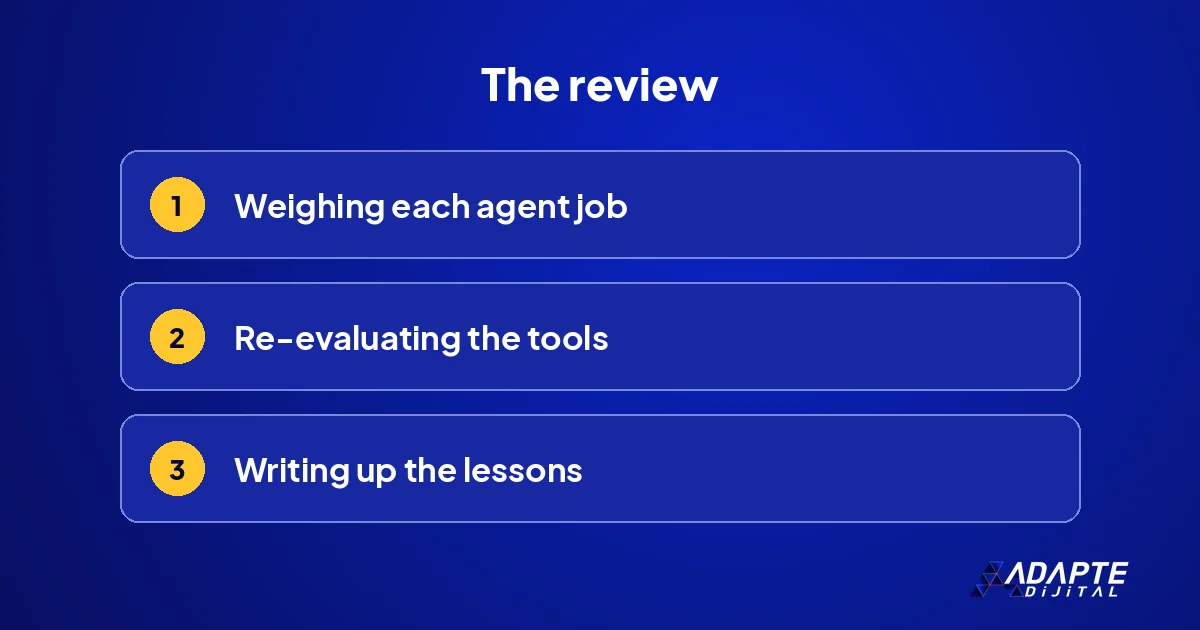
- Weighing each agent job
- Re-evaluating the tools
- Writing up the first year’s lessons
The annual review is a short audit spread over a few weeks. It runs in three steps.
Weighing each agent job
For each agent job, annual net time saved, cost per job, correction rate and customer response are set side by side. A job that does not pay off is closed or redesigned, however familiar it has become. For a job that does pay off, the options for year two are written down: growing it, or adding a connected new job alongside it. ⚖️
Re-evaluating the tools
Over a year, tools’ capabilities, prices and rules may have changed. Is the tool in use today still the best option? In an arrangement where instruction documents are kept independent of any tool, this question is easy to answer; a short comparison trial is enough. The decision is recorded with its reasons, so it can be checked again next year.
Writing up the first year’s lessons
The year’s three biggest successes and three most expensive mistakes are written in a short note. A written lesson stops the same mistake being repeated in year two. The general picture of why businesses struggle in their first year is covered in why businesses close in year one. Your own note can be compared with that picture. 📝
How is the liability arrangement tested?
A business that has worked with agents for a year has had its liability arrangement tested by a real problem at least once. The review focuses on three questions.
Which mistakes happen in year one?
BU BÖLÜMÜN ÖZETİ
- Looking only once a year
- Crediting success to the agent
- Freezing the rules
Mistakes in the annual period are usually about context and continuity.
Looking only once a year
The annual review does not replace monthly record reading; without monthly records, the annual reading stays shallow too. The annual view is built on top of the monthly habit. The review is therefore done by combining monthly notes, not from scratch. That way it is finished in a few weeks instead of becoming a project of its own. ⚠️
Crediting success to the agent
Crediting all of a year’s growth to agents ignores the share of the product, the price and human work. An agent is a tool that speeds up good work; it is not the work itself. If the sources of growth are read together, year two’s investment decisions also go to the right place, rather than simply buying more agent capacity.
Freezing the rules
Treating the first year’s rules as unchangeable makes the arrangement rigid as customers and tools change. The rules document is a living document. In the annual review it is simplified, updated and republished with a date. Earlier versions are kept in an archive, so anyone can see what changed and why. 📚
What is rising over this time frame?
BU BÖLÜMÜN ÖZETİ
- Today: the rules are under discussion
- Forecast: the rules become clearer
- Forecast and log
Over a one-year horizon, the rules for AI use in Türkiye are under discussion. The first item is today’s status; the next two are forecasts.
Today: the rules are under discussion
Bills on artificial intelligence have been submitted to Türkiye’s parliament, and a parliamentary research commission report was debated publicly in 2026. A comprehensive AI law has not yet been passed. The framework in force today is the data protection law, consumer legislation and general liability rules. An agent-run business works within these existing rules. 📅
Forecast: the rules become clearer
Forecast: within a year, the debate on regulating AI use in Türkiye will turn into more concrete drafts, with topics such as transparency and record-keeping coming to the fore. Businesses that build their records and approval arrangement today will adapt to any new rules more easily.
Forecast and log
Forecast: within a year, the annual review of agent-run businesses will become a normal part of the year-end meeting with the accountant. Update log. 12 November 2026: first publication. The forecasts on this page are re-read when they fall due; a forecast that turns out wrong is not deleted but corrected here. The next step in this series is starting a business with agents: year 2.
How is the annual review done with Adapte Digital?
BU BÖLÜMÜN ÖZETİ
- A single delivery package
- What is delivered
- Where to start
We do the annual review as delivered work: each agent job is weighed, tools are re-evaluated, the liability arrangement is tested and a year-two priorities note is delivered.
A single delivery package
Adapte Digital does not charge a monthly management fee. Work starts with a single delivery package whose scope is written down in advance: 36,000 TRY + VAT. If the work grows, the new need is defined as a separate add-on package, priced by what will be delivered rather than by the hours spent. 📦
What is delivered
The output is an agent jobs assessment table, a tool comparison note, a liability arrangement checklist and a year-two priorities note. How to read these records alongside the money coming in and going out is covered in cash flow management.
Where to start
Which packages are open, and at what price, is shown on our campaign pages, item by item. 🧭
Thinking of building a business in this area? Our article on Turkish agent content looks at that door separately.
Quick Summary
- Year one is when twelve months of records are read and year two’s priorities are written.
- The annual review weighs each agent job, re-evaluates tools and writes up lessons.
- The liability arrangement is tested through questions on mistakes, data and approval.
- Looking only once a year and crediting success to the agent are this period’s mistakes.
- Forecasts are re-read in the update log.
Short Glossary
- Annual review
- A short audit in which twelve months of records are read and agent jobs and rules are re-evaluated.
- Liability arrangement
- The written rules for noticing, reporting and fixing mistakes.
- Rules version
- The state of the rules document on a given date.
Frequently Asked Questions
Next Step
Write one line for each agent job: annual net gain, cost per job and correction rate; mark the ones that do not pay off. Our campaign pages list the delivery packages that cover this work.
Sources: TMMOB — TBMM Yapay Zekâ Komisyonu Raporuna İlişkin Görüş (1 Nisan 2026) · KVKK — Üretken Yapay Zekâ ve Kişisel Verilerin Korunması Rehberi (15 Soruda)
Updated: November 2026
Sık Sorulan Sorular
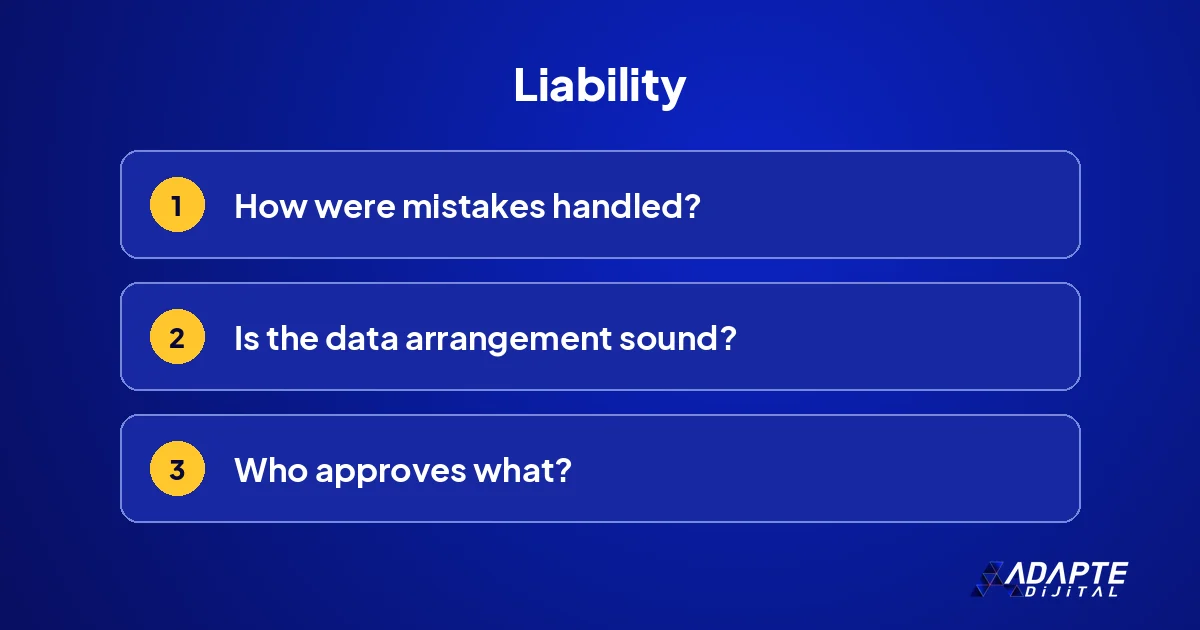
The year’s agent mistakes are read together with how they were noticed, whom they were reported to and how they were fixed. How to respond when an agent gets something wrong is covered in when an agent makes a mistake. A well-handled mistake is proof that the arrangement works. Missed mistakes show which gap in approval and records needs closing first in year two. 🧯
Which data went into which tool, who can access it and how long it is kept are reread. Tracing personal data is a business’s first responsibility under Türkiye’s data protection law. If a contract or privacy notice is found missing in the review, it is completed with a lawyer. The gap is closed before any new agent jobs are added.
How the approval flow changed during the year, who approved which output and whether approval actually happened are checked from the records. Approval that exists only on paper is not approval. Jobs where the approval step is constantly skipped are reorganised, either by changing the rules or by reducing the risk the job carries. ✅
If monthly notes were kept regularly, it is finished in a few weeks. Without monthly records, the missing data has to be gathered first.
If the records show no net gain, yes; it is either closed or redesigned by changing its rules and scope.
Bills have been submitted and are being discussed, but a comprehensive AI law has not yet been passed. Today the data protection law, consumer legislation and general liability rules apply.