
What do deli customers want? Experience at tasting, comfort in ordering, time saved
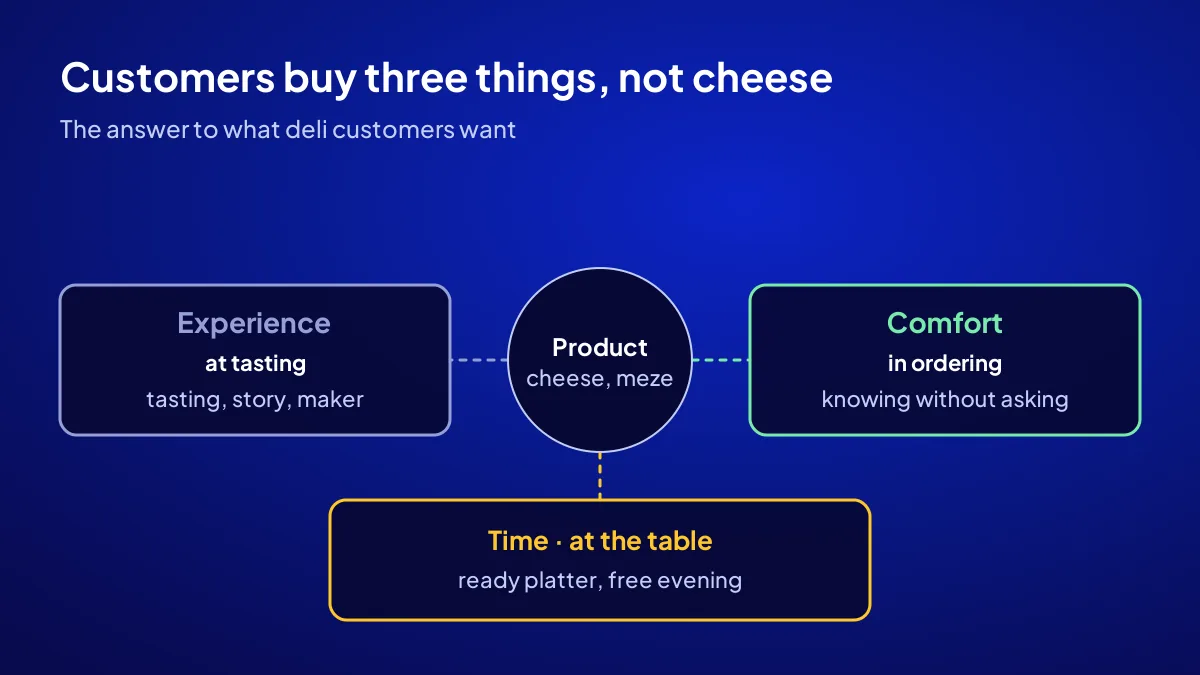
The answer to what deli customers want is not cheese or meze; it is the three things those products bring. Experience at tasting, comfort in ordering, time at the table. In an affluent district, a customer of a gourmet deli and meze shop can find the product elsewhere. What they buy from you is who they buy it from, how, and with how little effort.
Most people do not know this: a single word on the counter already makes a promise about all three. Write “daily meze” and you promise freshness. Under the labelling guide of Turkey’s Ministry of Agriculture and Forestry, “daily” (günlük) may only be used for food with a shelf life of 24 hours. The freshness your customer looks for is measured in hours in the rules too.
What does a “daily meze” sign promise the customer?
“Daily” tells the customer the product was made today and is sold to be eaten today. The Ministry’s guide limits the word to food with a 24-hour shelf life and, when it is used, asks that the day of production be stated as well. The rule points the same way as a selective customer’s instinct: freshness is not an adjective, it is a time.
Natural, homemade, organic
The guide expects a “natural” product to contain no additives or added ingredients and leaves no room for claims like “100 percent natural” or “most natural”. “Homemade” is not used for food produced at industrial scale. “Organic” belongs only to certified products.
What does buying an experience mean at a gourmet counter?
BU BÖLÜMÜN ÖZETİ
- Tasting
- The story of the product
- The person behind the counter
Experience is what the customer lives before buying: the tasting, the conversation, the story of the product. On a supermarket shelf cheese waits in silence; at a gourmet counter someone cuts a piece and tells you where it comes from. Customers pay more for those minutes. Without them you are an expensive supermarket.
Tasting
Tasting before buying is the gourmet customer’s favourite right. It carries product knowledge to the mouth and speeds up the decision.
The story of the product
Which village’s milk, how many months of ageing, which meze it goes with? A three-sentence story turns an item into a topic the customer repeats to guests that evening.
The person behind the counter
The name of whoever makes the meze and chooses the cheese is known. Customers grow used to a craftsperson, not a shop.
How is comfort measured when ordering?
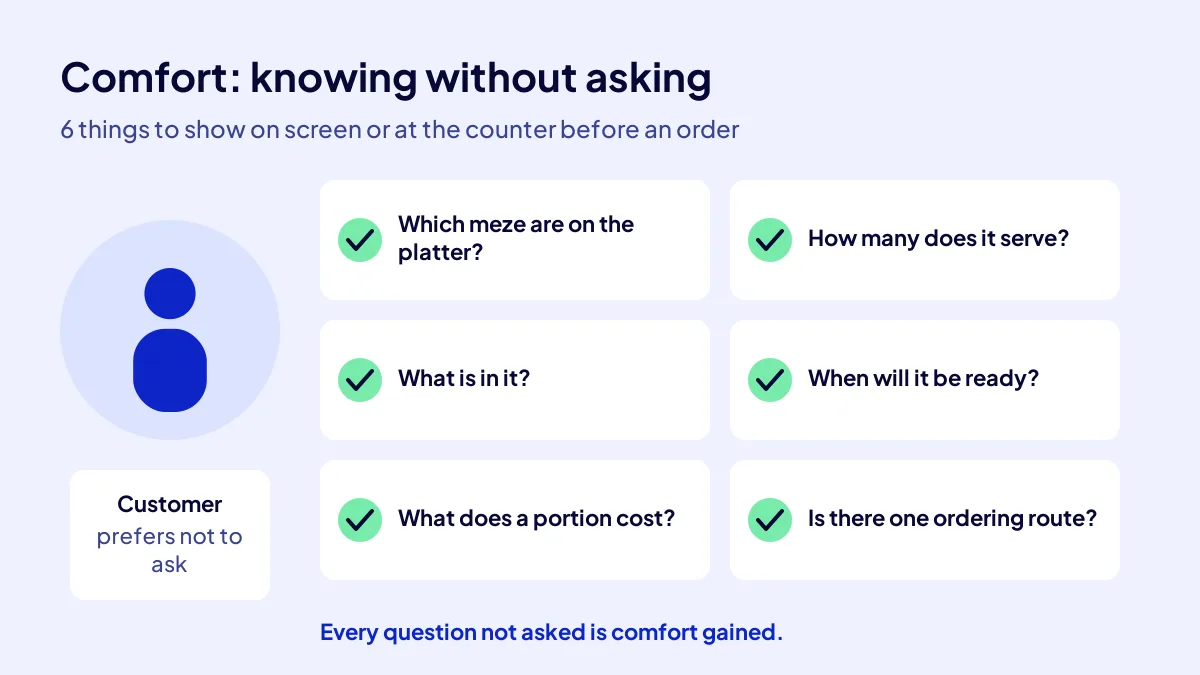
Comfort means the customer never has to ask. What is on the ready platter, how many people does it serve, what is in it, when will it be ready? If those answers are written on screen or at the counter before ordering, the customer feels at ease. Every question is a small effort; the more effort, the less comfort.
The ordering route
Phone, WhatsApp or a site form: keep one clear route. Three routes make customers wonder which one works.
The state of the package
The cold chain, keeping a product cold from the counter to the table, is the invisible part of comfort. A cool bag and a properly sealed tub tell the customer they can relax all the way home.
How does time show up at the table?
BU BÖLÜMÜN ÖZETİ
- Preparation time
- Options by head count
- A small smile
Time is the hours the customer does not spend in the kitchen. Preparing ten kinds of meze for a dinner party takes half a day; a ready platter gives that half day back. A selective customer treats time as their most expensive asset. So a “ready platter” is a product for you and a free evening for them.
Preparation time
Write how many minutes a platter takes, so the customer can plan the day.
Options by head count
Options for 6, 12 and 18 people remove the calculating, and customers decide faster.
A small smile
A cheese board is really the host’s insurance policy. If someone says “that was lovely” after the guests leave, the policy has paid out.
On which screen is each of the three tested?
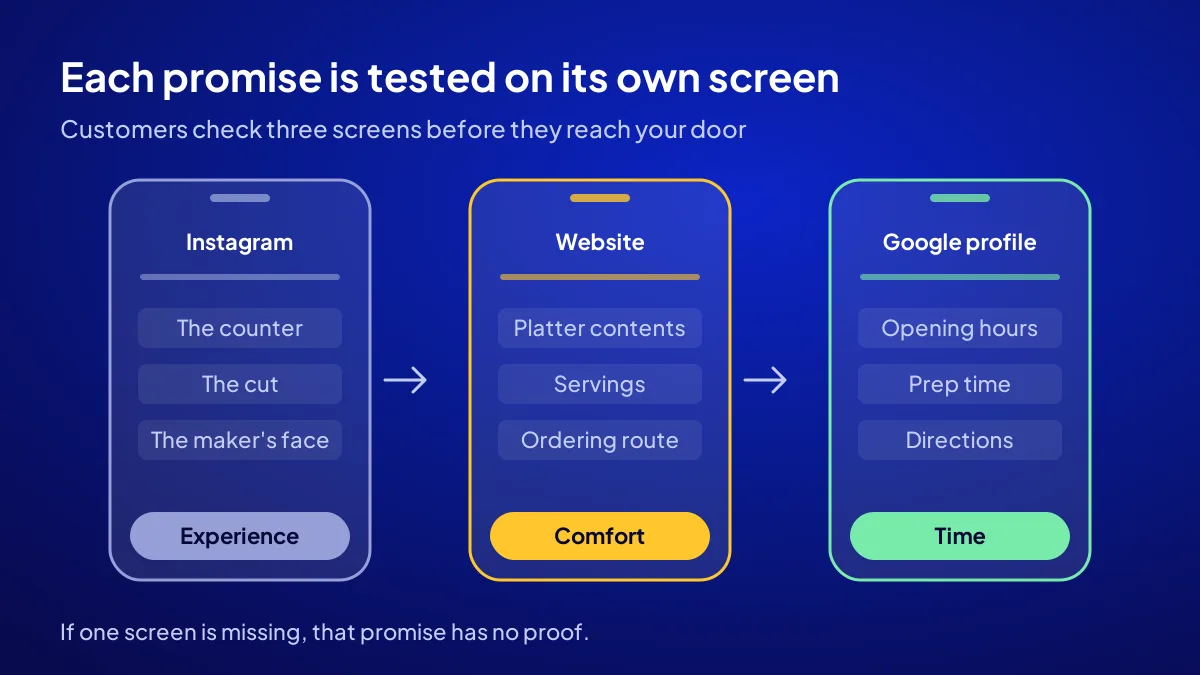
Customers test all three before they reach your door, each on a different screen: experience in photos, comfort on the website, time in the hours and order details on the Google profile. If one screen is missing, that promise has no proof.
| What is bought | Where it is tested | What the customer wants to see |
|---|---|---|
| Experience | Instagram and profile photos | The counter, the cutting, the maker’s face, the product’s source |
| Comfort | Website | Platter contents, servings, one ordering route |
| Time | Google Business Profile | Opening hours, preparation time, directions |
Photos carry experience
The Instagram window shows experience but cannot carry the decision alone. We explored that gap in deli Instagram promotion.
The site carries comfort
Platter contents and the ordering route live on the site. We listed the pages you need in deli website pages.
Why answer the price question before the till?
When products are sold by weight, price is the question customers are most shy to ask. A selective customer objects to surprise, not to expensive. With a portion price next to the price per kilo, they reach the till prepared. A customer forced to ask feels measured and leaves quietly.
Portion language
Instead of “this much per kilo”, say “250 grams is enough for breakfast for four”. Price becomes a table, not a number.
Behind the price question
We explained why customers always start with price in why do they only ask about price. In short: a customer who cannot see the value looks at the price.
How do the three become a brand?
Experience, comfort and time become a brand when told in one voice across the sign, the site, the package and Instagram. Positioning, saying in one sentence who you are for and how you differ, is the base of that voice. Name, colour and typeface are built on it.
Places and deadline
There are 12 brand places and the last day is 1 November 2026; just mention the 10 percent coupon code when you apply. Details are on the campaign page. The full plan is in the new deli promotion guide, the order of the first three months in the first 90 days plan.
Now you know
Customers do not buy the cheese; they buy the three things that come with it. A shop that knows which screen tests which one wins before the first visit.
Quick Summary
- Deli customers buy three things: experience at tasting, comfort in ordering, time at the table.
- Under the Ministry’s guide, “daily” may only be used for food with a 24-hour shelf life.
- Experience is tested in photos, comfort on the site, time on the Google profile.
Short Glossary
Cold chain: The cold chain is the routine used to keep chilled food at the right temperature from production to the table.
Mass catering place: A mass catering place is the regulatory term used for businesses where food is served and eaten on site, such as restaurants, cafés and meze houses.
Positioning: Positioning is the brand work used to say in one sentence who a business is for and how it differs.
Next Step
To turn your experience, comfort and time promise into one brand voice, apply to the Your Own Digital Brand campaign. Fill in the form and mention your coupon; consulting starts with payment.
Frequently Asked Questions
Source: Ministry of Agriculture and Forestry — Food labelling and consumer information guide updated
Sık Sorulan Sorular
A premium customer reads the label, looks at the product, then looks at you. If word and product do not match, trust cracks right there.
The rule is short: do not write a word you cannot prove. If you say “made every morning”, make it every morning; if you say “from Ezine”, keep the invoice at hand. Ask the provincial office about any word you are unsure of.
With its guide updated on 13 March 2026, the Ministry added consumer information on ingredients and energy values for food served at mass catering places, meaning businesses where food is served on site. Compliance periods differ by business size; according to press reports, small traders have until the end of 2027. The information can be given on the menu, by QR code or on a screen.
The Your Own Digital Brand campaign sets up, at a fixed TRY 36,000 + VAT: brand consulting, a TÜRKPATENT preliminary search (not a legal opinion), a digital identity chosen from 3 directions, a 6-page brand site with domain and 1 year of hosting, and 108 AI SEO-ready articles. The domain is registered in your name. Packaging and label design come as an add-on offer.
Freshness, the source of the product and how easy ordering is. A selective customer can find the product elsewhere; they choose you for the tasting, a clear ordering route and the time you save them.
Under the labelling guide of Turkey’s Ministry of Agriculture and Forestry, “daily” may only be used for food with a 24-hour shelf life. If unsure, ask the provincial office.
The package includes brand consulting, a digital identity, a 6-page site and 108 articles. Packaging and label design are not included and come as an add-on offer.
Updated: October 2026