
New deli promotion: 9 steps to the first customer for a gourmet deli and meze shop
New deli promotion starts with trust in freshness, not with the cheese board in the window. A selective customer leans over the counter and asks two things: when was this meze made, and where does this cheese come from? The right order: first the food business registration and the words on your labels, then the Google map and the phone screen, and only then the story of the table, the experience itself. A gourmet deli and meze shop that follows this order finds its first customer in 9 steps.
Look, at seven in the evening the same scene plays out in Kadıköy and in Çankaya. Someone leaves work with guests coming and one hour to spare, and types “deli near me”. In 2026 that decision has three stops: the Google Business Profile, the shop’s own website and an AI assistant. All three should show the same name, hours and way to order.
Why does new deli promotion start with freshness?
BU BÖLÜMÜN ÖZETİ
- The risk at the guest table
- Say you are an architect in Moda
- Three questions, one decision
A gourmet deli sells something the customer puts in their mouth. At a hair salon the result shows in the mirror; here it shows at the dinner table, in front of guests. So the customer’s first question is not taste but trust: the cold chain, the day it was prepared, a product with a known source. Promotion answers that first; price and range come after.
The risk at the guest table
In affluent districts meze and cheese are often bought for guests, so the first visit is a small test: 200 grams of cheese, two tubs of meze. If it goes well, Saturday breakfast and then the dinner party follow.
Say you are an architect in Moda
Six people are coming on Friday. You type “meze shop” and four places appear. One lists order times, ready platters and the day each meze was made; the others show only a window photo. You know who gets the order.
Three questions, one decision
Is it fresh? Will it be ready on time? Will it embarrass me in front of guests? If a screen leaves one unanswered, the customer moves to the next card.
Which registration and label rules come before the shutters go up?
Three things are settled before any promotion: the food business registration, the words you use on products, and the rules on discounts and reviews. The provincial office of the Ministry of Agriculture and Forestry and your municipality cover the first two. The third changed in 2026 and directly affects online promotion.
Food business registration
Under Turkey’s regulation on the registration and approval of food businesses, retail and mass catering businesses are subject to registration. The application is made within 30 days of receiving the workplace opening and operating licence. If customers sit and eat meze on site, ask the provincial office which class you register under. If you will cure your own pastırma or sucuk and sell it to other businesses, approval rather than registration may apply; get it confirmed in writing.
Discounts, reviews and the ad label
An amendment to the Commercial Advertising and Unfair Commercial Practices Regulation, published in the Official Gazette on 1 July 2026, says a discount must show the lowest price of the previous 10 days as the old price. Posts made in return for a benefit need an “ad” or “promotion” label, and reviews whose purchase cannot be verified may not be published. We worked through opening discounts in do opening discounts work.
On what calendar are the 9 steps to the first customer taken?
BU BÖLÜMÜN ÖZETİ
- Before opening: registration, words, profile
- Opening month: tasting, announcement, orders
- Days 31 to 90: reviews, list, numbers
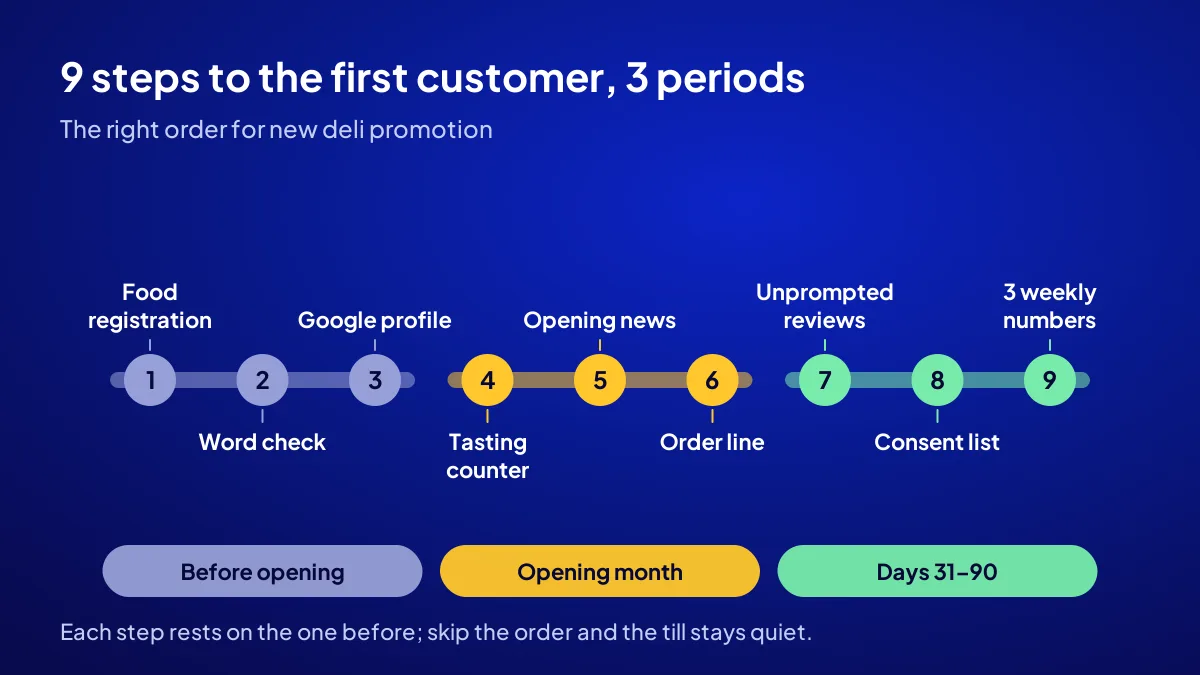
The nine steps fall into three periods. Before opening, registration, the word check and the Google profile are prepared. In the opening month come a tasting counter, the opening announcement and an order line; between day 31 and day 90 come unprompted reviews, a permission-based customer list and weekly measurement. Each step rests on the one before; skip the order and the till stays quiet even with ads running.
Before opening: registration, words, profile
Step one: no announcement until the licence and food registration are done. Step two: every word on the sign, the menu and the website is checked. Step three: the Google Business Profile is set up with the opening date; Google can show a verified profile 90 days before that date.
Opening month: tasting, announcement, orders
Step four: a tasting routine at the counter, so customers taste before they buy. Step five: the opening announcement names the district, address, hours and how to order. Step six: a phone or WhatsApp order line opens, with platter preparation times written down.
Days 31 to 90: reviews, list, numbers
Step seven: ask for reviews without offering anything in return. Step eight: get explicit permission from customers you want to send offers to; in Turkey commercial message consents are managed through the Message Management System (İYS). Step nine: every Monday, three numbers go in the notebook.
Which three factors move you up the map?
Google ranks local results on three factors: relevance, distance and prominence. Relevance is how well your profile matches the search; distance is how far you are from the customer. Prominence is how well known the business is, fed by reviews and online presence. A new shop is weak on prominence, and clarity, meaning relevance, closes that gap.
Distance is fixed, relevance is not
You cannot move the shop. But listing products such as “aged kaşar”, “olive oil meze” and “cheese board for a dinner party” on the profile and site matches more searches. Whatever word the customer types should be on the profile.
Prominence builds slowly
For 90 days after opening, Google shows a “Recently opened” tag on the profile; that is the window for collecting first reviews and photos. We laid out the weekly plan in the new deli first customers plan.
How do you show experience, comfort and time on a screen?
BU BÖLÜMÜN ÖZETİ
- The tasting moment
- Ready platters and the time promise
- The name behind the counter
Experience is shown through detail, not adjectives. “Select flavours, quality products” convinces nobody. A sentence like “olive oil dishes are made every morning, cheese is cut by knife, a platter for six is ready in 45 minutes” does. A selective customer buys a routine, not a promise.
The tasting moment
Introduce the product, say where it comes from, offer a small piece. Tasting is the cheapest and most effective promotion a gourmet counter has.
Ready platters and the time promise
For a premium customer, time is the second product after taste. Write how many minutes a platter takes and when an order can be collected. A delay message that arrives when guests are at the door loses a customer for good.
The name behind the counter
Put the name and face of whoever makes the meze and chooses the cheese on the website. We looked at what customers really buy in what deli customers want and at announcing the opening in deli opening announcement.
How wide is the gap between being seen and being chosen?
BU BÖLÜMÜN ÖZETİ
- Short keyword, long question
- What it means for a deli
- Here is what I have seen
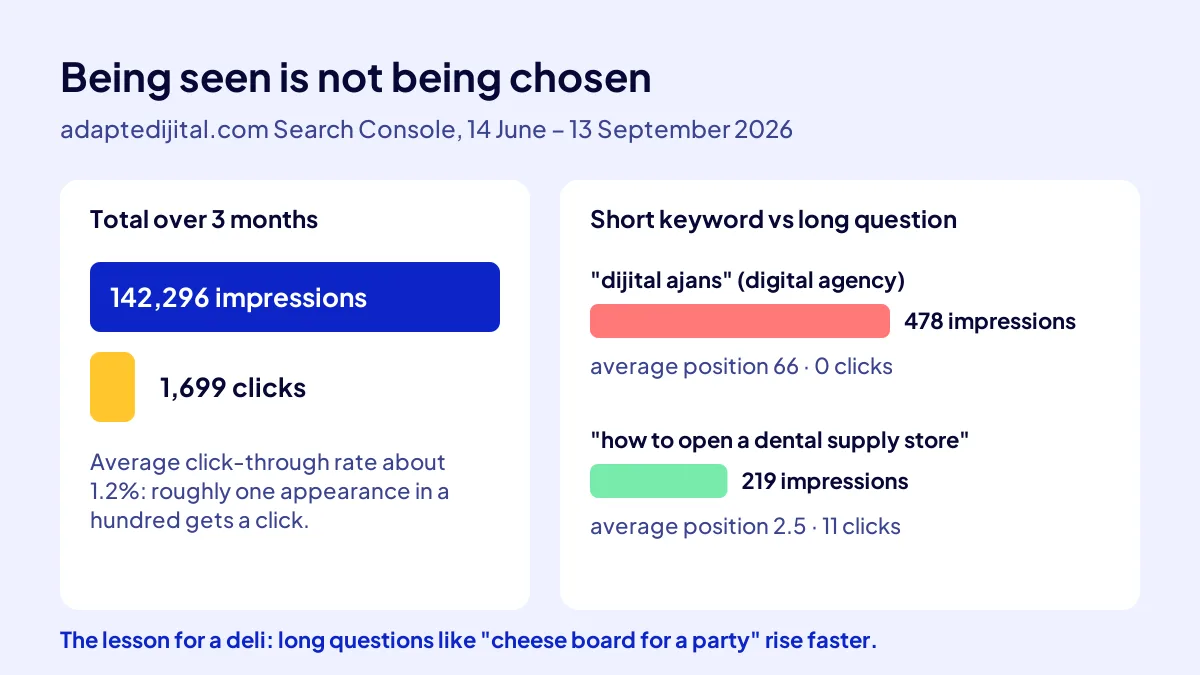
Being seen means your name appears on a screen; being chosen means the customer places an order. Our own Search Console data shows the gap: between 14 June and 13 September 2026, 142,296 impressions and 1,699 clicks, an average click-through rate of about 1.2 percent. Roughly one appearance in a hundred becomes a click.
Short keyword, long question
For “dijital ajans” (digital agency) we appear 478 times at an average position of 66, with zero clicks. For “diş deposu nasıl açılır” (how to open a dental supply store) we sit at an average position of 2.5 with 219 impressions and 11 clicks. A long question with clear intent climbs far faster than a short keyword.
What it means for a deli
Ranking for “deli” is slow. Ranking for “cheese board for a dinner party in Bakırköy” is much closer. Let every product and platter page answer a question like that.
Here is what I have seen
I test more than 100 domains and sites and look at search results every day. With a keyword domain, reaching the top for a term I could not crack for years within a single month is possible. The lesson: the right name and the right question come before a big budget.
Which shortcuts make a gourmet counter look cheap?
In a selective district the most expensive mistake is looking cheap. A new discount every week, an uncertified “organic” sign and bought reviews break a premium customer’s trust on the first screen. Some are also against the rules. The six shortcuts below look like they bring the first sale, then bring the shutters down early.
- Writing “organic” on uncertified products or “homemade” on industrial ones.
- Asking for reviews in return for money, gifts or a free platter.
- Announcing a new discount every week.
- Giving a vague answer when asked what day the meze was made.
- Sending bulk promotional messages to numbers without consent.
- Adding the district name or “best” to the business name on the map.
Which deli is the TRY 36,000 recipe for?
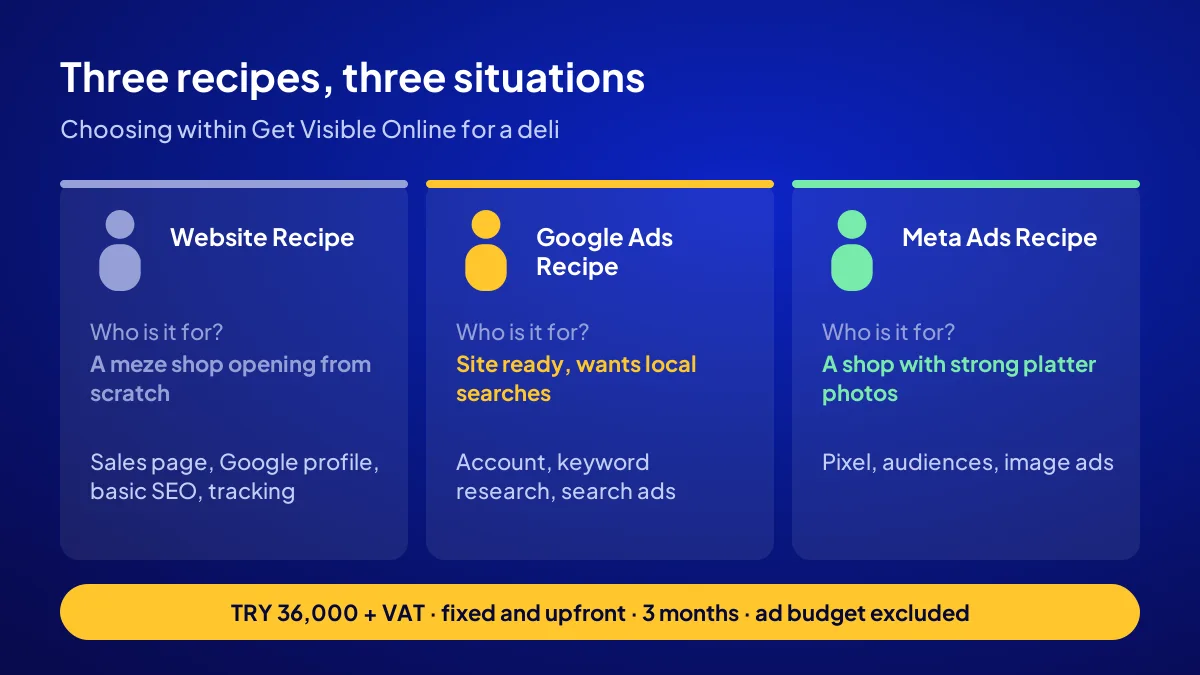
The Get Visible Online campaign is a 3-month period at a fixed, upfront price of TRY 36,000 + VAT. With 20 percent VAT that is TRY 43,200; check the current rate on the invoice. You choose one of three recipes: Website, Google Ads or Meta Ads. The ad budget is not included and is paid separately to Google or Meta.
| Recipe | What is set up? | Which deli is it for? |
|---|---|---|
| Website Recipe | Mobile-friendly sales page, contact buttons, Google Business Profile, basic SEO, visitor tracking | A meze shop opening from scratch with no site or profile |
| Google Ads Recipe | Ad account, keyword research, search campaigns, conversion tracking | A shop with a site ready that wants to appear now for “deli” or “meze order” in its district |
| Meta Ads Recipe | Pixel setup, audience settings, image and text ads, conversion tracking | A shop with strong platter photos that wants to reach its district on Instagram |
What decision is made at the end of day 90?
Look at three numbers: calls and direction requests from the profile, order messages, and customers who return the following week. The first two come from the Google profile performance screen and your phone, the third from receipts. Twelve weeks of numbers point in a direction. Decide by that, not by a quiet Tuesday afternoon.
What the second week means
In a deli, the real signal is the second week. A first-time customer is testing you; one who returns has started a habit. If that rate is low, look at freshness or preparation time before promotion.
Let me ask you one thing
If a customer looked you up on their phone tonight, would the first screen show the day your meze was made and how to order? If not, your first step is clear: build that screen first.
Quick Summary
- Gourmet deli promotion starts with trust in freshness: source, preparation day, order time.
- “Organic” only on certified products; “homemade” never on industrial ones.
- On day 90 the real signal is the customer who comes back the next week.
Short Glossary
Food business registration: Food business registration is the official procedure used to notify retail and catering businesses to the provincial office of the Ministry of Agriculture and Forestry.
Mass catering business: A mass catering business is the regulatory term used for places where food is served and eaten on site, such as restaurants, cafés and meze houses.
Prominence: Prominence is the local ranking factor Google uses to judge how well known a business is, based on reviews and online presence.
Next Step
To set up your deli’s profile, mobile page and visitor tracking before opening, apply to the Get Visible Online campaign. Fill in the needs form and the right recipe for your shop will be suggested.
Frequently Asked Questions
Source: Ministry of Agriculture and Forestry — Food business registration procedure and required documents
Sık Sorulan Sorular
“Organic” is not decoration. Under Turkey’s Organic Agriculture Law, organic labels and logos are used only for organic products, and the law treats organic, ecological and biological as the same term. The Ministry’s labelling guide also does not allow “homemade” on food produced at industrial scale. If your supplier has no certificate, keep these words off the sign.
The primary category says what the business is in one phrase. If most of your turnover is cheese and charcuterie sold over the counter, lead with that; if it is meze served at tables, lead with that instead and list the other side as an additional category and in your products. We covered category choice and every field in deli Google Business Profile.
An honest sentence builds trust: “We make the olive oil dishes every morning; the card in the fridge shows the day.” A freshness promise you break costs more than no promise.
A competitor bending the rules gives you no right to do the same. In Bebek and Çeşme, selective customers notice inconsistency quickly.
Opening from scratch? The groundwork, the Website Recipe, comes first; ads should not send traffic to an empty door. If the groundwork is done and rent is due, the ad recipes step in.
Now, the order: you fill in the needs form, Adapte suggests the right recipe, and delivery starts with payment. At the end of the first month the results are reviewed together. If you have a coupon code, mention it when you apply or in the call. Details are on the Get Visible Online campaign page.
Profile searches often move in the first weeks; product pages build their effect over months. Even aged kaşar waits months on the shelf; expecting maturity from a week of promotion is unfair to the cheese.
First complete the licence and food business registration and check the words on your sign and menu. Then set up the Google Business Profile with the opening date and announce with your order route, opening hours and preparation routine.
“Organic” and its equivalents are only for certified organic products. The Ministry’s labelling guide does not allow “homemade” on food produced at industrial scale. If unsure, ask the provincial office.
No. The package is TRY 36,000 + VAT, paid upfront at a fixed price; with 20 percent VAT that is TRY 43,200, so check the current rate on the invoice. If you choose the Google Ads or Meta Ads Recipe, the ad budget is paid to the platform separately.
Updated: October 2026