
Deli Google Business Profile: the right category and 6 key fields for a meze shop
A deli Google Business Profile is the first shop window a selective customer sees before reaching your counter. It rests on six fields: name, category, address or service area, hours, menu and product description, and photos. Get all six right and someone in Kadıköy typing “deli” or “meze” finds you, understands what you sell and asks for directions. Miss one and even a passer-by walks on to a rival’s cheese fridge.
Most people don’t know this: in Google’s own help page, a deli is not the example of a primary category. It is the additional category of a grocery store, next to a bakery. So the category describes what keeps the till ringing, not what the shop looks like. For a meze shop, it even decides which profile features open up.
Why does a deli profile start with the category?
Because the category is the first signal Google uses to decide which searches you appear in, and it affects local ranking. Google also unlocks special features by category; restaurant categories can add menu items, ordering and reservation links. A shop in the wrong category is like a jar with the wrong label. However good the olives inside, nobody looks for them on that shelf.
You choose from the list
You cannot invent a category; you pick from Google’s list, stepping down to the closest general one if no narrow match exists.
The “this business is a…” test
The category should complete the sentence “This business is a…”. Selling olive oil does not make you an olive oil producer.
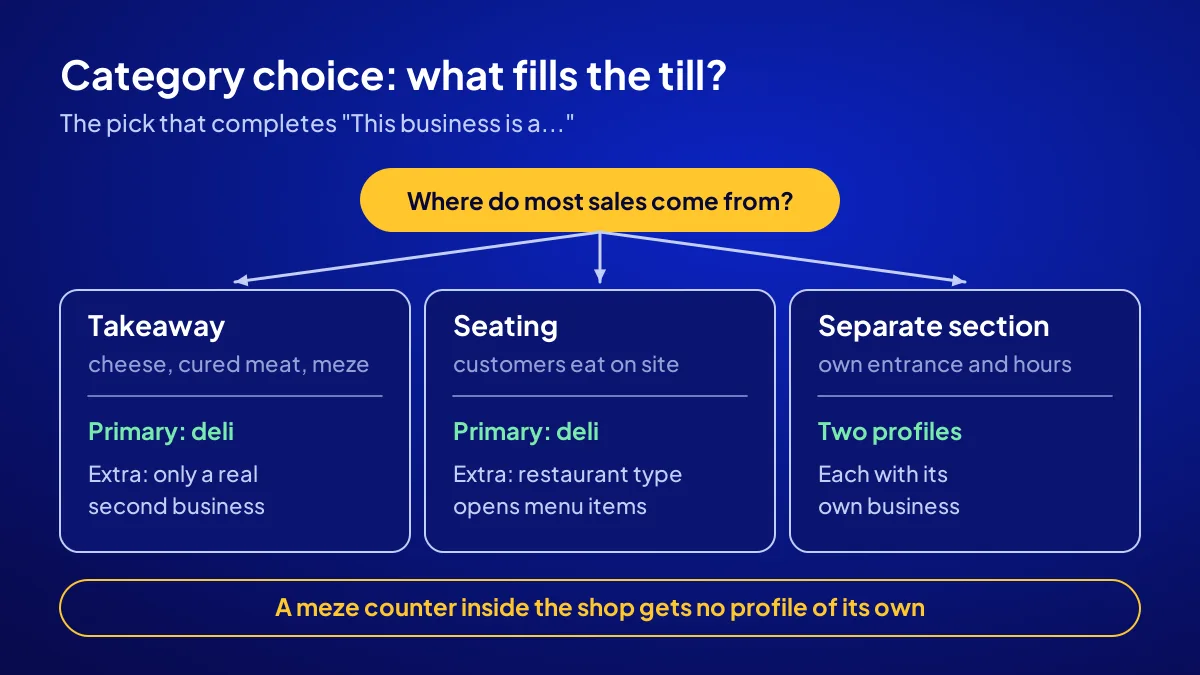
How does a meze shop split primary and additional categories?
BU BÖLÜMÜN ÖZETİ
- Takeaway meze
- If you have seating
- A counter inside the shop is not a separate profile
The primary category describes the business behind most of your receipts. In a gourmet deli that is usually cheese, cured meats and takeaway meze, so the primary category is the narrowest option that describes a deli. An additional category describes a second business you really run, not a word you want to rank for. Google advises keeping to a few.
Takeaway meze
If customers take meze home in tubs, the primary category stays deli. Hummus and haydari belong in the description and photos, not in categories.
If you have seating
If people eat at your tables, a restaurant-type additional category makes sense and opens menu items. Without tables, it leaves hungry visitors standing.
A counter inside the shop is not a separate profile
Google states that a product department or hot food bar inside a store cannot get its own profile. If your meze counter is part of the same shop, one profile is enough. An independent section with its own entrance, sign and hours can have its own.
| Situation | Primary category | Additional category |
|---|---|---|
| Most sales are cheese, cured meats and takeaway meze | Narrowest option describing a deli | Only for a real second line of business |
| Seating, customers eat on site | Deli | A restaurant-type category |
| Meze restaurant with its own entrance and hours | Two separate profiles | Each with its own business |
Can you add the district or “best meze” to the business name?
No. Google wants the name exactly as it appears on your sign, website and documents; adding unnecessary information is against the rules. Slogans, phone numbers, URLs, locations and all-caps spelling stay out. A tag like “Moda gourmet meze freshest” puts the profile at risk.
Sign name, profile name
If the sign shows only the shop’s name, so does the profile.
Same name, address and phone everywhere
Use the same name and address on Instagram, your website, invoices and your own meze labels. The district belongs in the address field. Setting up a profile from scratch is covered in how to set up a Google Business Profile.
Address, service area or both?
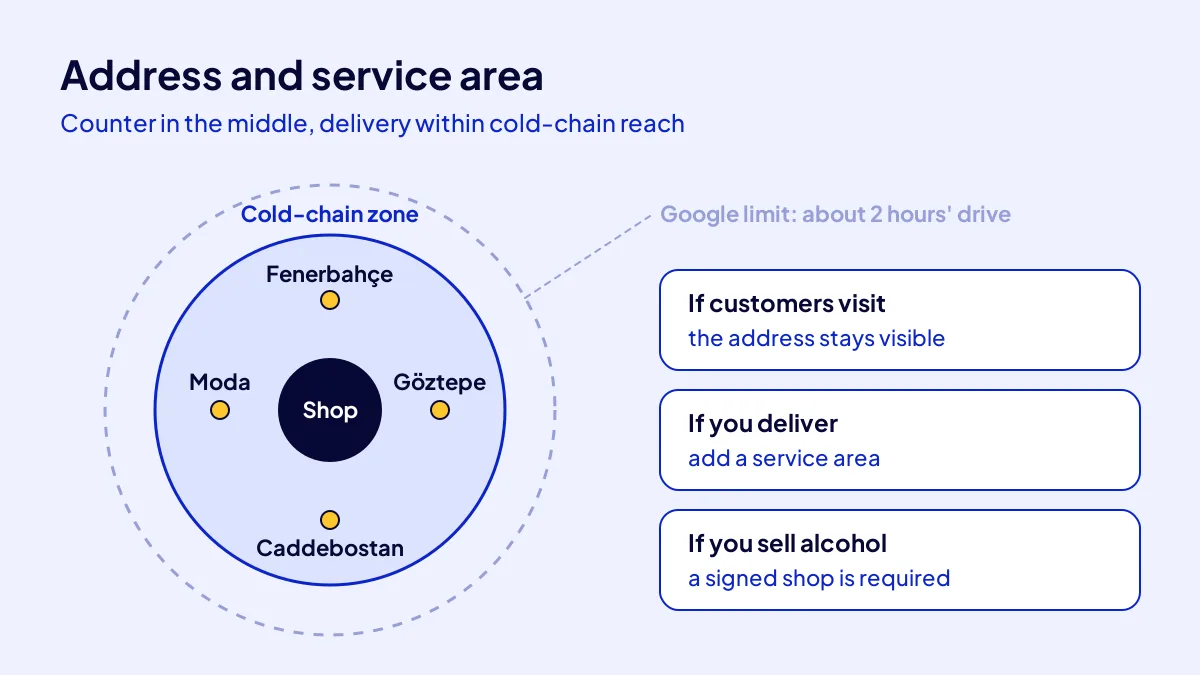
If you welcome customers at the counter, the address stays visible. If you also deliver, you add a service area next to it. Google says a service area should not extend beyond about two hours’ drive from the business. For a gourmet deli the realistic zone is much tighter: the few neighbourhoods meze can reach without breaking the cold chain.
Selling without a storefront
Without a signed shop, the address is hidden. For food sales, check registration rules with your local directorate of agriculture and forestry first.
A note on alcohol
Google does not treat a business selling age-restricted products such as alcohol as a service-area business without a signed storefront. If you sell drinks with your meze, the profile uses the shop address.
Which questions do the menu, product text and photos answer?
The menu and product text answer “do they sell it”, the photos answer “do they do it well”. A selective customer does not trust “gourmet products”; list aged kashar, pastırma, lakerda and Cretan dip by name. A trained palate stops when it sees its own cheese named.
Six photo shots
Facade, full counter, cheese fridge, meze display close-up, packaging and any seating. Real and current; stock photos break premium expectations first.
“Organic” and “homemade” in the description
Write only claims you can document. Turkey’s Organic Agriculture Law No. 5262 bans selling uncertified products under the organic name. “Homemade” or “natural” must not mislead about the production method either.
How should hours reflect seasons and weekends?
Google asks for the regular hours you are open to customers and allows seasonal hours to be used as regular hours. A meze shop in Çeşme that opens for summer and pulls down the shutter for winter marks the profile “temporarily closed” at the end of the season. For restaurants, the hours that count are dine-in hours. Wrong hours become a locked-door review.
Weekend breakfast hours
For someone buying cheese and olives on a Saturday morning, opening time is the service. Enter weekend hours day by day, and special hours for holidays.
Opening date
If you have not opened yet, you can add an opening date up to a year ahead. Once verified, the profile appears on Google 90 days before opening.
What comes after the profile is ready?
The profile is a start; the routine behind it brings people in. Check calls and direction requests weekly; a question asked three times goes into the description. The steps to win first customers are in finding customers for a new deli, and district searches from Bebek to Mavişehir in visibility in affluent districts.
Getting it set up in one go
The Website Recipe in the Get Visible Online campaign sets up the profile, a mobile-friendly sales page and visitor tracking. TRY 36,000 + VAT, fixed and paid upfront, for 3 months; results are reviewed together after month one. Details on the campaign page.
Now you know
The category is identity, the name is the sign, the service area is cold-chain reach and hours follow the season. The profile’s place in the first three months is in the first 90 days plan, the full framework in the new deli promotion guide.
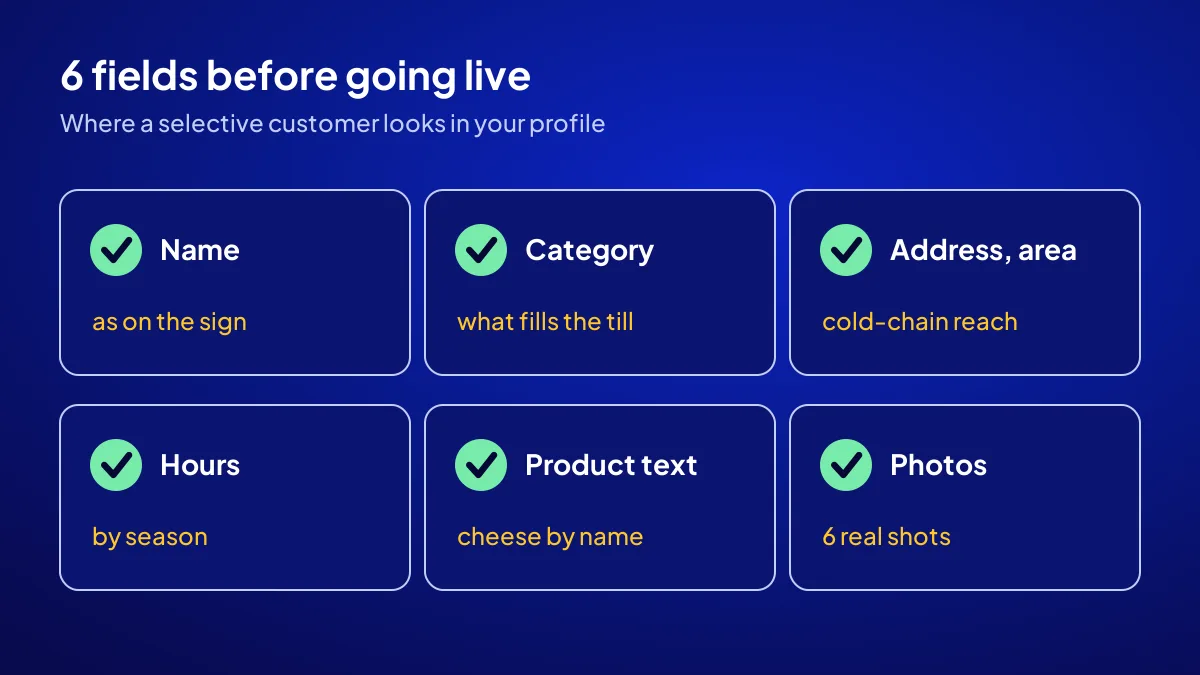
Quick Summary
- The primary category reflects what fills the till, not a product list.
- Add a restaurant-type category only if you have real seating.
- A meze counter inside the shop does not get its own profile.
- The name matches the sign; no district or “meze” added.
- Keep the service area to neighbourhoods within cold-chain reach.
- Seasonal hours count as regular hours; mark the profile temporarily closed off-season.
Short Glossary
Primary category: The primary category is the single choice used to tell Google what the business fundamentally is, and it affects local ranking.
Service area: A service area is the setting used to show on Google where a visiting or delivering business operates.
Cold chain: The cold chain is the process used to keep perishable food at the right temperature from production to delivery.
Next Step
To have your profile and sales page set up as one recipe, apply to the Get Visible Online campaign. Fill in the needs form and get the recipe that fits your deli.
Frequently Asked Questions
Source: Google Business Profile Help — Manage your business category
Sık Sorulan Sorular
If most sales are cheese, cured meats and takeaway meze, the narrowest option describing a deli. A restaurant-type additional category only makes sense with real seating.
No. A department or hot food bar inside a store cannot; an independent section with its own entrance, sign and hours can.
Yes. It covers a mobile-friendly sales page, contact buttons, Google Business Profile, basic SEO and visitor tracking. TRY 36,000 + VAT; at 20% VAT that is TRY 43,200, but check the current rate on your invoice.
Updated: October 2026