
New dry cleaner, no customers? 6 conditions before clients trust you with a costly coat
Say you have opened a premium dry cleaner and tailor in Bakırköy, on a street near the Ataköy seafront, and your new dry cleaner has no customers. The reason is rarely price. A selective customer weighs the risk of leaving a cashmere coat or an evening dress at an unfamiliar counter. That risk is set by a six-part trust threshold: who, how it is received, what if it is damaged, how much, when, and what others say.
All six parts must be visible on the phone before the customer reaches the door. If one is missing, they go back to the cleaner they have used for years. A new shop’s real rival is not the business on the next street but the customer’s habit. In 2026, in Istanbul or Ankara’s Çankaya, that habit only breaks with visible trust.
What is the passer-by really weighing?
BU BÖLÜMÜN ÖZETİ
- Risk, not price
- Habit is the strongest rival
- Customers decide without asking
The passer-by is weighing the possible loss, not the service. In dry cleaning the customer pays upfront but sees the result days later. Meanwhile the garment is out of sight. At a new shop that uncertainty is larger, because no neighbour has yet said “I left mine there, no problem”. A spotless window does not close this gap alone.
Risk, not price
In an affluent district a customer does not mind a small difference on a suit. What worries them is the colour or cut of an expensive jacket. That is why an opening discount rarely opens the door.
Habit is the strongest rival
Dry cleaning is a loyalty business. Customers rarely leave their old cleaner, and once burned by a new one, they never leave again. A new shop’s job is to make the risk of switching visibly smaller.
Customers decide without asking
A selective customer does not phone to ask “what if my garment is damaged?” If they cannot see the answer on Google, on your site or at the counter, they quietly go back. The day you feel the till is not turning is the sum of those silent decisions.
What are the 6 parts of the trust threshold?
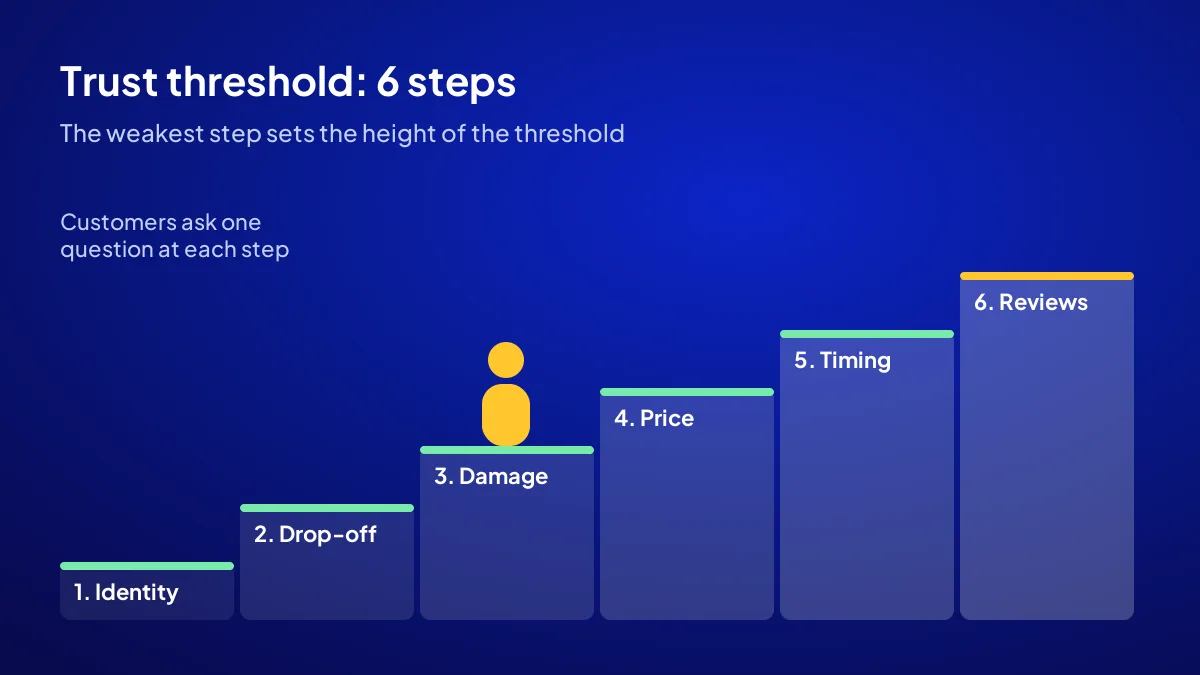
The six parts are six questions in the customer’s mind: who handles it, how is it received, what if it is damaged, will the price surprise me, when do I get it back, and what have others said. Each answer must be visible somewhere specific. The table lists each part, the customer’s question and where the answer belongs.
| Part | Customer’s question | Where the answer sits |
|---|---|---|
| 1. Identity | Who touches my clothes? | Cleaner’s and tailor’s names and photos on the profile |
| 2. Drop-off | Is my garment recorded? | Drop-off ticket, care label check |
| 3. Damage policy | What if it is ruined? | Written text on site and at the counter |
| 4. Price range | Any surprises? | Item-by-item list |
| 5. Time and service | When, and do you collect? | Profile and website |
| 6. Others’ word | Who tried it, what did they say? | Google reviews and replies |
The threshold is a chain
The parts are linked. Even with a perfect price list, a customer stalls at part two if there is no drop-off ticket. The weakest link sets the height of the threshold.
Why receive a costly garment by reading its label?
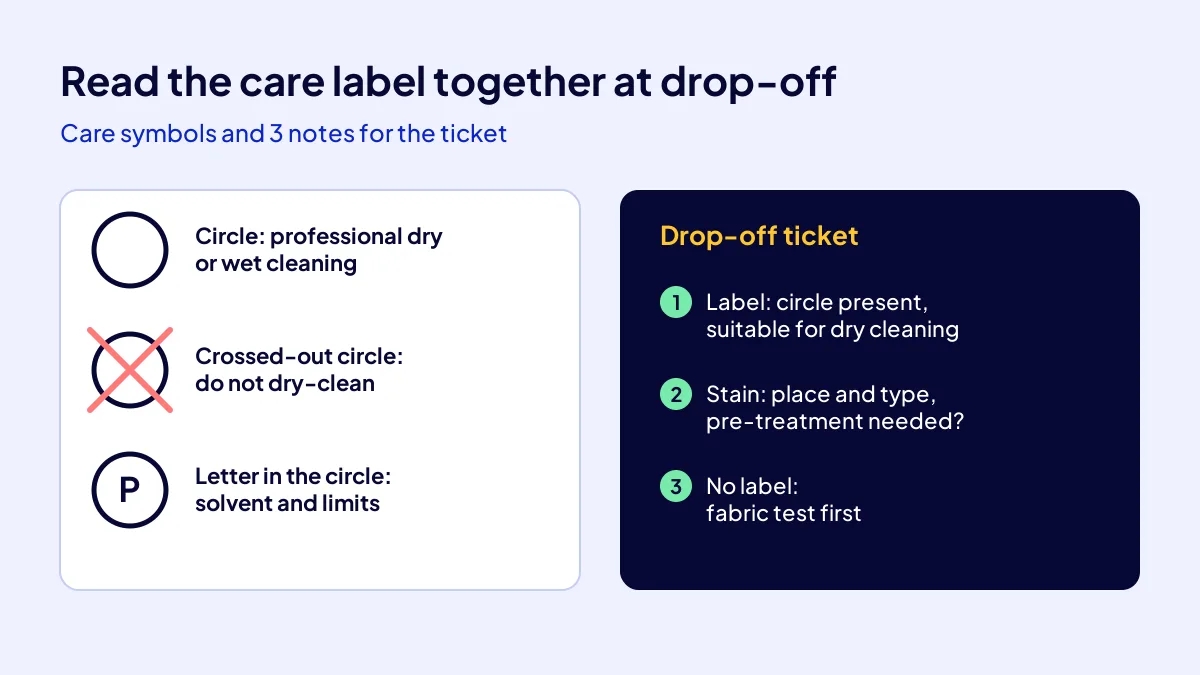
Because the maker has already written how it may be cleaned. A circle on the care label means the garment suits professional dry or wet cleaning. A crossed-out circle means it must not be dry-cleaned. Letters inside the circle tell the cleaner which solvents and limits apply. Most customers do not know this; showing that you do is where trust begins.
Read the label with the customer
At drop-off, read the label in front of the customer and note it on the ticket: “circle present, suitable for dry cleaning”. If a stain needs pre-treatment, write down its place and type. These two minutes carry the second part of the threshold on their own.
Missing or cut-off labels
For an evening dress with its label cut off, state the risk openly and write it on the ticket. “No label, fabric test needed” is far cheaper than an argument later.
Why write down in advance what happens if something goes wrong?
Because customers do not ask, but they look for the answer. Keep your damage and loss policy in writing on your site and at the counter: how you inspect the garment, how fast you respond, how you seek a solution. A written policy builds more trust than saying “we are reliable”. Have a specialist check the legal side.
“The stain may not come out” builds trust
Here is the unexpected finding: the shop that says upfront that not every stain will come out earns more trust. Selective customers respond to honest limits, not promises. Never use the word “guarantee”.
Customers already have a route to complain
Consumers unhappy with a service in Türkiye can turn to the Ministry of Trade’s consumer arbitration boards and complaint channels. Mentioning this calmly at the end of your policy shows you stand behind your work.
Why are the first reviews the last part of the threshold?
Because a new shop starts from zero. On a profile with an opening date, Google does not let others post reviews before you open. First reviews only come after the first returns. So the other five parts are built before reviews. When reviews arrive, reply to each; Google itself says replying shows customers you value their feedback.
Buying reviews breaks the threshold
Asking for reviews in exchange for a discount, or having friends write them, is the first thing a selective customer notices. We explain honest ways to gather them in getting first reviews for a new business.
A reply to a bad review is a shop window too
Answer a negative review calmly, briefly and with a solution. The next customer reads your reply more than the review.
Which part do you fix first in the first 30 days?
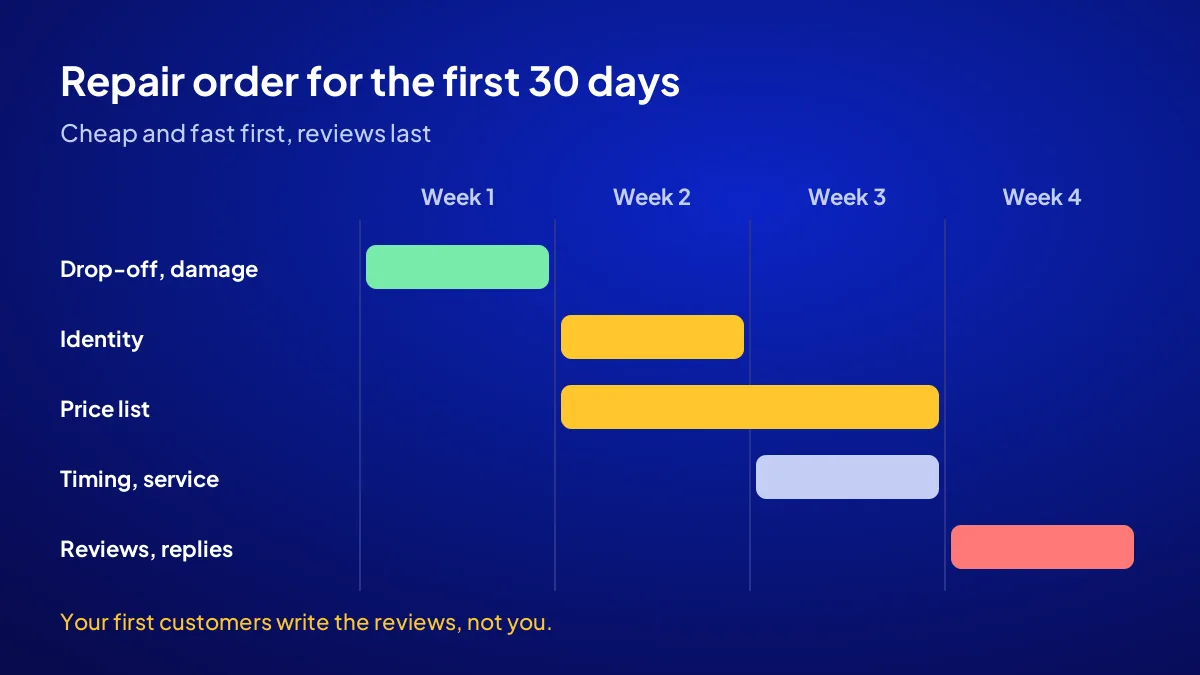
The cheapest and fastest part to fix is drop-off: ticket, label check and damage policy take a week. Identity and the price list come next. Time and service details are updated on the profile. Reviews come last, because your first customers write them, not you. A shop that follows this order finishes five of the six parts by the end of month one.
Build the threshold as a brand
Identity, brand voice, website and written policy can be built in one place. The Build Your Digital Brand campaign includes brand consulting, a digital identity, a 6-page brand website and 108 AI SEO-ready articles; the domain is registered in your name. TRY 36,000 + VAT at a fixed price, a 10% coupon, 12 brand places and a deadline of 1 November 2026. Details are on the campaign page.
The full picture
Once the threshold is built, the steps to reach customers are in how a new dry cleaner finds clients, the first three months in the first 90 days plan, and the whole picture in the new dry cleaner promotion guide. One principle: a selective customer does not choose a shop, they choose the person they trust with their clothes.
Quick Summary
- Customers fear damage to their clothes more than the price.
- A new shop’s real rival is the customer’s old cleaner.
- The trust threshold has six parts; the weakest sets its height.
- Reading the care label together and noting it on the ticket starts trust.
- The damage policy is written down, without the word “guarantee”.
- Reviews come last, and each one gets a reply.
Short Glossary
Trust threshold: The trust threshold is the concept used to describe all the information a customer wants to see before trying a new business.
Drop-off ticket: A drop-off ticket is the document used to record a garment’s condition, stains and return date when it is left at a dry cleaner.
Stain pre-treatment: Stain pre-treatment is the step used to break down a stubborn stain on the spot before the main cleaning.
Next Step
To build the identity, website and brand voice parts of your trust threshold together, apply for the Build Your Digital Brand campaign. Fill in the form and mention the coupon code when you apply.
Sık Sorulan Sorular
A premium customer buys time and peace of mind more than a clean garment. We unpack this in what dry cleaning clients really buy.
Usually the reason is risk, not price. Before leaving an expensive garment at an unfamiliar shop, a selective customer wants to see identity, drop-off, damage policy, price, timing and review information. If one is missing, they return to their old cleaner.
The care label shows with symbols whether a garment suits professional cleaning. A circle means it suits professional cleaning; a crossed-out circle means it must not be dry-cleaned. Reading it with the customer and noting it on the ticket starts trust.
The domain is registered in the customer’s name; the first year of hosting is included, and second-year renewal is the customer’s. The package is TRY 36,000 + VAT at a fixed price, the 10% coupon code is given when applying, there are 12 brand places and the deadline is 1 November 2026.
Updated: October 2026