
How a new dry cleaner finds clients: 9 steps, 9 thresholds and a daily ticket count
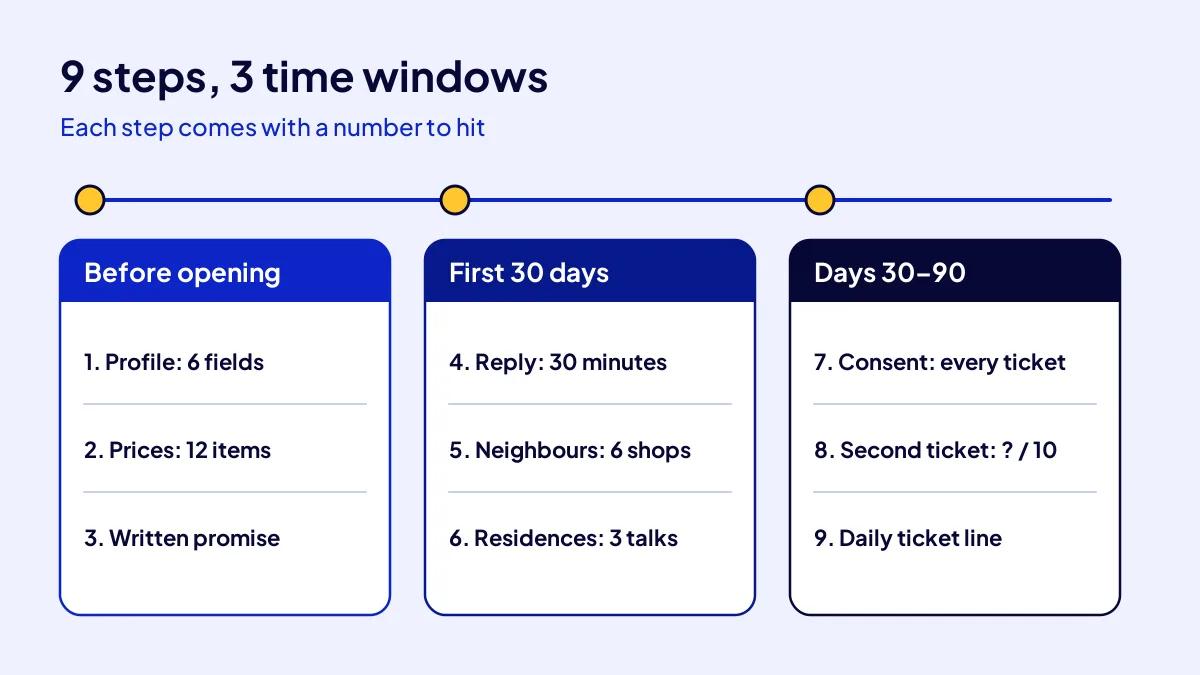
How a new dry cleaner finds clients comes down to 9 steps across three time windows: 3 steps before opening, 3 in the first 30 days, 3 between day 30 and day 90. Each step has a number to hit: reply time, a delivery promise, neighbours visited, the share of clients who come back. Hit them and the first regulars come without an ad budget.
The ninth step is a sum: how many tickets a day the shop needs to stay afloat. In Sarıyer or Çankaya, when the till is not turning, the reason is often this one missing figure.
In what order does a new dry cleaner find clients?
BU BÖLÜMÜN ÖZETİ
- Before opening: be seen
- First 30 days: build trust
- Days 30–90: measure returns
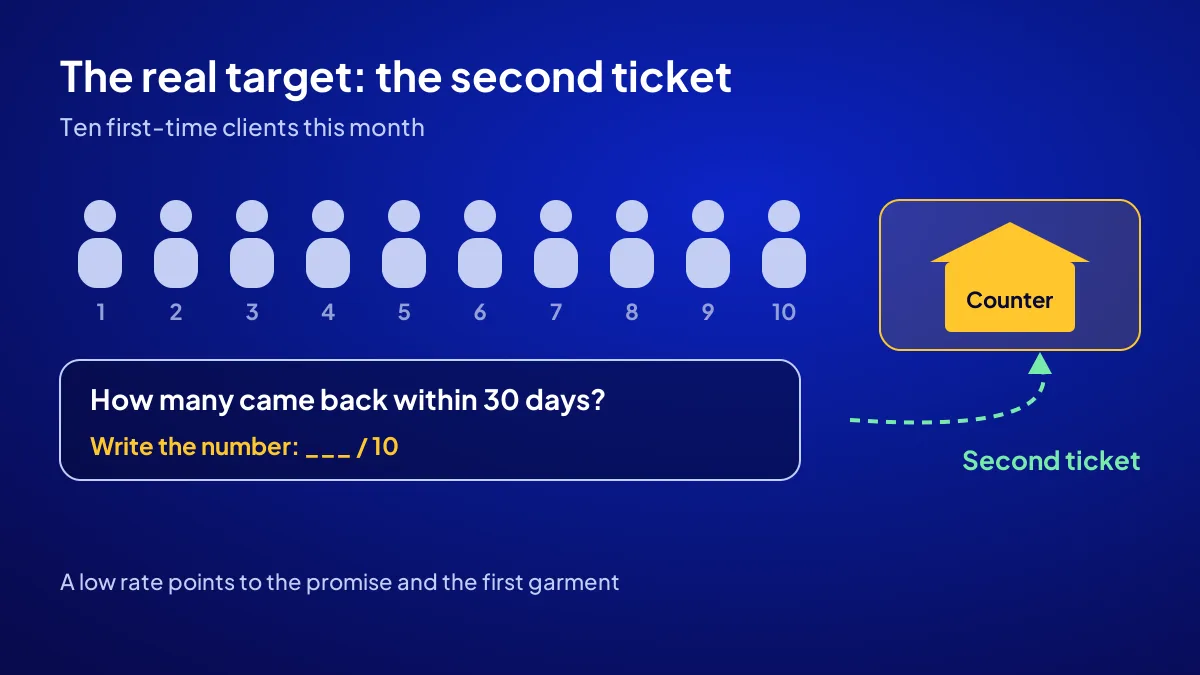
The order follows the calendar, not your mood. Visibility comes first, then trust in the first 30 days, then returns are measured. A client brings shirts every week and a coat every season, so the real target is the second ticket, not the first.
Before opening: be seen
Profile, price list and delivery promise. All three are ready before the sign goes up.
First 30 days: build trust
Reply speed, neighbouring shops and residence managers.
Days 30–90: measure returns
Consent-based messages, second-ticket rate and the daily ticket threshold.
Which 3 steps are finished before opening?
BU BÖLÜMÜN ÖZETİ
- 1. Profile: 6 fields complete, at least 3 service areas
- 2. Price list: the 12 most common items on one page
- 3. Delivery promise: written and keepable
The three pre-opening steps let a client find the shop, know what they will pay and learn when they will get the garment back. Miss one and a selective client does not even call. Together they take a few days of preparation; finish them before the sign goes up.
1. Profile: 6 fields complete, at least 3 service areas
Fill in name, category, address, hours, services and photos on your Google Business Profile. If you offer pickup and delivery, set the profile up as hybrid and add at least 3 neighbourhoods you deliver to as service areas. We covered the fields in the dry cleaner Google Business Profile.
2. Price list: the 12 most common items on one page
Shirt, jacket, suit, trousers, coat, overcoat, dress, evening gown, wedding dress, leather jacket, curtains and hemming. Put the price of those 12 items on the counter and on the mobile page. Premium clients are shy about asking prices.
3. Delivery promise: written and keepable
Write down how many hours a standard item takes. The rule is simple: never write a time you cannot keep. In the first 90 days, aim for 100 percent of items ready at the promised hour.
Which 3 steps come in the first 30 days?
BU BÖLÜMÜN ÖZETİ
- 4. Reply within 30 minutes
- 5. Six neighbours on the same street
- 6. Three residence managers
The first month is when the neighbourhood gets to know you. Three things happen: fast replies, neighbouring shops and nearby residence managers. None of them needs an ad budget, only time and a routine. Put each one in the calendar.
4. Reply within 30 minutes
During opening hours, answer every WhatsApp message and call within 30 minutes. A dry cleaning client often asks “will it be ready by tomorrow morning”.
5. Six neighbours on the same street
A boutique, a hair salon, an evening wear shop, a shoe repairer, a hotel reception and a café. Visit all six in the first 30 days. A new jacket needing a hem travels from the boutique to you by word of mouth.
6. Three residence managers
A residence with a reception or security desk is a natural point for handing garments over on residents’ behalf. In Beşiktaş or Sarıyer, meet the 3 nearest managements in the first 30 days. We gathered the general rules of street-level promotion in promoting a new business locally.
Which 3 numbers are tracked from day 30 to day 90?
Three numbers matter here: clients who gave consent, the share of clients who came back, and tickets per day. In month two the question changes from “how many came” to “how many came back”. In dry cleaning, profit is written by the repeat ticket.
7. A consent question on the first ticket
When you take the first order, ask whether the client wants campaign messages and reminders, and record the answer. Commercial electronic message consents in Turkey are managed through the Message Management System (İYS). Do not mix an order update with a promotional message.
9. The daily ticket threshold
Work out how many tickets a day cover your fixed costs. The sum is in the next section, line by line.
How do you calculate the daily ticket threshold?
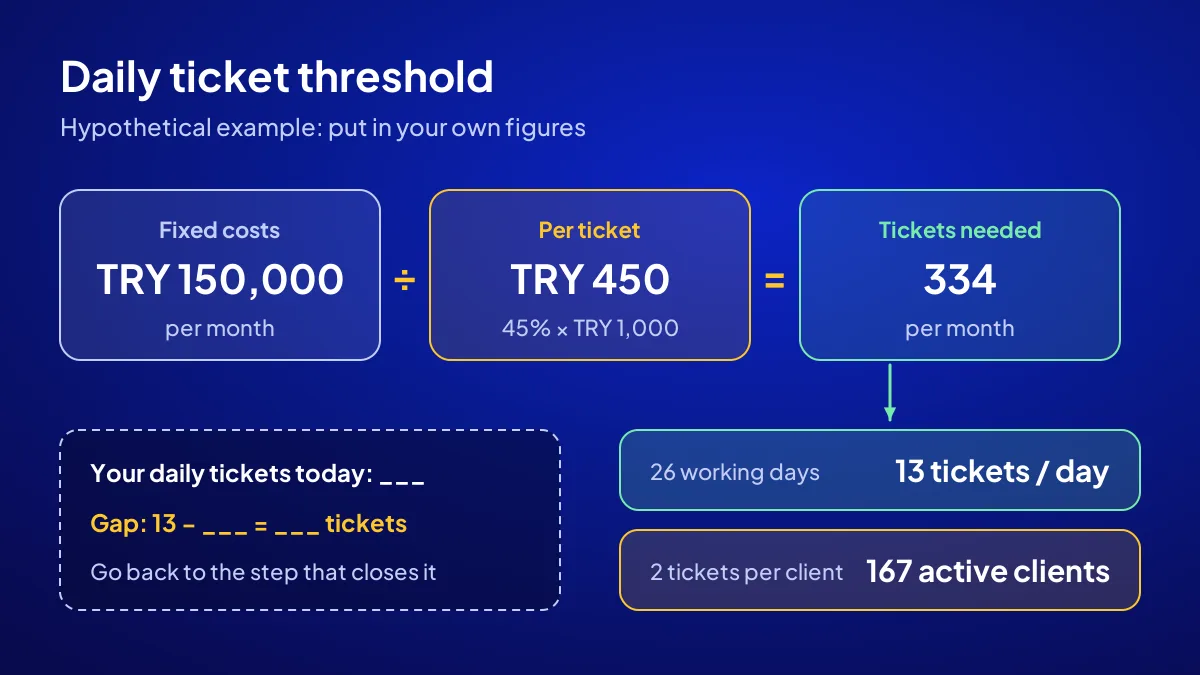
Three lines: the contribution left from one ticket, the tickets needed per month, then the tickets needed per day. The figures below are hypothetical. Put in your own rent, wages, energy and average ticket; the logic stays the same. Redo the sum every month.
| Item | Hypothetical example | Your value |
|---|---|---|
| Monthly fixed costs (rent, wages, base energy) | TRY 150,000 | …… |
| Average ticket | TRY 1,000 | …… |
| Contribution per ticket (solvent, bags, variable costs removed) | 45%, so TRY 450 | …… |
| Tickets needed per month (150,000 ÷ 450) | about 334 | …… |
| Working days per month | 26 | …… |
| Daily ticket threshold (334 ÷ 26) | about 13 | …… |
| Tickets per client per month | 2 | …… |
| Active clients needed (334 ÷ 2) | about 167 | …… |
| Your current daily average | …… | …… |
What the threshold tells you
In the example, the shutters do not pay for themselves until 13 tickets a day. If you are at 8, the gap is 5 tickets.
Match the gap to a step
Few new clients: go back to steps 1, 2 and 5. New clients who do not return: look at steps 3 and 8. Enough tickets but a low average: give the alterations and special-garment lines more room on the price list.
Which shortcuts drive clients away?
Bulk messages without consent, express promises you cannot keep and discounts in exchange for reviews look like quick wins in week one. A selective client spots them fast and leaves quietly. Lost trust costs more than a lost ticket.
- Sending campaign SMS, calls or emails to people who have not consented.
- Promising “same-day” on every item and missing it.
- Offering a discount or gift in exchange for a review.
Most common mistake: Announcing fifty percent off for everyone in opening week. The crowd comes for the discount, sees the normal price on the second ticket and does not return.
What to do instead
Hand first-time clients a short care note with the garment: the fabric and a tip for the next clean. We broke the budget down item by item in the dry cleaner marketing budget.
Getting it set up in one go
If you want the visibility steps set up with a ready-made recipe, the Get Visible Online campaign lets you choose one of three: the Website Recipe sets up the profile and mobile page, the Google Ads Recipe builds visibility for “dry cleaner” searches. TRY 36,000 + VAT, paid upfront at a fixed price for 3 months; ad spend is not included. Details on the campaign page.
How do you use the 9-step weekly template?
The template has 9 rows: step, threshold and this week’s value. Fill it in for 10 minutes every Monday; the row below its threshold is that week’s only job. The shop’s full promotion plan is in the new dry cleaner promotion guide, and the order of the first three months is in the first 90 days plan.
| Step | Threshold | This week |
|---|---|---|
| 1. Profile | 6 fields, at least 3 service areas | …… |
| 2. Price list | 12 items, counter and mobile | …… |
| 3. Delivery promise | Ready on time: 100% | …… |
| 4. Reply time | 30 minutes | …… |
| 5. Neighbouring shops | 6 visits | …… |
| 6. Residence managers | 3 meetings | …… |
| 7. Consent question | Every new client | …… |
| 8. Second ticket | …… of 10 new clients return | …… |
| 9. Daily tickets | Threshold: …… tickets | …… |
What to do at month end
Lay the four weekly templates side by side. A row that sits below its threshold two weeks running is next month’s main job. Keep everything else as it is.
Quick Summary
- Finding clients is 9 steps over three windows: before opening, first 30 days, days 30–90.
- Prices for the 12 most common items are visible on the counter and mobile page.
- The delivery promise is written down and kept every time.
- Messages get a reply in 30 minutes; 6 neighbours and 3 residences are visited.
- Consent comes before any campaign message.
- Daily ticket threshold: fixed costs ÷ contribution per ticket ÷ working days.
Short Glossary
Contribution per ticket: Contribution per ticket is the calculation used to find what is left from one ticket for fixed costs after variable costs are removed.
Second-ticket rate: The second-ticket rate is the ratio used to measure how many first-time clients come back within a set period.
İYS: İYS is the national system used in Turkey to manage consents and complaints for commercial electronic messages.
Next Step
To set up the visibility steps with a ready-made recipe, apply for the Get Visible Online campaign. Fill in the needs form and the right recipe for your shop is recommended.
Frequently Asked Questions
Source: Message Management System (İYS) — Commercial electronic message consents
Sık Sorulan Sorular
Each month, take 10 first-time clients and write down how many came back with a second ticket within 30 days. A low rate usually points to the delivery promise or the first garment, not visibility.
On the first ticket, ask “how did you hear about us”. Four options are enough: Google, a neighbouring shop, the residence, walking past.
Through 9 steps over three periods: profile, price list and delivery promise before opening; fast replies, neighbouring shops and residence managers in the first 30 days; consent-based messages, second-ticket rate and the daily ticket threshold between days 30 and 90. Each step has a number tracked weekly.
Campaign and promotional SMS, calls or emails need the person’s consent; in Turkey consents are managed through the Message Management System (İYS). Ask the consent question on the first ticket and record the answer.
No. The package is TRY 36,000 + VAT, paid upfront at a fixed price; at 20 percent VAT that is TRY 43,200, but check the current rate on the invoice. If you choose the Google Ads or Meta Ads Recipe, ad spend is paid to the platform separately.
Updated: October 2026